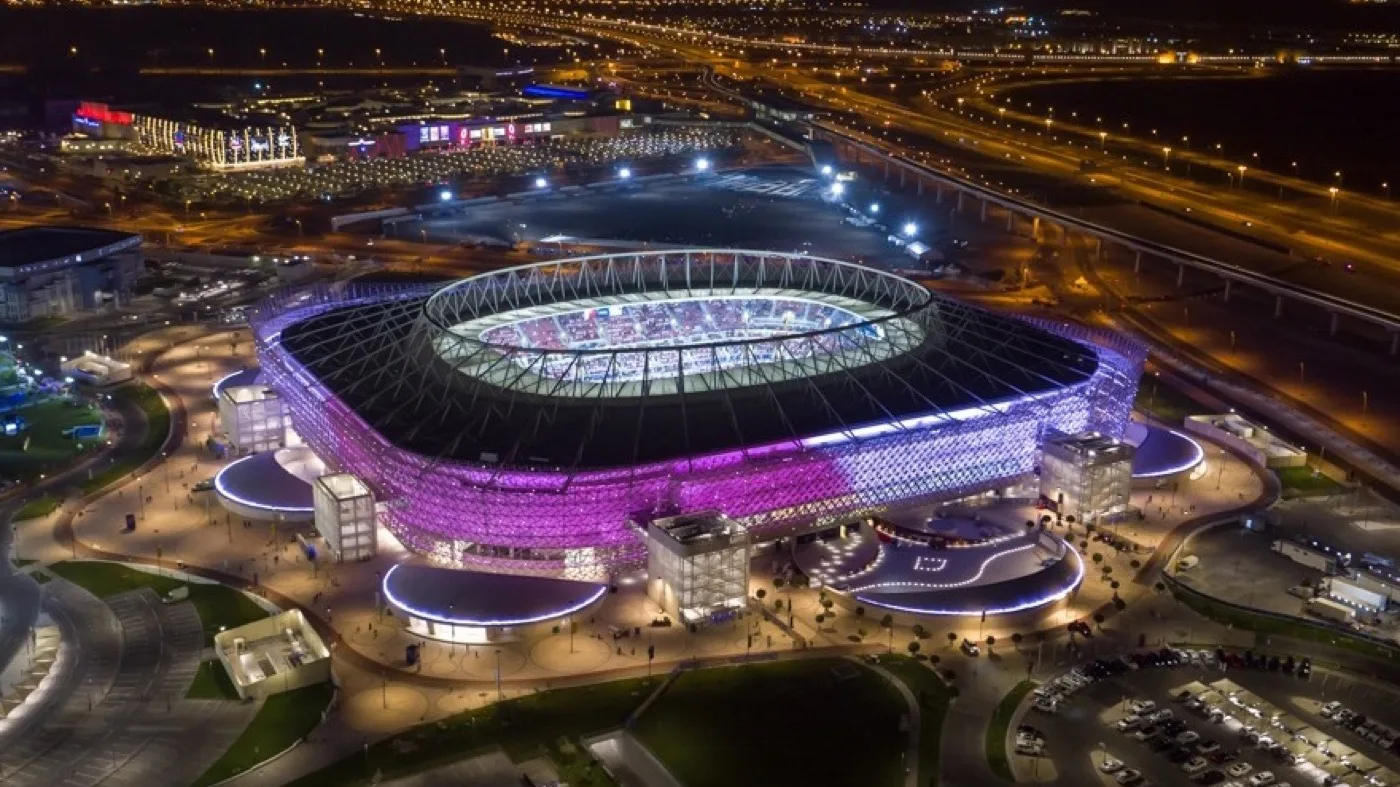
About Ahmad bin Ali Stadium
On December 3, 2022, Argentina nearly came undone here. Lionel Messi scored, Australia pulled one back late, and the last seconds inside Ahmad bin Ali Stadium were chaos before the eventual champions held on 2-1. The crowd that night, 45,032, was the largest the stadium ever held. For a venue on the western edge of Al Rayyan, well out toward the desert, it was a fitting peak.
Ahmad bin Ali sits beside Mall of Qatar in the Umm Al Afaei area, about 20 kilometres (12 miles) west of central Doha. Locals mostly call it Al Rayyan Stadium, after the district and the club that calls it home, Al-Rayyan SC, one of the country’s most decorated teams. The official name carried over from the original stadium that stood on this exact site until it was knocked down in 2015. The new building rose on the same footprint, which is a neat trick: about 90 percent of the old stadium’s rubble was reused or recycled into the replacement.
The defining feature is the skin. The curved outer facade is a media membrane, a screen that can light up and display patterns, scores, and graphics across the whole upper bowl. Its geometry is meant to stand for facets of Qatari life: family, the desert, native flora and fauna, and trade. Designed by BDP Pattern and built by a joint venture of Al-Balagh and Larsen & Toubro, it opened in 2020 and shades every seat under a wide canopy ring built from roughly 9,000 tons of steel.
After the tournament the stadium did what most Qatar 2022 venues did. The upper tier of around 20,000 modular seats came out, dropping capacity to about 21,000, and those seats were set aside for donation abroad. What remains is a sharp, right-sized club ground that still glows against the desert on a match night.
Getting to Ahmad bin Ali Stadium
Public Transit
This is one of the easier Qatar venues to reach by train, thanks to the mall next door.
→ From central Doha: Take the Green Line west to Al Riffa station, about 25 minutes. The station connects directly into Mall of Qatar, and from there it is a walk of roughly 15 minutes to the stadium, with shuttle buses on busy days.
→ Make a day of it: Because the metro feeds into the mall, plenty of fans arrive early to eat or shop, then cross to the gates. It beats waiting in the heat.
After the final whistle, trains fill fast. Give it 15 or 20 minutes, or wander back through the mall, and the platform crush eases off.
Driving + Parking
The stadium is reached from Doha along the Dukhan Highway, heading west toward Al Rayyan and the open desert beyond.
→ From central Doha (~20 km): Take the Dukhan Highway west, about 20-25 minutes outside peak traffic.
→ From Aspire Zone (~7 km): A short hop north and west from the Aspire and Villaggio area, roughly 10-15 minutes.
There is park-and-ride for big matches, but with Mall of Qatar’s own parking right beside the venue and the metro running into it, driving is rarely necessary. For a regular Al-Rayyan SC fixture, the mall lots are easy.
Rideshare
Uber, Careem, and the metered Karwa taxis all serve Al Rayyan. The drop-off and pickup zones around Mall of Qatar are well organized, but expect surge pricing and a queue right after a sold-out match.
Pro tip: Request your ride from inside or just outside the mall rather than at the stadium gates. The pickup flows better, and you stay in the air conditioning while you wait.
From the Airport
→ Hamad International Airport (DOH): About 34 km (21 mi) east, roughly 30 minutes by car. A taxi or rideshare is the simplest route, or take the metro into Doha and change to the Green Line.
→ From the west of the city: If you are staying near Aspire Zone or West Bay, the stadium is a short drive out along the Dukhan Highway.
The 2022 World Cup at Ahmad bin Ali Stadium
Ahmad bin Ali hosted seven matches, six in the group stage and one in the Round of 16, and it produced one of the tournament’s tensest finishes.
Argentina survive: On December 3, Argentina met Australia in the Round of 16. Messi opened the scoring, Julián Álvarez added a second, and then Australia struck late through a deflected effort. The final minutes were frantic, with Emiliano Martínez making a decisive save at the death. Argentina won 2-1 and moved on toward the title, in front of the stadium’s record 45,032.
Wales in Qatar: The venue also staged Wales’s first World Cup matches in 64 years. They drew 1-1 with the United States, Gareth Bale scoring from the spot, before England beat them 3-0 in the group’s final round.
The atmosphere: With the media membrane lit and the bowl shaded under its steel canopy, Ahmad bin Ali looked the part on television. For a ground rebuilt from the rubble of its predecessor, hosting a knockout night of a World Cup was a strong return.
Construction & Design
Ahmad bin Ali had a constraint the other new stadiums did not: it had to replace something. The original venue on the site, built in 2003, was demolished in 2015, and the design team treated that as an opportunity rather than a problem. Around 90 percent of the old stadium’s material was reused or recycled into the new build, a remarkable figure for a project of this size.
What rose in its place, designed by BDP Pattern, is defined by its facade. The undulating outer skin is a media membrane, a continuous screen wrapping the upper bowl that can display projections and graphics across the whole exterior. By day its geometric panels read as an abstract pattern; the architects describe the motifs as standing for family, the desert, native flora and fauna, and trade, unified under a shield-like emblem. By night the surface lights up, which is why the stadium is usually photographed glowing.
The roof is a wide cantilevered canopy that shades every seat, carried on a steel compression ring that used roughly 9,000 tons of structural steel. The pitch stays open to the sky, cooled by an advanced air system, and the building runs about 20 percent more efficiently on energy and water than comparable venues. That package earned a four-star rating under Qatar’s Global Sustainability Assessment System.
The new stadium opened in 2020, built by a joint venture of Al-Balagh and Larsen & Toubro at an estimated cost of around US$360 million. Like its neighbors, it was designed to shed its upper tier afterward, which is exactly what happened once the tournament moved on.
History of Ahmad bin Ali Stadium
The name Ahmad bin Ali predates the current building. An earlier stadium of the same name served Al-Rayyan SC and the surrounding district from 2003, until it was cleared in 2015 to make way for a World Cup venue on the same ground.
- Original demolished (2015): The 2003 stadium was taken down, with about 90 percent of its material recycled into the replacement.
- Construction (2016 onward): The new stadium rose on the same footprint, designed by BDP Pattern and built by Al-Balagh and Larsen & Toubro.
- Official opening (December 18, 2020): On Qatar’s National Day, exactly two years before the World Cup final, the stadium opened with the Amir Cup final, won 2-1 by Al Sadd over Al Arabi.
- World Cup Round of 16 (December 3, 2022): Argentina beat Australia 2-1 in front of a record 45,032, surviving a late scare on the way to the trophy.
- Asian Cup (2024): The stadium hosted matches at the 2023 AFC Asian Cup, held in early 2024, as Qatar defended their continental title.
Since the tournament, the venue has settled into its legacy size of about 21,000 and returned to its day job as the home of Al-Rayyan SC, still glowing against the desert whenever the lights come up.
Sources & Further Reading
- Wikipedia entry on Ahmad bin Ali Stadium: en.wikipedia.org/wiki/Ahmad_bin_Ali_Stadium. Capacity, contractors, the rebuild, and the World Cup matches.
- Visit Qatar stadium guide: visitqatar.com. Visitor information, the media membrane facade, and legacy plans.
- GSAS project page (Gulf Organisation for Research and Development): gsas.gord.qa. The stadium’s four-star sustainability rating and recycling figures.
- Doha Metro and event-day transport (Qatar Rail): qr.com.qa. Green Line service to Al Riffa and Mall of Qatar.
Quick Facts
Everything you need at a glance.
Stadium specs
- Capacity
- 45,032
- Opened
- 2020
- Cost
- estimated US$360 million
- Roof
- Partial (cantilevered canopy)
- Surface
- Natural Grass
- Tenants
- Al-Rayyan SC, Qatar National Team (selected matches)
Construction & location
- Groundbreaking
- 2016 (on the demolished original's site)
- Architects
- BDP Pattern (Pattern Design)
- Engineering
- Schlaich Bergermann Partner (roof)
- General contractor
- Al-Balagh / Larsen & Toubro joint venture
- Address
- Ahmad bin Ali Stadium, Umm Al Afaei, Al Rayyan, Qatar
- GPS
- 25.3296°N, 51.3423°E
Photo Gallery
Fun Facts
The undulating facade is a media membrane, a giant screen that wraps the upper bowl and can display projections, scores, and match graphics across the whole exterior.
On December 3, 2022, Ahmad bin Ali drew its record crowd of 45,032 to watch Argentina beat Australia 2-1 in the Round of 16, on the way to Lionel Messi's title.
The new stadium rose on the footprint of the demolished original, and about 90 percent of the old building's rubble was reused or recycled rather than dumped.
Stadium Location
Frequently Asked Questions
- What is the seating capacity of Ahmad bin Ali Stadium?
- Ahmad bin Ali held 45,032 for the 2022 World Cup, the figure that matched its record attendance for Argentina against Australia. After the tournament the modular upper tier was removed, cutting permanent capacity to about 21,000 for Al-Rayyan SC.
- Where is Ahmad bin Ali Stadium located?
- The stadium is in the Umm Al Afaei area of Al Rayyan, west of Doha, Qatar, right beside Mall of Qatar. It is about 20 km (12 mi) from central Doha and is served by the Green Line metro at Al Riffa station.
- Is Ahmad bin Ali Stadium the same as Al Rayyan Stadium?
- Yes. It is widely known as Al Rayyan Stadium after the district and the home club, Al-Rayyan SC. The official name, Ahmad bin Ali Stadium, also carried over from the original venue that stood on the same site before it was demolished.
- What 2022 World Cup matches did Ahmad bin Ali Stadium host?
- It hosted seven matches: six in the group stage and one Round of 16. The standout was Argentina's 2-1 win over Australia on December 3, 2022. England's 3-0 win over Wales and the USA's 1-1 draw with Wales were also played here.
- How do I get to Ahmad bin Ali Stadium by metro?
- Take the Doha Metro Green Line to Al Riffa station, which connects straight into Mall of Qatar next to the stadium. From there it is about a 15-minute walk, with shuttle buses on match days. It is one of the more transit-friendly Qatar venues.
- What is the facade of Ahmad bin Ali Stadium made of?
- The curved outer skin is a media membrane, a screen that wraps the upper bowl and can carry projections, scores, and graphics. Its geometric patterns are meant to represent facets of Qatari life: family, the desert, native plants and animals, and trade.
- Who designed and built Ahmad bin Ali Stadium?
- The stadium was designed by BDP Pattern, with Schlaich Bergermann Partner engineering the roof, and built by a joint venture of Al-Balagh and Larsen & Toubro. It was completed in 2020 at an estimated cost of around US$360 million.
- Was there an older stadium on this site?
- Yes. The original Ahmad bin Ali Stadium, built in 2003, was demolished in 2015 to make way for the new venue. About 90 percent of the demolition material was reused or recycled, one of the project's headline sustainability claims.
- When did Ahmad bin Ali Stadium open?
- It opened on December 18, 2020, Qatar's National Day, exactly two years before the World Cup final. The inaugural match was the Amir Cup final between Al Sadd and Al Arabi, won by Al Sadd 2-1.
- How far is Ahmad bin Ali Stadium from the airport?
- Hamad International Airport (DOH) is about 34 km (21 mi) east of the stadium, roughly 30 minutes by car. There is no single-train route, so most airport travellers use a taxi or rideshare, or change onto the metro in central Doha.
- What happened to Ahmad bin Ali Stadium after the World Cup?
- The upper tier of about 20,000 modular seats was removed, dropping permanent capacity to roughly 21,000 for Al-Rayyan SC. The removed seats were set aside for donation to football projects abroad, in line with Qatar's wider legacy plan.
- Does Ahmad bin Ali Stadium have a roof?
- It has a wide cantilevered canopy that shades every seat, supported on a large steel ring using roughly 9,000 tons of structural steel. The pitch itself is open to the sky, and an advanced cooling system handles the heat.
- Who plays at Ahmad bin Ali Stadium now?
- Al-Rayyan SC, one of Qatar's most successful clubs, plays its home matches here in the Qatar Stars League. The stadium also hosts Qatar national team games and hosted matches at the 2023 AFC Asian Cup.
- How sustainable is Ahmad bin Ali Stadium?
- It earned a four-star rating under Qatar's Global Sustainability Assessment System. The design reuses most of the old stadium's materials, runs about 20 percent more efficiently on energy and water than comparable venues, and shades the entire bowl to cut cooling loads.
- What does the stadium look like at night?
- At night the media membrane comes alive. The whole undulating facade can light up and display patterns and graphics, set against the desert on the city's western edge, which is why the venue is often described as glowing rather than simply lit.
Last updated: 2026-07-10