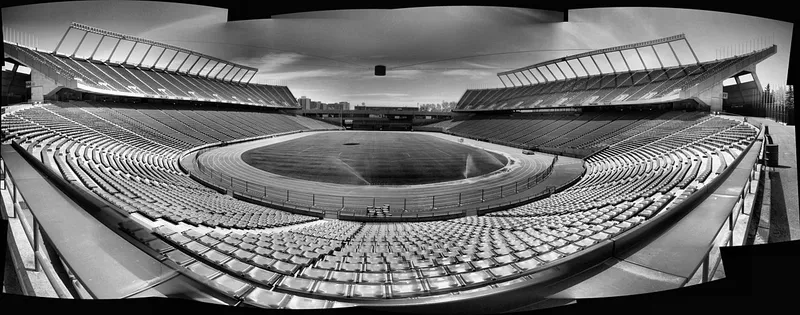
About Commonwealth Stadium
Ten minutes by LRT from downtown Edmonton, Commonwealth Stadium is Canada’s largest stadium and one of the most versatile outdoor venues in the country. With 56,302 seats, it is the home of the Edmonton Elks and the stage where Canada has hosted the world in athletics, soccer, and football.
Built for the 1978 Commonwealth Games, the stadium has served Edmonton for nearly five decades. It is the primary home of the Elks (CFL), but its resume extends far beyond Canadian football: the 2001 IAAF World Championships in Athletics, 12 matches of the 2015 FIFA Women’s World Cup, five Grey Cups, and concerts from U2 to Beyoncé have all played out here.
The original 42,500-seat structure was designed by Ragan, Bell, McManus Consultants and built at a cost of C$20.9 million. Expansions in 1982 pushed capacity above 60,000 for the 1983 Universiade, and a 2012 seat replacement project settled the current capacity at 56,302 with wider, more comfortable seating. Total investment in the stadium exceeds C$200 million across all renovations.
Commonwealth Stadium’s open-air design means you experience Edmonton’s weather firsthand. Summer CFL games are warm and long-lit (sunset after 10 PM in June), while late-season matches can bring frost and snow. The FieldTurf surface installed in 2010 handles it all.
Getting to Commonwealth Stadium
Public Transit
Commonwealth Stadium has excellent LRT access, the Capital Line station is directly adjacent to the stadium, built when the LRT opened in 1978.
→ Via Capital Line LRT: Take the Capital Line to Stadium Station (84 Street and 111 Avenue). Your Edmonton Elks game ticket is your free transit pass, free LRT, bus, and Park & Ride service runs 2 hours before and after every home game.
→ Via Bus: Routes 2, 3, and 101 serve Stadium Transit Centre, located between the LRT station and the stadium.
Free bike valet service is offered for all Elks home games and major stadium events. For trip planning, use the ETS Trip Planner or call 311.
Driving + Parking
Commonwealth Stadium is at 11000 Stadium Road NW, Edmonton, Alberta. The Queen Elizabeth II Highway (Highway 2) connects Edmonton to Calgary and Red Deer.
→ From Calgary (~187 mi / 301 km): Take the QEII Highway (Highway 2) north the entire way. About 3 hours on a divided multi-lane highway.
→ From Red Deer (~97 mi / 156 km): Take Highway 2 north. About 1 hour 45 minutes. Red Deer is roughly the midpoint between Calgary and Edmonton.
→ From Saskatoon (~326 mi / 525 km): Take Highway 16 (Yellowhead Highway) west the entire way. About 5 hours 15 minutes. Check road conditions before departing.
The North Lot at Edmonton EXPO Centre (7515 118 Avenue, via Wayne Gretzky Drive) costs $16.50 per vehicle (debit/credit only). Season Ticket Holders park for $10. Free Park & Ride is available with your game ticket, ride the LRT one stop from the North Lot to Stadium Station.
Rideshare
Uber and Lyft both operate in Edmonton. The primary rideshare zone is the curb lane on 112 Avenue eastbound from 95 Street to Stadium Road, with a secondary loop at the northwest corner near Lot A (90 Street). A ride from downtown Edmonton runs CAD $8–$15; from Edmonton International Airport about CAD $45–$65.
From the Airport
→ Edmonton International Airport (YEG): 20.5 miles (33 km) south of the city, about 30 minutes by car. By transit, take bus 747 to Century Park LRT station, then the Capital Line to Stadium Station, about 1 hour 5 minutes total.
Edmonton’s former City Centre Airport (3 km from the stadium) closed in November 2013. YEG is the only operating commercial airport serving Edmonton.
Construction & Design
Commonwealth Stadium was built for one event and grew into an institution. Edmonton needed a centerpiece for the 1978 Commonwealth Games, so the firm Ragan, Bell, McManus Consultants designed an open, symmetrical bowl modeled on Jack Trice Stadium in Iowa, and it opened on July 15, 1978, a few weeks before the Games. The original cost was a modest 20.9 million Canadian dollars, kept down in part by a decision made during construction to skip a roof rather than pay roughly 18 million dollars more for one. That left the stadium fully exposed to Edmonton’s northern weather, which is exactly how prairie football fans seem to like it.
The bowl grew in stages. A 1982-83 expansion for the World University Games added an upper ring and pushed capacity past 60,000, and a 24 million dollar facelift in 2001 for the World Athletics Championships rebuilt the façade, concourses, and track. Today it seats 56,302, which makes it the largest open-air stadium in Canada, and its record crowd of 63,317 turned up for the 2010 Grey Cup.
That flexibility is the whole story of the place. It has hosted the Commonwealth Games, a World University Games, a World Athletics Championships, the FIFA U-20 World Cup, the 2015 Women’s World Cup, five Grey Cups, and, in 2003, the Heritage Classic, the NHL’s first outdoor regular-season game, played in bitter cold. The natural grass that hosted all of that survived until 2010, making the Edmonton club one of the last in the CFL to play on real turf before it finally gave way to FieldTurf.
The setting helps. The stadium was built on the reclaimed ground of the old Rat Creek Dump, just northeast of downtown, and a light-rail station opened at its doorstep with Edmonton’s first LRT line in 1978, so tens of thousands of fans still arrive by train rather than car. Successive upgrades since, a 2008 renovation, new seats in 2013, a large video board, and LED ribbon boards, have kept a 1970s bowl feeling current without ever giving it the roof it was denied at birth. In a league of corporate-named venues, it stays plainly, stubbornly Commonwealth.
History of Commonwealth Stadium
Edmonton City Council approved a 40,000-seat stadium in January 1975, and construction began that March on the former site of the Rat Creek Dump. Designed by Ragan, Bell, McManus Consultants and modeled after Jack Trice Stadium in Ames, Iowa, the venue was built at a cost of C$20.9 million and opened on July 15, 1978, in time for its inaugural event.
1978 Commonwealth Games (August 3–12, 1978): The stadium’s first event. 1,474 athletes from 46 nations competed, and Canada achieved its all-time best performance with 45 gold medals and 109 total medals.
1983 Summer Universiade (July 1–12, 1983): Hosted athletics events and ceremonies. The upper tier was expanded to 60,081 seats at a cost of C$11 million for this event.
2001 IAAF World Championships (August 3–12, 2001): 1,677 athletes from 189 nations competed. The stadium received a $24 million facelift with a new facade, concourse, lighting, and all-weather running track.
2010 Grey Cup (November 28, 2010): Montreal Alouettes defeated Saskatchewan 21-18 before a record crowd of 63,317, the largest in stadium history. Tickets sold out before the CFL season started.
2015 FIFA Women’s World Cup (June–July 2015): Edmonton hosted 12 of 52 tournament matches, including the opening match (Canada 1, China 0 before 53,058 fans), a semifinal, and the third-place match.
106th Grey Cup (November 25, 2018): Calgary Stampeders defeated Ottawa Redblacks 27-16 before 55,819, the most recent of five Grey Cups hosted here.
Commonwealth Stadium has given Edmonton a world-class stage for nearly 50 years. From the Commonwealth Games to FIFA, from Grey Cups to U2, this open-air colossus in Canada’s north has proven that great events can happen anywhere, even at 53 degrees latitude.
Sources & Further Reading
- Wikipedia entry on Commonwealth Stadium: en.wikipedia.org/wiki/Commonwealth_Stadium. Construction, the 1978 Commonwealth Games, and the expansions.
- City of Edmonton official venue page: edmonton.ca. The city owner-operator’s stadium information.
- City of Edmonton, Commonwealth Stadium history: edmonton.ca/history. The venue’s past, present, and future.
- Edmonton Elks official site: goelks.com. The CFL tenant and gameday information.
Quick Facts
Everything you need at a glance.
Stadium specs
- Capacity
- 56,302
- Opened
- 1978
- Cost
- CAD$20.9 million (1978 original); 1982-83 expansion around CAD$11 million; 2001 facelift CAD$24 million
- Roof
- Open
- Surface
- Artificial Turf (FieldTurf)
- Tenants
- Edmonton Elks (CFL)
Construction & location
- Groundbreaking
- 1975-1976 (opened July 15, 1978)
- Architects
- Ragan, Bell, McManus Consultants
- Engineering
- Not separately recorded
- General contractor
- Not separately recorded
- Address
- Commonwealth Stadium, 11000 Stadium Road NW, Edmonton, AB T5H 4E2, Canada
- GPS
- 53.5583°N, 113.4750°W
Photo Gallery
Fun Facts
At 56,302 seats, Commonwealth Stadium is the largest stadium in Canada, the record attendance is 63,317, set at the 2010 Grey Cup.
The Edmonton Eskimos (now Elks) were one of the last CFL teams to play on natural grass, holding out until FieldTurf was installed in May 2010.
The 2002 FIFA U-19 Women's World Championship final drew 47,784 fans, a world record for attendance at a youth women's soccer match that still stands.
Stadium Location
Frequently Asked Questions
- What is the seating capacity of Commonwealth Stadium?
- Commonwealth Stadium has a seating capacity of 56,302 in an all-seater configuration, making it the largest stadium in Canada. The record attendance is 63,317, set at the 2010 Grey Cup.
- How do I get to Commonwealth Stadium by public transit?
- Take the Capital Line LRT to Stadium Station, directly adjacent to the stadium. On Edmonton Elks game days, your game ticket is your transit pass, free LRT, bus, and Park and Ride service runs 2 hours before and after the game.
- Is there parking at Commonwealth Stadium?
- Yes. The North Lot at Edmonton EXPO Centre costs $16.50 (debit/credit only). Season Ticket Holders park for $10. Free Park and Ride is available with a valid game ticket via LRT.
- Does Commonwealth Stadium have a roof?
- No. Commonwealth Stadium is an open-air stadium. A roof was debated during construction but rejected due to the additional $18.2 million cost. Edmonton winters can be harsh, but CFL games are played in summer and fall.
- What events have been held at Commonwealth Stadium?
- Major events include the 1978 Commonwealth Games, 2001 IAAF World Championships in Athletics, 2015 FIFA Women's World Cup (12 matches), five Grey Cups (1984, 1997, 2002, 2010, 2018), and concerts by U2, Taylor Swift, and Beyonce.
- What surface does Commonwealth Stadium have?
- Commonwealth Stadium has FieldTurf Duraspine Pro artificial turf, installed in May 2010. Before that, it was one of the last major stadiums in Canada with natural grass.
- Why is it called Commonwealth Stadium?
- It was built as the centerpiece for the 1978 Commonwealth Games, which Edmonton hosted from August 3-12, 1978. The name has stuck ever since, and the stadium remains city-owned rather than corporately named.
Last updated: 2026-07-03