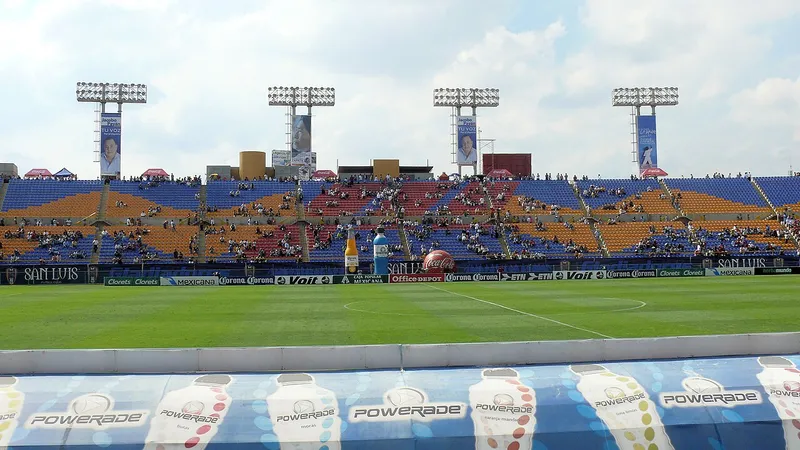
About Estadio Libertad Financiera
For more than two decades, football in San Luis Potosí has answered to one address in the Valle Dorado district. Locals call the concrete bowl there El Coloso, the Colossus, a nickname that says more about how it towers over the surrounding residential streets than about its raw size. Since January 2026 the formal name has been Estadio Libertad Financiera, after a naming-rights deal with a Mexican financial company. Almost everyone still says Alfonso Lastras.
With about 25,709 seats, it is the home of Atlético de San Luis, a Liga MX club whose majority owner is Spain’s Atlético de Madrid. The two share a crest style, the red-and-white stripes, and a front-office model. They do not share a founding story, and the timeline matters: the Potosí club was founded in 2013, and the Madrid takeover came four years later, in 2017. More on that below.
The ground has become a fortress. Since Atlético de San Luis climbed into Liga MX in 2019, the club has leaned on a loud, compact bowl and on geography. San Luis Potosí sits at roughly 1,860 meters (about 6,100 feet) above sea level, high enough that visiting sides from Acapulco or Veracruz can feel the thin air late in a game. The pitch is natural grass, 105 by 68 meters (344 by 223 feet), with no running track to push the crowd back. Fans sit close. The bowl is steep. It is not a big stadium by Liga MX standards, and that is exactly why it works.
The climate cooperates. San Luis Potosí is semi-arid, with warm days, cool nights, and little rain, so match-day conditions stay reliable most of the year. Summer evening kickoffs, the most common slot, usually land in the low 20s°C (low 70s°F), comfortable for players and supporters alike. The altitude is the variable that never softens.
Construction & Design
Work began in 1998, and the stadium opened in May 1999 to a design by architect José Francisco Alfaro Sousa. The plan was ambitious for a city that did not yet have a permanent top-flight team: a bowl for roughly 30,000, sunk partly below street level so the pitch would sit lower than the surrounding roads. That sunken layout keeps the building’s profile down and steepens the rake inside, which is a large part of why the atmosphere feels bigger than the seat count.
The upper tier never got built. Funding ran short, the ring was left open, and the capacity settled at about 25,709, roughly 4,291 seats below the blueprint. The unfinished feel has followed the ground for more than a quarter century, and renovation announcements, most recently a 2018 pitch for luxury boxes and a partial roof, have come and gone without closing the gap. The playing surface is natural grass at the standard 105 by 68 meters, and the ground stays open to the sky.
Ownership is where the story gets unusual. The building belongs to Jacobo Payán Latuff, a Potosí businessman with roots in the cement trade, who put a headline value of around USD $100 million on the property in 2020 (a valuation, not a construction bill, and one he floated while entertaining a possible sale). The original construction cost is not reliably documented in public sources, so treat any single dollar figure for the 1998–1999 build with caution. What is documented is the split that defines the place today: Payán owns the stadium, and Atlético de Madrid owns most of the club that fills it.
That Madrid connection is the design element you cannot see in the concrete. When the Spanish side took control in 2017, it brought its academy methodology, its staff pipeline, and its rojiblanco identity to a second-division Mexican club, betting that the model would travel. The bet paid off with promotion in 2019. The stadium did not change shape, but the ambition inside it did.
History of Estadio Libertad Financiera
The name honors Alfonso Lastras Ramírez, a lawyer and rector of the Universidad Autónoma de San Luis Potosí from 1986 to 1995, remembered locally as a patron of Potosí sport and a backer of the city’s early football clubs. The ground opened under his name in 1999 and carried it for more than 20 years.
Its first real tenant arrived later. San Luis F.C. moved in around 2002 and gave the stadium its first sustained run in the Mexican top flight, a stretch that even produced Copa Libertadores and Copa Sudamericana nights when the club carried a Mexican invitation into South America’s club competitions. That era ended in 2013, when the franchise was sold off and relocated. For a moment the city’s top team simply vanished.
Atlético de San Luis filled the void. Founded in 2013, the club spent its early years in the lower divisions until Atlético de Madrid acquired a majority stake, about 51 percent, in March 2017, with the Payán family and other investors holding the rest. The Spanish ownership accelerated everything. Two straight Ascenso finals against Dorados de Sinaloa ended with promotion on May 5, 2019, and San Luis was back in Liga MX for the first time under its new identity.
The deepest run so far came in the Apertura 2023. San Luis reached the semifinal, then ran into Club América. The first leg, at home on December 6, 2023, was brutal: a 5-0 loss in front of its own crowd. A 2-0 win in the return leg salvaged pride but not the tie, and América went through 5-2 on aggregate. A semifinal remains the club’s high-water mark, and the way it ended is a reminder that the fortress is not impregnable.
The national team has treated the ground as a favorite provincial stop. Mexico beat Iran 4-0 here in June 2007, and on October 6, 2017 it produced one of the venue’s loudest nights, trailing Trinidad & Tobago before scoring three times in the final 16 minutes to win 3-1 in front of 25,111 fans, a result that kept its 2018 World Cup qualifying campaign on track.
Two clubs, one bowl, and a new sponsor’s name over the gates. Whether it reads Libertad Financiera on the paperwork or Alfonso Lastras in conversation, El Coloso de Valle Dorado has anchored the city’s football life for more than two decades. The missing upper ring is still up there, open to the sky, a permanent note about what the place was meant to be.
Getting to Estadio Libertad Financiera
Public Transit
San Luis Potosí has no metro or rail system, but city buses serve the stadium well.
→ From Centro Histórico: CMOV bus routes 05, 17, 19, 27, 30, 33, and 50 all pass near the stadium. The nearest stop is on Avenida Coral, near number 920, a 2-minute walk from the gates.
→ From the bus terminal (Central Camionera): Take Ruta 17 or 27 toward Valle Dorado. About 20 minutes depending on traffic.
City buses run on flat fares of roughly MXN $13. Service thins out after evening matches, so sort out your return trip before kickoff, not after.
Driving + Parking
GPS address: Avenida Malaquita 1030, Colonia Valle Dorado, C.P. 78399, San Luis Potosí.
→ From Aguascalientes (165 km): Highway 70D east through Villa de Reyes. About 2 hours.
→ From Querétaro (207 km): Highway 57D north. About 2 hours 30 minutes.
→ From Monterrey (515 km): Highway 57 south through Matehuala. About 5 hours 40 minutes.
Two lots serve the stadium, one reserved for suite holders and a general public lot. Arrive early. Spaces fill quickly on match days, and street parking in the Valle Dorado neighborhood is the overflow option.
Rideshare
Uber and DiDi both operate in San Luis Potosí. A ride from Centro Histórico costs MXN $60-90 (USD $3-5), about 10 to 15 minutes. InDriver is also available with negotiable fares. Post-match surge pricing is common, so walk a few blocks along Avenida Malaquita for faster pickups.
From the Airport
→ Ponciano Arriaga International Airport (SLP): 19 km northwest, about 20 to 25 minutes by car. Uber or DiDi fare about MXN $150-200 (USD $8-12). Domestic flights connect to Mexico City, Monterrey, Guadalajara, Tijuana, and Cancún.
Sources & Further Reading
- Stadium reference (capacity, opening, architect): en.wikipedia.org. English-language overview of the ground, its tenants, and its naming history.
- Spanish-language stadium record: es.wikipedia.org. Fuller detail on dimensions, the 1998–1999 build, and CONMEBOL matches hosted by San Luis F.C.
- Ownership and naming background: sanluis.eluniversal.com.mx. Reporting on owner Jacobo Payán Latuff, the architect, and the property’s valuation.
- Naming-rights change (2026): atleticodesanluis.mx. The club’s official announcement of the switch to Estadio Libertad Financiera.
Quick Facts
Everything you need at a glance.
Stadium specs
- Capacity
- 25,709
- Opened
- 1999
- Roof
- Open
- Surface
- Natural Grass
- Tenants
- Atlético de San Luis (Liga MX)
Location
- Address
- Avenida Malaquita 1030, Colonia Valle Dorado, 78399 San Luis Potosí, S.L.P., Mexico
- GPS
- 22.1366°N, 100.9505°W
Photo Gallery
Fun Facts
The blueprints called for roughly 30,000 seats, but the upper ring was never finished, leaving the stadium at about 25,709 today, some 4,291 seats short of what the architect drew.
At roughly 1,860 meters (about 6,100 feet) above sea level, San Luis Potosí is one of the higher-altitude stops in Liga MX, and visiting teams from the coast tend to feel the thin air by the second half.
In January 2026 the ground picked up a sponsor's name, Estadio Libertad Financiera, after more than two decades as the Alfonso Lastras. Most people in the city still use the old name.
Stadium Location
Frequently Asked Questions
- What is the capacity of Estadio Alfonso Lastras?
- About 25,709 seats. The venue was drawn up for roughly 30,000, but the upper sections were never completed, so the figure has held near 25,709 for years. A few sources list slightly different numbers because of that unfinished upper ring.
- Why is the stadium now called Estadio Libertad Financiera?
- In January 2026, Atlético de San Luis sold the naming rights to Libertad Servicios Financieros, a Mexican financial company. The ground became Estadio Libertad Financiera for the Clausura 2026 season. The club stressed that the old name's legacy stays intact, and most fans and local media still say Alfonso Lastras.
- What team plays at Estadio Alfonso Lastras?
- Atlético de San Luis of Liga MX. The club was founded in 2013, and Spain's Atlético de Madrid bought a majority stake in March 2017. It has played here throughout its rise, earning promotion to Liga MX in 2019.
- When did Estadio Alfonso Lastras open?
- May 1999. Construction started in 1998. San Luis F.C. moved in as the top-flight tenant in 2002, which is why a few references mistakenly list that year as the opening date.
- Who owns the stadium?
- The building itself belongs to Potosí businessman Jacobo Payán Latuff, who valued the property at around USD $100 million in 2020. That is separate from the club, whose majority owner is Atlético de Madrid. Atlético de San Luis operates the ground as the resident tenant.
- How do I get to Estadio Alfonso Lastras by public transit?
- San Luis Potosí has no metro or train, so city buses do the work. Several CMOV routes stop within a 2-minute walk, including Ruta 05, 17, 19, 27, 30, 33, and 50. The nearest stop is on Avenida Coral, near number 920.
- Is there parking at Estadio Alfonso Lastras?
- Yes. Two lots serve the ground, one reserved for suite holders and a general public lot. Both fill quickly on match days, so arrive early. Street parking in Valle Dorado is the overflow.
- How far is the airport from Estadio Alfonso Lastras?
- Ponciano Arriaga International Airport (SLP) sits about 19 km northwest, roughly a 20 to 25 minute drive. Domestic flights connect to Mexico City, Monterrey, Guadalajara, Tijuana, and Cancún.
- Can I use Uber to get to the stadium?
- Yes. Uber, DiDi, and InDriver all operate in San Luis Potosí. A ride from the city center runs roughly MXN $60-90 (about USD $3-5) and takes 10 to 15 minutes. Post-match surge pricing is common.
- Does the altitude affect matches here?
- It can. The city sits at roughly 1,860 meters (about 6,100 feet) above sea level. It is not Mexico City or Toluca, but visiting players from sea-level cities often notice the thinner air late in games, which has quietly helped the home side over the years.
- Has the Mexico national team played at Estadio Alfonso Lastras?
- Yes. El Tri beat Iran 4-0 here in June 2007 and edged Trinidad & Tobago 3-1 on October 6, 2017 in CONCACAF qualifying for the 2018 World Cup, a comeback watched by 25,111 fans after the visitors led early.
Last updated: 2026-07-10