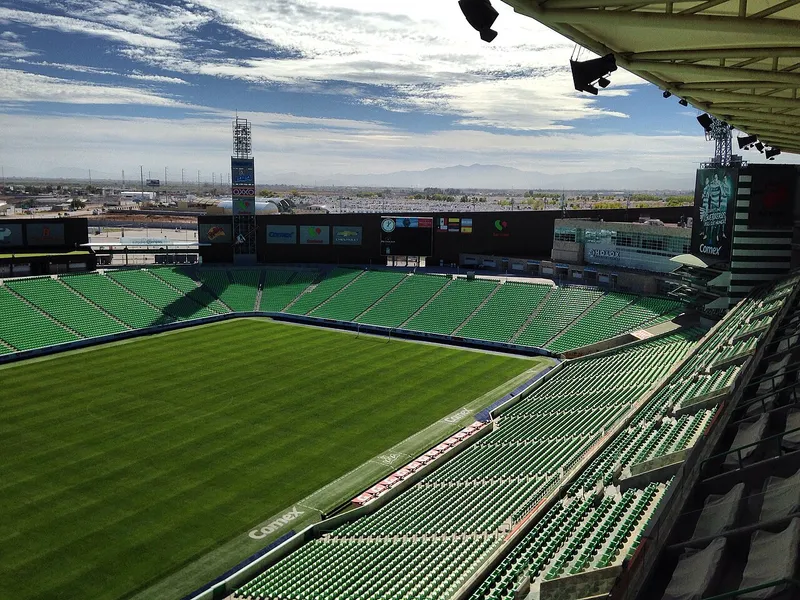
About Estadio TSM Corona
Pelé kicked the first ball here. On the night of November 11, 2009, the King of football stepped onto a brand-new pitch in the middle of the Chihuahuan Desert and got Estadio TSM Corona started, flanked by Franco Baresi, Gabriel Batistuta, George Weah, Enzo Francescoli, Bebeto, and FIFA president Sepp Blatter. Ricky Martin played the concert. A 17-year-old Neymar turned out for the visiting Santos FC of Brazil. It was a lot of star power for a mid-size cotton city few outsiders could find on a map.
The stadium seats 30,000 across five levels, with 112 luxury suites and 2,000 club seats, and the bowl was engineered so a later phase could stretch it toward 40,000. It replaced the old Estadio Corona, a 1970 ground that started life as the Estadio Moctezuma and held 18,000. The new building roughly doubled that. Home to Santos Laguna, and now the women’s side Santos Laguna Femenil, it goes by a few names in Torreón: locals call it the TSM, the marketing calls it “El Templo del Desierto,” and an older, meaner nickname stuck too, “La Casa del Dolor Ajeno,” the House of Others’ Pain.
The stadium is only one piece of Territorio Santos Modelo, the sprawling complex it anchors. Around it sit a high-performance training center with six fields, a soccer school that runs hundreds of kids through its program, a residence for young academy players, a Hall of Fame museum, a gymnasium, an auditorium, and even a chapel, the Parroquia de Todos los Santos. Orlegi Sports, which bought Santos Laguna in 2019, says the grounds draw more than half a million visitors a year. Few Liga MX clubs have built anything this comprehensive.
Torreón itself is the heart of the Comarca Lagunera, a desert basin where Coahuila and Durango meet along the Nazas River. This was Mexico’s cotton capital. The town grew from a couple hundred people in 1892 to some 34,000 by 1910, and today it anchors a metro area of more than 1.3 million. Cotton country became football country, and the temple in the desert is the proof.
Getting to Estadio TSM Corona
Public Transit
Torreón has no metro or rail system. Bus service and dedicated match-day routes carry the load.
→ Via Ruta al Corona: Dedicated bus routes run to the stadium on match days for just 15 MXN (about $0.75 USD) per trip, the cheapest way to get there. Buses drop off at the northern parking lots.
→ Via City Bus: Regular routes including Los Laureles, Norte, and Independencia-Aeropuerto pass near the stadium. The nearest stop is on Calzada Profesor Ramón Méndez.
The match-day shuttles are Santos Laguna’s fix for a stadium parked on the city’s northern edge. Cheap, direct, and a good deal easier than fighting for a parking space.
Driving + Parking
The stadium address is Calzada Territorio Santos Modelo 1, Conjunto de Todos los Santos, C.P. 27014, Torreón, Coahuila. Federal Highway 30 is the primary approach.
→ From Downtown Torreón (~12 km): North via Bulevar Independencia to Federal Highway 30. About 20 minutes.
→ From Saltillo (~259 km): West via Highway 40D. About 3 hours.
→ From Durango (~243 km): East via Highway 40D. About 2 hours 45 minutes.
The stadium has a 4,800-space surface parking lot, one of the largest in Liga MX. Traffic on Federal Highway 30 backs up on match days, so arrive at least an hour early.
Rideshare
Uber and DiDi both operate in Torreón. From downtown, expect 80-150 MXN ($4-$8 USD) and about 20 minutes. From the airport, 100-180 MXN ($5-$9 USD). Traditional taxis work too, and they are everywhere.
From the Airport
→ Torreón International Airport (TRC): Just 10 km (6 miles) east, about 15-20 minutes by car. Domestic flights connect to Mexico City, Guadalajara, Monterrey, and Tijuana via Aeroméxico, VivaAerobus, and Volaris. Rideshare runs 100-180 MXN ($5-$9 USD).
Construction & Design
The plan went public on November 14, 2007, when Santos Laguna unveiled a US$100 million stadium meant to drag the club into a new class of Mexican football. Crews cleared the ground in February 2008. The first concrete was poured on April 20, 2008, and about a year and a half later the doors opened. That is a fast build for a venue of this size, and it shows in how single-minded the design is.
Santos handed the job to HKS, Inc., the Dallas firm best known for AT&T Stadium and the Dallas Cowboys. Rather than drop a generic bowl into the desert, HKS leaned into where it stands. The architects used what they called vernacular materials to fit high-performance stadium standards to the region’s climate and culture, a stated goal of making the building “the essence of the city” and a center of community life year-round, not just on the eighteen or so days a season when Santos plays at home. The result is a stadium that reads as of the Comarca Lagunera rather than parachuted into it. CNN Expansión voted it “Best Sports Project” and the “People’s Choice Favorite of the year” in Mexico.
The program is unusually deep. Beyond the 30,000 seats spread across five levels, HKS packed in 112 suites and 2,000 club seats, a Hall of Fame museum with an interactive zone, a six-field training center, a soccer school and clinic, classrooms for sports careers, a restaurant and party deck, executive offices, and a 4,800-car surface lot. It was billed as the first stadium of its kind in Mexico built without perimeter fencing between the stands and the pitch, a small detail that changed how the crowd feels from the front rows. The natural-grass field has long been rated among the country’s best for pace.
The money and the land came from Grupo Modelo’s world, and the naming rights still do. “Corona” is the brewer’s flagship beer, and when Grupo Orlegi bought Santos Laguna in 2019, it kept the Corona deal rather than rename the place. Orlegi now owns and operates the whole complex, which spreads across more than twenty hectares of what used to be the northern edge of the city. Sustainability was written into the brief from the start, with solar panels and a water-treatment system serving the grounds, a practical concession to a basin where water is never a given.
History of Estadio TSM Corona
The old Estadio Corona had done its job for four decades. Opened on July 2, 1970 as the Estadio Moctezuma and renamed for the Corona brand in 1986, it held 18,000 and had hosted a run of Mexican league finals. By the mid-2000s it was too small for the club’s ambitions, and Santos decided to build rather than renovate. The old ground was demolished in November 2009, weeks before the new one opened.
Inauguration (November 11, 2009): President Felipe Calderón declared the stadium open. On the pitch, Santos Laguna faced Santos FC of Brazil, with a teenage Neymar in the Brazilian squad. Pelé took the ceremonial kick, Ricky Martin sang, and a bench of legends turned out: Baresi, Batistuta, Weah, Francescoli, Bebeto, Jorge Campos, René Higuita, and FIFA’s Sepp Blatter.
2011 FIFA U-17 World Cup (June-July 2011): The stadium hosted matches in the youth tournament Mexico went on to win, including knockout football in front of packed desert crowds. It was the venue’s first taste of a FIFA event.
Clausura 2012 Championship (May 20, 2012): Santos beat Monterrey 2-1 at home to take the final 3-2 on aggregate, after a 1-1 draw in the first leg away at the Estadio Tecnológico. Daniel Ludueña and Oribe Peralta scored. It was the club’s fourth league title, and the first won inside the new building.
Clausura 2015 Championship (May 2015): Santos overwhelmed Querétaro in the final to lift a fifth title, one of the most lopsided runs the club has put together at home.
Clausura 2018 Championship (May 2018): Santos edged Toluca, winning the first leg 2-1 and drawing 1-1 away to take the series 3-2 on aggregate. A sixth star, and the third earned on this pitch.
2026 World Cup Team Base Camp (2026): FIFA certified the TSM complex as an official Team Base Camp for the 2026 World Cup, a training-and-lodging site for one of the participating nations. Portugal and the Netherlands have been floated as candidates. It is not a match venue, but the designation is a nod to how much sits behind the 30,000-seat bowl.
From Pelé’s opening kick to three Liga MX titles won on this turf, Estadio TSM Corona is where Santos Laguna lives. A desert temple by the architects of AT&T Stadium, dropped into cotton country and made to look like it belongs.
Sources & Further Reading
- Stadium overview and history: en.wikipedia.org. Capacity, opening date, architect, ownership, and notable events for the current Estadio Corona.
- Spanish-language stadium record: es.wikipedia.org. Construction timeline, nicknames, suites, and expansion plans in detail.
- Construction cost report: expansion.mx. CNN Expansión’s opening-day story confirming the US$100 million cost and 30,000 capacity.
- Architect’s project page: hksinc.com. HKS on the vernacular design, the program of amenities, and the CNN Expansión awards.
- World Cup base camp designation: mediotiempo.com. Reporting on the TSM’s FIFA Team Base Camp certification for 2026.
Quick Facts
Everything you need at a glance.
Stadium specs
- Capacity
- 30,000
- Opened
- 2009
- Cost
- US$100 million
- Roof
- Open
- Surface
- Natural Grass
- Tenants
- Santos Laguna (Liga MX)
Location
- Groundbreaking
- April 20, 2008 (first concrete pour)
- Address
- Calzada Territorio Santos Modelo 1, Conjunto de Todos los Santos, 27014 Torreón, Coahuila, Mexico
- GPS
- 25.6291°N, 103.3795°W
Photo Gallery
Fun Facts
Pelé kicked the ceremonial first ball at the November 11, 2009 inauguration, alongside legends Franco Baresi, Gabriel Batistuta, George Weah, Enzo Francescoli, Bebeto, Jorge Campos, René Higuita, and FIFA President Sepp Blatter, followed by a Ricky Martin concert.
Designed by HKS, Inc. (the same firm behind AT&T Stadium in Dallas), the US$100 million stadium adapted state-of-the-art stadium standards to the Chihuahuan Desert using vernacular materials, and roughly doubled the old Estadio Corona's 18,000 capacity to 30,000.
On August 20, 2011, a Liga MX match between Santos Laguna and Monarcas Morelia was suspended in the 40th minute when gunfire erupted outside the stadium from a police pursuit. Players dropped to the turf and fans fled, though no one inside was injured.
Stadium Location
Frequently Asked Questions
- What is the seating capacity of Estadio TSM Corona?
- Estadio TSM Corona holds 30,000 spectators across 5 levels, with 112 luxury suites and 2,000 club seats. The bowl was designed so a second phase could push it to roughly 40,000. It opened on November 11, 2009, at a cost of about US$100 million.
- Where is Estadio TSM Corona located?
- The stadium is at Calzada Territorio Santos Modelo 1, in the northern part of Torreón, Coahuila, Mexico. It sits between Federal Highway 30 and Coahuila 60, about 20 minutes from downtown Torreón.
- How do I get to Estadio TSM Corona from the airport?
- Torreón International Airport (TRC) is just 10 km (6 miles) east, about a 15-20 minute drive. Uber and DiDi both operate in Torreón and provide the easiest option. Traditional taxis are also available at the airport.
- Is there parking at Estadio TSM Corona?
- Yes. The stadium has a 4,800-space surface parking lot. On match days, the 'Ruta al Corona' bus service runs dedicated routes to the stadium for 15 MXN per trip, a cheap alternative to driving.
- Who designed Estadio TSM Corona?
- HKS, Inc. of Dallas, Texas, the same firm that designed AT&T Stadium (home of the Dallas Cowboys). CNN Expansión voted it 'Best Sports Project' and 'People's Choice Favorite of the year' in Mexico.
- Who owns Estadio TSM Corona?
- The stadium and Santos Laguna are owned by Grupo Orlegi (Orlegi Sports), which acquired the club in 2019. The 'Corona' name is a naming-rights deal with the beer brand of Grupo Modelo, which Orlegi kept in place.
- What team plays at Estadio TSM Corona?
- Santos Laguna of Liga MX, and the club's women's team, Santos Laguna Femenil. Santos was founded in 1983 and has won 6 Liga MX titles. The wider TSM complex also includes training fields, a soccer school, a Hall of Fame museum, and a clinic.
- Is Estadio TSM Corona a 2026 World Cup venue?
- It is not a match venue. FIFA certified the TSM complex as an official Team Base Camp for the 2026 World Cup, meaning a participating national team can train and stay there during the tournament.
- Why is Estadio TSM Corona called 'El Templo del Desierto'?
- The nickname, 'The Temple of the Desert,' took hold around 2016 and refers to the stadium's setting in the Comarca Lagunera, a desert basin where summer temperatures regularly climb past 40°C (104°F). An older nickname is 'La Casa del Dolor Ajeno,' or 'The House of Others' Pain.'
- How far is Torreón from other major cities?
- Saltillo is 259 km east (3 hours), Monterrey is 339 km east (3 hours 45 minutes), and Durango is 243 km west (2 hours 45 minutes). Torreón is in the Comarca Lagunera, a desert basin where Coahuila and Durango states meet.
Last updated: 2026-07-10