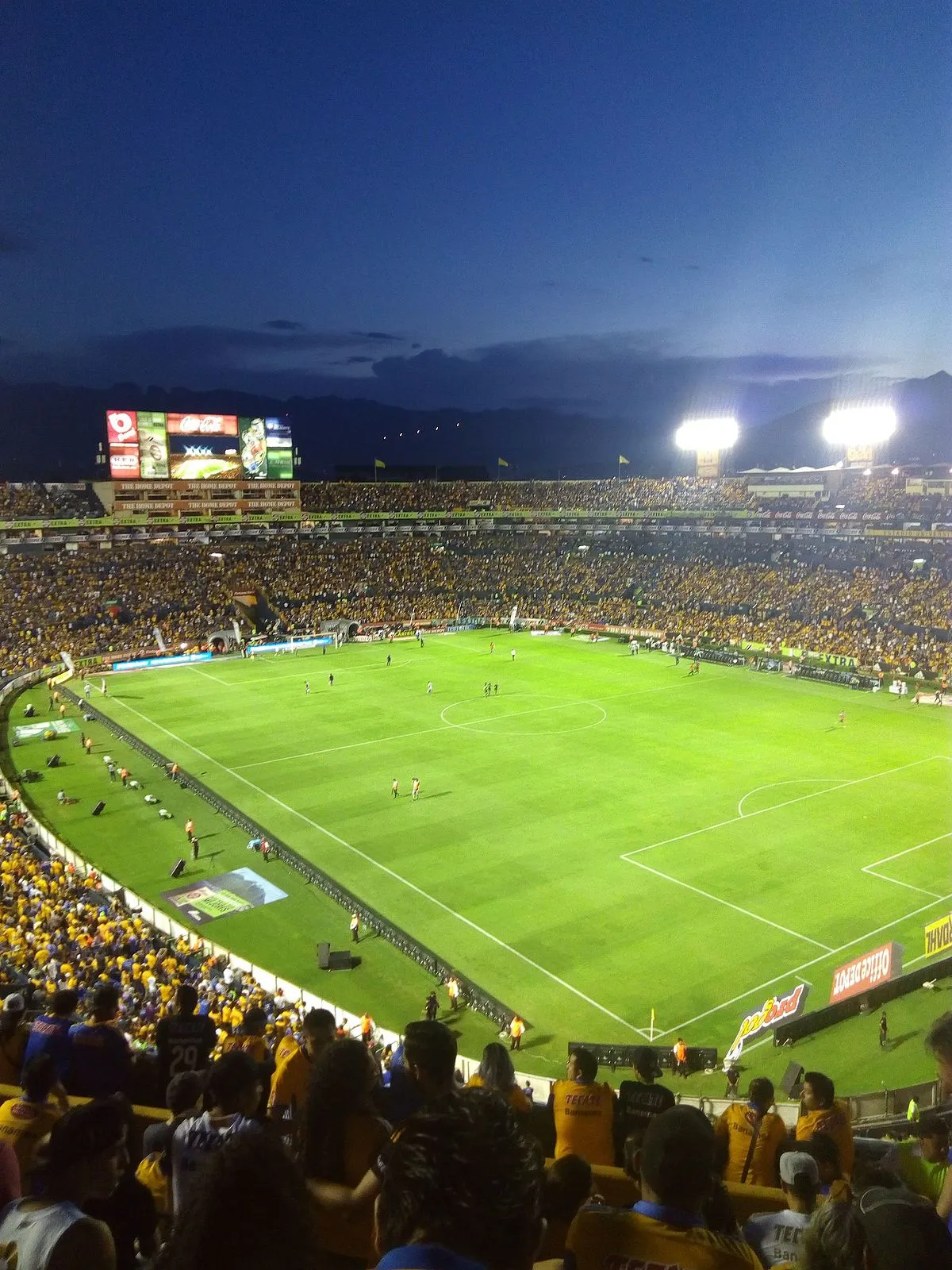
About Estadio Universitario
Estadio Universitario rises from the campus of the Universidad Autónoma de Nuevo León like the volcano it’s named after. Known to every Tigres fan as El Volcán, this 42,000-seat bowl sits in San Nicolás de los Garza, just 6 kilometers north of downtown Monterrey — close enough to feel the pulse of Mexico’s industrial capital, rooted enough in its university setting to have a character all its own.
El Volcán is home to Tigres UANL, one of Liga MX’s most successful and passionate clubs. On match nights, the steep circular bowl traps sound and energy in a way that few stadiums can match. The nickname isn’t just about the shape — when 42,000 Tigres fans erupt, you understand why they call it The Volcano.
The stadium was inaugurated on May 30, 1967, after seven years of construction at a cost of 23 million pesos. Originally planned to hold 90,000 spectators, budget constraints scaled the design to its current two-tier configuration. The natural grass pitch sits well below street level, and the open-air bowl channels the warm Nuevo León air across the field — expect heat and humidity during summer matches.
El Volcán has hosted some of the biggest moments in Mexican football. Five 1986 FIFA World Cup matches played out here including a quarterfinal between West Germany and Morocco. The stadium also served as a venue for the 1983 FIFA World Youth Championship and the 2011 FIFA U-17 World Cup. Add multiple CONCACAF Champions League runs and Liga MX title-winning campaigns, and you have a stadium that punches well above its capacity.
Getting to Estadio Universitario
Public Transit
Metrorrey is your best option. Line 2 (the green line) runs directly to Universidad station, which puts you a short walk from the stadium gates. It connects to downtown Monterrey and the central bus terminal, making it accessible from anywhere in the metro area.
→ From Downtown Monterrey (Macroplaza): Take Metrorrey Line 2 northbound from Zaragoza station to Universidad. About 15 minutes, under 10 pesos.
→ From the Central Bus Terminal: Walk to Cuauhtémoc station on Line 2 and ride north to Universidad. Roughly 20 minutes door to door.
Several bus routes also serve the stadium area — lines 017, 213, 227, and 685 all stop nearby. On match days, transit gets crowded, so arriving early is strongly recommended.
Driving + Parking
The stadium is on Avenida Universidad, within the UANL campus. GPS users should search for “Estadio Universitario UANL, San Nicolás de los Garza, Nuevo León.”
→ From Downtown Monterrey: Head north on Avenida Universidad. About 6 km, 15–20 minutes without traffic.
→ From San Pedro Garza García: Take Avenida Lázaro Cárdenas north to Avenida Universidad. Approximately 30 minutes.
The stadium has parking for around 3,600 vehicles, but the lot opens at 4:00 PM and is reserved for season ticket holders first. If you don’t have a parking pass, use the overflow lots at Palacio Sultán or Parque Ferromex on Avenida Manuel L. Barragán. Pre-planning is essential on match days — street parking fills fast.
Rideshare
Uber and DiDi both operate in Monterrey and will get you to the stadium without hassle. A ride from downtown runs about 80–120 MXN ($5–7 USD). After matches, expect surge pricing and 15–25 minute waits near the university exits.
Pro tip: Walk a few blocks away from the stadium toward Avenida Manuel L. Barragán to find faster pickups and lower fares.
From the Airport
→ Monterrey International Airport (MTY): 15 miles northeast, about 25–35 minutes by car. Take Highway 54 south toward the city, then Avenida Universidad north to the campus. A taxi or rideshare from the airport costs 400–600 MXN ($25–35 USD).
Legacy of El Volcán
El Volcán isn’t just a stadium — it’s a cultural landmark for Monterrey and the wider Nuevo León region. As the home of Tigres UANL, one of Liga MX’s most decorated clubs with multiple league titles, it has witnessed some of the most electric atmospheres in Mexican football. The Incomparable supporters’ group fills the south end every match, creating a wall of gold and blue that defines the Tigres experience.
The stadium’s place in global football history runs deeper than most fans realize. During a 1984 match here, the crowd spontaneously created what became known as the “Mexican Wave” — the synchronized standing wave that spread worldwide during the 1986 World Cup and remains a universal stadium tradition.
History of Estadio Universitario
Construction began in 1960 under the vision of UANL rector Manuel L. Barragán, who wanted a world-class venue for the university and the city of Monterrey. Seven years and 23 million pesos later, the stadium was inaugurated on May 30, 1967. Its circular, sunken-bowl design immediately earned the El Volcán nickname that has stuck for nearly six decades.
FIFA World Cup 1986: El Volcán hosted five matches including group stage games and the quarterfinal between West Germany and Morocco (1-0), putting the stadium on the global map.
FIFA World Youth Championship (1983): The stadium served as a venue for the U-20 tournament, an early signal of its capacity to host international football.
FIFA U-17 World Cup (2011): Major renovations preceded this tournament — the pitch received advanced irrigation and drainage systems, press facilities expanded to support 120+ journalists, and Latin America’s largest video screen (12.48 × 8.60 meters) was installed.
Tigres’ Golden Era (2015–present): Tigres UANL emerged as a Liga MX powerhouse, winning multiple league titles and reaching the 2015 Copa Libertadores Final and 2021 FIFA Club World Cup Final. Every title run passed through El Volcán’s cauldron.
Zero-Waste Milestone (2022): Estadio Universitario became Mexico’s first zero-waste stadium through a partnership with CEMEX and Pro Ambiente, implementing comprehensive recycling and waste diversion across all operations.
Today, El Volcán remains one of the most feared away grounds in Liga MX and a point of deep pride for the people of Monterrey.
Photo Gallery
Fun Facts
Estadio Universitario was originally planned to hold 90,000 spectators, but budget constraints scaled the design down to two tiers and roughly half that capacity.
The stadium is widely credited as the birthplace of the 'Mexican Wave' — the crowd tradition reportedly started here during a 1984 match and spread worldwide through the 1986 World Cup.
In 2022, El Volcán became Mexico's first zero-waste stadium through a partnership with CEMEX, implementing a comprehensive recycling and waste diversion program.
Stadium Location
Frequently Asked Questions
- What is the seating capacity of Estadio Universitario?
- Estadio Universitario has a current seating capacity of approximately 42,000. The stadium originally held over 50,000 after 1986 World Cup renovations, but capacity was reduced in later years to improve safety and the fan experience.
- Where is Estadio Universitario located?
- Estadio Universitario is located on the campus of the Universidad Autónoma de Nuevo León (UANL) in San Nicolás de los Garza, Nuevo León, Mexico. It sits about 6 kilometers north of downtown Monterrey in the city's metropolitan area.
- Why is Estadio Universitario called El Volcán?
- The nickname 'El Volcán' (The Volcano) comes from the stadium's distinctive circular, crater-like shape. Its steep, tiered seating resembles a volcanic crater, and on match nights the roaring crowd completes the volcanic atmosphere.
- How do I get to Estadio Universitario by public transit?
- Take Metrorrey Line 2 (the green line) to Universidad station, which is a short walk from the stadium entrance. Line 2 connects to downtown Monterrey and the central bus terminal. Bus routes 017, 213, 227, and 685 also serve the area.
- Is there parking at Estadio Universitario?
- Yes, the stadium has parking for approximately 3,600 vehicles. The lot opens at 4:00 PM for season ticket holders. Visitors without a parking pass can use nearby lots at Palacio Sultán and Parque Ferromex on Avenida Manuel L. Barragán.
- What major events has Estadio Universitario hosted?
- El Volcán hosted five 1986 FIFA World Cup matches including a quarterfinal, the 1983 FIFA World Youth Championship, the 2011 FIFA U-17 World Cup, multiple CONCACAF Champions League campaigns, and numerous Liga MX Finals for Tigres UANL.
- When was Estadio Universitario built?
- Construction began in 1960 and the stadium was inaugurated on May 30, 1967. It was built on the UANL university campus under the direction of rector Manuel L. Barragán at a cost of 23 million pesos.
Last updated: 2026-03-01