About AT&T Stadium
Jerry Jones bought the Dallas Cowboys in 1989 for $140 million. Two decades later, he built them a stadium that cost roughly nine times that amount. AT&T Stadium opened on May 27, 2009, at a final construction cost of between $1.15 and $1.3 billion, which made it the most expensive sports venue in the world at the time. A record that held until SoFi Stadium in Inglewood overtook it in 2020. The original 2004 estimate had been $650 million. It roughly doubled.
The project was proposed to Arlington voters as a public-private partnership. In a 2004 referendum, the city approved a half-cent sales tax increase to contribute $325 million toward construction. Jones and the Cowboys covered the remaining $800+ million, including every dollar of cost overrun. The stadium is owned by the City of Arlington and operated by the Cowboys under a long-term lease. A common arrangement in American stadium finance, although the specific cost-sharing ratio favours the team more heavily here than at most comparable venues.
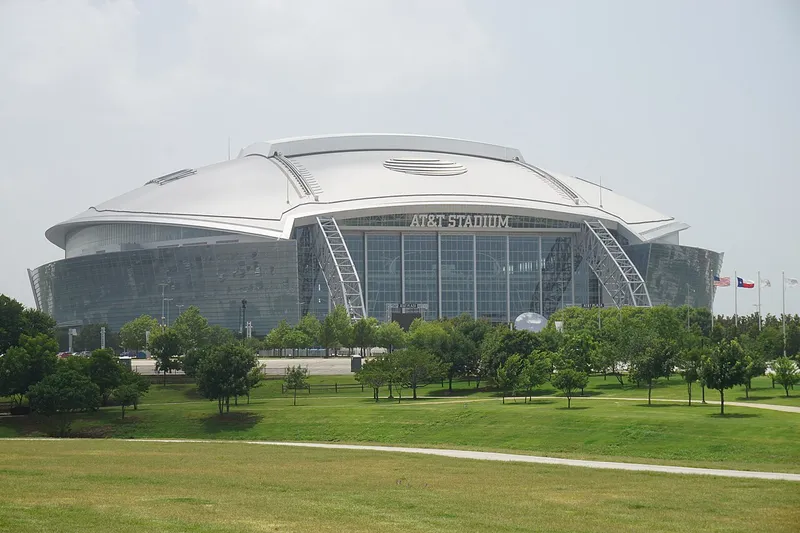
AT&T Stadium sits in Arlington, Texas, midway between Dallas and Fort Worth, at 1 AT&T Way. Its immediate neighbours are Globe Life Field (home of the Texas Rangers) and Choctaw Stadium (the Rangers’ former ballpark, now used for concerts and minor league baseball). The stadium replaced Texas Stadium, the Cowboys’ previous home from 1971 through the 2008 NFL season. Texas Stadium had been famous for a partial roof with an open hole above the field, which became an unintentional Cowboys visual trademark. The new building’s retractable roof, when open, produces a similar silhouette, which some observers have read as an homage. Others have read it as Jerry Jones being Jerry Jones.
Design was led by HKS, Inc., the Dallas firm also responsible for Lucas Oil Stadium and SoFi Stadium. Bryan Trubey served as lead architect. Structural engineering was shared between Walter P Moore and Campbell & Associates. General contracting was executed by a three-firm joint alliance of Manhattan Construction, Rayco Construction, and 3i Construction. The retractable roof membrane was installed by K Post Company of Dallas. Roof mechanization was engineered by Uni-Systems. Electrification by VAHLE, Inc. The membrane rests on two steel arches, each 300 feet (91 metres) tall, which span the length of the dome.
The most unmistakable architectural feature is the pair of glass end-zone doors. Each stands 120 feet (37 metres) tall. The largest operable glass doors in the world. They can open and close independently of the roof, which allows Texas-sized airflow even when the roof itself stays closed. Suspended above the field, 90 feet up, is the Mitsubishi center-hung video board. Total weight approximately 1.2 million pounds. Each face spans roughly 175 feet by 72 feet. At installation, it was the largest 1080p HDTV ever built. It held that title until SoFi Stadium opened in 2020. The stadium also contains more than 3,000 Sony LCD screens scattered through concourses and premium spaces, and one of the largest private contemporary art collections displayed in any sports venue. Curated by Jones’ family. Valued at more than $40 million. Pieces by Anish Kapoor, Ellsworth Kelly, Teresita Fernández, Olafur Eliasson.
Listed seating capacity is 80,000. With standing-room sections deployed, actual attendance has exceeded 100,000 repeatedly. The NFL record of 105,121 was set at the very first regular-season game, against the New York Giants, on September 20, 2009 (four years to the day after groundbreaking). WrestleMania 38 drew 131,372 over two nights in April 2022, the largest professional wrestling gate in history. The 2010 NBA All-Star Game drew 108,713, a basketball attendance record that may never be broken. George Strait’s 2014 farewell concert drew 104,793, then the largest indoor concert audience in US history. For the 2026 FIFA World Cup, nine matches have been assigned to AT&T Stadium, more than any other venue in the tournament, including a semi-final. Under FIFA’s branding policy, the venue will be temporarily renamed “Dallas Stadium” throughout the competition.
Getting to AT&T Stadium
Public Transit
Honestly, this is the weakest transit profile of any 2026 World Cup venue. Arlington has no local bus system. No rail station sits within walking distance. The Cowboys and the city have resisted expanding transit into the stadium area for years. Most Cowboys fans drive, and most World Cup visitors will too.
→ DART Rail (Dallas): The nearest DART light rail station is CentrePort/DFW Airport on the Orange Line, about 8 kilometres (5 miles) from the stadium. On event days, shuttle buses typically run from the station.
→ TEXRail (Fort Worth): Fort Worth’s TEXRail also stops at CentrePort/DFW Airport. From there, the same event-day shuttle system applies.
→ World Cup shuttles: The local organising committee has announced dedicated shuttle services from both Dallas (DART hubs) and Fort Worth (TEXRail and Trinity Metro hubs) directly to the stadium for the tournament. Schedules will be confirmed closer to match dates.
If you can get to CentrePort station, the event-day shuttle is workable. Otherwise, plan to drive or rideshare. This is simply not a transit-accessible venue, and FIFA’s shuttle network is the practical answer for international visitors without rental cars.
Driving + Parking
Highway access is straightforward. I-30 runs directly between Dallas and Fort Worth, and the Collins Street and Ballpark Way exits drop you within minutes of the stadium. GPS: 1 AT&T Way, Arlington, TX 76011.
→ From Dallas: I-30 West to Collins Street or Ballpark Way exit. Around 32 kilometres (20 miles), 25-45 minutes depending on traffic.
→ From Fort Worth: I-30 East to the same exits. Around 24 kilometres (15 miles), 20-35 minutes.
→ From DFW Airport: Highway 360 South to I-30 West. Around 16 kilometres (10 miles), 15-25 minutes without event traffic.
The stadium complex has more than 12,000 official parking spaces, with thousands more in private lots across the surrounding district. Official parking runs $20 for distant lots to $75+ for premium proximity. Private lots around Randol Mill Road and Collins Street often undercut stadium pricing. The Globe Life Field lots directly across the way sometimes offer game-day parking at competitive rates when the Rangers aren’t playing at home. Pre-purchase either way.
Rideshare
Uber and Lyft are the primary alternatives to driving, particularly for visitors without rental cars. Designated pickup and drop-off zones are located on the east side of the stadium complex. A ride from downtown Dallas runs $30-50. From downtown Fort Worth, $25-40. From DFW Airport, $25-35. Expect significant surge pricing after events. The same trick that works at every American mega-stadium works here. Walk 5-10 minutes away from the venue before opening the app to escape the surge geofence.
From the Airport
→ DFW International Airport: Around 16 kilometres (10 miles) north. 15-25 minutes by car without event traffic. The closest major airport to any 2026 World Cup venue.
→ Dallas Love Field: Around 32 kilometres (20 miles) east. 25-40 minutes by car. Southwest Airlines’ home hub.
FIFA World Cup 2026 at AT&T Stadium
Nine matches have been assigned to AT&T Stadium, more than any other venue in the 2026 tournament. Five group stage games, two Round of 32 fixtures, one Round of 16 fixture, and one semi-final. The first match at the venue is June 14, 2026 (Netherlands vs Japan). The semi-final is on July 14. For how AT&T compares to the other NFL venues converting for the tournament, see our guide to the NFL stadiums hosting the World Cup.
Name change: Under FIFA’s corporate naming policy, the stadium will be temporarily renamed “Dallas Stadium” in all broadcasts, signage, printed materials, and ticketing throughout the tournament. Corporate naming rights resume afterwards.
Climate control: Texas summers are brutal. Arlington in June and July regularly sees daytime highs above 38°C (100°F). The retractable roof resolves this completely. Close the roof, close the glass end-zone doors, engage the HVAC, and the bowl sits at a comfortable temperature regardless of what is happening outside. A genuine advantage over open-air venues in Houston, Kansas City, and Philadelphia.
Pitch conversion: The Hellas Matrix Turf surface will be removed and replaced with natural grass laid on a modular tray system. AT&T Stadium has hosted soccer matches before under the same type of temporary grass installation, including the 2024 Copa América match between Argentina and Canada.
Capacity: With standing-room sections deployed for FIFA, actual attendance at AT&T Stadium during the tournament is expected to reach 94,000 for the larger matches, the highest of any venue in the tournament.
Video board: The 1.2-million-pound Mitsubishi center-hung display will provide the broadcast profile that only AT&T Stadium can. Replays, graphics, match atmosphere. For international viewers, the interior shots of the venue will look unmistakable.
Construction & Design
Groundbreaking was on September 20, 2005. The site in Arlington had been selected following the Cowboys’ failed negotiations with the city of Dallas over a potential replacement for Texas Stadium inside the city limits, and failed negotiations with Fair Park. Arlington offered a better deal. A 2004 sales-tax referendum committed $325 million in public contribution. Jones and the Cowboys agreed to cover the rest, including any overruns.
The design was led by HKS, Inc., a Dallas firm that had previously built Lucas Oil Stadium for the Indianapolis Colts and would go on to design SoFi Stadium for Stan Kroenke a decade later. Bryan Trubey served as lead architect. Structural engineering was split between Walter P Moore (handling the roof and primary structure) and Campbell & Associates. General contracting was executed by a three-firm joint alliance of Manhattan Construction Company, Rayco Construction, and 3i Construction. Roof membrane installation was handled by K Post Company of Dallas. Mechanization engineering was performed by Uni-Systems. Electrification by VAHLE, Inc.
The structural headline is the roof. Two steel arches, each roughly 300 feet (91 metres) tall, span the length of the dome. The retractable membrane rides on these arches. A full open or close sequence takes approximately 12 minutes. The end-zone glass doors, each 120 feet (37 metres) tall and 180 feet (55 metres) wide, operate independently of the roof. They are the largest operable glass doors in the world. Both the roof and the doors can be left open during pleasant Texas spring or autumn evenings, producing a partially open-air effect that the Cowboys use for marquee games when the weather cooperates.
The original construction budget of $650 million roughly doubled during construction, driven by scope expansion rather than delays. The roof mechanism grew more complex. The video board grew larger. Premium suite counts expanded. Jones paid the overruns out of private capital rather than going back to Arlington voters for additional public contribution. By completion, the final figure was between $1.15 billion and $1.3 billion, depending on what costs were counted as construction versus operational capital. Approximately $1.95 billion in 2025 dollars. The most expensive sports venue in the world at completion, a record held until SoFi Stadium opened in 2020.
Inside, the center-hung Mitsubishi video board hangs 90 feet above the field. Twin display faces, each approximately 175 feet wide by 72 feet tall. Approximately 1.2 million pounds in total weight. At installation in 2009, it was the largest 1080p HDTV ever built. The field below is a Hellas Matrix Turf surface with Helix Soft Top, installed in 26 interchangeable panels. Individual panels can be swapped for repair or event reconfiguration without closing the entire field. The stadium contains 414 luxury suites, more than 15,000 club seats across multiple premium tiers, and more than 3,000 Sony LCD screens distributed through concourses and premium lounges.
The contemporary art collection curated by the Jones family is one of the most distinctive operational features. Valued at more than $40 million. Installations by Anish Kapoor, Ellsworth Kelly, Teresita Fernández, Olafur Eliasson, and others. Most of the pieces are installed throughout the main concourses and premium lounges and are visible to any ticketholder. Guided art tours run on non-event days.
The stadium has a published list of notable maintenance issues over its operational life, including ice falling from the roof during Super Bowl XLV week in 2011 (which injured six people) and occasional condensation buildup during cold-weather games. The roof operation has been systematically refined since opening. Current protocols leave the roof open during mild weather to reduce mechanical wear.
History of AT&T Stadium
The Dallas Cowboys played at Texas Stadium in Irving from 1971 through the 2008 NFL season. Texas Stadium was famous for a distinctive partial roof with an open hole above the field, a compromise between Tom Landry’s preference for an outdoor venue and the NFL’s push for weatherproofing. By the early 2000s, the building was aging and Jerry Jones wanted a replacement. The Cowboys negotiated unsuccessfully with the city of Dallas for a downtown site. They negotiated unsuccessfully with Fair Park. They negotiated with Arlington, and Arlington said yes.
The 2004 referendum that funded the public $325 million contribution passed with 55% of the vote. Groundbreaking followed on September 20, 2005. Construction took just under four years. The stadium opened as “Cowboys Stadium” on May 27, 2009, with a George Strait concert that drew 66,000 the following week, establishing an immediate touring-concert reputation. The first NFL regular-season game was on September 20, 2009, against the New York Giants, attended by 105,121 fans. An NFL single-game attendance record that stood for years.
On July 25, 2013, AT&T signed a naming rights deal reportedly worth between $17 and $19 million per year, and the venue was renamed AT&T Stadium accordingly. Under FIFA’s tournament policy, the venue will revert to “Dallas Stadium” for the 2026 World Cup, then return to AT&T Stadium afterwards.
Super Bowl XLV was hosted at AT&T Stadium on February 6, 2011. The Green Bay Packers defeated the Pittsburgh Steelers 31-25 in front of 103,219 fans. The event was marred by temporary seating issues that left approximately 400 ticketholders without usable seats. The NFL later issued refunds and additional compensation. Weather conditions outside the stadium (an unusual North Texas ice storm) also caused logistical problems during Super Bowl week.
Notable events:
- First event, George Strait in concert, June 6, 2009: Drew 66,000, establishing an early reputation as a premier concert venue.
- First NFL game, September 20, 2009: Dallas Cowboys hosted the New York Giants. Attendance 105,121, the largest regular-season NFL gate in history to that point.
- 2010 NBA All-Star Game, February 14, 2010: Eastern Conference defeated Western Conference 141-139. Attendance 108,713, a basketball attendance record that may be permanent.
- Super Bowl XLV, February 6, 2011: Green Bay Packers 31, Pittsburgh Steelers 25. Attendance 103,219.
- 2015 College Football Playoff National Championship, January 12, 2015: Ohio State defeated Oregon 42-20 in the first championship game of the CFP era.
- WrestleMania 32, April 3, 2016: WWE drew 101,763, a then-WrestleMania attendance record.
- WrestleMania 38, April 2-3, 2022: WWE returned for a two-night event that drew a combined 131,372, the largest professional wrestling gate in history.
- Concert history: George Strait’s 2014 farewell concert drew 104,793, an indoor concert attendance record at the time. Taylor Swift, Beyoncé, The Rolling Stones, Kenny Chesney, and many others have sold out multi-night runs.
- 2024 Copa América: Argentina defeated Canada 2-0 in the opening match of the tournament on June 20, 2024, with the Hellas turf replaced by temporary natural grass, which confirmed the venue’s pitch-conversion protocol for the 2026 World Cup.
AT&T Stadium will host Super Bowl LX in February 2026, just five months before the FIFA World Cup semi-final. Two globally-watched events in five months is an unusual operational profile for any venue. For FIFA, the assignment of nine total matches (the most at any tournament venue) and a semi-final reflects confidence in both the physical infrastructure and the operations team’s proven ability to handle large-scale international events back to back.
Sources & Further Reading
- AT&T Stadium official site: attstadium.com. Capacity, operations, parking, art collection information, and event calendars.
- Dallas Cowboys official site: dallascowboys.com/stadium. Team-branded stadium information including suite and membership programs.
- FIFA World Cup 2026 match schedule: fifa.com. Official match assignments and venue information.
- DART event-day service: dart.org. Rail schedules and shuttle connections to CentrePort/DFW Airport station.
- Trinity Metro TEXRail: trinitymetro.org. Fort Worth rail service to DFW Airport and shuttle connections.
- Wikipedia entry on AT&T Stadium: en.wikipedia.org/wiki/AT%26T_Stadium. Comprehensive reference with construction details, events, and attendance records.
- Wikipedia entry on Texas Stadium (1971-2008): en.wikipedia.org/wiki/Texas_Stadium. Background on the predecessor venue.
Quick Facts
Everything you need at a glance.
Stadium specs
- Capacity
- 94,000
- Opened
- 2009
- Cost
- $1.15-1.3 billion (~$1.95 billion today)
- Roof
- Retractable
- Surface
- Synthetic Turf (Natural Grass for FIFA)
- Tenants
- Dallas Cowboys (NFL)
- WC 2026
- Semi-Final · 9 matches
- First WC match
- June 14, 2026
Construction & location
- Groundbreaking
- September 20, 2005
- Architects
- HKS, Inc. (Bryan Trubey, lead)
- Engineering
- Walter P Moore / Campbell & Associates
- General contractor
- Manhattan Construction / Rayco / 3i Joint Alliance
- Address
- 1 AT&T Way, Arlington, TX 76011, USA
- GPS
- 32.7473°N, 97.0945°W
Photo Gallery
Fun Facts
Nine matches will be hosted here during the 2026 World Cup, more than any other venue in the tournament. Including a semi-final.
The retractable roof is anchored by two 300-foot steel arches that span the interior. The end-zone glass doors, each 120 feet tall, are the largest operable glass doors in the world.
The Mitsubishi center-hung video board weighs approximately 1.2 million pounds and was the largest 1080p HDTV ever built at the time of installation.
Stadium Location
Frequently Asked Questions
- What is the seating capacity of AT&T Stadium?
- Seating capacity is 80,000. With standing-room sections deployed, the venue has exceeded 100,000 multiple times. The NFL record of 105,121 was set at the very first game, against the New York Giants on September 20, 2009. WrestleMania 38 drew 131,372 over two nights in April 2022, the highest professional wrestling attendance in history. For the 2026 World Cup, FIFA's configuration is expected to sit in the 80,000-94,000 range.
- Where is AT&T Stadium located?
- 1 AT&T Way, Arlington, Texas 76011. The venue sits roughly midway between Dallas and Fort Worth, about 16 kilometres (10 miles) south of DFW International Airport. Directly across from Globe Life Field (home of the Texas Rangers) and Choctaw Stadium (the former Rangers ballpark).
- Does AT&T Stadium have a retractable roof?
- Yes. The roof is anchored by two 300-foot (91 metre) steel arches that span the interior of the dome. The mechanism opens or closes in roughly 12 minutes. The end-zone glass doors, each 120 feet (37 metres) tall, are the largest operable glass doors in the world and can open independently. For World Cup matches during the Texas summer, the roof can be closed and the air conditioning system can cool the bowl to a comfortable temperature.
- What World Cup 2026 matches will be played at AT&T Stadium?
- Nine matches, more than any other venue in the 2026 tournament. Five group stage games, two Round of 32 fixtures, one Round of 16 fixture, and one semi-final. Under FIFA's branding policy, the stadium will be temporarily renamed 'Dallas Stadium' in all broadcasts, signage, printed materials, and ticketing throughout the tournament. Corporate naming rights resume afterwards.
- How do I get to AT&T Stadium by public transit?
- Honestly, this is the weakest transit profile of any 2026 World Cup venue. Arlington has no local bus system and no rail station within walking distance. The nearest DART rail station is CentrePort/DFW Airport on the Orange Line, roughly 8 kilometres (5 miles) from the stadium. TEXRail out of Fort Worth also connects to CentrePort. On event days, shuttles typically run from that station. For the 2026 tournament, dedicated shuttle services from both Dallas and Fort Worth transit hubs are being planned. Most visitors drive or rideshare.
- Is there parking at AT&T Stadium?
- The stadium complex has more than 12,000 official parking spaces, with thousands more in private lots in the surrounding district. Official parking ranges from $20 for distant lots to $75+ for premium proximity. Pre-purchase is strongly recommended. For World Cup matches with visitors unfamiliar with the area, arriving two hours before kickoff is sensible.
- When was AT&T Stadium built?
- Groundbreaking was on September 20, 2005. Opening was on May 27, 2009, roughly 44 months later. The first event was a George Strait concert on June 6, 2009, which set an indoor concert attendance record at the time. The first NFL regular-season game was on September 20, 2009, exactly four years to the day after groundbreaking.
- Who designed and built AT&T Stadium?
- The design was led by HKS, Inc., with Bryan Trubey as lead architect. Structural engineering was shared between Walter P Moore and Campbell & Associates. General contracting was executed by a joint alliance of Manhattan Construction Company, Rayco Construction, and 3i Construction. The center-hung video board was manufactured by Mitsubishi Electric. The retractable roof membrane was installed by K Post Company of Dallas, with mechanization by Uni-Systems and electrification by VAHLE, Inc.
- How much did AT&T Stadium cost to build?
- Between $1.15 and $1.3 billion at completion, roughly $1.95 billion in 2025 dollars. The initial 2004 estimate was around $650 million. Arlington voters approved a half-cent sales tax increase in 2004 to contribute $325 million toward construction. Jerry Jones and the Dallas Cowboys covered the remainder, including all cost overruns beyond the city and NFL contributions. At completion, it was the most expensive sports venue ever built in the world. A record that held until SoFi Stadium overtook it in 2020.
- What was the Cowboys Stadium naming history?
- The venue opened on May 13, 2009 under the name 'Cowboys Stadium,' the Cowboys having been unable to secure a suitable naming-rights partner before opening. On July 25, 2013, AT&T signed a naming rights deal reportedly worth $17-19 million per year, and the stadium was renamed accordingly. Under FIFA's tournament policy, the venue will revert to 'Dallas Stadium' for the 2026 World Cup, then return to AT&T Stadium after the final match.
- Who owns AT&T Stadium?
- The stadium is owned by the City of Arlington, Texas, and operated by the Dallas Cowboys under a long-term lease. This public-owner, private-operator structure is common in American stadium finance. The $325 million public contribution was approved by Arlington voters in a 2004 referendum that committed half-cent sales tax revenue to the project. The Cowboys, Jerry Jones specifically, covered the remaining $800+ million in private capital.
- What is the Center-Hung Video Board at AT&T Stadium?
- A Mitsubishi Electric twin-panel display suspended 90 feet above the field on custom trusses. Each face spans approximately 175 feet wide by 72 feet tall. Total weight approximately 1.2 million pounds. At installation in 2009, it was the largest 1080p HDTV ever built and remained the largest center-hung display at any sports venue until SoFi Stadium's Infinity Screen overtook it in 2020. The stadium also contains more than 3,000 Sony LCD screens throughout concourses and premium areas.
- What was Texas Stadium?
- The Dallas Cowboys' previous home, operational from 1971 through the 2008 NFL season. Texas Stadium was famous for its partial roof with an open hole above the field, which became a Cowboys visual trademark. It hosted Super Bowl XXX preparations and countless Cowboys playoff games during the franchise's 1990s dynasty. After the Cowboys moved to the new stadium in 2009, Texas Stadium was imploded on April 11, 2010. AT&T Stadium's own retractable roof design, which can be opened to create a similar silhouette, is sometimes described as an homage.
- What is the AT&T Stadium Art Collection?
- One of the largest private contemporary art collections displayed in any sports venue. Curated by Jerry Jones' family, it includes works valued at more than $40 million, including pieces by Anish Kapoor, Ellsworth Kelly, Teresita Fernández, Olafur Eliasson, and others. Most of the work is installed throughout the main concourses and premium lounges, visible to any ticketholder. Guided art tours run on non-event days.
- Will AT&T Stadium be renamed for the World Cup?
- Yes. Under FIFA's corporate naming policy, all venues are referred to by neutral geographic names during the tournament. AT&T Stadium will be temporarily known as 'Dallas Stadium' in all broadcasts, signage, printed materials, and ticketing. Corporate naming rights resume after the tournament ends.
Last updated: 2026-04-17