About Levi's Stadium
The 49ers had played at Candlestick Park since 1971. The building was cold, windy, fog-soaked, and increasingly obsolete, but it was in San Francisco. By the early 2000s, the franchise had started pushing for a replacement. After years of negotiations with the city over potential downtown or Hunters Point sites, the York family ownership concluded that San Francisco was not going to deliver. In November 2006, they shifted focus 64 kilometres (40 miles) south to Santa Clara. That decision set the entire project in motion.
Santa Clara offered what San Francisco could not. A 17-acre parcel immediately adjacent to the California’s Great America theme park. A cooperative city government. Voter approval for a public financing contribution, which was passed in 2010 with 58% of the vote. Groundbreaking followed on April 19, 2012. Construction was unusually fast for a project of this scale. Around 27 months of site work and build-out, which produced a completed venue ready for soccer and NFL events by mid-2014.
The ribbon-cutting came on July 17, 2014. The stadium’s first event followed on August 2, a Major League Soccer match between the San Jose Earthquakes and the Seattle Sounders, attended by 48,765 fans. A fitting baptism, in retrospect. The first NFL game came two weeks later, a 49ers preseason matchup against the Denver Broncos on August 17. The design was led by HNTB Corporation, the Kansas City firm responsible for a long list of American stadium projects over the past two decades. Structural engineering came from Magnusson Klemencic Associates. General contracting was executed by a Turner Construction and Devcon joint venture. Civil engineering by Winzler & Kelly. Final construction cost approximately $1.3 billion, which translates to roughly $1.77 billion in 2025 dollars, unusually economical for a post-2010 NFL venue of this size and specification.
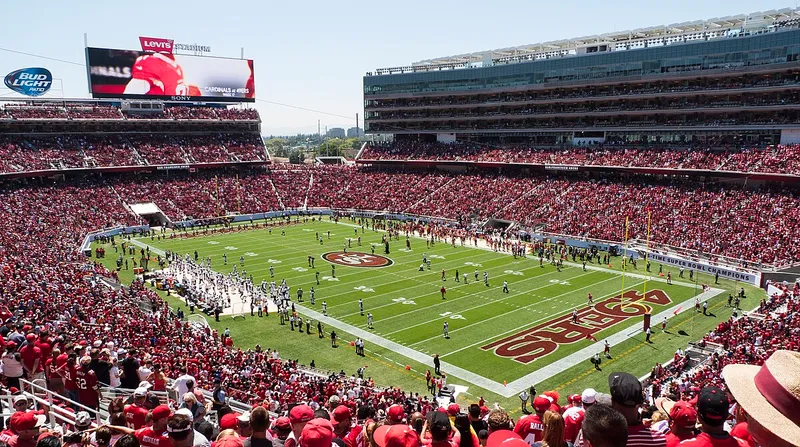
One of Levi’s Stadium’s defining features is the suite tower on the west side of the bowl. Rather than distribute premium seating around the stadium’s perimeter, the architects concentrated 174 executive suites and more than 9,000 club seats into a single tall structure along one sideline. The tower delivers an unusual fan experience (all premium seats on one side, general admission on the other) and creates a distinctive architectural profile. It also casts a long shadow over the playing field during parts of the day, which became part of the ongoing turf story.
That turf story. The natural Bermuda grass surface has been a recurring headache since opening. The suite tower’s shadow pattern creates uneven sun exposure across the field. The Bay Area’s mild but damp microclimate has caused slow recovery from wear. Players complained loudly in the stadium’s early seasons. Clumps coming up, poor footing, inconsistent coverage. The grounds crew has made significant improvements since, but the pitch remains a subject of ongoing attention, and FIFA’s groundskeeping teams will be on-site for months ahead of the 2026 World Cup to bring it to tournament standard.
Super Bowl 50, on February 7, 2016, was the stadium’s first global broadcast moment. The Denver Broncos defeated the Carolina Panthers 24-10 in what would be Peyton Manning’s final NFL game. The halftime show featured Coldplay, Beyoncé, and Bruno Mars. The “50” branding, rather than the standard Roman numeral “L,” stuck largely because the NFL concluded “Super Bowl L” looked wrong in single-character logo layouts. WrestleMania 31 in March 2015 drew more than 76,000 fans. The 2019 College Football Playoff National Championship, in which Clemson defeated Alabama 44-16, was another major milestone. For the 2026 FIFA World Cup, six matches have been assigned to Levi’s Stadium: five group stage fixtures and one Round of 32. Under FIFA’s policy, the venue will be temporarily renamed “San Francisco Bay Area Stadium” for the duration of the tournament.
Sustainability is a genuine part of the stadium’s identity. Levi’s was the first professional football stadium in the United States to earn LEED Gold certification. A 27,000 square foot green roof, planted with native California vegetation, sits atop the suite tower. Approximately 20,000 square feet of solar photovoltaic panels are distributed across the canopy and adjacent structures. Recycled water handles landscape irrigation. The environmental credentials are not retrofit afterthoughts. They were designed in from the start, which is unusual for NFL venues of this era.
Getting to Levi's Stadium
Public Transit
Public transit to Levi’s is workable but not seamless. Silicon Valley was built around the automobile, and despite VTA’s expanding network, it still shows.
→ VTA Light Rail (primary option): Great Mall Transit Center on the VTA Green Line is about a 10-minute walk from the stadium. On event days, free shuttles bridge the gap between the station and the venue. VTA Light Rail connects Great Mall to downtown San Jose and other South Bay destinations.
→ Caltrain from San Francisco: Take Caltrain south from 4th & King in San Francisco to the Santa Clara station. About 55-70 minutes depending on express or local service. Transfer to VTA Light Rail at Mountain View, or catch a game-day shuttle from Santa Clara station.
→ BART from East Bay: BART to the Milpitas station, then transfer to VTA Light Rail heading toward the stadium. The connection adds time, but it keeps you off I-880 during peak congestion.
→ Event-day express shuttles: The 49ers and the 2026 organising committee operate dedicated shuttle services from multiple locations on match days, including downtown San Jose, select Caltrain stations, and the San Francisco Ferry Building.
Pre-pandemic ridership levels have mostly returned, and VTA has significantly expanded event-day service since the 49ers moved in. For the 2026 World Cup, expect further service expansion, with details confirmed closer to match dates.
Driving + Parking
Levi’s Stadium is immediately accessible from US-101 and I-880, the two primary freeways running through Silicon Valley. GPS: 4900 Marie P DeBartolo Way, Santa Clara, CA 95054.
→ From San Francisco: US-101 South for approximately 64 kilometres (40 miles) to the Great America Parkway exit. 50-90 minutes depending on traffic. The 101 corridor through Silicon Valley is one of the most congested stretches in Northern California during commute hours.
→ From downtown San Jose: US-101 North to Tasman Drive or Great America Parkway exit. About 13 kilometres (8 miles), 15-30 minutes.
→ From the East Bay (Oakland, Fremont): I-880 South to US-101 South, exit at Great America Parkway. 40-65 kilometres (25-40 miles), 35-70 minutes depending on starting point.
→ From the Peninsula (Palo Alto, Mountain View): US-101 South, around 20-32 kilometres (12-20 miles). 20-40 minutes outside event traffic.
Parking is primarily in the Great America surface lots immediately adjacent to the stadium, with additional parking at the nearby Santa Clara Convention Center and satellite lots. Standard parking runs $40-60 for NFL events. Pre-purchase through the 49ers app or Ticketmaster. Walk-up availability is not guaranteed. Arriving two hours before kickoff is sensible. Tailgating is permitted in designated lots and is part of the 49ers pregame culture, though less elaborate than at venues like Arrowhead or Hard Rock.
Rideshare
Uber and Lyft operate a designated pickup and drop-off zone on Tasman Drive, on the north side of the stadium. Post-event wait times can reach 20-40 minutes as thousands of fans compete for rides simultaneously. A trip from downtown San Jose runs $15-25. From San Francisco, $50-80 depending on surge multipliers. Scheduling rides in advance or walking a few blocks to a less congested pickup point typically cuts wait times.
From the Airport
→ San Jose International Airport (SJC): Only 8 kilometres (5 miles) south. By far the closest and most convenient option. 10-15 minutes by car without event traffic, 20-30 minutes on match days. VTA Light Rail also connects SJC to the stadium area. SJC is a mid-size airport with direct flights from most major US cities and some international routes.
→ San Francisco International Airport (SFO): Around 51 kilometres (32 miles) north, the major international hub with flights from around the world. 35-60 minutes via US-101, sometimes exceeding 90 minutes in heavy traffic. Caltrain connects SFO to the South Bay for those preferring rail.
→ Oakland International Airport (OAK): Around 45 kilometres (28 miles) north via I-880. 30-55 minutes by car. Frequently cheaper for domestic flights. BART connects OAK to the Milpitas VTA transfer point.
FIFA World Cup 2026 at Levi's Stadium
Six matches have been assigned to Levi’s Stadium for the 2026 World Cup: five group stage games and one Round of 32 knockout fixture. The first match is scheduled for June 13, 2026. Under FIFA’s branding policy, the stadium will be temporarily renamed “San Francisco Bay Area Stadium” in all broadcasts, signage, printed materials, and ticketing throughout the tournament.
Natural grass already: Unlike SoFi, MetLife, NRG, and several other 2026 venues that need to install temporary natural grass over synthetic turf, Levi’s plays on Bermuda grass year-round. One less logistical variable for FIFA. The turf quality is a known concern with this specific pitch, but the base surface is already real grass.
Climate: Santa Clara in June and July is almost ideal for outdoor sport. Average daytime highs in the 24-29°C (75-85°F) range with minimal rainfall. The open stadium bowl means afternoon matches will have direct sun exposure, which the open-air design amplifies rather than mitigates. Evening kickoffs, which are expected for several Levi’s matches, will be more comfortable, often cooling into the mid-60s as the Pacific influence reaches inland.
Silicon Valley soccer culture: The Bay Area has a deeper soccer culture than outsiders often assume. San Jose Earthquakes have played MLS soccer in the region since 1996, and the Bay’s immigrant communities from Mexico, Central America, Vietnam, India, and the Philippines bring passionate local fanbases for the tournament. Tickets for Levi’s matches will sell out immediately.
Broadcast profile: Silicon Valley’s broadcast infrastructure is dense, and production at Levi’s matches should be among the most advanced in the tournament. High-bandwidth connectivity, integrated camera systems from the 49ers’ existing broadcast operations, and proximity to YouTube, Apple, and Meta production facilities all contribute. Interior shots from the stadium will be clean and broadcast-friendly, albeit less architecturally distinctive than SoFi or Mercedes-Benz.
Weather factor for fans: Bring layers. The temperature drop between a warm afternoon and a cool evening in Santa Clara can exceed 10 degrees Fahrenheit, and the breeze picks up as the sun sets. Comfortable for soccer players. Less comfortable for fans in short sleeves who were warm two hours earlier.
Construction & Design
Levi’s Stadium took nearly a decade of negotiations to build, and it ended up well outside the city whose name the team still carries. Groundbreaking came on April 19, 2012, after the project shifted from San Francisco down to Santa Clara. The 17-acre site, immediately adjacent to California’s Great America theme park, was selected for a combination of land availability, cooperative city leadership, and voter-approved public financing. Measure J, which authorised the Santa Clara Stadium Authority to issue bonds and pursue the project, passed in June 2010 with 58% voter support.
The design was led by HNTB Corporation, the Kansas City firm that had previously worked on Lambeau Field renovations, MetLife Stadium, and a long list of other American sports facilities. Structural engineering was performed by Magnusson Klemencic Associates. General contracting was executed by a joint venture of Turner Construction and Devcon Construction, with civil engineering handled by Winzler & Kelly. Final cost came to approximately $1.3 billion, roughly $1.77 billion in 2025 dollars. The project was delivered on schedule and on budget, both unusual for NFL stadium builds of the 2010s decade.
The most visible architectural decision was to concentrate premium seating into a single suite tower on the west sideline, rather than distributing luxury boxes around the full perimeter. The tower holds 174 executive suites and more than 9,000 club seats. The east sideline, by contrast, is general admission with open-air club concourses. The asymmetric layout produced a distinctive architectural silhouette and increased revenue-per-seat efficiency, but it also created the shadow geometry that complicates turf maintenance. Sunlight reaches different parts of the pitch at different times of day, and the field grows unevenly as a result.
Sustainability was part of the programme from the beginning. Levi’s was the first professional football stadium in the United States to earn LEED Gold certification. A 27,000 square foot green roof on top of the suite tower is planted with native California species selected for drought tolerance. Approximately 20,000 square feet of solar photovoltaic panels are distributed across the canopy and adjacent structures, supplying a portion of the stadium’s daytime electrical load. Recycled water from the Santa Clara Valley Water District handles landscape irrigation, which dramatically reduces potable water consumption compared with NFL peers. Construction materials included significant percentages of locally-sourced steel, concrete, and finishing materials, reducing the project’s carbon footprint by roughly one-third compared with typical large-scale sports venue builds.
Inside, the bowl follows a standard NFL geometry with 68,500 seats, expandable to around 75,000 with temporary seating for Super Bowls, concerts, and FIFA-required configurations. The natural Bermuda grass field has been the stadium’s most persistent operational challenge. Sun exposure patterns caused by the suite tower’s shadow, combined with the Bay Area’s mild temperatures and foggy overnight conditions, have produced uneven grass coverage and recurring complaints from players. The grounds crew has experimented with supplementary lighting, hybrid turf reinforcement, and adjusted irrigation schedules over the years. Results have improved but the pitch remains a subject of ongoing attention, particularly ahead of the 2026 World Cup.
Broadcast and connectivity infrastructure is among the most advanced of any NFL venue. The stadium runs dense Wi-Fi coverage, a dedicated DAS (distributed antenna system) for cellular service, and an integrated camera and replay production facility used by both the 49ers and visiting broadcasters. Silicon Valley’s proximity has made recruiting broadcast-tech expertise considerably easier than at most NFL venues. For the World Cup, FIFA’s HDR broadcast workflow integrates cleanly with the existing facility, requiring minimal bespoke infrastructure build-out.
History of Levi's Stadium
The 49ers had been playing at Candlestick Park since 1971, sharing the venue with the San Francisco Giants until the baseball team moved to Oracle Park in 2000. Candlestick had a distinct character. It was also cold, windy, fog-soaked, and operationally inadequate by the late 1990s. Eddie DeBartolo Jr., then the 49ers owner, had tried and failed to get a new stadium built in San Francisco in the late 1990s. Legal troubles forced DeBartolo out of football in 2000, and his sister Denise DeBartolo York inherited majority ownership, with her husband John York stepping into day-to-day leadership.
San Francisco offered no viable site over the years that followed. Multiple locations were discussed through the mid-2000s, including a significant redevelopment at the Hunters Point Naval Shipyard on the city’s southeastern waterfront, but none of the negotiations produced a workable deal between the city, the franchise, and the public financing such a project would have required. In November 2006, the Yorks formally shifted the project 40 miles south to Santa Clara. The decision drew sharp criticism in San Francisco media, where the prevailing argument was that keeping the 49ers in their historic city took precedence over financial efficiency; supporters of the move pointed to the years of failed San Francisco negotiations and the franchise’s need for modern revenue infrastructure to remain competitive in the NFL’s high-stakes cap environment.
Santa Clara’s Measure J, which authorised the Stadium Authority and committed public financing to the project, passed in June 2010 with 58% voter approval. Construction broke ground at the 17-acre site in April 2012. The stadium’s ribbon-cutting was July 17, 2014; its first event, two weeks later on August 2, was a soccer match between the San Jose Earthquakes and the Seattle Sounders, a coincidence that would take on new meaning a decade later when FIFA awarded the 2026 World Cup to North America. Within eighteen months of opening, Levi’s had hosted Super Bowl 50.
Notable events:
- WrestleMania 31, March 29, 2015: WWE event attended by more than 76,000, the largest WrestleMania gate in the Bay Area.
- Super Bowl 50, February 7, 2016: Denver Broncos defeated the Carolina Panthers 24-10 in what would be Peyton Manning’s final NFL game. Halftime show featured Coldplay, Beyoncé, and Bruno Mars.
- Copa América Centenario, June 2016: Multiple tournament matches including a quarterfinal.
- College Football Playoff National Championship, January 7, 2019: Clemson defeated Alabama 44-16, one of the most lopsided championship games of the CFP era.
- CONCACAF Gold Cup matches: Hosted repeatedly across multiple tournaments from 2017 onward.
- Taylor Swift Eras Tour, July 2023: Two sold-out nights with combined attendance above 140,000.
- Beyoncé Renaissance Tour, August 2023: Major concert run during the tour’s American leg.
The geographic debate about whether the 49ers belong in Santa Clara has persisted for more than a decade. Fans from San Francisco face a 64-kilometre (40-mile) drive south on one of the most congested freeway corridors in the United States, and the stadium’s surroundings consist of suburban Silicon Valley office parks, parking lots, and an adjacent theme park rather than the urban fabric of a city-centre venue. Commercially, however, the outcome has largely vindicated the York family’s 2006 decision. Silicon Valley corporate money has made Levi’s Stadium a financial success through naming rights, premium suite revenue, and sponsorship deals that would have been considerably harder to secure in a constrained San Francisco location. Whether the trade-off was worth the loss of urban authenticity remains, for longtime fans, an open question.
Sources & Further Reading
The 49ers operate a comprehensive stadium page at 49ers.com/stadium that covers ticketing, parking, premium seating, and event calendars. The Santa Clara Stadium Authority publishes ownership and operational transparency documents at santaclaraca.gov/stadium-authority for visitors interested in public-agency governance of the venue.
For 2026 World Cup match schedules and venue assignments, the FIFA official page (fifa.com) remains the authoritative source.
Transit planning runs through multiple agencies in the Bay Area. VTA (vta.org) covers light rail and bus service in Santa Clara County. Caltrain (caltrain.com) connects San Francisco and the Peninsula to the South Bay, with event-day service for match days. BART (bart.gov) operates from the East Bay to Milpitas, connecting to VTA Light Rail.
Historical and architectural depth is available through Wikipedia (en.wikipedia.org/wiki/Levi%27s_Stadium) for the 2006 Santa Clara move, the Measure J referendum, the construction timeline, and event history. The Candlestick Park Wikipedia entry (en.wikipedia.org/wiki/Candlestick_Park) covers the predecessor venue and its 1971-2013 operational history.
Quick Facts
Everything you need at a glance.
Stadium specs
- Capacity
- 68,500
- Opened
- 2014
- Cost
- $1.3 billion (~$1.77 billion today)
- Roof
- Open
- Surface
- Natural Grass (Bermuda)
- Tenants
- San Francisco 49ers (NFL)
- WC 2026
- Round of 32 · 6 matches
- First WC match
- June 13, 2026
Construction & location
- Groundbreaking
- April 19, 2012
- Architects
- HNTB Corporation
- Engineering
- Magnusson Klemencic Associates
- General contractor
- Turner Construction / Devcon Joint Venture
- Address
- 4900 Marie P DeBartolo Way, Santa Clara, CA 95054, USA
- GPS
- 37.4033°N, 121.9694°W
Photo Gallery
Fun Facts
The first professional football stadium in the United States to earn LEED Gold certification. A 27,000 square foot green roof sits on the suite tower, approximately 20,000 square feet of solar panels are installed across the site, and the facility uses recycled water for landscape irrigation.
Super Bowl 50 in February 2016 was the only Super Bowl ever branded with an Arabic numeral rather than Roman. The NFL avoided 'Super Bowl L' because it looked awkward in single-letter branding.
The 49ers moved 64 kilometres (40 miles) south from Candlestick Park to this suburban Silicon Valley site in 2014. The 'San Francisco' in the team name is now a historical artefact, not a geographic one.
Stadium Location
Frequently Asked Questions
- What is the seating capacity of Levi's Stadium?
- Seating capacity is 68,500 for NFL games, expandable to approximately 75,000 for major events such as concerts, the Super Bowl, and the FIFA World Cup. The venue has 174 executive suites and more than 9,000 club seats, the majority concentrated on the west side of the bowl in a dedicated suite tower.
- Where is Levi's Stadium located?
- 4900 Marie P DeBartolo Way, Santa Clara, California 95054. The stadium sits about 64 kilometres (40 miles) south of San Francisco, in Silicon Valley, immediately adjacent to the California's Great America theme park. Despite being home to the 'San Francisco' 49ers, the building is geographically in the South Bay.
- How many FIFA World Cup 2026 matches will Levi's Stadium host?
- Six matches, including five group stage games and one Round of 32 fixture. The first match at the venue is scheduled for June 13, 2026. Under FIFA's branding policy, the stadium will be temporarily renamed 'San Francisco Bay Area Stadium' in all broadcasts, signage, and printed materials throughout the tournament.
- How do I get to Levi's Stadium by public transit?
- Take VTA Light Rail to the Great Mall Transit Center on the VTA Green Line, roughly a 10-minute walk from the stadium's main gates. On event days, free shuttles bridge the gap between the station and the venue. From San Francisco, take Caltrain south to the Santa Clara station (about 55-70 minutes from 4th & King), then transfer to VTA Light Rail or catch a game-day shuttle. From the East Bay, take BART to Milpitas and transfer to VTA.
- How much does parking cost at Levi's Stadium?
- Parking typically costs $40-60 for NFL games, with premium lots closer to the stadium costing more. The main parking areas are the Great America surface lots adjacent to the venue, with additional parking at the nearby convention center and satellite lots. Pre-purchase through the 49ers app or Ticketmaster. Lots fill up quickly.
- Does Levi's Stadium have grass or turf issues?
- The natural Bermuda grass surface has been a recurring challenge since the stadium opened. The Bay Area's mild but foggy climate, combined with the stadium's open bowl design and uneven sun exposure caused by the tall suite tower on one side, has produced well-documented turf quality issues over the years. Players have complained. The grounds crew has made significant improvements since the early seasons, and FIFA's groundskeeping teams will be on-site months in advance to bring the pitch to tournament standard for the 2026 World Cup.
- Why is Levi's Stadium in Santa Clara and not San Francisco?
- The 49ers were unable to secure a suitable site and public funding in San Francisco after years of negotiation with the city. The family ownership, led by Denise DeBartolo York and John York, shifted focus to Santa Clara in November 2006. Santa Clara offered a 17-acre parcel adjacent to Great America theme park and voter-approved public financing. The move has been controversial with some longtime San Francisco fans, but the corporate wealth of Silicon Valley has made the stadium financially successful through naming rights and luxury suite sales.
- What is the weather like at Levi's Stadium during summer?
- Santa Clara has warm, dry summers typical of the Bay Area's inland South Bay region. June and July temperatures average 24-29°C (75-85°F) with essentially no rainfall. The open stadium means direct sun exposure during afternoon matches, so sunscreen and hydration are essential. Evening games cool into the mid-60s as the Pacific influence rolls inland, which is often comfortable for players and spectators alike.
- When was Levi's Stadium built?
- Groundbreaking was on April 19, 2012. The ribbon-cutting was on July 17, 2014, roughly 27 months later, remarkably fast for a project of this scale. The stadium's first event followed on August 2, 2014, a soccer match between the San Jose Earthquakes and the Seattle Sounders, attended by 48,765 fans. The first NFL game followed on August 17, 2014, a preseason matchup against the Denver Broncos.
- Who designed and built Levi's Stadium?
- Design was led by HNTB Corporation, a Kansas City firm with extensive stadium experience. Structural engineering was performed by Magnusson Klemencic Associates. General contracting was executed by a Turner Construction and Devcon joint venture. Civil engineering was handled by Winzler & Kelly. The naming rights deal with Levi Strauss & Co., signed in 2013 for $220.3 million over 20 years, provides revenue to both the City of Santa Clara and the 49ers.
- How much did Levi's Stadium cost to build?
- Approximately $1.3 billion at completion, roughly $1.77 billion in 2025 dollars. The project was funded through a combination of NFL stadium loans, 49ers private investment, and a voter-approved public financing deal from the City of Santa Clara. The venue remains one of the least-expensive purpose-built NFL stadiums of the 2010s decade, when adjusted for inflation and facility size.
- Who owns and operates Levi's Stadium?
- The stadium is owned by the Santa Clara Stadium Authority, a public agency established specifically to hold the asset. The Forty Niners Football Company LLC, controlled by the York family, operates the venue under a long-term management agreement. Denise DeBartolo York inherited ownership of the 49ers from her brother Eddie DeBartolo Jr. in 2000, with her son Jed York serving as the current CEO.
- What sustainability features does Levi's Stadium have?
- Levi's Stadium was the first professional football stadium in the United States to earn LEED Gold certification. Sustainability features include a 27,000 square foot green roof planted with native California vegetation on top of the suite tower, approximately 20,000 square feet of solar photovoltaic panels distributed across the stadium canopy and adjacent structures, recycled water usage for landscape irrigation, and locally-sourced construction materials. The green credentials were designed in from the planning phase rather than retrofit later.
- Will Levi's Stadium be renamed for the World Cup?
- Yes. Under FIFA's corporate naming policy, all venues are referred to by neutral geographic names during the tournament. Levi's Stadium will be temporarily known as 'San Francisco Bay Area Stadium' in all broadcasts, signage, printed materials, and ticketing. Corporate naming rights resume after the tournament ends.
Last updated: 2026-07-09