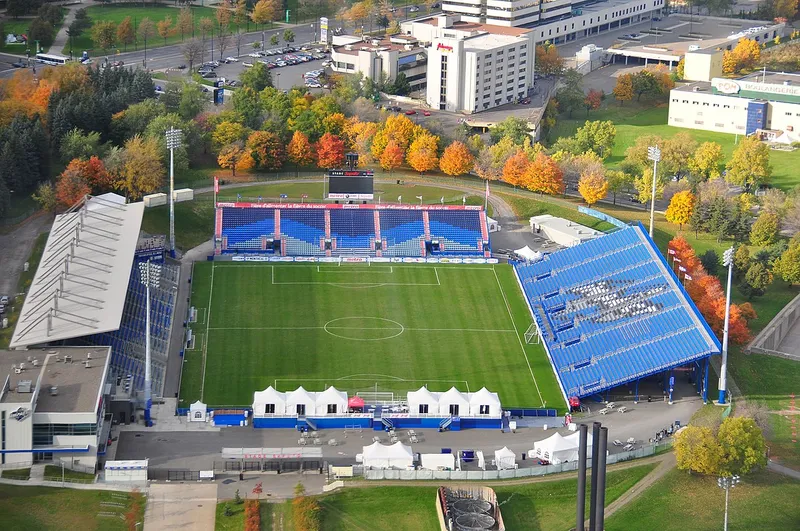
About Saputo Stadium
Within Montreal’s Olympic Park, on the exact ground where athletes warmed up during the 1976 Summer Olympics, sits the only MLS venue built directly on a Summer Olympics footprint. With 19,619 seats, Saputo Stadium is the second-largest soccer-specific stadium in Canada, and the leaning tower of Olympic Stadium rises behind its east end, a constant reminder of the site’s heritage.
CF Montreal, rebranded from the Montreal Impact in 2021, has called this place home since 2008. The club entered MLS in 2012, and the stadium was expanded from 13,034 seats to its current capacity for that debut season. On match days, the surrounding Olympic Park precinct comes alive: the Biodome, Botanical Garden, and Planetarium are all within walking distance, making this one of the most destination-rich stadium visits in MLS.
The stadium is one of the few MLS venues with a natural grass pitch, a deliberate choice that has earned praise from players and coaches. Canada’s national team has hosted qualifiers here, and players have publicly preferred the grass surface over BMO Field’s former artificial turf. The design by Zinno Zappitelli Architectes (Phase 1) and Provencher_Roy (Phase 2 expansion) is functional and intimate, with a partial canopy covering roughly 30% of seats.
The Saputo family, of Saputo Inc., one of the world’s largest dairy companies, contributed $7.5 million of the original $17 million construction cost. The Quebec government later provided $23 million for the 2012 expansion, bringing the total investment to approximately $40 million CAD. It’s a modest budget by MLS standards, but the result is a compact, atmospheric ground that gets loud when full.
Getting to Saputo Stadium
Public Transit
The STM metro’s Green Line is your best bet. Viau station is closest, but you’ll want to connect to a bus for the final stretch.
→ From downtown Montreal: Take the Green Line east to Viau station. Transfer to Bus Route 136, which runs every ~20 minutes and drops you at the “Viau / Stade Saputo” stop, a 4-minute walk to the gates. Total trip about 25 minutes.
→ Alternative walk: Pie-IX metro station is also on the Green Line. From either Viau or Pie-IX, the stadium is about a 20-25 minute walk along Sherbrooke Est.
Driving + Parking
GPS address: 4750 Rue Sherbrooke Est, Montreal, QC H1V 3S8.
→ From Quebec City (251 km): Autoroute 20 West to Montreal, then Autoroute 25 South toward Hochelaga-Maisonneuve. Follow Sherbrooke Est to the stadium. About 2 hours 40 minutes.
→ From Ottawa (198 km): Autoroute 417 East / Highway 40 into Montreal. Exit at Pie-IX Boulevard South, then left on Sherbrooke Est. About 2 hours.
Olympic Park parking lots P1 through P4 serve the stadium on match days. Advance online booking costs about $25 CAD; on-site is about $30. The lot entrance is on Rue Viau. Lots are about a 15-minute walk from the stadium, factor that into your arrival time.
Rideshare
Uber operates throughout Montreal. Drop-off at the stadium entrance on Sherbrooke Est. From downtown, expect about $12-18 CAD; from YUL airport, $35-50 CAD. Post-match surge pricing is common, wait 15 minutes or walk to a quieter pickup spot.
From the Airport
→ Montréal-Trudeau International Airport (YUL): 25 km west, about 28 minutes by car. Take the STM 747 Express bus to downtown ($11 CAD), then Green Line metro to Viau. Total transit time about 46 minutes.
Construction & Design
Saputo Stadium was built on the footprint of a 1976 Olympic outdoor practice track within Montreal’s Olympic Park, a choice that let the project reuse publicly controlled, already-serviced land beside existing metro and road infrastructure. The Montreal firm Zinno Zappitelli Architectes designed the original venue and Broccolini Construction built it after groundbreaking on April 18, 2007. The first phase was a compact 13,034-seat single bowl, delivered for roughly CAD$17 million, of which the Saputo family donated $7.5 million outright and the balance of about $9.5 million was financed over a 25-year term. It opened in 2008 while the Impact were still a second-tier club, an aspirational soccer-specific home built years before any MLS franchise was secured.
When Montreal won its MLS bid, the club expanded the ground rather than relocate. Provencher_Roy led the 2011-2012 redesign, with Broccolini again as general contractor, and the Quebec government invested approximately CAD$23 million, converting a privately built stadium into a mixed public-private asset. The work nearly lifted capacity from 13,034 to 19,619 seats and added a roof canopy over roughly one-third of the seating, with CF Montréal counting 6,948 seats under cover. The open corners and uncovered sections were kept deliberately, preserving the venue’s airy character and the sightline east toward the Olympic Stadium’s inclined tower. The enlarged stadium hosted its first MLS match on June 16, 2012, a 4-1 win over the Seattle Sounders.
The result is a modernist bowl that keeps spectators close to the pitch on one of the few natural grass surfaces in MLS. That grass is a deliberate choice, praised by players and by Canada’s national team, which has used it for international fixtures rather than an artificial pitch. It also shapes the club’s calendar: Montreal’s cold spring leaves the pitch dormant into April, so CF Montréal has historically opened some seasons across the plaza at the domed Olympic Stadium before moving outdoors to Saputo once the weather warms. With 19,619 seats, Saputo Stadium is the second-largest soccer-specific stadium in Canada, behind Toronto’s BMO Field.
History of Saputo Stadium
Saputo Stadium rose from the ashes of Montreal’s complicated soccer history. The city had supported professional soccer since the 1970s, including the NASL’s Montreal Manic, but never had a dedicated soccer ground. The Impact, founded in 1992, spent years playing at Claude-Robillard Sports Complex and briefly at Olympic Stadium before the Saputo family’s philanthropic vision changed everything.
Groundbreaking came on April 18, 2007. Zinno Zappitelli Architectes designed the initial 13,034-seat Phase 1, which Broccolini Construction built for $17 million, including $7.5 million donated directly by the Saputo family. The stadium opened May 19, 2008, with a 0-0 draw against Vancouver in the USL First Division.
Key moments in the stadium’s history:
- May 19, 2008: Inaugural match, Impact 0-0 Vancouver Whitecaps (USL First Division).
- 2008: In the stadium’s first season, the Impact win the inaugural Canadian Championship (clinched away at Toronto), qualifying for the CONCACAF Champions League.
- June 16, 2012: First MLS match at the expanded stadium, Impact 4-1 Seattle Sounders FC.
- 2013-2014: Back-to-back Canadian Championship titles for the Impact.
- April 2015: The Impact reach the CONCACAF Champions League Final, the first Canadian club to do so, losing 3-5 on aggregate to Club América. The home leg drew a record 61,004 at the neighboring Olympic Stadium, too big a night for Saputo.
- September 2021: CF Montreal wins a 5th Canadian Championship.
- June 5, 2026: Canada’s men’s national team drew the Republic of Ireland 1-1 before 19,616 here, their final send-off friendly before FIFA World Cup 2026.
The stadium’s location within Olympic Park connects it to a lineage of world-class sport. The observation tower of the 1976 Olympic Stadium looms just east, and the precinct’s “Space for Life” museums, Biodome, Insectarium, Planetarium, and Botanical Garden, make the area one of Montreal’s most visited destinations. For CF Montreal, having a purpose-built home on this ground is both a statement of ambition and a reminder that great sport has always lived here.
Sources & Further Reading
- Wikipedia entry on Saputo Stadium: en.wikipedia.org/wiki/Saputo_Stadium. Capacity history, architects, groundbreaking, opening, and the expansion.
- CF Montréal, Saputo Stadium: cfmontreal.com. The club’s account of the build cost, the Saputo family donation, and the Quebec-government expansion.
- Provencher_Roy, Stade Saputo project: provencherroy.ca. The architecture firm’s account of the 2012 expansion.
- Building magazine, Introducing the Saputo Stadium: building.ca. The original design-and-build team.
Quick Facts
Everything you need at a glance.
Stadium specs
- Capacity
- 19,619
- Opened
- 2008
- Cost
- Around CAD$17 million (2008), incl. a $7.5M Saputo family donation; ~CAD$23 million 2011-2012 expansion funded by the Quebec government
- Roof
- Open
- Surface
- Natural Grass
- Tenants
- CF Montreal (MLS)
Construction & location
- Groundbreaking
- April 18, 2007 (opened May 2008)
- Architects
- Zinno Zappitelli Architectes (2008), Provencher_Roy (2011-2012 expansion)
- Engineering
- Not separately recorded
- General contractor
- Broccolini Construction
- Address
- Saputo Stadium, 4750 Rue Sherbrooke Est, Montreal, QC H1V 3S8
- GPS
- 45.5623°N, 73.5530°W
Photo Gallery
Fun Facts
Saputo Stadium is built on the former outdoor practice track from the 1976 Montreal Summer Olympics, the only MLS stadium constructed directly on a Summer Olympics footprint.
The Saputo dairy family contributed $7.5 million of the original $17 million construction cost, making it the only MLS venue named after a private family's philanthropic donation.
CF Montreal's natural grass surface was a deliberate choice, Canada Men's National Team players have publicly preferred it over BMO Field's former artificial turf for international matches.
Stadium Location
Frequently Asked Questions
- Where is Saputo Stadium located?
- At 4750 Rue Sherbrooke Est in Montreal's Mercier-Hochelaga-Maisonneuve borough, within the Olympic Park complex. It sits on the former 1976 Olympic outdoor practice track.
- What team plays at Saputo Stadium?
- CF Montreal (formerly the Montreal Impact) plays their MLS home matches here. The club has competed in Major League Soccer since 2012.
- What is the capacity of Saputo Stadium?
- 19,619 seats. Originally built in 2008 with 13,034 seats, the stadium was expanded to its current size for the 2012 MLS season.
- How do I get to Saputo Stadium by transit?
- Take the STM Green Line to Viau station, then board Bus Route 136 for an 8-minute ride to the Stade Saputo stop (4-minute walk to gates). Pie-IX metro station is also walkable.
- Is there parking at Saputo Stadium?
- Yes. Olympic Park lots P1-P4 serve CF Montreal match days. Advance online parking costs about $25 CAD; on-site game day parking is about $30. The entrance is on Rue Viau.
- When did Saputo Stadium open?
- May 19, 2008, with an inaugural USL First Division match between the Montreal Impact and Vancouver Whitecaps (0-0 draw). The 2012 expansion upgraded it for MLS entry.
- Does Saputo Stadium have a roof?
- Saputo Stadium is primarily open-air. A partial canopy covers approximately 30% of the seating area. Open corners maximize airflow and natural light.
- What surface does Saputo Stadium use?
- Natural grass. This was a deliberate design choice, Canada's national team players have publicly preferred it for international matches over stadiums with artificial turf.
Last updated: 2026-07-04