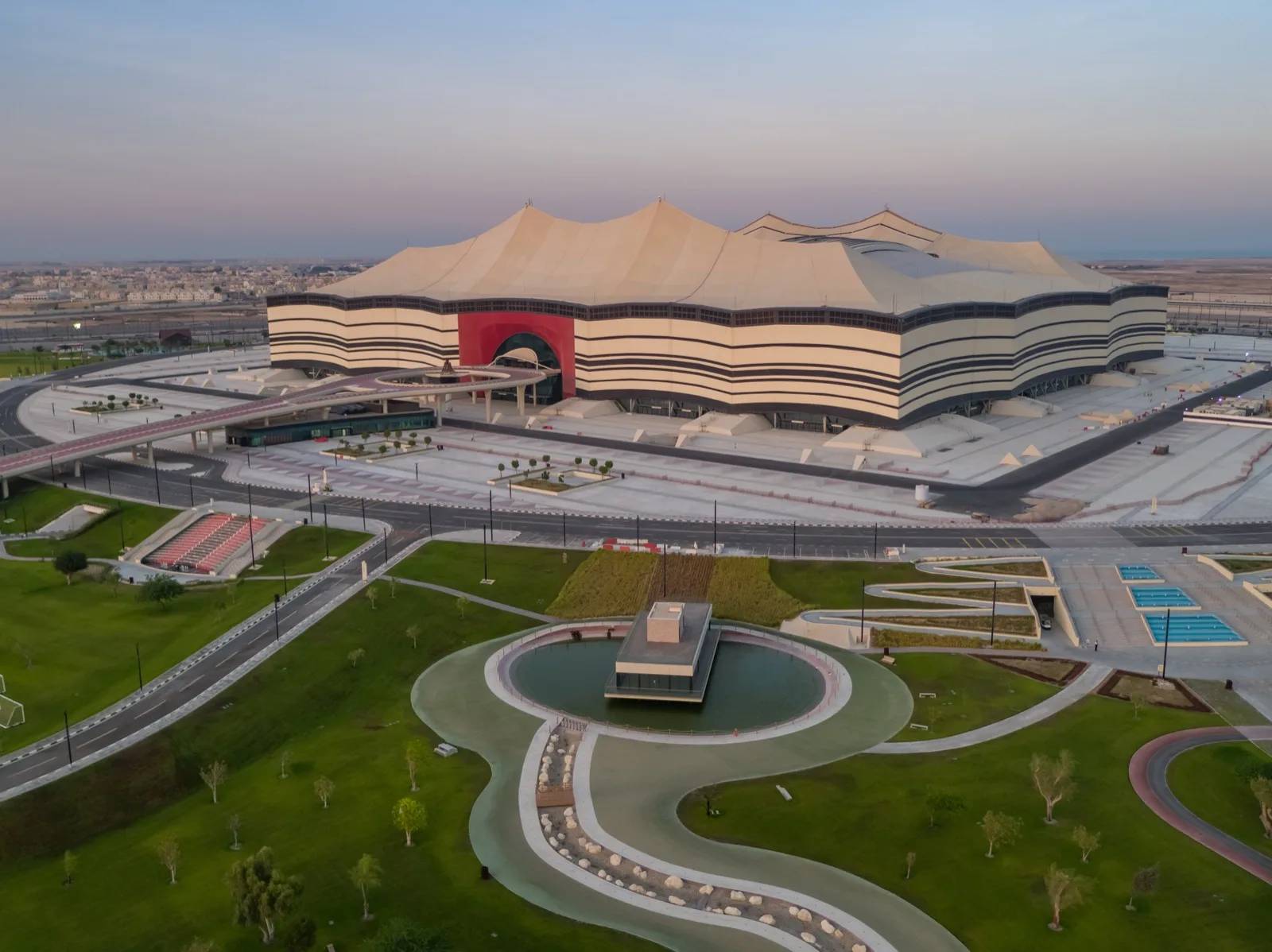
About Al Bayt Stadium
On the evening of November 20, 2022, the World Cup opened inside what looks like a giant tent pitched in the desert north of Doha. That tent is Al Bayt Stadium, and the night did not go to plan for the hosts: Ecuador won 2-0, the first time a host nation had ever lost a World Cup opener. The building, though, made its point instantly. From a distance it reads as a single enormous bayt al sha’ar, the black-and-white woven tent that Gulf nomads have used for centuries, scaled up to hold nearly 69,000 people.
Al Bayt sits in Al Khor, a coastal city about 35 kilometres (22 miles) north of central Doha. That distance matters. Of all the Qatar 2022 venues, this was the hardest to reach, parked well beyond the end of the metro line, and getting a full house in and out of the desert took a small army of buses and a lot of parking. It was worth the trouble. Al Bayt was the second-biggest stadium of the tournament after Lusail, and it drew the marquee fixtures to match.
The stadium was designed by Dar Al-Handasah, the Lebanon-based practice, with Schlaich Bergermann Partner engineering the retractable roof, and built by a joint venture led by Italy’s Webuild. The tent is not just a silhouette. Its skin wraps the whole structure, and the interior carries the red sadu weaving that lines a real Gulf tent, so the reference holds up close as well as from the highway. A retractable membrane can close over the pitch, and an advanced cooling system kept the air manageable through the Gulf autumn.
What happens next is the interesting part. Rather than leave 69,000 seats to rot in a small city, Qatar planned to take the upper tier apart and rebuild that volume into a five-star hotel, a shopping mall, and a health clinic. The capacity drops toward 32,000. The tent in the desert is slowly becoming a resort with a football pitch at its heart.
Getting to Al Bayt Stadium
Public Transit
Here is the catch with Al Bayt: the Doha Metro does not reach it. Al Khor is too far north, so the train is only ever part of the journey.
→ From central Doha: On match days, Stadium Express buses ran from several points around the city straight to the stadium precinct, a trip of around 45 minutes. From the drop-off it is a walk of roughly 15 minutes to the gates.
→ By metro and shuttle: The nearest station is Lusail QNB, the northern terminus of the Red Line, about 30 km south of Al Khor. A connecting shuttle bus covered the rest on event days, though driving was usually simpler.
For a normal Al-Khor SC fixture, none of this circus applies. The crowds are small and you simply drive.
Driving + Parking
Al Khor is reached from Doha along the Al Khor Coastal Road, a straight run up the coast. Unlike the city-center venues, here driving is the sensible default.
→ From central Doha (~35 km): Head north on the Al Khor Coastal Road, about 35-45 minutes outside peak traffic.
→ From Lusail (~20 km): Continue north past Lusail on the same coastal road, roughly 25 minutes.
This is the one Qatar 2022 stadium built for cars. The lots hold around 6,000 vehicles and 350 buses, and on a sold-out night the walk from the far park-and-ride to the gates can run about 25 minutes. Leave a little early, or linger after the whistle, and the exit is far less painful than the metro crush at the city venues.
Rideshare
Uber and the Gulf’s Careem both serve Al Khor, alongside the metered Karwa taxis, but the distance from Doha makes a one-way fare add up. After a big match, expect a wait and surge pricing as tens of thousands try to leave a small city at once.
Pro tip: If you are heading back to Doha, a pre-booked car or the Stadium Express bus beats hailing a ride from the gates, where supply dries up fast.
From the Airport
→ Hamad International Airport (DOH): About 50-55 km south, roughly 45-55 minutes by car. There is no direct transit, so a taxi, rideshare, or hired car is the way in from the airport.
→ Via Doha: Many visitors based in the city travelled out to Al Khor only on match days, treating Al Bayt as a day trip rather than somewhere to stay.
The 2022 World Cup at Al Bayt Stadium
Al Bayt drew the big occasions. It hosted nine matches, including the opener and a semi-final, more weight per fixture than almost any other venue.
The opener: On November 20, 2022, the tournament began here with Qatar against Ecuador. Enner Valencia scored twice, the hosts lost 2-0, and history was made for the wrong reason: no host nation had ever lost a World Cup opening match. The crowd of 67,372 filed out early.
The semi-final: On December 14, France beat Morocco 2-0 to reach the final, ending the most remarkable run of the tournament. Morocco had become the first African and first Arab nation to reach a World Cup semi-final, and they did it in front of a region that had adopted them. The noise inside Al Bayt that night was something else.
The crowds: The stadium’s official record, 68,895, was set twice, for Spain against Germany in the group stage and again for England against France in the quarter-final. For a tent in the desert, it filled up like a cathedral.
Construction & Design
The brief for Al Bayt was unusual: build a 69,000-seat stadium in a small coastal city, make it unmistakably Qatari, and design it so most of it can come apart afterward. Dar Al-Handasah answered with the most literal of the Qatar 2022 concepts. The whole building is a tent. Not a stadium with a tent-like roof, but a structure wrapped, inside and out, to read as the bayt al sha’ar that Gulf nomads have lived in for generations.
The skin is a PTFE woven fiberglass membrane in the traditional black, white, and red, and a section of the roof retracts to open the pitch to the sky. Schlaich Bergermann Partner engineered that roof, the same firm behind several of the tournament’s stadiums. Inside, the upper concourse carries the red sadu weaving that lines a real tent, a detail most architects would have skipped. It is what makes the reference land rather than feel like a logo.
Keeping the air comfortable under a closed roof in the Gulf took serious cooling, and the stadium’s system, paired with the insulating tent skin, earned it a five-star rating under Qatar’s Global Sustainability Assessment System. The figure that tells the real story, though, is the parking: space for 6,000 cars and 350 buses, a reminder that this venue had to move a full house through open desert rather than off a metro platform.
The build ran from a 2015 contract award to completion in 2021, delivered by a joint venture of Webuild, Galfar Al Misnad, and Cimolai for a construction contract worth around €770 million. Every part of the upper bowl was planned for disassembly, so the same stands that held a World Cup semi-final could later become hotel rooms and shopfronts.
History of Al Bayt Stadium
Al Bayt did not exist before Qatar’s World Cup bid. It was conceived as the northern anchor of the tournament, the venue that would carry the opening ceremony and the host nation’s first match, set deliberately apart from the cluster of stadiums around Doha.
- Contract awarded (2015): The construction contract went to a joint venture of Webuild, Galfar Al Misnad, and Cimolai, and work began on the raw site in Al Khor.
- Completion (2021): The stadium was finished, with its tent membrane and retractable roof in place, the second of Qatar’s purpose-built venues to be ready.
- Official opening (November 30, 2021): Al Bayt staged the opening match of the FIFA Arab Cup, where Qatar beat Bahrain 1-0, a full dress rehearsal a year out from the main event.
- World Cup opener (November 20, 2022): The tournament began here with Ecuador beating Qatar 2-0, the first host-nation defeat in a World Cup opening match.
- World Cup semi-final (December 14, 2022): France beat Morocco 2-0 to reach the final, ending Morocco’s historic run as the first African and Arab semi-finalists.
Since the tournament, Al Bayt has hosted the 2023 AFC Asian Cup and continues to stage Qatar national team matches and Al-Khor SC fixtures, while the slow conversion of its upper tier into a hotel and mall turns the desert tent into something a small city can use all year.
Sources & Further Reading
- Dar Al-Handasah project page: dar.com. The lead designer’s account of the tent concept and the stadium.
- Wikipedia entry on Al Bayt Stadium: en.wikipedia.org/wiki/Al_Bayt_Stadium. Capacity, contractors, the opener, and the legacy conversion.
- Visit Qatar stadium guide: visitqatar.com. Visitor information, design background, and legacy plans.
- Doha Metro and event-day transport (Qatar Rail): qr.com.qa. Red Line service to Lusail QNB and connecting shuttle details.
Quick Facts
Everything you need at a glance.
Stadium specs
- Capacity
- 68,895
- Opened
- 2021
- Cost
- construction contract around €770 million
- Roof
- Retractable (PTFE membrane)
- Surface
- Natural Grass
- Tenants
- Al-Khor SC, Qatar National Team (selected matches)
Construction & location
- Groundbreaking
- 2015 (construction contract awarded)
- Architects
- Dar Al-Handasah (lead design), KEO International Consultants
- Engineering
- Schlaich Bergermann Partner (roof)
- General contractor
- Webuild / Galfar Al Misnad / Cimolai joint venture
- Address
- Al Bayt Stadium, Al Khor City, Al Khor, Qatar
- GPS
- 25.6522°N, 51.4878°E
Photo Gallery
Fun Facts
Al Bayt is shaped like a bayt al sha'ar, the black-and-white woven tent that nomadic peoples of the Gulf have used for centuries, and the giant tent skin wraps the entire stadium rather than just the roof.
On November 20, 2022, Al Bayt staged the tournament opener, where Ecuador beat the hosts 2-0 in front of 67,372 fans, the first time a host nation had ever lost the opening match of a World Cup.
The upper tier is being taken apart and rebuilt into a five-star hotel, a shopping mall, and a health clinic, cutting the stadium from about 68,000 seats toward 32,000 for its second life.
Stadium Location
Frequently Asked Questions
- What is the seating capacity of Al Bayt Stadium?
- Al Bayt held about 68,895 for the 2022 World Cup, making it the second-largest tournament venue after Lusail. In legacy mode the capacity is being cut to roughly 32,000 as the upper tier is removed and rebuilt into a hotel, mall, and clinic.
- Where is Al Bayt Stadium located?
- Al Bayt is in Al Khor, a coastal city about 35 km (22 mi) north of central Doha, Qatar. It sits well beyond the Doha Metro network, which is why getting there relies on Stadium Express buses, park-and-ride lots, or driving.
- Why is it called Al Bayt Stadium?
- Al Bayt means the house in Arabic. The name and the design both reference the bayt al sha'ar, the black-and-white woven tent that nomadic peoples of Qatar and the Gulf have lived in for centuries. The giant tent skin wraps the whole stadium.
- What 2022 World Cup matches did Al Bayt Stadium host?
- Al Bayt hosted nine matches: the opening game, five more group matches, a Round of 16, a quarter-final, and a semi-final. The opener on November 20, 2022 saw Ecuador beat Qatar 2-0, and the semi-final on December 14 saw France beat Morocco 2-0.
- Did Al Bayt Stadium host the World Cup opening match?
- Yes. The 2022 tournament opened at Al Bayt on November 20, 2022, with Ecuador beating the hosts Qatar 2-0. Enner Valencia scored both goals. It was the first time a host nation had lost the opening match of a World Cup.
- How do I get to Al Bayt Stadium?
- There is no metro to Al Khor. Most fans either drove to the large park-and-ride lots or caught a Stadium Express bus from Doha, then walked about 15 minutes to the gates. The nearest rail, Lusail QNB on the Red Line, is still around 30 km south.
- Is there parking at Al Bayt Stadium?
- Yes, and unusually for a Qatar 2022 venue, driving is the practical choice here. The stadium has large lots with space for roughly 6,000 cars and 350 buses, with a walk of about 25 minutes from the outer park-and-ride to the gates on busy days.
- Who designed and built Al Bayt Stadium?
- Al Bayt was designed by the Lebanon-based firm Dar Al-Handasah, with Schlaich Bergermann Partner engineering the retractable roof. It was built by a joint venture of Italy's Webuild, Qatar's Galfar Al Misnad, and Cimolai, under a construction contract worth around €770 million.
- Does Al Bayt Stadium have a retractable roof?
- Yes. A retractable PTFE membrane roof can close over the pitch, and the whole stadium is sheltered under the tent structure. Together with an advanced cooling system, that let organizers control the climate inside through the Gulf autumn.
- How far is Al Bayt Stadium from Doha and the airport?
- Al Bayt is about 35 km (22 mi) north of central Doha, roughly 35-45 minutes by car outside peak traffic. From Hamad International Airport, south of the city, it is closer to 50-55 km, or about 45-55 minutes by road.
- When was Al Bayt Stadium built?
- The construction contract was awarded in 2015, and the stadium was completed in 2021. It opened on November 30, 2021 with the inaugural match of the FIFA Arab Cup, in which Qatar beat Bahrain 1-0, almost exactly a year before the World Cup.
- What is happening to Al Bayt Stadium after the World Cup?
- The upper tier is being dismantled and rebuilt into a five-star hotel, a shopping mall, a health clinic, and more sports facilities, cutting capacity from about 68,000 toward 32,000. The removed seats were earmarked for donation to developing nations.
- How sustainable is Al Bayt Stadium?
- Al Bayt earned a five-star rating under Qatar's Global Sustainability Assessment System. The tent skin and retractable roof help manage heat and cut cooling demand, and the legacy plan reuses the upper structure rather than demolishing it.
- What is the red pattern inside Al Bayt Stadium?
- The interior reproduces the sadu, the traditional red-and-black geometric weaving of Gulf tent linings. So the stadium reads as a tent from the outside and from within, with the patterned decoration that would line a real bayt al sha'ar.
- What events has Al Bayt Stadium hosted besides the World Cup?
- Al Bayt opened the 2021 FIFA Arab Cup, hosted matches at the 2023 AFC Asian Cup held in early 2024, and continues to stage Qatar national team games and big occasions. Al-Khor SC also uses the venue.
Last updated: 2026-07-10