About Michigan Stadium
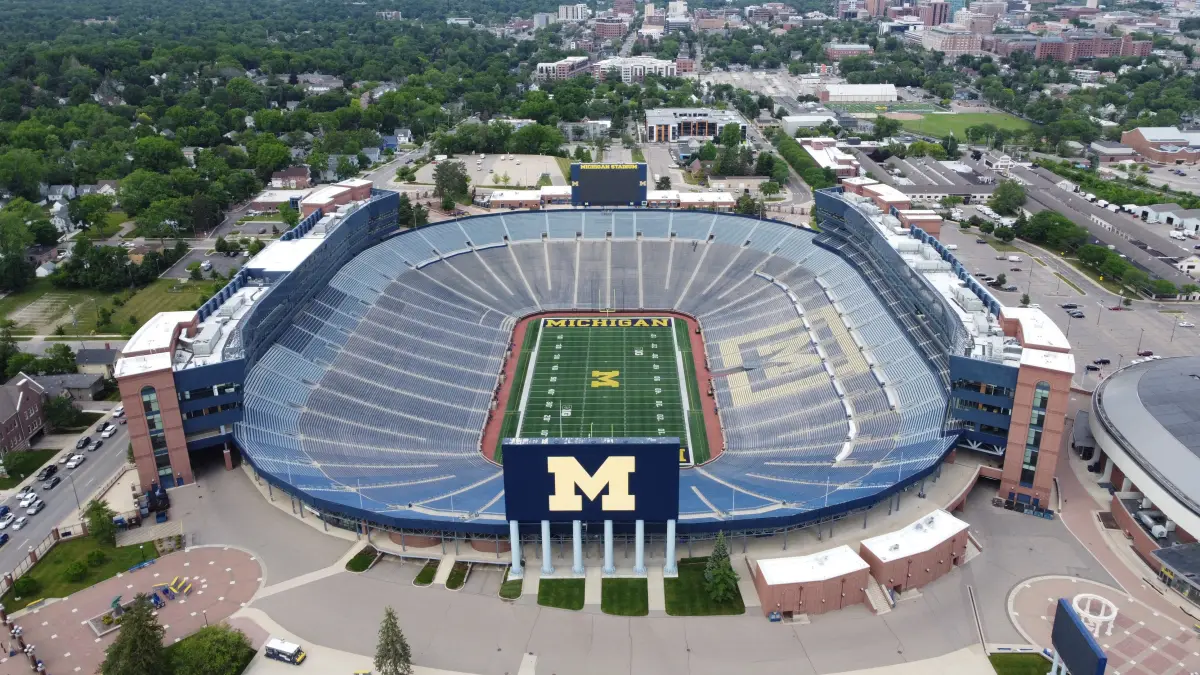
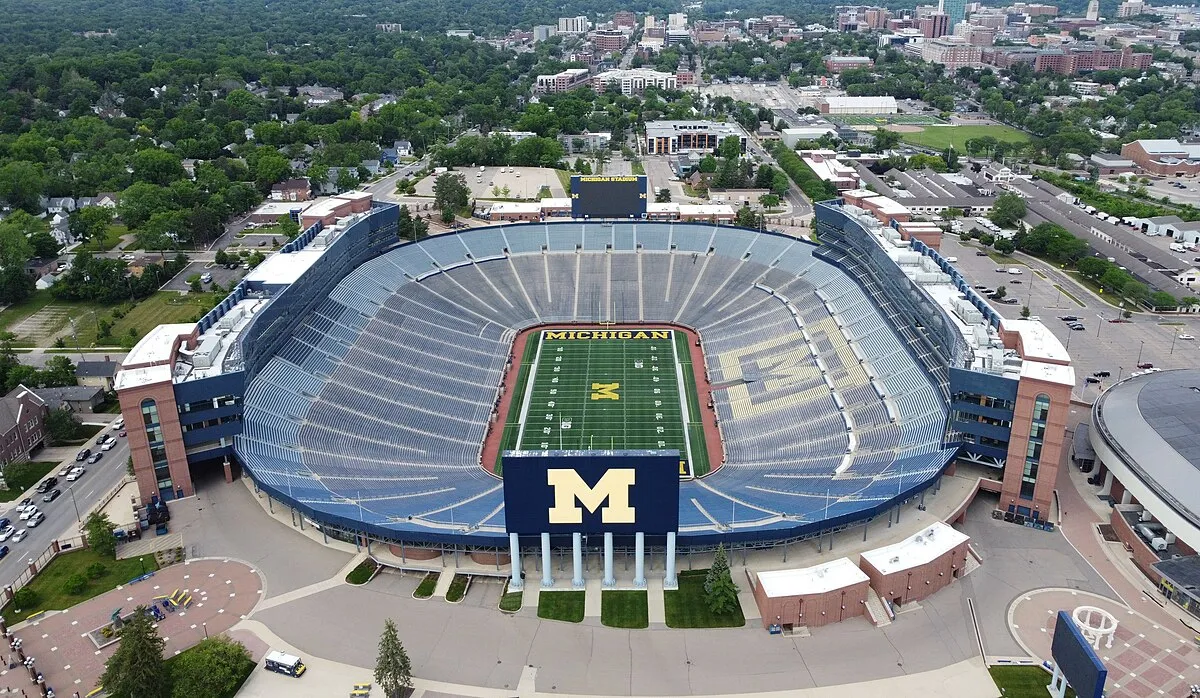
Michigan Stadium has a seating capacity of 107,601, making it the largest stadium in the United States, the largest in the Western Hemisphere, and the third-largest in the world. It sits on the University of Michigan campus in Ann Arbor, about 42 miles (68 km) west of Detroit. They call it The Big House, and on a fall Saturday when every seat is full, the name doesn’t feel like an exaggeration.
Home to the Michigan Wolverines since 1927, the stadium has hosted over 300 consecutive games with attendance above 100,000, a streak that dates back to November 1975 and shows no sign of ending. The atmosphere on a rivalry Saturday against Ohio State or Michigan State is among the loudest, most intense experiences in all of American sports.
Michigan Stadium has hosted far more than football. The 2014 NHL Winter Classic drew 105,491 fans for a Red Wings game against Toronto. A 2014 soccer match between Manchester United and Real Madrid set the U.S. attendance record at 109,318. And in September 2025, Zach Bryan’s concert drew 112,408, the largest ticketed concert in American history.
Getting to Michigan Stadium
Public Transit
Ann Arbor’s TheRide transit system operates a FootballRide shuttle on game days, with five routes running from hotels and park-and-ride lots across the city directly to Gate 2 near Crisler Center. It’s $1.50 each way (exact cash required).
→ From Downtown Ann Arbor: The Downtown Shuttle stops at the Michigan Union, Graduate Ann Arbor Hotel, and several parking structures. Shuttles run every 20 minutes starting 2 hours before kickoff.
→ From the North Side: The North Shuttle departs from the DoubleTree by Hilton and the Plymouth Road Park & Ride lot.
Amtrak’s Wolverine line serves the Ann Arbor station about 1.5 miles from the stadium, connecting Chicago, Kalamazoo, Jackson, and Detroit. It’s a viable option for day-trippers from Detroit (about 45 minutes by train).
Driving + Parking
Michigan Stadium is accessible from I-94 and US-23. GPS users should enter “1201 S Main Street, Ann Arbor, MI 48104.” Arrive early, because 107,000 fans emptying into a college town creates serious congestion.
→ From Detroit (~42 mi): Take I-94 West to Exit 172 (Ann Arbor-Saline Road), head north, then right onto W Stadium Blvd directly to the stadium.
→ From Toledo (~51 mi): Take US-23 North to I-94 West, then Exit 177 for State Street south into the campus area.
→ From Lansing (~66 mi): Take I-96 East to US-23 South, then exit onto I-94 East or use the Stadium Blvd exits.
The university operates color-coded lots (Blue, Grey, Green, Red, and others) around the stadium. Season permits run $60 per game. The U-M Golf Course south of the stadium is a major game-day lot. Tailgating is permitted but setups must fit within the assigned space (8’9” x 18’), and all vehicles must leave within 2 hours of the final whistle.
Rideshare
Uber and Lyft drop off and pick up near Gate 2 on Stadium Boulevard by Crisler Center. After games, expect 20-45 minute waits and heavy surge pricing, the inevitable result of 107,000 fans all requesting rides at once.
Pro tip: Walk 10-15 minutes away from the stadium to a quieter side street. You’ll cut your wait time in half and avoid the worst of the surge.
From the Airport
→ Detroit Metropolitan Airport (DTW): 25 miles southeast, 30-40 minutes by car. The closest major airport with full carrier service (Delta hub). No direct transit, so rideshare or car rental is your best bet.
→ Flint Bishop Airport (FNT): 51 miles north, about 55 minutes by car. Limited carrier service (Allegiant, American Eagle) but can offer cheaper flights.
Construction & Design
Fielding Yost picked a difficult piece of land on purpose. The site he chose for his stadium in 1926 was a low-lying 16-acre (6.5-hectare) lot fed by an underground spring, ground so wet it behaved like quicksand. Most athletic directors would have walked away. Yost saw a bowl waiting to be dug.
His engineer, Bernard L. Green of Osborn Engineering, the Cleveland firm behind Yankee Stadium and Comiskey Park, designed the seating bowl to sit almost entirely below grade. Nearly three-quarters of the structure went underground, modeled on the Yale Bowl. That choice solved two problems at once: it kept the profile low over the surrounding neighborhood, and it let the stands grow upward later without rebuilding the foundation. Yost insisted those footings be poured strong enough to one day carry 150,000 seats. He never got his 150,000. But every expansion since has leaned on concrete he paid for in 1926.
The wet ground fed a legend. The most famous story in Michigan Stadium lore holds that a construction crane sank into the muck and was simply left there, buried somewhere beneath the field to this day. It is a great story. It is also almost certainly a myth, since no construction records, invoices, or news accounts from 1926 mention a lost crane, and the tellers cannot even agree whether it was a crane, a steam shovel, or a bulldozer. The spring was real. The buried machine probably is not.
Groundbreaking was September 12, 1926. Thirteen months and $950,000 later (roughly $13.8 million today), the stadium opened on October 1, 1927, seating 72,000. It was ahead of its time from the start. In 1930 Michigan Stadium became the first in the country to install electronic scoreboards showing official game time.
Then it grew, piece by piece. Wooden bleachers gave way to permanent steel seating in 1949. A new press box in 1956 pushed capacity past six figures to 101,001. Further expansions in 1973, 1992, and 1998 nudged the number higher. The big modern overhaul came in 2007-2010, a $226 million project designed by HNTB and built by Mortenson Construction. It wrapped the bowl in two brick structures holding 83 luxury suites and 3,200 club seats, widened the seats and aisles, added handrails throughout, and finally gave the open-air stadium permanent lights in 2010. The video boards kept pace: 4,000-square-foot screens in 2011, then enormous end-zone boards in 2023 measuring 152 by 55 feet each, among the largest in college football.
The field itself has been restless. Natural grass until 1968, then 3M TartanTurf through 1990, back to grass for the 1990s, and FieldTurf since 2003. The bowl looks timeless. Almost nothing inside it is original.
History of Michigan Stadium
Michigan Stadium opened on October 1, 1927, with a 33-0 win over Ohio Wesleyan before a crowd that nearly filled its original 72,000 seats. Almost a century of milestones has followed.
- Dedication Game (October 22, 1927): Michigan defeated Ohio State 21-0 before 84,401 fans in the stadium’s official dedication.
- Capacity Breaks 100,000 (1956): A new press box and additional seating pushed capacity past the six-figure mark for the first time, reaching 101,001.
- 100,000+ Streak Begins (November 8, 1975): Every home game since this date has drawn over 100,000 fans, a streak surpassing 300 consecutive games and still active.
- $226 Million Renovation (2007-2010): Added 83 luxury suites, 3,200 club seats, a new press box, wider seats, improved accessibility, and handrails throughout the bowl.
- NCAA Attendance Record (September 7, 2013): Michigan vs. Notre Dame drew 115,109 fans, the largest crowd in college football history. Michigan won 41-30.
- NHL Winter Classic (January 1, 2014): Toronto defeated Detroit 3-2 in a shootout before 105,491 fans, the largest hockey crowd ever.
- U.S. Soccer Record (August 2, 2014): Manchester United beat Real Madrid 3-1 in front of 109,318, the largest soccer crowd in American history.
- Largest U.S. Concert (September 27, 2025): Zach Bryan drew 112,408 fans, setting the record for the biggest ticketed concert ever held in the United States.
Sources & Further Reading
- University of Michigan Athletics official site: mgoblue.com. Capacity, gameday information, parking, and facility details.
- University of Michigan Athletics stadium history: mgoblue.com. The 1926-27 construction, Fielding Yost’s vision, and the below-grade bowl design.
- Alumni Association of the University of Michigan: alumni.umich.edu. An investigation into the buried-crane legend and the underground spring beneath the site.
- Wikipedia entry on Michigan Stadium: en.wikipedia.org/wiki/Michigan_Stadium. Construction history, expansions, surface changes, and attendance records.
Quick Facts
Everything you need at a glance.
Stadium specs
- Capacity
- 107,601
- Opened
- 1927
- Cost
- $950,000 (1927); $226 million (2007-2010 renovation)
- Roof
- Open
- Surface
- FieldTurf (Artificial)
- Tenants
- Michigan Wolverines (NCAA)
Construction & location
- Groundbreaking
- September 12, 1926
- Architects
- Bernard L. Green (Osborn Engineering), HNTB (2010 expansion)
- General contractor
- Mortenson Construction (2007-2010 renovation)
- Address
- 1201 South Main Street, Ann Arbor, MI 48104, USA
- GPS
- 42.2658°N, 83.7487°W
Photo Gallery
Fun Facts
Michigan Stadium has hosted over 300 consecutive games with attendance exceeding 100,000, a streak dating back to November 8, 1975.
The 2014 NHL Winter Classic drew 105,491 fans to watch the Maple Leafs and Red Wings, the largest crowd ever to attend a hockey game.
Athletic Director Fielding Yost had the original 1927 foundation poured strong enough to support expansion to 150,000 seats, a vision never fully realized but one every later expansion has leaned on.
Stadium Location
Frequently Asked Questions
- What is the seating capacity of Michigan Stadium?
- Michigan Stadium seats 107,601, making it the largest stadium in the United States and the third-largest in the world. With temporary seating, crowds have exceeded 115,000.
- Why is Michigan Stadium called The Big House?
- The nickname refers to its sheer scale. Michigan Stadium became widely known as The Big House by the mid-1980s, with broadcaster Keith Jackson often credited for popularizing the phrase. When it opened in 1927 it was already the largest college-owned stadium in the country, and as capacity climbed past 100,000 the name stuck.
- Where is Michigan Stadium located?
- Michigan Stadium is at 1201 South Main Street in Ann Arbor, Michigan, on the University of Michigan campus. It sits about 42 miles west of Detroit.
- How do I get to Michigan Stadium without a car?
- Ann Arbor's TheRide transit system runs a FootballRide shuttle on game days for $1.50 each way, with five routes from hotels and park-and-ride lots. Rideshare drops off at Gate 2 near Crisler Center. Amtrak serves the Ann Arbor station about 1.5 miles from the stadium.
- Is there parking at Michigan Stadium?
- Yes. The university operates color-coded lots (Blue, Grey, Green, Red, and others) around the stadium complex. Season permits cost $60 per game. The U-M Golf Course south of the stadium is a major game-day lot. Pre-purchasing is essential, since the neighborhood has very limited street parking.
- When was Michigan Stadium built?
- Michigan Stadium opened on October 1, 1927, when Michigan defeated Ohio Wesleyan 33-0. Ground was broken on September 12, 1926. It was designed by Bernard L. Green of Osborn Engineering and cost $950,000 to build. The original capacity was 72,000.
- How was Michigan Stadium built on an underground spring?
- The site Fielding Yost chose in 1926 was a low-lying 16-acre lot fed by an underground spring, leaving ground that behaved like quicksand. Engineer Bernard L. Green set nearly three-quarters of the seating bowl below ground level, modeled on the Yale Bowl, with foundations strong enough to support future growth to 150,000 seats.
- Is there really a crane buried under Michigan Stadium?
- Almost certainly not. The story that a construction crane sank into the muddy site in 1926 and was left under the field is a beloved piece of Michigan lore, but no construction records, invoices, or news accounts from the period support it, and tellers disagree on whether it was a crane, a steam shovel, or a bulldozer. The underground spring was real. The buried machine is a myth.
- What is the largest crowd in Michigan Stadium history?
- The record is 115,109, set on September 7, 2013, when Michigan beat Notre Dame 41-30 in a night game. It stands as the largest crowd in college football history.
- Is Michigan Stadium grass or turf?
- Artificial turf. The field was natural grass from 1927 to 1968, switched to 3M TartanTurf through 1990, returned to grass for the 1990s, and has used FieldTurf since 2003. The current surface is FieldTurf Duraspine, installed in 2010.
- Does Michigan Stadium have a roof?
- No. Michigan Stadium is fully open-air and has been since 1927. A permanent lighting system was not added until 2010, so for most of its history the stadium hosted day games only.
- Can you bring bags into Michigan Stadium?
- No. Michigan Stadium prohibits all bags, purses, and fanny packs, including clear bags. Exceptions are made only for medical needs and diaper bags. Bag check is available at Crisler Center's south entrance.
- Is Michigan Stadium the biggest stadium in the world?
- It is the third-largest by capacity (107,601), behind Narendra Modi Stadium in India (132,000) and Rungrado Stadium in North Korea (114,000). However, Michigan Stadium regularly hosts the largest actual crowds of any stadium worldwide.
- Is Michigan Stadium hosting any 2026 FIFA World Cup matches?
- No. Michigan Stadium is not a 2026 World Cup venue. The nearest host site is Detroit's metro area, which was not selected; the closest confirmed host stadiums to Ann Arbor are in Toronto and Kansas City. Michigan Stadium did host a record-setting 2014 friendly between Manchester United and Real Madrid that drew 109,318 fans.
Last updated: 2026-07-10