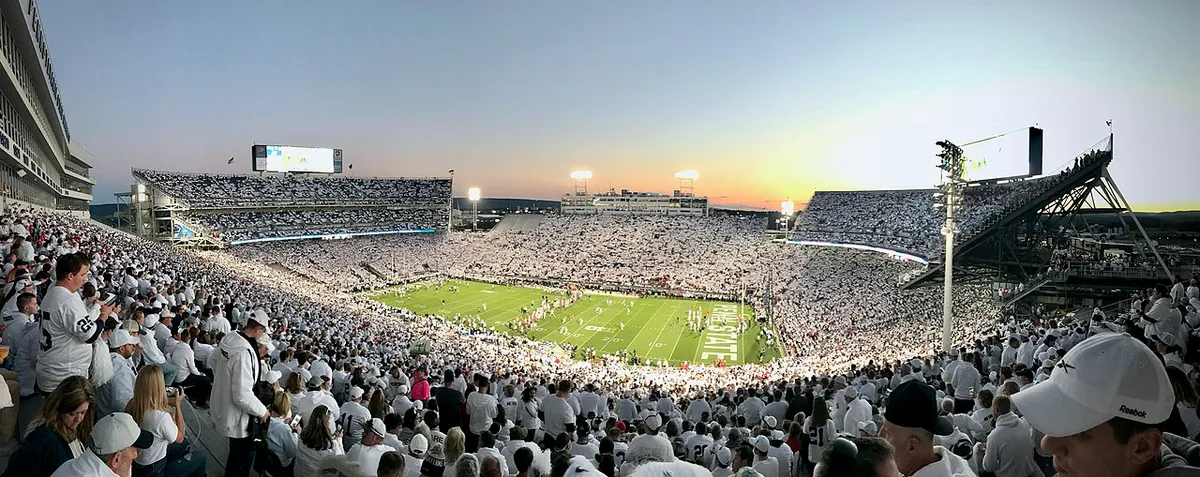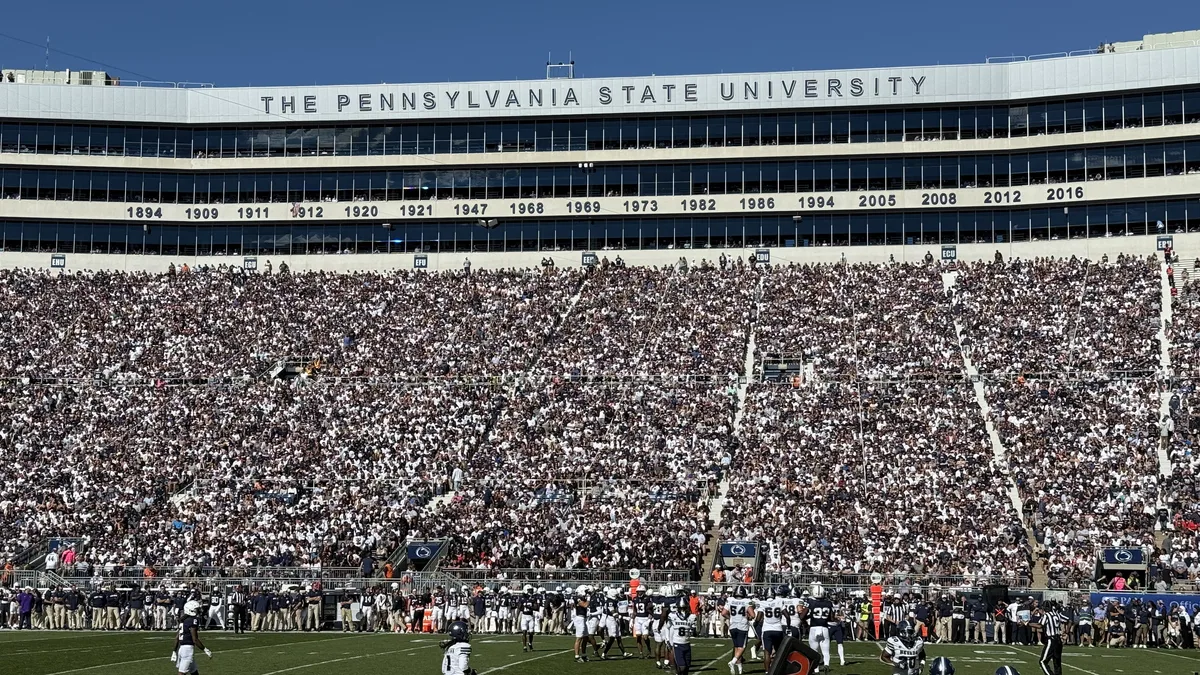
The number goes up on the videoboard in the third quarter, and that’s the first thing worth noticing about it. The crowd has been on its feet since before the band came out. Everyone in white. The temperature doing what central Pennsylvania does to you on an October night once the sun is long gone. Somewhere above all of it, a sports information director has finished a piece of arithmetic. 114,419. The place roars at the size of itself. There’s still a quarter of football to play, and USC is about to win it.
It’s a strange number, and it gets stranger. Penn State’s own 2026 media guide still lists Beaver Stadium at 106,572, the capacity it had before any of the building work started, and the game notes the school published two days after the record repeat the figure. It has never published a revised number for the enlarged stadium. And yet it announced a crowd roughly 8,000 people bigger than the one printed in its own book, in writing, as a record, and nobody blinked. A Penn State student emailed us about it. They were right that it was a record. They were wrong about what the building holds. Both halves are in here.
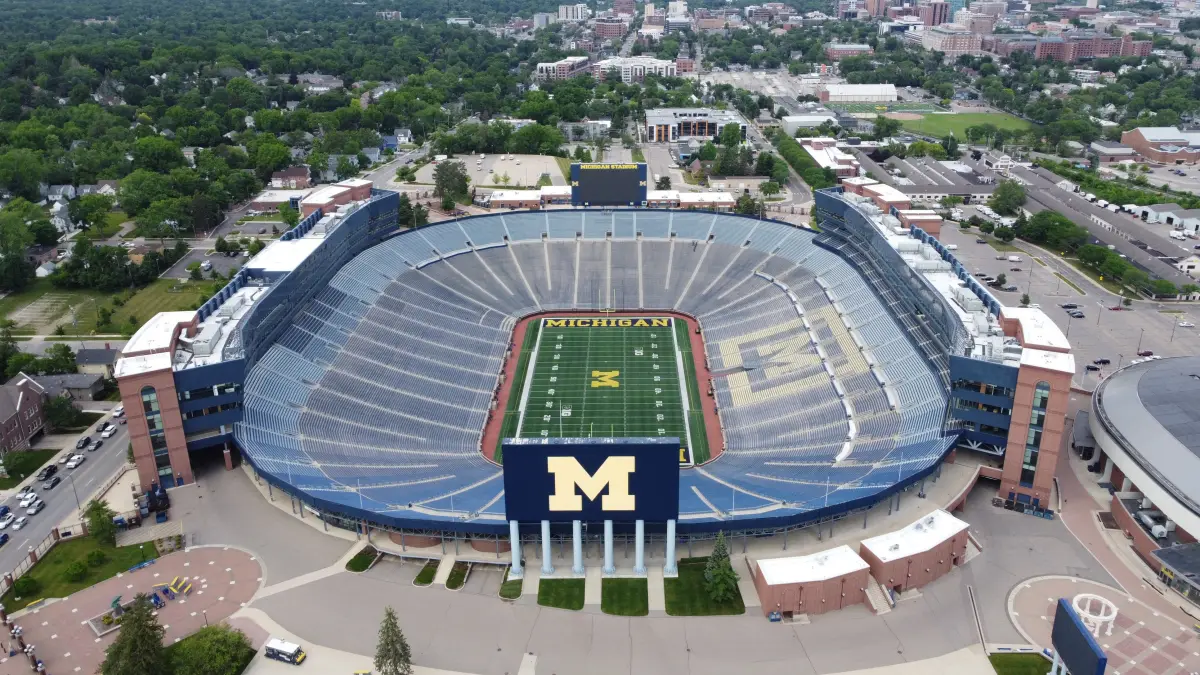
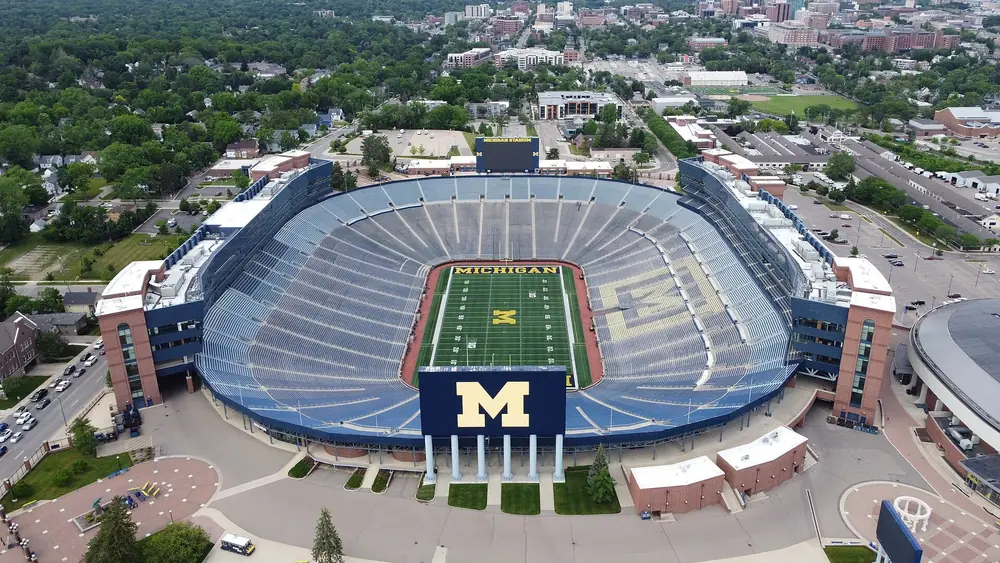
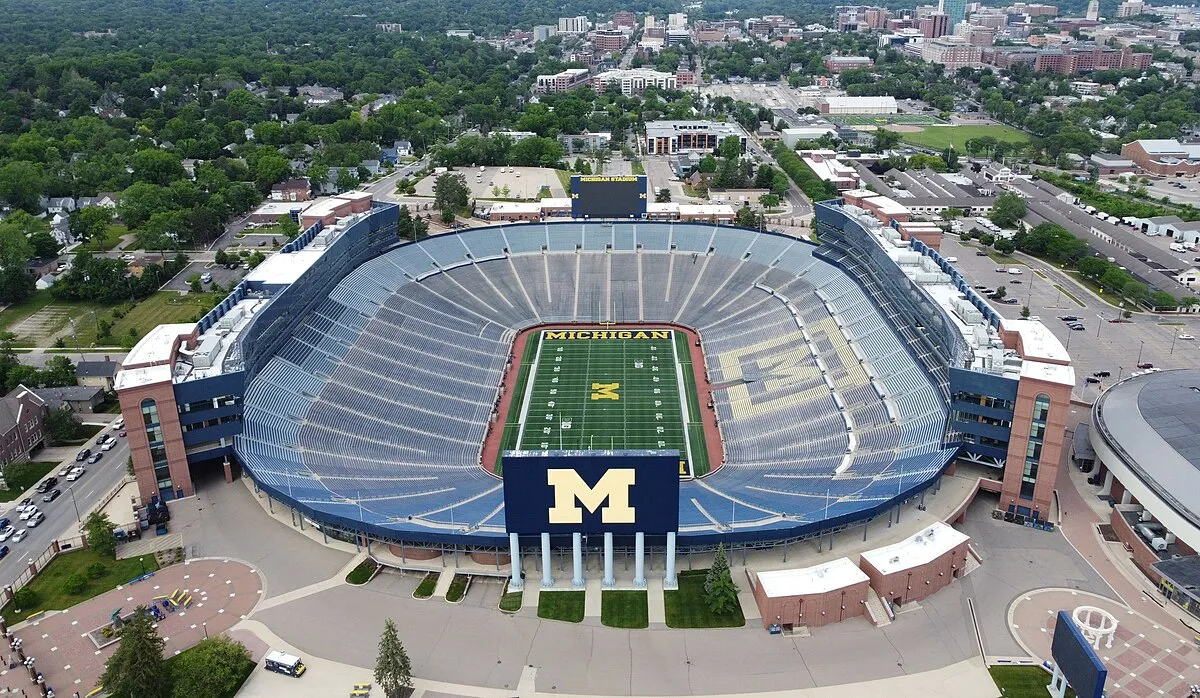
Has Penn State passed Michigan? Not yet, and the reason is better than the question. Here are the four biggest crowds ever announced at a college football regular season game.
| Rank | Crowd | Game | Venue | Date | What the figure is |
|---|---|---|---|---|---|
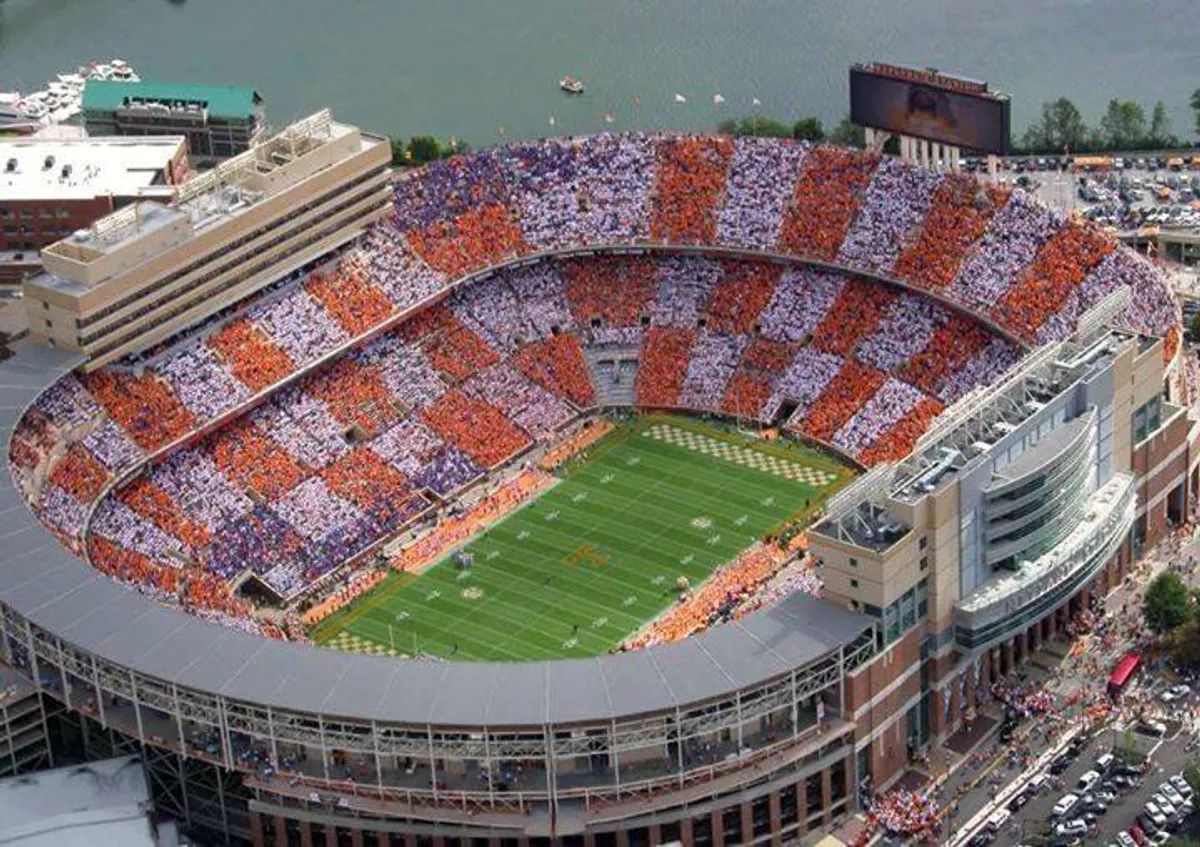
| 1 | 156,990 | Tennessee vs Virginia Tech | Bristol Motor Speedway | Sep 10, 2016 | Announced, at a NASCAR track temporarily converted into a football stadium |
| 2 | 115,109 | Michigan vs Notre Dame | Michigan Stadium | Sep 7, 2013 | Announced |
| 3 | 114,804 | Michigan vs Notre Dame | Michigan Stadium | Sep 10, 2011 | Announced |
| 4 | 114,419 | Penn State vs USC | Beaver Stadium | Oct 10, 2026 | Announced. Press box, suites, bands, ushers and other stadium personnel are inside it |
The right-hand column matters more than the left one. All four are announced numbers. Not one is a count of people who came through a turnstile, and two of the four came from the same athletic department in Ann Arbor. The record at the top belongs to a motor speedway, with Tennessee a long way from Neyland Stadium. Penn State’s own game notes handle the awkwardness by splitting the category: 114,419 is the fourth-largest crowd for any college football regular season game, and the third-highest in a traditional college football stadium, both of which are true. When a record needs two categories to be stated, the category is doing work the number can’t.
A fifth crowd would sit second on that list if anyone had written it down. Notre Dame beat Southern California at Chicago’s Soldier Field in 1927 in front of a crowd “believed” to have been 120,000 to 123,000. Believed. No turnstile total, no announced figure, no record. So the top of that table records the biggest crowd anybody counted, which is a different thing from the biggest crowd that happened. This article lives in that gap.
What Penn State announced, and when
A crowd figure announced in the third quarter is not a count of who came. It can’t be. There’s a quarter left. People are still drifting in from the lots and back out to them. A number finished with that much football still to play was mostly settled before kickoff.
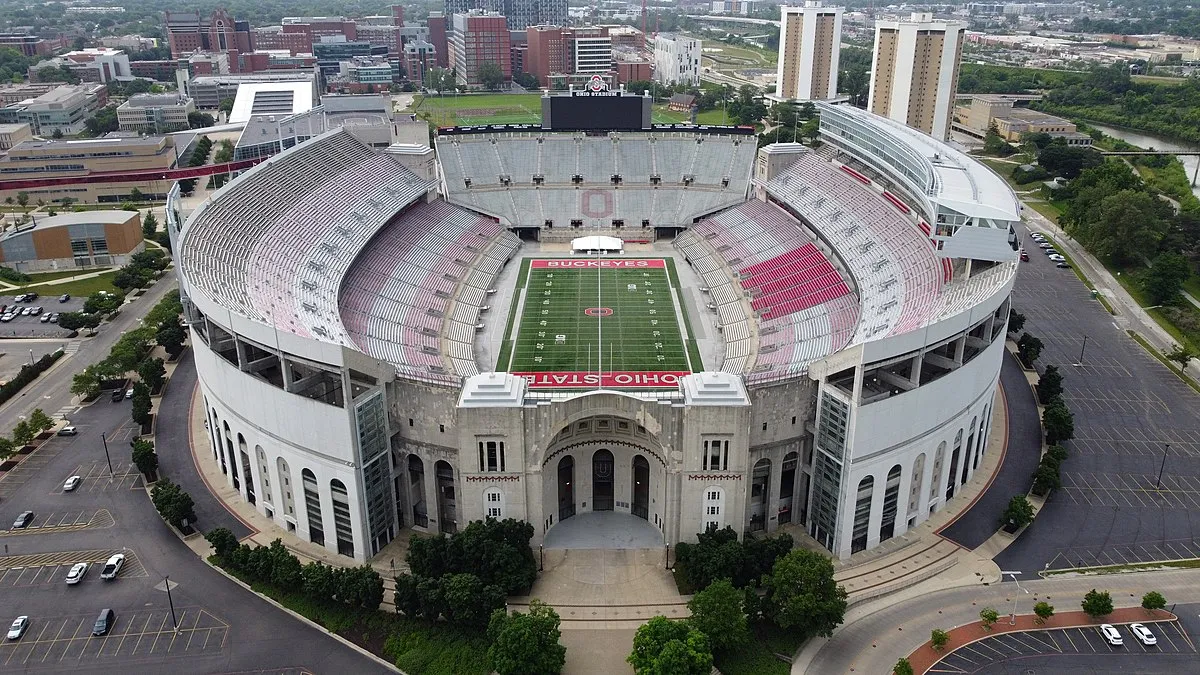
The game was the White Out against USC on October 10, 2026, the tradition that keeps putting Beaver Stadium near the top of any list of the loudest college football stadiums. USC arrived ranked 19th in one poll and 17th in the other and left with a 31 to 23 win, which means the biggest crowd Beaver Stadium has ever announced went home having watched the visitors take the game. Penn State’s game notes say: “Penn State set the all-time Beaver Stadium record with an attendance total of 114,419.” The previous mark was 111,030, set against Ohio State on November 2, 2024. It lasted less than two years. Visitors from Ohio Stadium hold two of the ten biggest crowds Beaver Stadium has ever announced.
7 of 10 How many of Beaver Stadium’s ten biggest crowds came at White Out games. The setting wasn’t the surprise.
The price went the other way. Penn State came in 3-2, 0-2 in the Big Ten, beaten 34-13 at Northwestern the week before, and resale prices for the White Out fell about 60 percent over that week and were down nearly 75 percent from late August. By Saturday morning fewer than 1,000 seats were left on the market, starting at 88 dollars after a 60 dollar floor on the Friday. Sixty dollars, the night before the largest crowd in the building’s history. What the record ran on was distribution: an athletics department spokesperson said Penn State had put out more than 110,000 tickets, itself a single-game program record, and a ticket counts toward the announced figure whether or not anybody ever sits in the seat it names.
So the school put out a record number of tickets and then announced a number bigger than any crowd it had ever announced. That is not sleight of hand and Penn State does not pretend otherwise. It will tell you exactly who the extra people were, in a document you can download.
What the 114,419 is made of
Penn State isn’t hiding how it gets there. It publishes the recipe, in a footnote under the attendance records table in its own media guide: “Beaver Stadium attendance figures include the press box, suites, bands, ushers and other stadium personnel.” That footnote says what gets added. For the base it starts from, Sports Illustrated, reading the same guide, reports the figures begin with tickets sold, and Penn State has separately described them as tickets sold and distributed, which is the NCAA’s second method almost word for word. What Penn State does not do is release actual attendance on a per-game basis. Whatever the gates recorded stays in the building. The announced figure is the only one that leaves.
So read the definition again, slowly, because every clause is a group of people. The band is in the number. The ushers are in the number. The people in the suites are in the number. The reporters writing about the number are in the number. Someone who worked the game in a vest with a radio counted toward the record exactly as much as a student in the stands. That’s not a scandal. It’s a definition. But it does mean 114,419 answers the question “how many tickets went out, plus how many people worked the building” and not the question “how many people walked in.”
None of which is new. The media guide prints Beaver Stadium’s nine attendance records in two columns, capacity beside record, starting with 50,144 against Pittsburgh in 1964 in a stadium listed at 46,284. Every one of the nine sits above the capacity printed next to it, by somewhere between 1,380 and 4,458 people. Sixty years of records, not one of them inside the building.
Now the building itself. Beaver Stadium’s listed capacity was 106,572 through 2024. For the 2025 season, with the west side under renovation, the listed figure was 106,304. Hold that against what Penn State averaged in 2025: 107,093 a game, second in the country behind Michigan. On an average home Saturday in 2025, the announced crowd ran 789 people past the listed capacity. Not the best crowd of the year. The average one. For scale, the biggest crowd ever recorded at an NFL regular season game is the 105,121 who turned up at AT&T Stadium in 2009. An average Saturday at Beaver Stadium in 2025 announced more people than that. The biggest NFL stadiums are not built for these numbers.
Michigan ran this experiment once, by accident
The clearest case in American sport came when a stadium announced a crowd, an independent adjudicator counted the same crowd, and both numbers got published. It wasn’t a football game. December 2010, and the ice was laid down over the middle of a football field.
The Big Chill at the Big House, December 11, 2010. Michigan against Michigan State, outdoor hockey, Michigan Stadium. Michigan announced 113,411. As the reporting put it, the school used “the NCAA-accepted measure that goes by tickets sold,” a measure that “includes media and other non-ticketed people who attended the game.”
Guinness World Records was there to certify a hockey crowd, and Guinness wanted scans. Its adjudicator, Mike Janela, had a problem that night: the announcement had to be made during the game, and the number wouldn’t sit still. By the middle of the second period, 85,451 tickets had been scanned. “That number was continuing to climb by the minute as the backlog of scans was getting tracked by their digital ticketing system,” Janela said. “In order to make the announcement on time during the game, we had to just go with the existing number at that point.” The figure read out that night was not a count of who was there. It was a count of how far the ticketing system had got.
That 85,451 was the figure Guinness called the attendance mark on the night, representing tickets scanned through the second period, with a final tally promised later. The final tally came in 18,722 higher. Guinness certified 104,173, “the largest confirmed audience for a game of ice hockey,” and it publishes no method for how that total was reached. Michigan’s hockey spokesman, Matt Trevor, said university officials reviewed photos and scans of the crowd to give Guinness a true idea of its size. Guinness describes the university’s own 113,411 as “an unofficial number … announced by the university.” Set the two side by side and the gap is 9,238, in the same building on the same night, with the only difference being who did the counting.
9,238 The distance between what Michigan announced at the Big Chill, 113,411, and what Guinness certified, 104,173.
That proves less than it looks like it proves. Michigan has never published a scan count for the 115,109 football crowd of 2013, and neither Beaver Stadium nor Michigan Stadium has ever published one for any football Saturday. At Michigan Stadium, the Big Chill is the one time the two methods were run on the same crowd, and it happened to be hockey. So what we know is that the gap can run past nine thousand. What we don’t know is what it was on any football Saturday. Our own all-time attendance records list uses 104,173 for that night, as does Guinness. The number that survived is the smaller one, and it’s smaller by a town.
The NCAA lets a school pick its own method
This isn’t a Penn State habit. It’s the rule. NCAA rules permit announced attendance to be based on either “actual attendance (tickets scanned)” or “tickets distributed (tickets sold and complimentary tickets).” Two methods, one line, and the school picks. The choice isn’t close.
Matt Monroe, Maryland’s associate athletic director for ticket operations, called the distributed-tickets approach “common practice.” Then he went further: “I don’t really know of many places that would announce their actual numbers.” A man who runs ticket operations at a Big Ten school, on the record, telling you the figure on your broadcast is a distribution count almost everywhere.
Nebraska is the clearest case. For the Iowa game in 2019 the announced figure was 89,039. Two newsrooms filed separate records requests for the scan total and both got the same number back: 60,232. Asked to account for the difference, Nebraska Athletics listed its people: “Our announced attendance figures include all ticketed fans, including students, as well as numerous other groups including media, security, team personnel, working athletic department staff, band(s), event staff, concession workers and others.” Nine categories, volunteered without being asked for them one by one. Add them all back in your head. You will not get to 89,039.
60,232 Tickets scanned at Nebraska against Iowa in 2019, obtained twice over by records request. The announced crowd was 89,039.
Nebraska’s sellout streak stood at 375 consecutive games when those records were filed in 2019, a run dating to 1962. Across 29 home games from 2016 to 2019 the announced attendance totaled 2,508,661 and the scans totaled 2,012,724. Every one of those games was a sellout, and 495,937 announced people never crossed a scanner. The scan isn’t the truth either. The reporting on those records sets out what it misses: “Scanned ticket totals don’t include concession workers, media, support staff, players and coaches.” So the announcement overcounts the room by a lot, the scan undercounts it by a little, and the actual figure sits in a gap nobody publishes. Both of Nebraska’s numbers are true at the same time, which tells you what a sellout is: a statement about tickets. Nobody’s lying. That’s what makes it uncomfortable. Everybody is answering a slightly different question and reporting the answer as if it were the same one.
FOIAball, which obtained scanned-ticket data from more than 40 programs for the 2025 season, recorded one school refusing to hand its figures over, on the grounds that the data “did not count the team’s band and cheerleaders.” The argument: the band is part of the crowd, so a count without it is incomplete. That is Penn State’s position exactly, with the paperwork pointed the other way. Penn State puts the band in the number and publishes it. This school’s scans left the band out, so it published nothing.
So has Beaver Stadium passed Michigan Stadium?
Not yet, and the reason is that one of these two numbers is a capacity and the other is a forecast.
Michigan Stadium’s official capacity is 107,601, which is what puts it at the top of our ranking of the biggest college football stadiums. Beaver Stadium’s 2026 capacity is a sentence with a hedge in it. The stadium is partway through a renovation that runs to the start of the 2027 season. At Big Ten media days, athletic director Pat Kraft said he expected a capacity of 109,000 by the time USC visited on October 10. Then he undercut himself in the same breath: “I can’t give you a guaranteed number because we’re finding areas that we can put temporary” seating.
That hedge is as close as Penn State has come to a new number. It has never released a revised capacity for the enlarged stadium, and an athletics spokesperson said “the stadium footprint continues to change throughout the construction process.” Its 2026 publications simply carry the old 106,572 forward. The media guide went up six weeks before the game, which means the announced crowd ran 7,847 past the number the school itself was still printing. The game notes went out two days after it, repeat the 106,572, and call Beaver Stadium “the nation’s second-largest facility” in a document published after the 114,419 had gone up on the board. The Revitalization FAQ, asked directly what the work will do to seating capacity, publishes no stadium capacity at all and answers that Penn State is “committed to maintaining” its place as “one of the largest stadiums in the country.” One of. A school that had the biggest stadium in the country and could prove it would not write “one of.”
Here’s where the student who emailed us went wrong, and they were right about everything else. The record is real and it belongs to Beaver Stadium. But they had the building comfortably clear of Michigan Stadium. If Kraft’s 109,000 holds, the margin over Michigan’s 107,601 is about 1,400 seats. Fourteen hundred. Out of a hundred and nine thousand. And it rests entirely on a figure the athletic director said he couldn’t guarantee. The permanent capacity after the renovation hasn’t been published either, and we’re not going to guess at it. Michigan’s 107,601 is a published capacity. Penn State’s 109,000 is an expectation, and the man who gave it said so himself. Measure the record against even that generous figure and the announced crowd is about 5,400 over it. Until something changes, there’s only one real number in the comparison, and it belongs to Michigan.
The attendance record moved because the building did
Penn State didn’t find 3,389 more fans this October. It found somewhere to put them, for one season only.
Here is the building’s top ten, which is really a picture of a ceiling.
| # | Crowd | Opponent | Year |
|---|---|---|---|
| 1 | 114,419 | USC | 2026 |
| 2 | 111,030 | Ohio State | 2024 |
| 3 | 111,015 | Oregon | 2025 |
| 4 | 110,889 | Ohio State | 2018 |
| 5 | 110,856 | Michigan | 2023 |
| 6 | 110,830 | Iowa | 2023 |
| 7 | 110,823 | Michigan | 2017 |
| 8 | 110,753 | Nebraska | 2002 |
| 9 | 110,747 | West Virginia | 2023 |
| 10 | 110,669 | Michigan | 2019 |
Second through tenth sit inside a spread of 361, across nine games and 23 years. A top ten clusters near the maximum by construction, so that on its own proves nothing. What proves it is the game that missed. The 2025 White Out against Oregon was the hottest ticket of its season and it landed on 111,015, fifteen short of the record it was chasing. Wanting it more didn’t produce more people.
111,015 The 2025 White Out against Oregon. Fifteen short of the record, in a building with nowhere left to put anyone.
Then the structure changed, and only for a while. Temporary bleachers covered the 2025 season while the west side came down, and for 2026 Penn State finished a permanent deck in its place. Kraft had said the full west deck would not be available until midseason; in the event every section of it was open from the Marshall game on September 5. But the lower bowl on that side is still standing. It comes out after this season and gets replaced by premium chairback seating, which Sports Illustrated reports will push capacity below 109,000. Add the two temporary stands on the east side and what Penn State assembled for 2026 was, in that same reporting, a one-year expansion. 114,419 was announced into the largest version of Pennsylvania’s biggest stadium that will exist until the work is finished.
The deck didn’t produce the crowd, though. It only made the crowd reachable. That same configuration, every section open, announced 103,817 against Buffalo on September 19. Three weeks later nothing in the building had changed and the announced figure came in 10,602 higher. Penn State’s four home crowds in 2026 were 108,489 for Marshall, 103,817 for Buffalo, 108,014 for Wisconsin and 114,419 for USC. In 2025, across seven home games, it announced 106,915, 103,818, 109,516, 111,015, 108,121, 105,231 and 105,038, and three of those came in below the 106,304 the stadium was listed at that season. The number has always moved with the opponent. What was pinned for 23 years was the top of the range, because the announced figure ran out somewhere near 111,000, and that is the ceiling the new deck lifted.
Which number to use
Announced attendance is real, it’s published, and it isn’t a headcount. The trouble starts when somebody drops the third.
Use it for records. Every school that has said what it does describes the same thing: Penn State in its media guide, Michigan for at least one event in its own building, Nebraska in a statement about its own figures, Maryland through the man who runs its ticket office. In all four, people who never bought a ticket are inside the number, and the NCAA permits it. 114,419 belongs on the list beside 115,109 and 114,804 because nobody has published a count that says otherwise, and taking Penn State’s number off the list for including the band would mean asking Michigan the same question.
Don’t read it as people in seats. Nobody publishes that figure for Beaver Stadium or for Michigan Stadium, and Penn State does not release it on a per-game basis. The one time an independent adjudicator counted a crowd alongside the announcement, the certified figure came in 9,238 smaller, and that was hockey. For football, nobody knows. Anyone who tells you how many people were physically inside Beaver Stadium on October 10 is guessing.
Then look at the margins. 114,419 sits 690 behind Michigan’s 115,109 and 385 behind Michigan’s 114,804. Six hundred and ninety. Three hundred and eighty-five. Now set those against the routine overshoots, both of which Penn State prints in its own media guide. Penn State averaged 107,093 in 2025, which is 789 past the capacity it was listed at. Michigan averaged 110,842, which is 3,241 past the 107,601 the same book gives for Michigan Stadium. The program that owns both records above Penn State on this list announces three thousand more people than its building holds, every Saturday, as a matter of routine. Either margin at the top of the all-time list vanishes inside that. The order inside the top four isn’t resolvable, and pretending it is would be the only dishonest thing in the whole business. The crowd was enormous. That’s the fact. The rank is a rounding error.
The renovation finishes for the 2027 season. At some point after that, Penn State will publish a capacity, a real one, with no hedge in it. Whatever the figure turns out to be, the record it supports will still be a number that includes the band.
Sources
- Penn State Athletics: the 2026 media guide (PDF), the October 12 game notes (PDF), the Beaver Stadium Revitalization FAQ. The attendance definition in a media-guide footnote, the 106,572 printed in four places and repeated two days after the record, the 2025 crowds, and an FAQ that publishes no capacity at all.
- Sports Illustrated: the ticket numbers, the permanent deck and the one-year expansion. Kraft’s expected 109,000, the spokesperson on a footprint that keeps changing, the resale collapse, and the deck that made 2026 a one-year stadium.
- 247Sports: the new Beaver Stadium record and the venue’s top ten, the scanned-ticket totals at Nebraska’s home games. The third-quarter announcement, and the second records request that returned Nebraska’s 60,232.
- The Big Chill: Guinness World Records on the largest ice hockey crowd, Guinness puts the Big Chill at 104,173, AnnArbor.com. The certified 104,173 against the announced 113,411, the 85,451 scanned by mid-second period, and why that figure kept climbing.
- Scanned tickets: the NCAA’s two methods, and Maryland on which one everybody picks, CNS Maryland, Nebraska’s own account of what its figures include, 10/11 NOW, records requests to more than 40 programs, FOIAball. What a scanned-ticket total shows when somebody files for it, the 89,039 against Iowa, and the school that withheld its figures because the scans left out the band.
- Battle at Bristol draws 156,990 in attendance, The Canadian Press. The speedway crowd that still tops college football, the NFL regular season record of 105,121, and the 1927 Soldier Field crowd nobody counted.
Hero photo: Beaver Stadium during the 2025 season opener against Nevada by Famartin, via Wikimedia Commons, CC BY-SA 4.0.
Attendance figures in this piece are announced figures unless stated otherwise, and announced attendance is not a count of people who entered the stadium. Capacities and crowd totals are cross-referenced against our own stadium pages and the sources above. Where figures are disputed or unpublished, we say so rather than picking one.