The biggest stadium in the NFL is not the one most people picture. If you guessed AT&T Stadium, the Cowboys’ billion-dollar home in Arlington with the hundred-yard video board and the retractable roof, that’s the common answer. It’s also wrong.
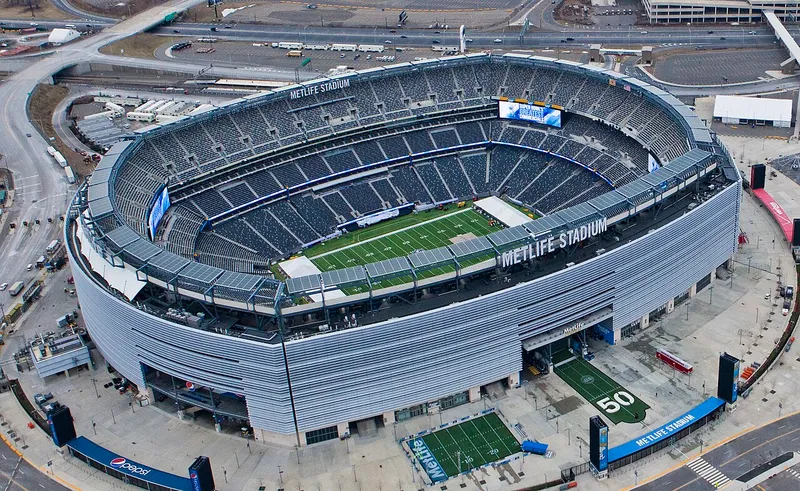
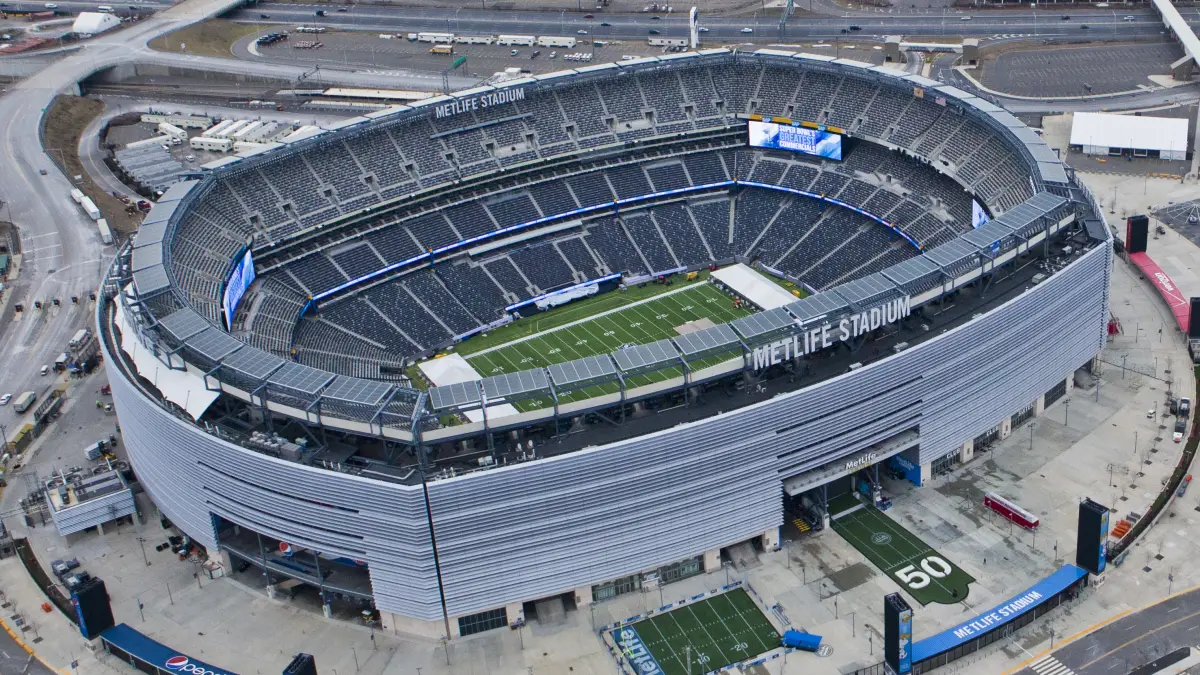
By the seats the league lists for a regular Sunday, the biggest NFL stadium is MetLife Stadium in the New Jersey Meadowlands, home to both of New York’s teams, the Giants and the Jets, who play across the river from the city they’re named for. AT&T comes third. The distance between the stadium people expect and the one on the official list is what makes this worth a closer look.
The full ranking is below, from MetLife at the top down to the newest stadiums that were built smaller on purpose.
82,500 seats. The capacity of MetLife Stadium, the largest NFL stadium by listed seating, home to both the New York Giants and the New York Jets.
The biggest NFL stadiums, ranked by capacity
The biggest NFL stadiums start at MetLife’s 82,500 and drop quickly into a tight band of 70,000-seat bowls. The top of the list is closer than you’d think: only 2,500 seats separate first place from third. The table below uses each team’s standard listed capacity, the figure the league quotes for a normal game. Standing-room and special-event expansions get their own section, because they change the answer.
| Rank | Stadium | Team(s) | Capacity | Opened | Roof |
|---|---|---|---|---|---|
| 1 | MetLife Stadium | Giants / Jets | 82,500 | 2010 | Open |
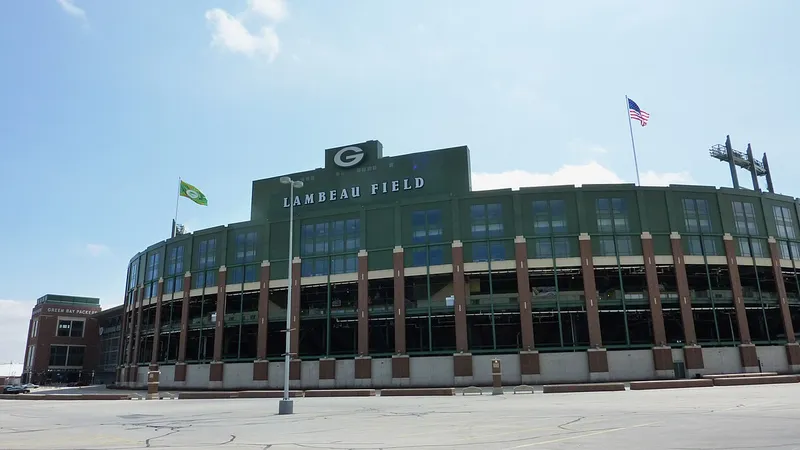
| 2 | Lambeau Field | Packers | 81,441 | 1957 | Open |
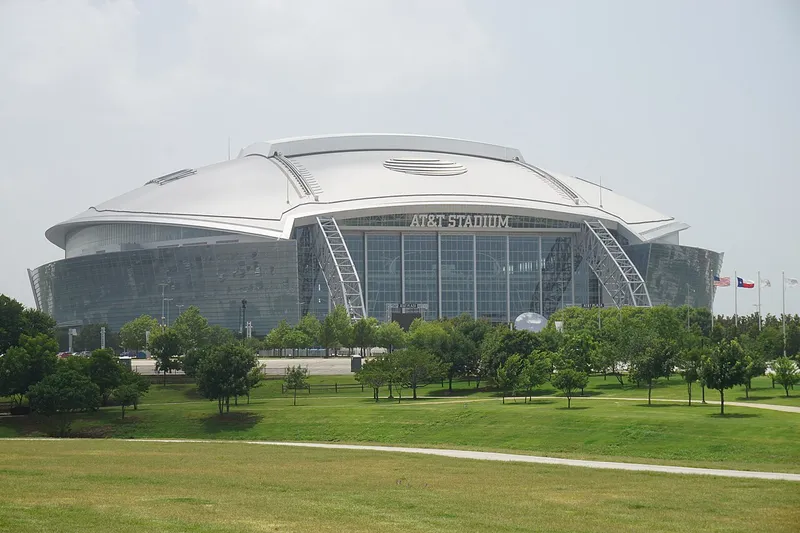
| 3 | AT&T Stadium | Cowboys | 80,000* | 2009 | Retractable |
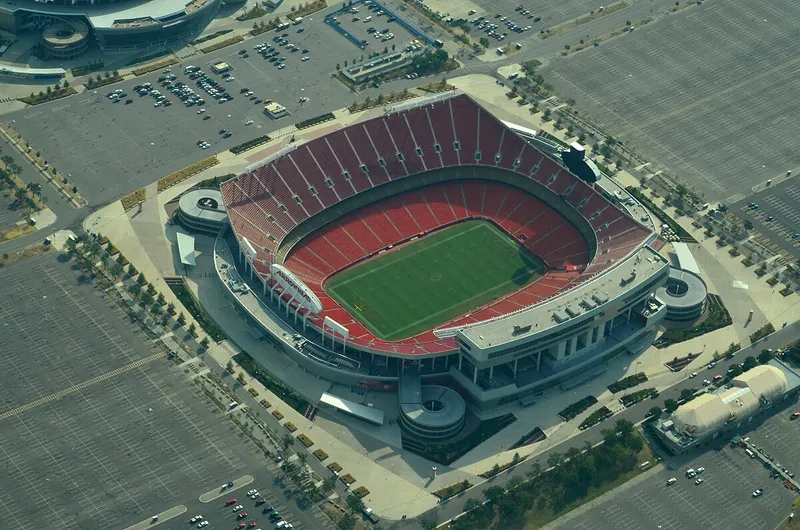
| 4 | Arrowhead Stadium | Chiefs | 76,416 | 1972 | Open |
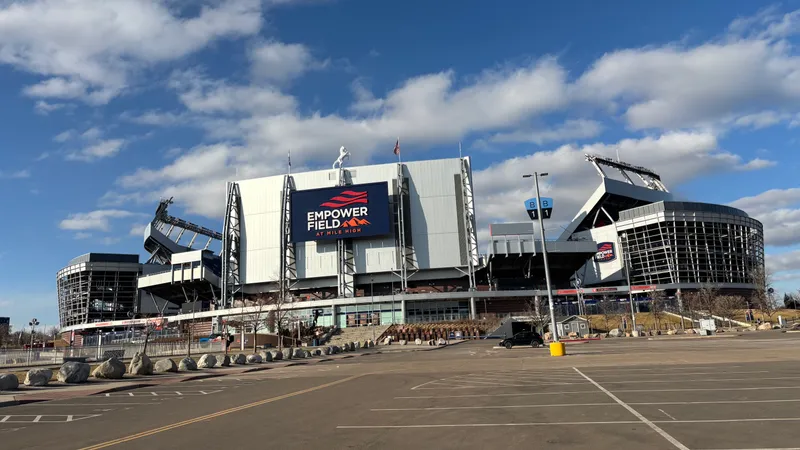
| 5 | Empower Field at Mile High | Broncos | 76,125 | 2001 | Open |
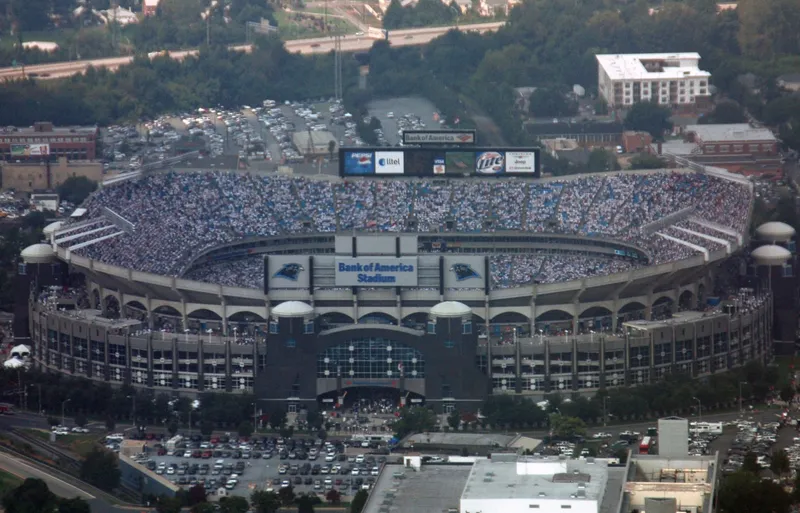
| 6 | Bank of America Stadium | Panthers | 75,037 | 1996 | Open |
| 7 | Caesars Superdome | Saints | 73,208 | 1975 | Dome |
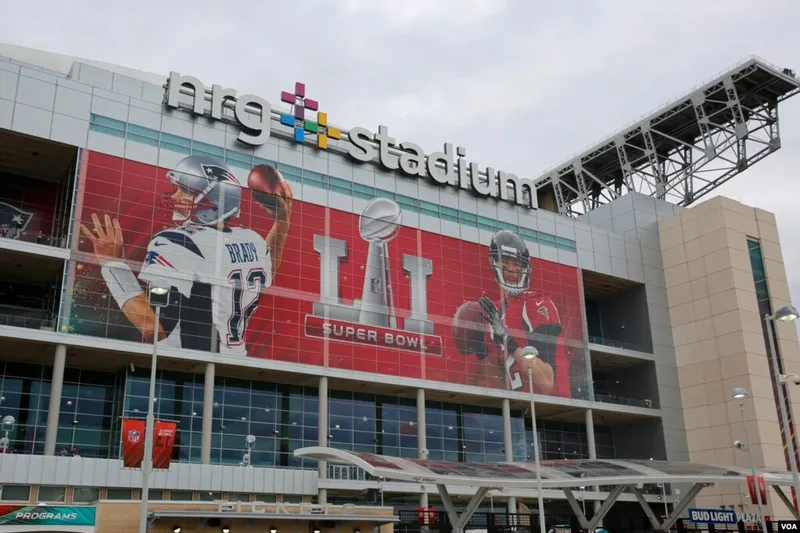
| 8 | NRG Stadium | Texans | 72,220 | 2002 | Retractable |
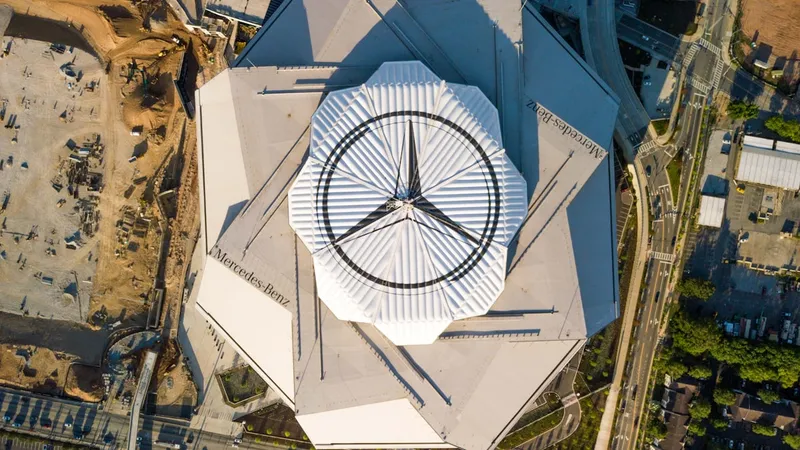
| 9 | Mercedes-Benz Stadium | Falcons | 71,000 | 2017 | Retractable |
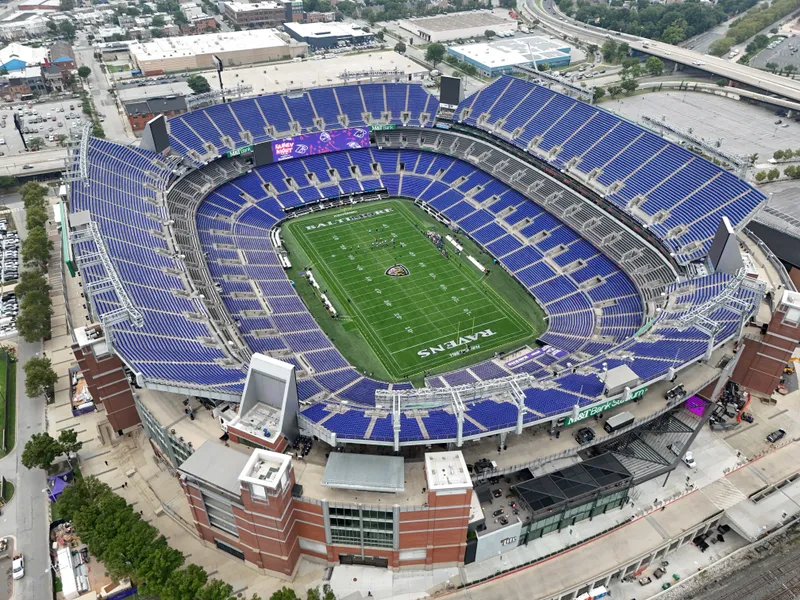
| 10 | M&T Bank Stadium | Ravens | 70,257 | 1998 | Open |
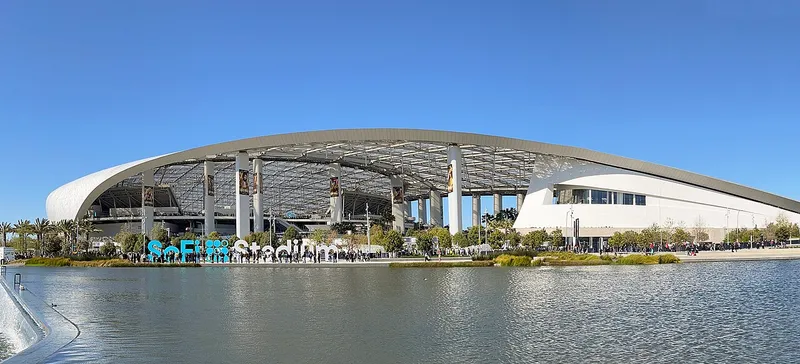
| 11 | SoFi Stadium | Rams / Chargers | 70,240* | 2020 | Fixed |
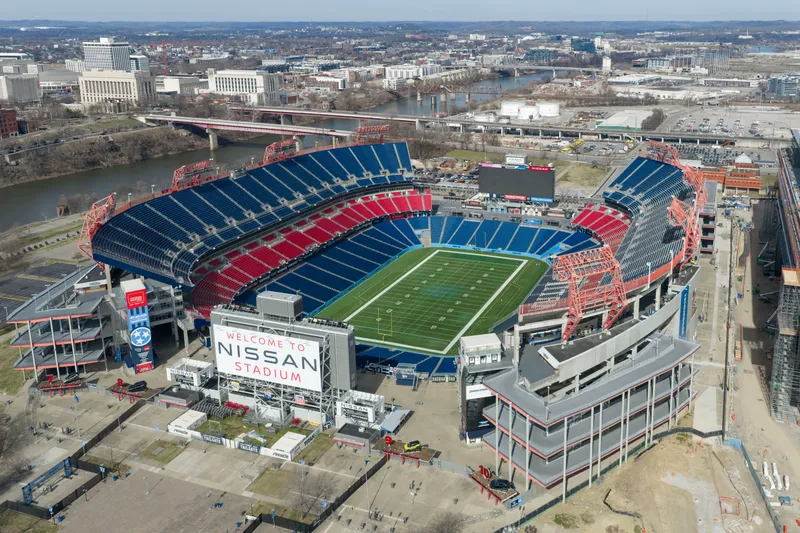
| 12 | Nissan Stadium | Titans | 69,143 | 1999 | Open |
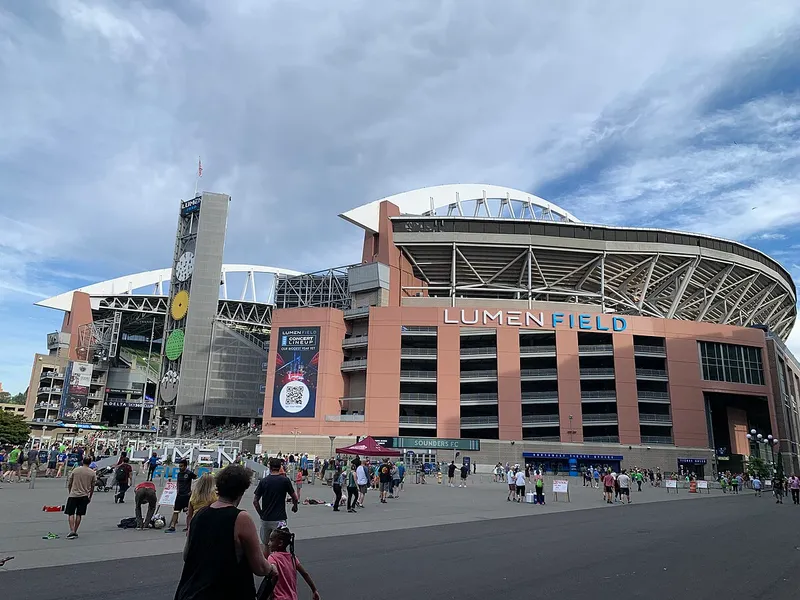
| 13 | Lumen Field | Seahawks | 68,740 | 2002 | Open |
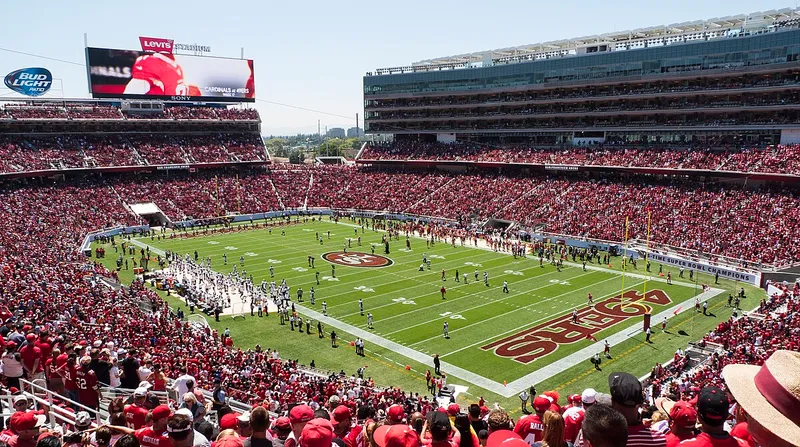
| 14 | Levi’s Stadium | 49ers | 68,500 | 2014 | Open |
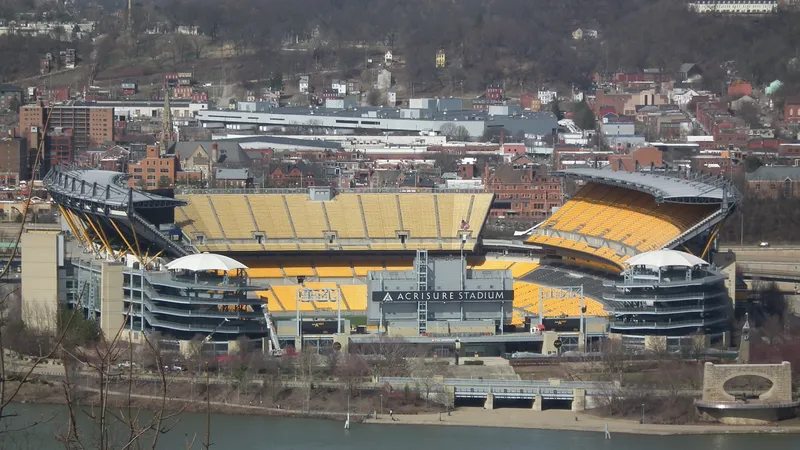
| 15 | Acrisure Stadium | Steelers | 68,400 | 2001 | Open |
The asterisks on AT&T and SoFi matter. Both list a modest number for a normal game but were built to expand for the biggest events, like Super Bowls and World Cup matches. More on that below.
Why MetLife is number one, and AT&T isn’t
MetLife is the biggest because it has more permanent seats than any other NFL stadium, and permanent seats are the number the league counts. It opened in 2010, cost a reported $1.6 billion, and is shared by the Giants and the Jets. It holds 82,500 in a plain gray bowl with no roof. It’s not a good-looking building, but no NFL stadium seats more people for a regular game.
The reason it’s so big comes down to demand. MetLife is the only NFL stadium shared by two teams, and it was built deliberately neutral: no permanent branding for either side, gray seats, and an exterior that lights up blue for the Giants or green for the Jets depending on who’s home. Two teams means two fanbases and two season-ticket lists. That’s enough demand to fill 82,500 seats, which a single-team market couldn’t do.
Lambeau Field is second at 81,441, which shouldn’t be possible for a stadium in a town of 106,000. It gets its own section below. Then comes AT&T Stadium at 80,000, and this is where the common assumption falls apart. AT&T looks like it should be the biggest. It’s the most expensive-looking, the most photographed, and it hosted a Super Bowl and, in 2026, a World Cup semifinal. But its listed capacity for a normal game is 80,000, third behind two stadiums people rarely think of as giants.
That 80,000 is a starting point, not a limit. AT&T was built with standing-room platforms and party decks that raise real attendance well above the listed number for big events. It has cleared 100,000 more than once, and that’s the next section.
2,500 seats. The gap between the biggest NFL stadium (MetLife, 82,500) and the third-biggest (AT&T, 80,000). The top of the list is close.
The asterisk: how “biggest” depends on how you count
Standing room is where the ranking gets complicated, and two stadiums lean on it more than the rest. AT&T Stadium and SoFi Stadium both list capacities in the 70,000 to 80,000 range for a normal game, then expand well past 100,000 for events that call for it. Rank the league by maximum possible attendance instead of listed seating and the order changes, with the Cowboys on top.
AT&T’s expanded setup tops 100,000 with standing room open. The NFL single-game record of 105,121 was set at the very first game there, against the Giants in September 2009. The 2010 NBA All-Star Game, staged on the football field, drew 108,713, still the largest crowd for any basketball game anywhere. The largest crowd ever recorded at an NFL stadium wasn’t a football game at all: WrestleMania 38 drew 131,372 across two nights in April 2022. And for the 2026 World Cup, where AT&T hosted more matches than any other venue, FIFA’s expanded configuration seated around 94,000.
131,372. The two-night WrestleMania 38 crowd at AT&T Stadium in 2022, the largest attendance recorded at any NFL venue. Listed capacity and maximum attendance are two different numbers.
SoFi does the same thing. It hosted Super Bowl LVI in February 2022 and the College Football Playoff title game the next season, both with the seating pushed well beyond the 70,240 the Rams and Chargers use on a Sunday, toward 100,000. So the honest answer to “what’s the biggest NFL stadium” is really two answers. By the seats sold for a Sunday in November, it’s MetLife. By the most people you can fit for a rare, one-off event, it’s AT&T. Both are true. You just have to say which one you mean.
Open air or roof: the split at the top of the list
The biggest NFL stadiums fall into two groups, and the roof column tells you which is which. The open-air bowls dominate the top of the ranking. MetLife, Lambeau, Arrowhead, and Empower Field at Mile High all sit under open sky, built when a stadium was a place to watch a game rather than a climate-controlled entertainment complex. Then come the newer roofed stadiums: AT&T and Mercedes-Benz with retractable roofs, NRG in Houston with its own, the Caesars Superdome as the oldest of the fixed domes, and SoFi under its translucent canopy.
The split isn’t random. Warm-weather and rain-prone cities built roofs to protect the fan experience and to attract Super Bowls, which is most of why so many NFL stadiums now have roofs. The biggest open-air stadiums tend to belong to cold-weather teams that treat the weather as an advantage rather than a problem. You see it at Lambeau in Green Bay and Arrowhead in Kansas City, where the December cold works in the home team’s favor and the fans wouldn’t have it any other way.
Lambeau Field: how a town of 100,000 has the second-biggest stadium
Lambeau Field is the most surprising entry on the list. Green Bay, Wisconsin has about 106,000 residents. Its football stadium seats 81,441. On a game day, more than three-quarters of the entire city could fit inside one building, which is close to what it feels like when the Packers play.
No other major American sports team is set up like this. The Packers are publicly owned, held by more than 500,000 shareholders who can’t sell their shares for profit or move the team. That’s why the smallest market in the league has never lost its franchise and never will. The stadium opened in 1957, making it the oldest still in use in the NFL, and a run of expansions grew it from an original 32,500 seats to today’s 81,441 without losing the shape of the old bowl. The “Frozen Tundra” nickname is honest: December games here happen in single-digit temperatures, and the season-ticket waiting list runs so long that spots on it are often passed down within families.
Second-biggest stadium, smallest market, oldest building, and the only community-owned team in the league. Lambeau is the exception to almost everything else on this list.
The NFL’s biggest stadiums are smaller than college football’s
Not one NFL stadium would make the ten largest stadiums in the United States. Michigan Stadium in Ann Arbor holds over 107,000. Penn State’s Beaver Stadium and Ohio State’s Ohio Stadium both top 100,000, and Texas A&M, Tennessee, LSU, and Alabama all run bigger than MetLife’s 82,500. Eight of the ten largest stadiums in the country are college football venues, and it isn’t close.
The reason comes down to money. College programs fill enormous stadiums a handful of Saturdays a year with students, alumni, and cheap general-admission tickets. The NFL sells a smaller, pricier product: fewer seats, more suites, more club level, and more revenue per fan. A modern NFL owner would rather sell 65,000 expensive seats than 100,000 cheap ones. Michigan and Beaver Stadium each seat more people for an ordinary Saturday than AT&T can reach on its biggest night with standing room. That’s why the biggest venues in American sports carry college logos, and why the largest stadiums in the world are mostly college football and international soccer, not the NFL.
107,000+ seats. Michigan Stadium, the largest in the US, holds roughly 25,000 more than the biggest NFL stadium. College football owns the size record.
The newest NFL stadiums keep getting smaller
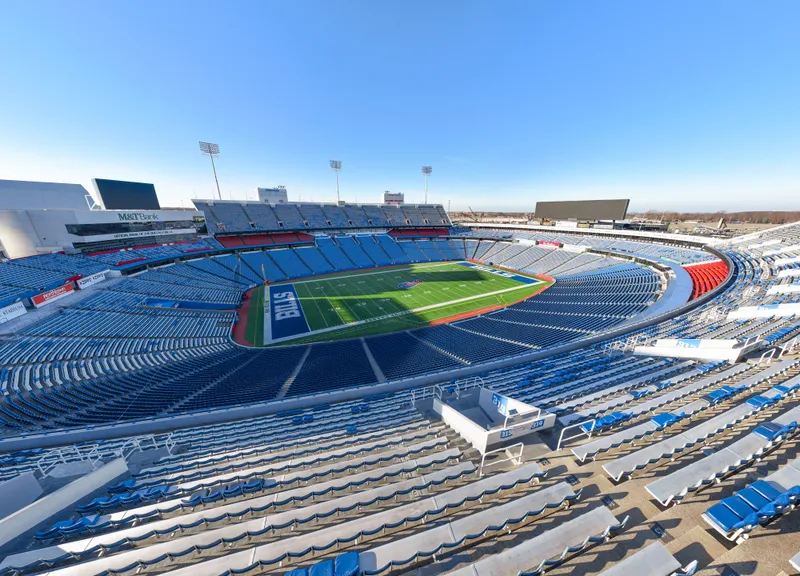
Newer does not mean bigger. The last decade of NFL construction has trended the other way. The new Highmark Stadium in Orchard Park, home of the Buffalo Bills and opened in 2026, seats 60,108. That makes the league’s newest stadium its smallest, more than 22,000 seats behind MetLife, and the Bills built it that way on purpose.
They chose a smaller stadium than the roughly 71,000-seat building it replaced, trading raw capacity for better sightlines, more premium seating, and weather protection under a canopy. SoFi Stadium (2020) lists 70,240. Allegiant Stadium in Las Vegas (2020) holds around 65,000. Mercedes-Benz Stadium in Atlanta (2017) seats 71,000. All of them cost well over a billion dollars, and none of them chased a big seat count. The money is in the club levels and suites, not the upper bowl, which is why the most expensive stadiums ever built aren’t the biggest ones.
The exceptions are the expandable stadiums. SoFi and AT&T stay flexible so they can host the Super Bowls and World Cup matches that a 60,000-seat building can’t. They sell premium seating for the regular season and keep the option to grow for the big events. That’s the shape of new NFL construction now.
The smallest NFL stadiums, and the oldest
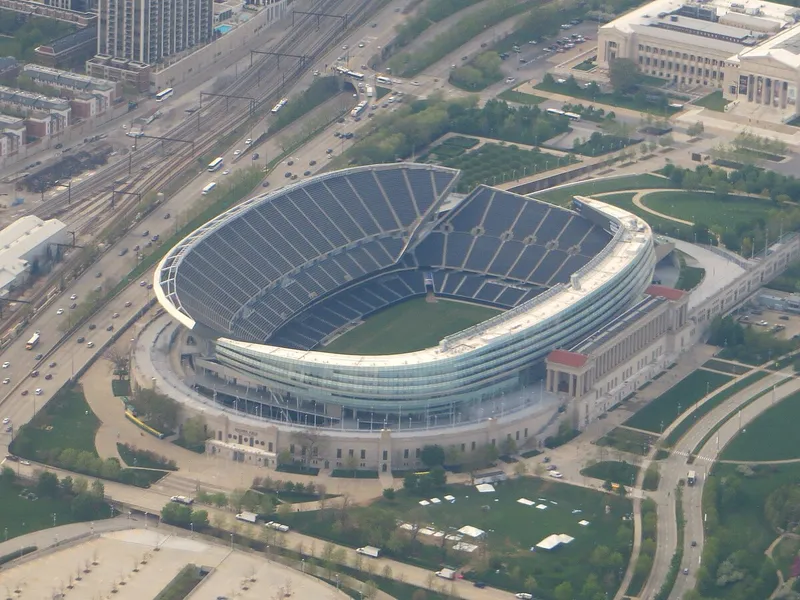
The bottom of the league is a mix of the brand-new and the very old. Highmark Stadium (60,108) is the smallest by design, as covered above. Just behind it is Soldier Field in Chicago at about 61,500, small for the opposite reason: it’s the oldest stadium in the NFL, opened in 1924, and a much-debated 2003 renovation dropped its capacity below the league average while fitting a modern seating bowl inside its historic colonnades. Bears fans have wanted a bigger home for years, and the team keeps looking at a new build in the suburbs.
Just above them, State Farm Stadium in Arizona (63,400) and Northwest Stadium outside Washington (64,000) round out the smaller end. None of this is a knock on the teams. A full 60,000-seat stadium with a great atmosphere beats a half-empty 80,000-seat one every time, which the loudest venues in the league, Arrowhead among them, prove every Sunday. Being the loudest stadium in the world has nothing to do with being the biggest.
What the ranking actually tells you
Read the whole list and a pattern shows up that has nothing to do with which teams are good. The biggest NFL stadiums are mostly older, open-air bowls built before the premium-seating era: MetLife, Lambeau, Arrowhead, Empower Field. The newest ones, like SoFi, Allegiant, and the new Highmark, are smaller, more expensive, and more flexible. And the biggest crowd the league has ever drawn came at a stadium that lists only the third-most seats, because listed capacity and maximum attendance turned out to be different questions.
Nine of these fifteen stadiums hosted 2026 World Cup matches, from the final at MetLife to nine games at AT&T, which is one reason the expandable-capacity approach still matters. The World Cup needed the extra room. The NFL, more and more, doesn’t. So the next time someone tells you AT&T is the biggest stadium in football, you’ll have the honest answer: biggest crowd, yes; biggest stadium, no, not by the number the league actually lists.
Sources
- List of current National Football League stadiums (Wikipedia). Baseline capacity table for all 30 NFL venues.
- Arrowhead Stadium (Wikipedia). Confirms the 76,416 current capacity (2010 to present) and record attendance.
- AT&T Stadium (Wikipedia). Confirms the 80,000 listed seating and the expandable-to-100,000-plus standing capacity, plus event attendance records.
- MeetStadium’s own verified stadium pages (linked throughout) for each venue’s capacity, opening year, and roof type.
Hero photo: MetLife Stadium aerial by Anthony Quintano, CC BY 2.0. NFL capacity figures vary by roughly 1,000 to 2,000 seats across sources and can change with renovations or event configurations; listed seated capacities are used here for the ranking, with standing-room and expanded figures noted separately. Where sources differed, the figure consistent with our own verified venue pages was used.