About MetLife Stadium
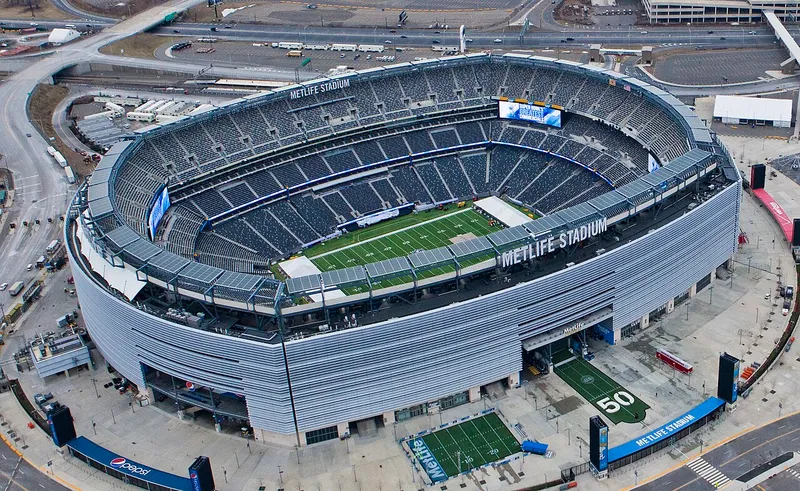
MetLife Stadium is located within the Meadowlands Sports Complex in East Rutherford, New Jersey, approximately 5 miles (8 km) west of Midtown Manhattan, at 1 MetLife Stadium Drive. The venue was opened on April 10, 2010, several months ahead of its planned completion date, replacing the original Giants Stadium which had stood on the adjacent lot since 1976 and was demolished in the same year that MetLife was opened. The official capacity is listed at 82,500 seats, of which 10,005 are club seats and approximately 218 are luxury suites, which makes MetLife the largest NFL venue by total seating, the largest stadium in New Jersey, and the selected host for the Final of the 2026 FIFA World Cup, scheduled for July 19, 2026.
The stadium is one of only two NFL venues that are shared between two franchises. Since 2010, the schedule has been split between the New York Giants and the New York Jets, while the only other shared arrangement is SoFi Stadium in Inglewood, California, which is the home of the Los Angeles Rams and the Los Angeles Chargers. Due to this dual tenancy, MetLife hosts more regular-season NFL games than any other venue in the league, up to 20 per season, not counting preseason or playoff games. Both franchises established the New Meadowlands Stadium Company, LLC, a 50/50 joint venture, to build and operate the facility, with the underlying land leased from the New Jersey Sports and Exposition Authority (NJSEA) for an initial 25-year term, with options to extend the lease up to 97 years.
The total investment cost was $1.6 billion (approximately $2.36 billion in 2025 dollars), which made MetLife the most expensive stadium in the United States at the time of its completion. Unlike nearly every other NFL venue that was constructed during the 2005 to 2015 wave of stadium development, MetLife was financed entirely privately by the Giants and the Jets, without public bonds or taxpayer subsidies. The design was entrusted to a team of four architectural firms: 360 Architecture, EwingCole, Rockwell Group, and Bruce Mau Design. The team was tasked with designing a neutral venue that could reflect both franchises at once, while the Giants preferred exposed steel and rusticated stone and the Jets wanted sleek metal and glass. The final facade combines both approaches, with internal lighting that can shift from blue (Giants) to green (Jets) within hours, depending on which team is playing. The concept was borrowed from Allianz Arena in Munich, which was at the time shared by Bayern Munich and 1860 Munich.
The Meadowlands is situated in a natural wind corridor, and the decision to build without a roof was intentional. Proposals to include a roof collapsed during planning, due to funding disputes, which additionally ruled the venue out of hosting indoor events such as the NCAA Final Four. Regulars who have attended Giants and Jets January games often describe the cold as part of the home-field advantage, and visiting teams accustomed to domed or warm-weather conditions tend to struggle in the windchill. For the 2026 World Cup, the existing FieldTurf Core System will be replaced with natural grass, following the same protocol that was successfully executed at MetLife for Copa America 2024 and for the 2025 FIFA Club World Cup Final (Chelsea 3, Paris Saint-Germain 0).
The venue has already demonstrated that it can handle globally-watched events. On February 2, 2014, Super Bowl XLVIII was hosted at MetLife, which was the first cold-weather outdoor Super Bowl in league history, with a game-time temperature of 49°F (9°C). Other major events have included WrestleMania 29 (2013) and WrestleMania 35 (2019), each of which drew more than 80,000 fans, Copa America 2024 matches including a semifinal, and concerts from Bruce Springsteen, U2, Taylor Swift, Beyoncé, and Ed Sheeran, whose June 11, 2023 show set the venue concert record at 89,106 attendees. The July 19, 2026 World Cup Final is expected to exceed all of them in global reach, as the 2022 Qatar Final was watched by an estimated 1.5 billion viewers, and projections for 2026 are above 2 billion.
Getting to MetLife Stadium
Public Transit
The Meadowlands Rail Line of NJ Transit runs directly from Secaucus Junction to the stadium. The ride takes about 10 minutes, and the station is located basically at the gates.
→ From Manhattan: Any NJ Transit train from Penn Station (33rd Street) to Secaucus Junction can be taken, followed by a transfer to the Meadowlands line. The total journey is roughly 30 minutes. Round-trip tickets are typically $5-10.
→ From Newark Airport: The AirTrain can be taken to Newark Penn Station, then NJ Transit to Secaucus Junction, and finally the Meadowlands line. About 45 minutes in total.
→ From other NJ Transit stops: Many lines converge at Secaucus Junction. The NJ Transit app can be checked for a specific route.
Trains run every 10-15 minutes before events and continue to operate for about 90 minutes after the final whistle. The rush that follows a game is real, so it is recommended to get in line early, or to wait 20-30 minutes for the crowd to thin out.
Driving + Parking
The stadium is situated on I-95 (New Jersey Turnpike) and Route 3. GPS address: 1 MetLife Stadium Drive, East Rutherford, NJ 07073.
→ From Manhattan: Lincoln Tunnel to Route 3 West. 20 minutes without traffic, 45-90 on event days.
→ From the George Washington Bridge: I-95 South to Route 3 East. About 25 minutes without traffic.
The complex is served by 28,000+ parking spaces in lots A through P. Standard NFL parking costs $40-60. A pass should be purchased in advance, because walking up on event day without one is a bad bet.
Tailgating is a fixture of Meadowlands Sundays. FIFA will almost certainly be more restrictive for World Cup matches than the Jets are for a 1pm game.
Rideshare
MetLife is served by both Uber and Lyft, with a designated pickup and drop-off zone near Lot J. Surge pricing and 20-40 minute waits after events should be expected. Rides to Midtown are typically $40-80, depending on demand.
Pro tip: It is best to walk to the rideshare lot the moment the match ends, or to wait 30+ minutes for the first wave to clear.
From the Airport
→ Newark Liberty (EWR): 15 miles, 20-40 minutes by car. The closest airport. AirTrain + NJ Transit is a workable option if driving is not preferred.
→ JFK Airport: 30 miles, 45-90 minutes by car depending on traffic. Not great but doable.
→ LaGuardia Airport: 15 miles, 30-60 minutes by car. No direct transit is available, so rideshare or driving is the option.
FIFA World Cup 2026 at MetLife Stadium
MetLife is scheduled to host 8 matches at the 2026 World Cup, including the Final on July 19. Only AT&T Stadium in Arlington hosts more, with nine, though no other venue was awarded the Final. For a full look at the grass conversion, the $100M+ upgrades, and the transit plan, see our deep dive on how MetLife is getting ready for the World Cup Final.
Matches: Five group stage games, one Round of 32, one Round of 16, and the Final. The tournament’s two semifinals are at AT&T Stadium and Mercedes-Benz Stadium, not MetLife.
Pitch: The FieldTurf will be replaced with natural grass for the tournament. FIFA requires real grass for all World Cup matches, and the conversion protocol has already been executed by MetLife for Copa America 2024. For how MetLife’s grass install compares to the other 15 venues, see our venue-by-venue World Cup 2026 stadium preparations breakdown.
Capacity: The standard 82,500 setup may be reduced slightly to accommodate the soccer pitch and FIFA’s broadcast requirements, but matches are expected to be close to full.
Fan zones: FIFA will operate official Fan Festivals in the NY/NJ metro area, most likely in Manhattan and near the stadium, with big screens, food, merchandise, and everything else for fans without match tickets.
This is New York hosting the Final. More than 20 million people live within an hour of the stadium, the infrastructure is built for crowds, and the entire metro area will be filled with visiting fans for a week. No host city in World Cup history has had this much media capacity behind it.
Construction & Design
Construction of the New Meadowlands Stadium project (which was rebranded as MetLife Stadium following the August 2011 naming rights deal) began on September 5, 2007. The general contractor Skanska, the structural engineer Thornton Tomasetti, and the main steel supplier Canam Group (through its Structal–Heavy Steel Construction division) executed the build over a period of approximately 30 months, with the project completed five months ahead of schedule and within the original $1.6 billion budget. The full architectural team spanned four firms: the overall design was led by 360 Architecture (now HOK, following a 2015 acquisition), with EwingCole handling engineering, Rockwell Group on interior architecture, and Bruce Mau Design on branding and graphics. Project management was overseen by Hammes Company Sports Development.
The finished structure comprises more than 17,000 individual steel components, and a total of 4.5 million labor hours were logged during construction without any serious accidents. The safety record was attributed by the contractors to a Project Labor Agreement which, unusually for a stadium of this scale, also mandated that 33% of the workforce and subcontractors had to come from WMBE (women- and minority-owned business enterprises). Prefabricated concrete elements were tracked by RFID technology during installation, and BIM (Building Information Modeling) was used for steel prefabrication, which accelerated the timeline significantly. The facility was built on reclaimed Meadowlands land on concrete piles and foundations, and 40,000 tons of recycled steel and 30,000 tons of concrete from the demolished Giants Stadium were incorporated into the new structure. Half of that concrete was crushed and reused as road base material for the surrounding infrastructure.
Sustainability was embedded in the planning phase. In June 2009, a Memorandum of Understanding was signed between the New Meadowlands Stadium Corporation and the U.S. Environmental Protection Agency, under which commitments were made to reductions in emissions, the use of compostable food-service packaging, solar integration, and water-saving infrastructure. The plan targeted a reduction of approximately 1.68 million metric tons of CO₂ emissions during construction and the stadium’s first year of operation. By the time the venue was opened, 7,000 tons of construction debris had been diverted from landfills, 83% of construction waste had been recycled (which exceeded the original 70% target by 13 percentage points), and the seating bowl was surrounded by crushed granite that covered roughly four football fields in area. This design choice was estimated to save approximately 7.5 million liters of water annually. Plastic seats throughout the venue were manufactured from recycled materials.
The most visible architectural feature is the louvered facade. A limestone-like base wraps the lower level of the stadium, while above it, an outer skin is formed from 50,000 meters (50 kilometers, or 163,681 feet / 31.1 miles) of aluminum louvers combined with glass, which wraps the upper structure. The facade is backlit by LED lighting which can shift color palettes within hours: blue for Giants games, green for Jets games, or custom combinations for concerts, soccer matches, and other events. In 2012, DLR Group partnered with NRG Energy to install the “Solar Ring” along the upper rim, which comprises 1,350 building-integrated photovoltaic (BIPV) panels assembled into 47 frames. The system generates approximately 350 kW, which is nearly 25 times the amount required to power the LED display system, and the surplus is directed into general stadium operations or fed back to the grid.
Inside the venue, the seating bowl follows the layout of the old Giants Stadium, but is raked more aggressively to eliminate overhangs, which allows fans in the upper deck to follow the full arc of a 90-foot (27 m) punt. Front-row 50-yard-line seats are located 46 feet (14 m) from the sideline, which is the shortest distance of any NFL stadium. The venue is served by four locker rooms (one each for the Giants and the Jets, and two for visiting teams), with the home rooms positioned at opposite ends and visitor rooms adjacent, which allows both franchises to operate without physically intersecting on shared game weekends. Ten HD LED pylons (each 54 feet / 16 m tall by 20 feet / 6.1 m wide) are positioned at the north, south, east, and west entrances, and are used to display team video for the current home tenant. Inside, four HD video displays measuring 30 × 116 feet (9.1 × 35 m) hang from each upper-deck corner.
In January 2024, a lower-bowl renovation was initiated specifically to prepare the field for the expanded FIFA pitch dimensions required for the 2026 World Cup. The work was phased in order to minimize disruption to NFL operations, with Phase I completed in May 2024 and Phase II in May 2025. Four corners of the existing precast concrete seating bowl were demolished and replaced with a new modular grandstand system built from steel composite, and 1,740 permanent seats were replaced as part of the upgrade. Mechanical, electrical, audiovisual, and plumbing systems were all upgraded simultaneously in order to meet FIFA’s broadcast and operational standards.
History of MetLife Stadium
Giants Stadium was opened in 1976 on the same Meadowlands site, as part of the larger Meadowlands Sports Complex, which was developed under Governor William Cahill’s 1971 initiative to bring professional sports and racing to New Jersey. Over 34 years of operation, the original venue was used by the New York Giants (from 1976), the New York Jets as tenants (from 1984), the New York Cosmos of the NASL (1977–1984), two matches of the 1994 FIFA World Cup, and countless concerts from the Rolling Stones, Bruce Springsteen, and U2. By the mid-2000s, as Giants Stadium approached 30 years of age and was becoming one of the older venues in the NFL, both franchises began to explore alternatives.
The Jets, who had been paying rent to the Giants as tenants, initially pursued a standalone venue called the West Side Stadium in Manhattan, which was designed to hold 85,000 spectators as the main stadium for New York City’s bid to host the 2012 Summer Olympic Games, with a downsized 75,000-seat configuration for Jets games. The project required significant public funding and was halted in 2005, following opposition from Cablevision (then owner of Madison Square Garden), Assembly Speaker Sheldon Silver, and several labor unions. With the West Side Stadium blocked, the Giants and Jets pivoted to a joint venture, in which, rather than build competing stadiums, both teams would share a new Meadowlands facility as 50/50 equal partners under the New Meadowlands Stadium Company, LLC.
The lease structure includes a notable exit mechanism. The 25-year land lease from the NJSEA has an option to be extended for up to 97 years, and after year 15 of the lease (and every five years thereafter), either team has the right to opt out, provided that state authorities are notified one year in advance. The first opt-out window fell in 2025, which required notification in 2024 (neither team filed). If the opt-out is exercised by one team, the remaining team is contractually obligated to stay through the end of the lease. In practice, the economics of relocation make this outcome unlikely, as significant revenue is collected by both franchises from year-round parking lot rentals on the Meadowlands complex’s western lots, even on non-event days, which offsets stadium operating costs.
The naming rights process was not a straightforward one. Allianz, the German insurance and financial services giant, was the initial leading bidder, with an offer of approximately $20–30 million per year for up to 30 years of naming rights. The bid drew opposition from the New York Jewish community, the Anti-Defamation League, and several U.S. senators, which cited Allianz’s extensively documented role in insuring Nazi-era concentration camps, including Auschwitz, during World War II, and the company’s later settlement payments to survivors. Although Allianz had publicly acknowledged its wartime history and had funded Holocaust memorial programs, the backlash was substantial enough that the deal fell through. The naming rights were secured by MetLife in August 2011, in a deal reported to be worth between $400 and $625 million over 25 years, though the full financial terms were never disclosed.
Notable events:
- Super Bowl XLVIII (February 2, 2014): The Seattle Seahawks defeated the Denver Broncos 43–8 in the first cold-weather outdoor Super Bowl in NFL history. The kickoff temperature was 49°F (9°C), warmer than forecast. The game was attended by 82,529 fans and set broadcast viewership records for its time.
- WrestleMania 29 (April 7, 2013) and WrestleMania 35 (April 7, 2019): Two WWE pay-per-view events, each of which drew more than 80,000 fans. WrestleMania 29 set a then-record for WWE gate revenue, while WrestleMania 35 was headlined by Becky Lynch, Ronda Rousey, and Charlotte Flair in the first women’s-match main event in WrestleMania history.
- Copa America 2024: Multiple matches were hosted by MetLife, including a semifinal, with the grass conversion protocol successfully executed, which is now slated for reuse in 2026.
- FIFA Club World Cup 2025 Final (July 13, 2025): Chelsea defeated Paris Saint-Germain 3–0. The match served as a dress rehearsal for MetLife’s 2026 World Cup Final operations.
- Record attendance: The all-time record for any event is 93,000, which was set at the 12th Siyum HaShas on August 1, 2012. The concert record (89,106) belongs to Ed Sheeran’s +–=÷× Tour on June 11, 2023. The football attendance record (83,367) was set on October 29, 2023, during Jets at Giants.
The open-air design remains a divisive one. Proponents point to authentic outdoor football weather and the atmospheric advantage that is given to the Giants and Jets against opponents unaccustomed to the cold, while critics note the lack of protection from January snow, rain, and the wind corridor which consistently affects passing games and kicking operations. For the July 2026 World Cup matches, the concern is inverted: summer Meadowlands temperatures regularly reach 85°F (29°C) with humidity above 70%, which has been addressed by FIFA through the scheduling of afternoon and evening kickoffs and the requirement of enhanced cooling stations for players and officials.
The Meadowlands Sports Complex itself now includes MetLife Stadium, the adjacent American Dream mall (a 3-million-square-foot retail and entertainment complex featuring an indoor water park, an indoor ski slope, and a DreamWorks Water Park), and the remnants of the now-closed Izod Center arena. The American Dream mall is worth a pre-game stop for fans who arrive early, particularly for those traveling with families.
Sources & Further Reading
- MetLife Stadium official site: metlifestadium.com. Capacity, operations, parking, tailgating rules, event calendars.
- NJ Transit FIFA World Cup service page: njtransit.com/fifa. Meadowlands Rail Line schedules, ticket purchase details, and event-day service for the 2026 World Cup.
- FIFA World Cup 2026 match schedule: fifa.com. Official match assignments and venue information.
- Wikipedia entry on MetLife Stadium: en.wikipedia.org/wiki/MetLife_Stadium. Comprehensive reference with construction details, lease terms, and attendance records.
- Wikipedia entry on Giants Stadium (1976–2010): en.wikipedia.org/wiki/Giants_Stadium. Background on the predecessor venue.
- New Meadowlands Stadium Environmental MOU (U.S. EPA, June 2009): details of the sustainability commitments made during construction.
- New York State and New Jersey Sports and Exposition Authority (NJSEA) lease documentation: njsea.com. Ownership structure and lease terms for the Meadowlands complex.
Quick Facts
Everything you need at a glance.
Stadium specs
- Capacity
- 82,500
- Opened
- 2010
- Cost
- $1.6 billion (~$2.36 billion today)
- Roof
- Open
- Surface
- Natural Grass (for FIFA events)
- Tenants
- New York Giants (NFL), New York Jets (NFL)
- WC 2026
- Final · 8 matches
- First WC match
- June 13, 2026
Construction & location
- Groundbreaking
- September 5, 2007
- Architects
- 360 Architecture, EwingCole, Rockwell Group, Bruce Mau Design
- Engineering
- Thornton Tomasetti
- General contractor
- Skanska
- Steel supplier
- Canam Group (Structal–Heavy Steel Construction division)
- Address
- 1 MetLife Stadium Drive, East Rutherford, NJ 07073, USA
- GPS
- 40.8128°N, 74.0742°W
Photo Gallery
Fun Facts
MetLife Stadium was built without any public funding, costing $1.6 billion, which makes it one of the most expensive privately financed stadiums ever built.
MetLife is the only NFL stadium shared by two franchises (Giants and Jets), which means it hosts more regular-season NFL games than any other venue, up to 20+ per year.
The open-air design of the stadium was intentional: the Meadowlands is situated in a natural wind corridor, and the architects chose to embrace weather as part of the game-day experience.
Stadium Location
Frequently Asked Questions
- What is the seating capacity of MetLife Stadium?
- The seating capacity of MetLife Stadium is listed at 82,500 for NFL games. For the FIFA World Cup 2026 Final, the configuration may be adjusted slightly to accommodate the soccer pitch layout, but the venue remains one of the largest in the tournament.
- Where is MetLife Stadium located?
- MetLife Stadium is located at 1 MetLife Stadium Drive, East Rutherford, New Jersey 07073. The venue is situated within the Meadowlands Sports Complex, approximately 5 miles west of Midtown Manhattan.
- What World Cup 2026 matches will be played at MetLife Stadium?
- MetLife Stadium will host the FIFA World Cup 2026 Final on July 19, 2026, along with group stage matches and knockout round games. In total, 8 matches are expected to be held at the venue, which makes it the centerpiece of the tournament.
- How do I get to MetLife Stadium by public transit?
- NJ Transit's Meadowlands Rail Line can be taken from Secaucus Junction, which connects directly to the stadium. From Manhattan, an NJ Transit train from Penn Station to Secaucus Junction is taken, followed by a transfer. On event days, express trains run frequently and the journey takes about 30 minutes from Midtown.
- Is there parking at MetLife Stadium?
- Yes, MetLife Stadium is served by over 28,000 parking spaces distributed across multiple lots. Parking typically costs $40-$60 for NFL games. For World Cup matches, similar or adjusted pricing is expected. Pre-purchasing parking passes online is strongly recommended, as lots fill up quickly.
- Does MetLife Stadium have a roof?
- No, MetLife Stadium is an open-air venue with no roof or retractable cover. Preparation for all weather conditions is advised. Summer World Cup matches in June and July will be warm, with average temperatures around 80-85°F (27-29°C).
- When was MetLife Stadium built?
- MetLife Stadium was opened on April 10, 2010, replacing the original Giants Stadium which had stood on the same site since 1976. Construction broke ground on September 5, 2007 and was completed five months ahead of schedule at a cost of $1.6 billion (approximately $2.36 billion in 2025 dollars), which made it the most expensive stadium in the United States at the time of its completion.
- Who designed and built MetLife Stadium?
- The architectural team included 360 Architecture (now HOK), EwingCole, Rockwell Group, and Bruce Mau Design. Thornton Tomasetti served as the structural engineer. Skanska was the general contractor, while the steel structure was supplied by Canam Group through its Structal–Heavy Steel Construction division. The project comprises over 17,000 steel components and was delivered via a Project Labor Agreement which required 33% WMBE (minority-owned business) participation.
- Why was MetLife Stadium built instead of renovating Giants Stadium?
- By the mid-2000s, Giants Stadium was approaching 30 years of age and was becoming one of the older venues in the NFL. The Jets initially pursued a separate West Side Stadium in Manhattan, which was intended to host the 2012 Summer Olympics, but the project was halted in 2005 due to funding opposition from Cablevision and state officials. The Giants and the Jets then formed a 50/50 joint venture (the New Meadowlands Stadium Company, LLC) to jointly build a shared facility at the Meadowlands site.
- What was the MetLife Stadium naming rights controversy?
- Allianz, the German insurance giant, was the initial leading bidder for naming rights, at approximately $20–30 million per year for up to 30 years. The bid faced strong opposition from the New York Jewish community, the Anti-Defamation League, and several U.S. senators, due to the company's documented role in insuring Nazi-era concentration camps, including Auschwitz, during World War II. The Allianz deal fell through, and the naming rights were secured by MetLife in August 2011, in a deal reported to be worth $400–625 million over 25 years.
- Why doesn't MetLife Stadium have a roof?
- Proposals to include a roof during the original design phase collapsed over disputes about funding, since a roof would have added significantly to the $1.6 billion construction cost. The Meadowlands site is situated in a natural wind corridor, so the open-air design became a deliberate feature rather than a compromise. The lack of a roof rules MetLife out of hosting indoor events such as the NCAA Final Four, but has no impact on World Cup plans, as FIFA matches are always played on natural grass in open-air conditions.
- How does the FieldTurf-to-grass conversion work for World Cup matches?
- The standard NFL surface at MetLife is the FieldTurf Core System, which was installed in 2023 as the first multilayer dual-polymer monofilament fiber surface with heavyweight infill. For FIFA events, natural grass is laid over the FieldTurf in modular sections, which are then grown and maintained according to FIFA pitch specifications. The same conversion protocol was successfully executed for Copa America 2024 and for the 2025 FIFA Club World Cup Final. The 2024–2025 lower bowl renovation expanded the pitch dimensions by replacing four corners of the precast concrete seating bowl with a new modular steel composite grandstand system.
- Who owns MetLife Stadium and the land it sits on?
- The stadium itself is owned and operated by the New Meadowlands Stadium Company, LLC, which is a 50/50 joint venture between the New York Giants and the New York Jets. The underlying land is owned by the New Jersey Sports and Exposition Authority (NJSEA) and is leased to the stadium company for an initial 25 years, with options to extend up to 97 years in total. Either franchise can opt out of the lease after year 15, and every five years thereafter, provided that one year of advance notice is given. The first opt-out window fell in 2025.
Last updated: 2026-04-17