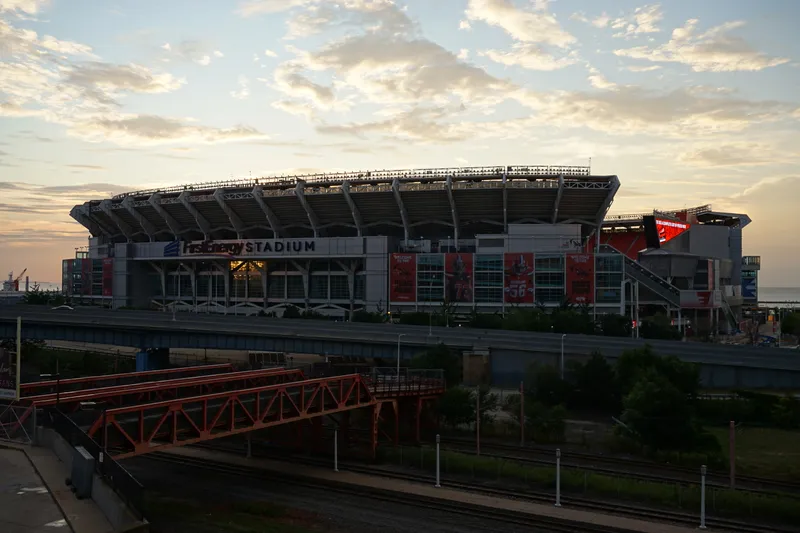
About Huntington Bank Field
On the shore of Lake Erie in downtown Cleveland, a 67,895-seat open-air venue puts the Cleveland Browns in front of the lake, the North Coast Harbor, and the downtown skyline. It is one of the only NFL stadiums built right at the edge of a Great Lake, and on winter Sundays, the wind off Erie makes this one of the coldest and most challenging environments in professional football.
The Browns have called this place home since 1999, when Cleveland was awarded an expansion franchise after Art Modell controversially moved the original Browns to Baltimore in 1996. The city kept the name, the colors, and the history, and on opening day in 1999, 73,000 fans showed up to reclaim what was theirs. The Dawg Pound moved to the east end zone, and the barking hasn’t stopped since.
Designed by HOK Sport (now Populous) and built for $283 million, the stadium opened on September 12, 1999. Funded through a combination of the NFL’s expansion fund, city bonds, and a sin tax on alcohol and tobacco in Cuyahoga County, the venue was constructed on the site of the old Cleveland Municipal Stadium, which had been demolished in 1996. The Kentucky Bluegrass playing surface is maintained year-round despite Cleveland’s harsh winters.
The stadium has cycled through several names since 1999, Cleveland Browns Stadium, FirstEnergy Stadium, back to Cleveland Browns Stadium, and now Huntington Bank Field, but its identity has never changed. This is the Dawg Pound’s home, the Muni Lot’s stage, and the place where Cleveland football lives on the lakefront.
Getting to Huntington Bank Field
Public Transit
Huntington Bank Field is on the lakefront in the North Coast Harbor district, accessible by streetcar and rapid transit.
→ Via RTA Waterfront Line: The streetcar runs from Tower City Center to the stadium stop on game days. Service begins 2 hours before kickoff and runs for 1 hour after the game. Fare is $2.50.
→ Via RTA Rapid Transit: The Red, Blue, and Green Lines all connect to Tower City Center downtown, about a 15-minute walk north along East 9th Street to the stadium. The Red Line connects directly to Cleveland Hopkins International Airport.
The walk from Tower City to the stadium along East 9th Street passes the Rock & Roll Hall of Fame and Great Lakes Science Center, one of the best pregame walks in the NFL.
Driving + Parking
The stadium address is 100 Alfred Lerner Way, Cleveland, OH 44114. The Shoreway (OH-2) and I-90 are the primary approaches.
→ From Columbus (~143 mi): I-71 North directly to Cleveland. About 2 hours 15 minutes.
→ From Pittsburgh (~130 mi): I-76 West to Ohio Turnpike (I-80) to I-77 North into Cleveland. About 2 hours.
→ From Detroit (~170 mi): I-75 South to Ohio Turnpike (I-80/90) East to I-77 North. About 2 hours 40 minutes.
The Muni Lot, the free municipal parking lot west of the stadium, is Cleveland’s famous tailgate destination and one of the NFL’s most talked-about pregame scenes. Arrive early; it fills well before kickoff. Stadium lots cost $25–$40, and downtown garages run $15–$30 with a short walk north.
Rideshare
Uber and Lyft have a designated zone on Erieside Avenue near the stadium’s south entrance. From downtown Cleveland hotels, expect $6–$10. Post-game surge pricing is moderate, walk south toward Public Square and wait 10–15 minutes for rates to settle.
From the Airport
→ Cleveland Hopkins International (CLE): 12 miles southwest of the stadium, about 20 minutes by car. Served by United (hub), American, Delta, Southwest, Frontier, and Spirit. The RTA Red Line rapid transit connects the airport to Tower City Center for $2.50 (about 25 minutes). Rideshare runs $20–$30.
Construction & Design
Huntington Bank Field exists because of one of the NFL’s most bitter franchise departures. When Art Modell announced during the 1995 season that he was moving the original Browns to Baltimore, Cleveland fought back through litigation and negotiation. The resolution was unusual: the city agreed to demolish the aging Cleveland Municipal Stadium and build a new venue on the same lakefront footprint, while the NFL guaranteed that the Browns’ name, colors, and records would stay in Cleveland and that a reactivated franchise would begin play by 1999. The stadium was therefore purpose-built to receive a team that did not yet exist when ground broke on May 15, 1997.
The stadium was designed by HOK Sport, now Populous, working with local associate architects Robert P. Madison International and Ralph Tyler Companies, with structural engineering by Osborn Engineering, the historic Cleveland firm that had engineered the original Municipal Stadium decades earlier, and Huber, Hunt & Nichols as general contractor. Built for roughly $283 million and funded largely through a voter-approved Cuyahoga County sin tax on alcohol and tobacco, the open-air bowl sits directly on the shore of Lake Erie in the North Coast Harbor district. That lakefront placement is the venue’s defining trait and its greatest liability: it sits right at the edge of Lake Erie, and the wind and cold off the water produce some of the harshest playing conditions in the league. The natural Kentucky bluegrass field grows over a sand-soil root zone with an underground heating system to survive Cleveland’s late-season weather.
The stadium’s run as the Browns’ home is now finite. A once-planned $1.2 billion renovation of the lakefront site was shelved, and in October 2024 the Browns announced they would instead build a new enclosed, domed stadium in suburban Brook Park near Cleveland Hopkins Airport, designed by HKS and targeting a 2029 opening, with the Huntington Bank Field name set to transfer to the new venue. For now the lakefront stadium remains the home of the Dawg Pound, the east end-zone bleachers where fans in dog masks bark at opposing players, a tradition carried over from the old Municipal Stadium.
History of Huntington Bank Field
Huntington Bank Field was built to bring the Cleveland Browns back. After Art Modell moved the original Browns to Baltimore following the 1995 season, Cleveland negotiated to keep the name, colors, and franchise history, and the NFL awarded the city an expansion team that would begin play in 1999. The $283 million stadium was designed by HOK Sport (now Populous) and built on the site of the old Cleveland Municipal Stadium.
First Game (September 12, 1999): The expansion Browns hosted the Pittsburgh Steelers in the franchise’s return game before 73,138 fans. Pittsburgh won 43–0, but Cleveland had its team back.
The Bottle Game (December 16, 2001): A controversial official review reversal with 48 seconds left prompted fans to throw plastic bottles onto the field, halting play. The NFL later reversed the officials’ on-field decision, one of the only times the league has done so.
Return of the Dawg Pound (1999–present): The Dawg Pound tradition moved from the old Municipal Stadium to the east end zone bleachers. Fans in dog masks, face paint, and orange-and-brown gear have made it one of the NFL’s most hostile sections for visiting teams.
Naming Rights History: The stadium was Cleveland Browns Stadium from 1999 to 2013, FirstEnergy Stadium from 2013 to 2023, reverted to Cleveland Browns Stadium in 2023, and became Huntington Bank Field in 2024 under a 20-year partnership with Huntington Bancshares.
From heartbreak to homecoming to the Dawg Pound’s relentless devotion, Huntington Bank Field is where Cleveland football was resurrected, a lakefront fortress where the wind, the cold, and the fans never let visitors forget where they are.
Sources & Further Reading
- Wikipedia entry on Huntington Bank Field: en.wikipedia.org/wiki/Huntington_Bank_Field. Architect, engineer, contractor, cost, funding, the naming history, and the Brook Park plans.
- Stadiums of Pro Football, Huntington Bank Field: stadiumsofprofootball.com. Construction, cost, funding split, and capacity.
- Cleveland Browns, Huntington Bank naming-rights announcement: clevelandbrowns.com. The 2024 renaming and 20-year partnership.
- Cleveland.com Browns coverage: cleveland.com. Local reporting on the stadium and the Brook Park move.
Quick Facts
Everything you need at a glance.
Stadium specs
- Capacity
- 67,895
- Opened
- 1999
- Cost
- Around $283 million (1999), largely publicly funded via a Cuyahoga County sin tax
- Roof
- Open
- Surface
- Natural Grass (Kentucky Bluegrass)
- Tenants
- Cleveland Browns (NFL)
Construction & location
- Groundbreaking
- May 15, 1997 (opened September 12, 1999)
- Architects
- HOK Sport (now Populous), Robert P. Madison International and Ralph Tyler Companies (associate)
- Engineering
- Osborn Engineering
- General contractor
- Huber, Hunt & Nichols
- Address
- Huntington Bank Field, 100 Alfred Lerner Way, Cleveland, OH 44114
- GPS
- 41.5061°N, 81.6995°W
Photo Gallery
Fun Facts
Huntington Bank Field sits right on the shore of Lake Erie, whose waves crash against the North Endzone seawall, and winter winds off the lake have produced some of the most brutal weather conditions in league history.
The Dawg Pound, the bleacher section in the east end zone, is one of the NFL's most intimidating fan sections, where fans have dressed in dog masks and barked at opposing players since the tradition began in the late 1980s at the old Municipal Stadium.
When the Browns returned as an expansion team in 1999, they had sold out their season tickets before playing a single game, reflecting Cleveland's desperation to have its team back.
Stadium Location
Frequently Asked Questions
- What is the seating capacity of Huntington Bank Field?
- Huntington Bank Field seats 67,895 for NFL games. Its record crowd is 73,718, set in 2002 before a 2014 renovation trimmed the lower bowl. The Browns have announced they will leave for a new domed stadium in suburban Brook Park, targeting a 2029 opening.
- Where is Huntington Bank Field located?
- Huntington Bank Field is at 100 Alfred Lerner Way in Cleveland, Ohio 44114. It sits on the shore of Lake Erie in the North Coast Harbor area, adjacent to the Rock & Roll Hall of Fame and Great Lakes Science Center.
- How do I get to Huntington Bank Field by public transit?
- The RTA Waterfront Line streetcar runs from Tower City Center to the stadium on game days. RTA's Red, Blue, and Green rapid transit lines connect to Tower City, about a 15-minute walk from the stadium. Multiple RTA bus routes also serve the lakefront on game days.
- Is there parking at Huntington Bank Field?
- Stadium lots on the North Coast Harbor cost $25–$40 on game days. Muni Lot (the free municipal parking lot west of the stadium) is Cleveland's famous tailgating spot, arrive early as it fills by 8 AM. Downtown garages run $15–$30 with a 15-minute walk.
- What was the stadium called before Huntington Bank Field?
- The stadium opened as Cleveland Browns Stadium in 1999, was renamed FirstEnergy Stadium in 2013, reverted to Cleveland Browns Stadium in 2023, and became Huntington Bank Field in 2024 under a 20-year partnership with Huntington Bancshares.
- What is the Dawg Pound?
- The Dawg Pound is the bleacher section in the east end zone (sections 136–148), known as one of the NFL's most intense fan sections. Fans wear dog masks, throw dog biscuits, and bark at opposing players. The tradition began in the late 1980s at the old Cleveland Municipal Stadium.
- What is the Muni Lot?
- The Muni Lot is the free municipal parking lot west of the stadium, Cleveland's famous tailgate destination. Fans arrive as early as 6 AM for 1 PM kickoffs. It is one of the largest and most talked-about tailgate scenes in the NFL. The lot fills well before kickoff.
- How far is the airport from Huntington Bank Field?
- Cleveland Hopkins International Airport (CLE) is 12 miles southwest of the stadium, about 20 minutes by car. The RTA Red Line rapid transit connects the airport to Tower City Center downtown for $2.50 (about 25 minutes), then walk or take the Waterfront Line to the stadium.
Last updated: 2026-07-08