Seven NFL clubs are building or rebuilding their stadiums right now, the biggest construction wave the league has seen in years, and every one of the finished buildings will be more expensive, more engineered and more comfortable than the one it replaces. Almost every one will also be smaller.
Six of the seven projects have published a capacity. Add them up and the new buildings hold 32,268 fewer people than the ones they’re knocking down. Five shrink. One, Washington’s, gains about a thousand seats. None gets meaningfully bigger. Billions of dollars are going in, roofs are going on, and the seat counts are coming down, on purpose, everywhere at once.
That’s not an accident of architecture. It’s a decision, and the reason for it is sitting at the end of this piece. First, the map.
The seven projects
| Club | Stadium | City | Opens | New | Old | Change |
|---|---|---|---|---|---|---|
| Bills | Highmark Stadium | Orchard Park, NY | Open | 60,108 | 71,608 | -11,500 |
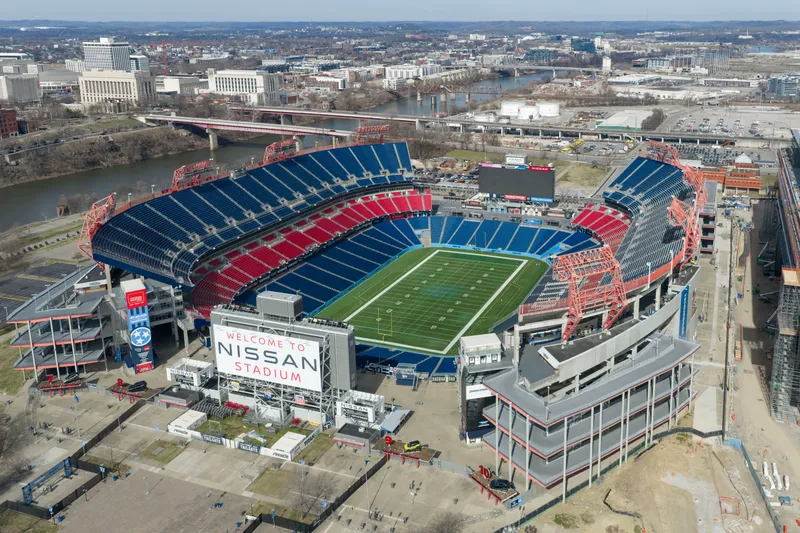
| Titans | New Nissan Stadium | Nashville | 2027 | 60,000 | 69,143 | -9,143 |
| Jaguars | EverBank Stadium rebuild | Jacksonville | 2028 | 62,000 | 67,814 | -5,814 |
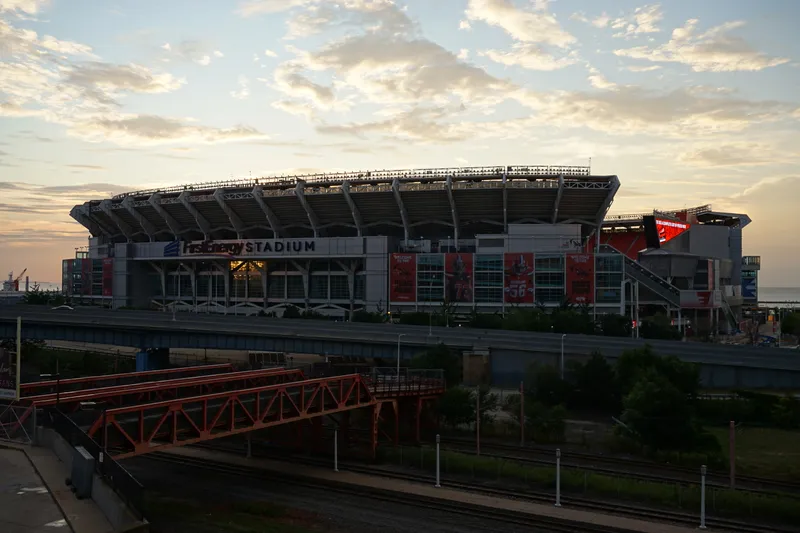
| Browns | New Huntington Bank Field | Brook Park, OH | 2029 | 67,500 | 67,895 | -395 |
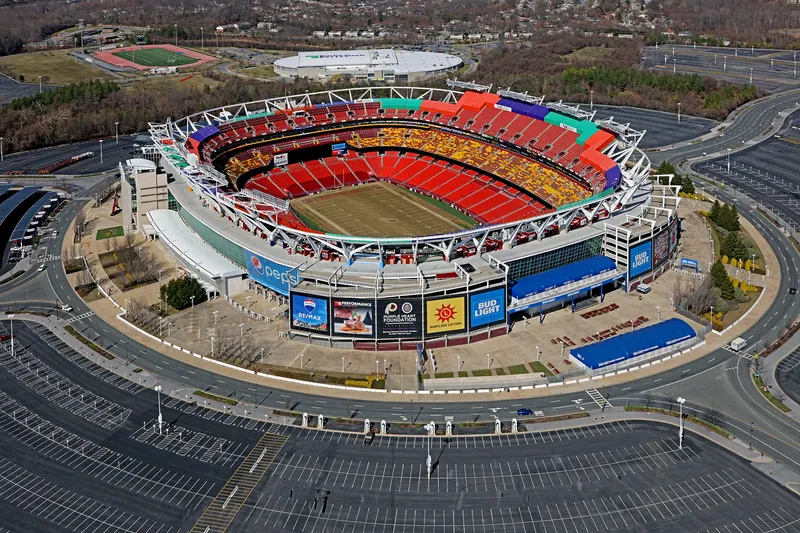
| Commanders | New Stadium at RFK Campus | Washington, DC | 2030 | 65,000 | 64,000 | +1,000 |
| Chiefs | New Chiefs Stadium | Kansas City, Kansas | 2031 | 70,000 | 76,416 | -6,416 |
| Bears | Chicago Bears Stadium | Hammond, Indiana | 2031 | not published | 61,500 |
The math, so you can check it: the six projects with published capacities replace 416,876 seats with 384,608. That’s 32,268 gone, and it’s MeetStadium’s own calculation, not a league figure. The Bears are excluded because no capacity has been published for Hammond, so the real total will move once Chicago’s number lands.
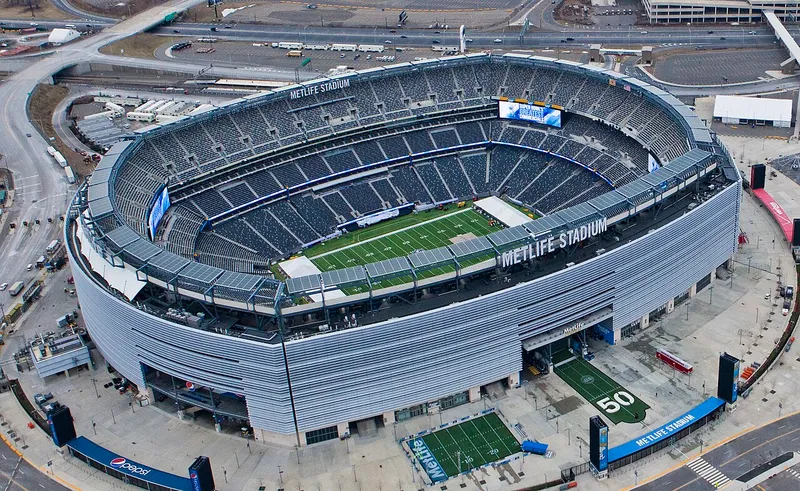
For scale, MetLife Stadium is the NFL’s biggest at 82,500, and nothing under construction comes within 12,000 seats of it. Eight college football stadiums hold more than 100,000 people. No NFL stadium does, and after this wave the league will be further from that number than ever.
32,268 seats removed across six new stadiums, against one gain of about a thousand in Washington.
December in Orchard Park
Start in Buffalo, because Buffalo made the strangest choice on this list and the most honest one.
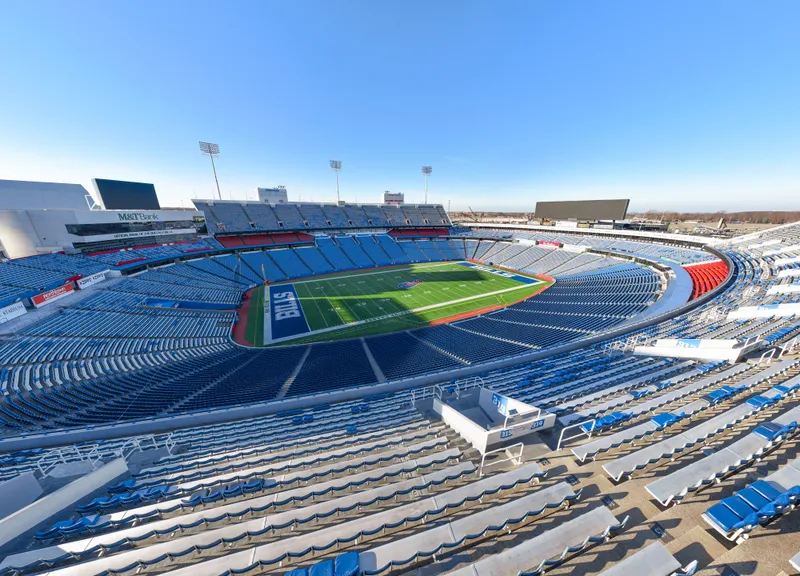
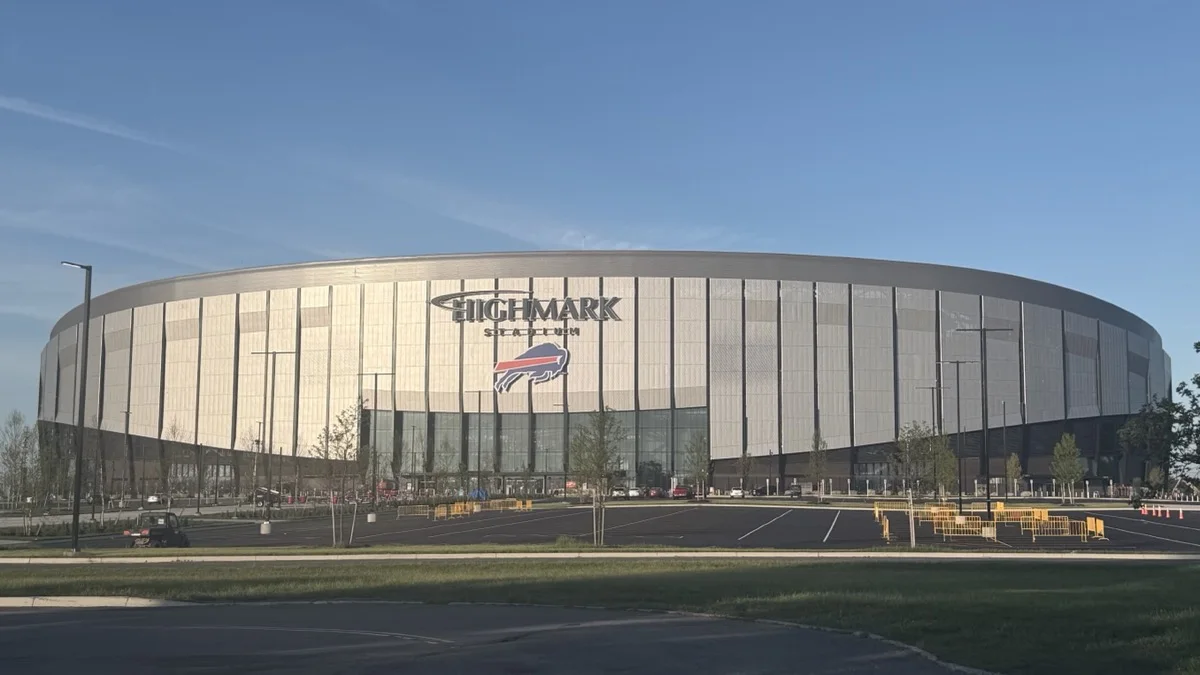
New Highmark Stadium holds 60,108, the fewest in the NFL. Soldier Field, the league’s oldest building, is next at 61,500. The Bills took a 71,608-seat stadium in the lake-effect snow belt, removed 11,500 seats, and then, with somewhere between $1.7 and $2.2 billion on the table, declined a roof. A canopy covers about two thirds of the seats. The field is open to the sky. They chose to cover the people and leave the game outside.
Sit in that building in December and you understand it as a position, not an oversight. The wind comes off Lake Erie with nothing much to slow it down, gets under the canopy edge and finds the back of your neck anyway. The snow doesn’t fall so much as travel, sideways, through the light towers, and the grass below you goes white in bands while the ground crew fights the yard lines. Your coffee is a hand warmer first and a drink second. Sixty thousand people sit in a heated-adjacent crescent of steel and watch twenty-two men play football in weather the rest of the league has decided to abolish. The old stadium spent fifty-three seasons becoming famous for exactly this, games played in horizontal snow, and the new one is built to keep the famous part.
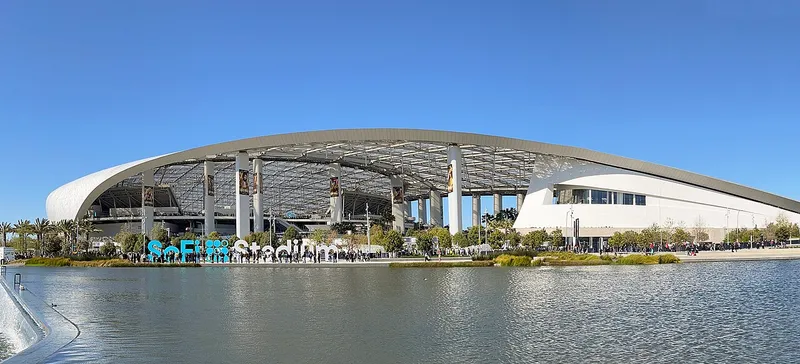
Meanwhile Nashville, Cleveland, Kansas City, Washington and Chicago are all putting lids on. The newest open-air buildings before this wave, SoFi Stadium and Allegiant Stadium, both went under roofs too. Buffalo looked at the same weather that drove everyone else indoors and built a porch.
The opening was really three openings, and it’s worth being precise because “opened in June” isn’t true in any way a fan would recognize. The ribbon was cut on June 23, 2026. The first crowd came on August 8, 2026, when 51,807 season-ticket holders showed up to watch an open practice. The first regular-season game was September 17, 2026. The building it replaced opened in 1973 as Rich Stadium, hosted its last regular-season game on January 4, 2026 against the Jets, and came down over the course of that year. Fifty-three seasons, then months to erase.
11,500 seats removed in a single rebuild, in the one market nobody accuses of weak demand.
The money, and who’s paying it
Buffalo’s public share, $850 million ($600 million from New York State, $250 million from Erie County), was the biggest subsidy in NFL history when it was struck in March 2022. The record lasted thirteen months.
Nashville’s new Nissan Stadium costs $2.1 billion, and $1.26 billion of it is public money: $500 million from the State of Tennessee, $760 million in Metro Sports Authority revenue bonds, with $840 million coming from the Titans and the NFL together. Forbes calls the public share an NFL record, “the most in NFL history.” The building is indoor, with a skylight, seats 60,000, and hosts Super Bowl LXIV in 2030, which tells you what the league thinks of the arrangement.
Buffalo’s own construction cost is genuinely unpinnable. It was struck at $1.4 billion in 2022, rose $300 million by 2023, and published totals since run between $1.7 and $2.2 billion depending on the source. Anyone who gives you one clean number for that building is rounding toward the story they want to tell.
Cleveland is the caution flag. Ohio’s legislature approved public funding in June 2025, but the state’s $600 million is on hold pending a class-action lawsuit, and Brook Park has not approved its share. The financing is not settled. The Browns broke ground anyway, on April 30, 2026, on Five Points Road out by the airport, for a 67,500-seat indoor stadium replacing Huntington Bank Field in 2029. Building the hole before the money clears is a bet, and it’s being made with a straight face.
$1.26 billion in public money for Nashville’s stadium, an NFL record that beat Buffalo’s thirteen-month-old one.
Washington goes home
The Commanders’ project is the only one on this list moving toward its history instead of away from it. The franchise played at the RFK site before decamping to Landover, Maryland, where Northwest Stadium has stood since September 14, 1997. The new stadium puts them back on the RFK campus: 65,000 seats plus room for 5,000 standing, under a skylight of cable-netted ETFE, groundbreaking planned for early 2027, the stadium itself scheduled for completion in December 2030.
The price is $3.8 billion, the largest single figure in this piece. The club pays $2.7 billion. The District adds $500 million in infrastructure through a Sports Facilities Fee, $356 million for a parking garage through Events DC bonds, and $202 million in utilities from general taxes: $1.058 billion public, all in.
And the old stadium doesn’t get to linger. Josh Harris signed a memorandum of understanding with Maryland officials to begin demolishing Northwest Stadium within 90 days of the club’s first game at the new one. That’s contractual, not aspirational. A 64,000-seat building with a scheduled execution date, 200 acres of Landover turning into mixed-use development behind it.
Jacksonville rents in Orlando
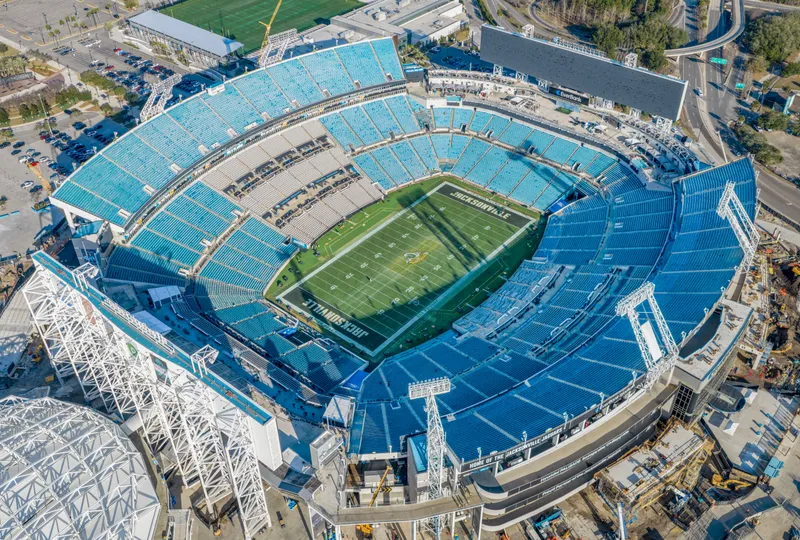
The Jaguars aren’t building a stadium. They’re rebuilding EverBank Stadium, a project the club calls the Stadium of the Future, approved unanimously by NFL owners in October 2024. Work started in February 2025 and finishes for the 2028 season: a 360-degree concourse, an energy-efficient facade, and a large canopy for shade. It’s a canopy. It is not a dome, and Jacksonville will correct you.
Capacity drops from 67,814 to 62,000, though the building can expand to 71,500 for college football, which says something about who still fills upper decks.
The strange part is the gap year. EverBank closes after the 2026 season and the Jaguars play the entire 2027 season at Camping World Stadium in Orlando, approved by all 32 owners. An NFL club, homeless for a full year, renting a college bowl venue down the road. Camping World is itself in the middle of a $400 million renovation to reach 65,000, so the temporary home is being rebuilt to receive the tenant whose real home is being rebuilt.
The league goes indoors
Five of the seven will be covered, continuing a twenty-year move toward roofs: New Nissan and the new Huntington Bank Field are fully indoor, Washington gets its ETFE skylight, Chicago’s Hammond building is planned as indoor with a skylight, and Kansas City goes under translucent ETFE, more than 400,000 square feet of it.
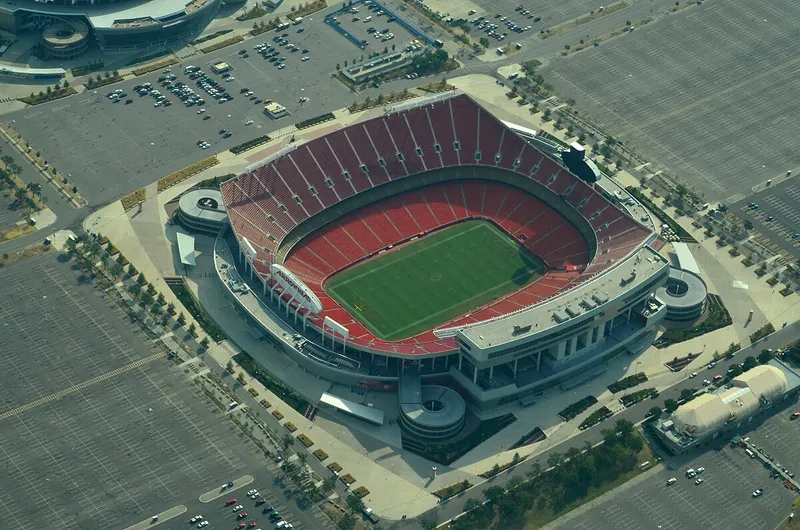
The Chiefs are the interesting case, because they’re trying to move a ghost. Arrowhead holds the Guinness record for the loudest crowd roar at an outdoor sports stadium, 142.2 decibels, and the new bowl in Kansas City, Kansas is deliberately shaped to be reminiscent of Arrowhead so the noise survives the move. Team president Mark Donovan said in July 2026 that the club’s “preference is grass,” relying on light through the translucent roof to keep it alive, with artificial turf or a hybrid as fallbacks. Real grass under a sealed sky, grown by filtered daylight, so that a record set in the open air has somewhere to live indoors.
Buffalo and Jacksonville are the two holdouts, and they arrived at the same design from opposite climates: cover the crowd, leave the field open. Buffalo’s canopy is for snow. Jacksonville’s is for sun. Between them they mark out the last of something.
142.2 decibels at Arrowhead, the loudest crowd roar ever recorded at an outdoor stadium. The new bowl is shaped to carry it indoors.
The Bears, in nine dates
No project on this list has wandered like Chicago’s, so here it is as a timeline, which is the only honest shape for it.
February 2023: the Bears buy the 326-acre Arlington Park racetrack site in Arlington Heights. March 2024: they float a lakefront stadium in Chicago instead. May 2024: Governor Pritzker’s office calls the lakefront plan a “non-starter for the state,” lacking “demonstrable and tangible benefit to the taxpayers of Illinois.” September 2025: the club recommits to Arlington Heights, saying it would build there with “zero state money for construction.” November 2025: the Arlington Heights plan stalls anyway, over state infrastructure money and a frozen property tax assessment. December 17, 2025: the search widens to Northwest Indiana. February 2026: Indiana’s Senate Bill 27 names Hammond. June 5, 2026: the board votes to “advance our stadium development project in Hammond, Indiana,” while the club says “the exact site” is still “to be selected.”
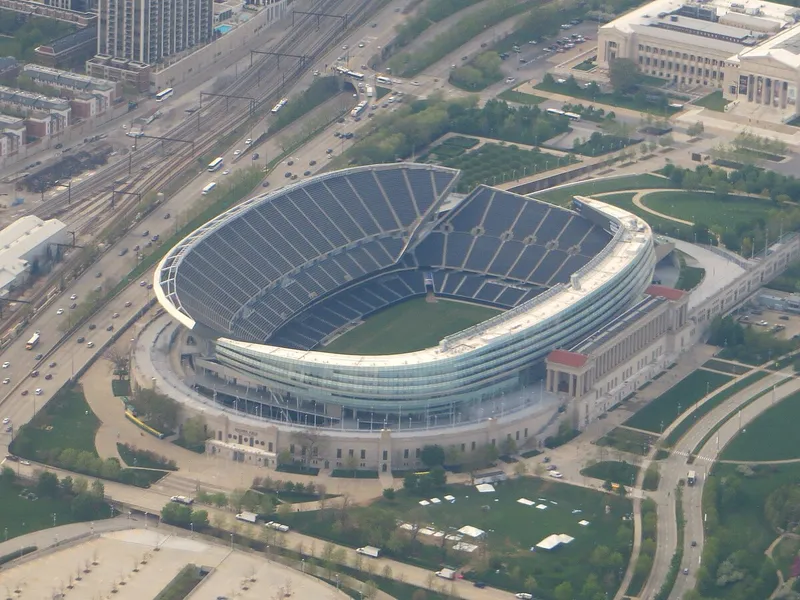
So the team that has played on the Chicago lakefront since 1971, in a building that opened in 1924 and stands as the oldest in the league, is now headed for Hammond, Indiana. The Hammond area, near Wolf Lake, is heavily industrialized ground. One earlier cleanup there ended with a golf course built on top of “a mountain of slag,” capped with “bio-solids that are treated human waste.” Next to the area sits a Superfund site at the former Federated Metals smelter, where the EPA has attempted a partial cleanup of elevated lead and arsenic. The stadium site itself is not the Superfund site; that’s a formal EPA designation and the distinction is real. It’s just the neighbor.
No cost has been published for Hammond, and no capacity. Whatever the number turns out to be, Soldier Field’s 61,500 is the second-smallest figure in the league today, so the Bears are one of the few clubs that could grow and still fit the pattern.
Why the seats are disappearing
Because the cheapest ones stopped paying for themselves.
A corner seat in the upper deck sells one ticket, cheaply, and sells nothing else. Give that same floor area to club seating and a wider concourse and it earns more every Sunday from fewer people. Smaller crowd, better business. That’s the whole answer, and every owner on this list has done the same arithmetic and reached it independently, which is why the trend looks coordinated without being coordinated.
If you’re inside the building, you win. Better concourses, shorter lines, a seat closer to the field, and in five of these seven stadiums, weather that can’t reach you. The old buildings were bigger and worse, and almost nobody who actually attends games will miss them.
The cost lands on the people who aren’t in the building. Buffalo removed 11,500 seats. Tennessee removes 9,143. Kansas City takes 6,416 out of Arrowhead, the loudest outdoor room the sport ever measured. None of these clubs expects demand to fall; nobody spends two billion dollars on a product they think fewer people want. Same number of people wanting in, narrower door. The upper-deck corner seat, the one a kid’s first game happened in because it was the one the family could afford, is the specific thing being traded away, market by market, for a wider concourse it will never see.
Sources
- Buffalo: the Bills’ own account of the three separate days this stadium can be said to have opened.
- Nashville: Nissan Stadium (2027) for the building, and Forbes for the public subsidy being an NFL record, and for Buffalo holding it first.
- Washington: New Stadium at RFK Campus for the building and the funding, and Maryland Matters for the signed 90-day commitment to demolish Northwest Stadium.
- Cleveland: NFL.com for the groundbreaking, the capacity, and Ohio’s money being on hold.
- Kansas City: New Chiefs Stadium for the Kansas move, the bowl shaped after Arrowhead, and the grass preference.
- Chicago: Chicago Bears Stadium for the timeline, the Pritzker quotations and the Wolf Lake site.
Hero photo: Highmark Stadium viewed from the west, May 2026, by Dekema, Wikimedia Commons, CC0.
Costs and capacities for unbuilt stadiums are projections and move as projects advance; several cost figures, Buffalo’s above all, are disputed between reputable sources. The 32,268-seat total is MeetStadium’s own calculation across the six projects with published capacities.