About SoFi Stadium
Los Angeles had no NFL team between 1995 and 2016, which made the metropolis the largest unclaimed market for professional football in the United States. That gap closed when the NFL approved Stan Kroenke’s relocation of the Rams from St. Louis, with the Chargers joining a year later under Dean Spanos. The project that would become SoFi Stadium began the same year, when Kroenke bought a large parcel of the recently defunct Hollywood Park horse racing track, just under 5 kilometres (3 miles) east of Los Angeles International Airport.
The Inglewood location forced serious compromises. Federal aviation authorities objected to any structure that would rise above a threshold set by LAX approach radar, so the seating bowl went below street level instead. Kroenke paid around $29 million for airport infrastructure upgrades to avoid radar interference, and no tower cranes were permitted on the construction site. An estimated 7.5 million cubic yards of earth had to be excavated. HKS puts the finished bowl at 100 feet below existing grade, two to three times the depth of comparable multi-use venues, and describes the restriction that forced it as having become one of the project’s most prominent features. Fans descend into the bowl rather than climb into it. An unusual approach for a US venue.
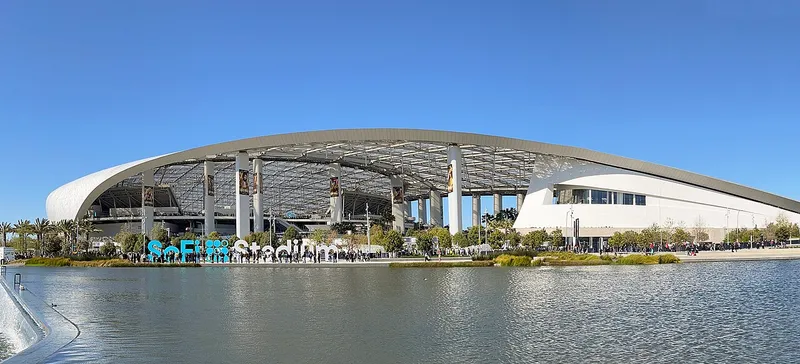
Design was awarded to HKS, the Dallas firm responsible for AT&T Stadium in Arlington. The brief called for maximum flexibility: a district-scale venue capable of hosting the NFL’s Rams and Chargers, MLS Cup finals, Super Bowls, the 2026 FIFA World Cup (eight matches including a quarterfinal), and a share of the 2028 Olympic opening ceremony. Under a single ETFE canopy, HKS fit a 70,240-seat main bowl (expandable by 30,000 more for major events), a 6,000-seat indoor concert venue (the YouTube Theater), and the 2.5-acre American Airlines Plaza in between, also available for events. At 3.1 million square feet (288,500 square metres) it is the largest stadium in the NFL, with 260 luxury suites, 13,000 premium seats and twelve club spaces.
The canopy is the stadium’s dominant architectural feature. Covered with single-layer ETFE and composed of 302 panels (46 of which can open mechanically for ventilation), it spans around 75,000 square metres (807,000 square feet) and is the largest of its kind. Weight is substantial. Approximately 67,000 tons of materials, including 20,000 tons of primary steel trusses and 1,400 tons of tensile cables, resting on 37 primary columns. Beneath the canopy hangs the “Infinity Screen,” a panoramic dual-sided video board weighing about 1,000 tons, offering 6,500 square metres (70,000 square feet) of 4K display surface across 80 million pixels. Integrated with 260 speakers and 56 5G antennas.
The financial numbers are the other record. SoFi broke the stadium cost record before construction even began. A $2.66 billion estimate at 2016 groundbreaking grew to $3.4 billion by May 2020. The stadium itself landed around $5.5 billion, and it sits inside a wider Hollywood Park development of 2,500 housing units, 83,600 square metres of retail, 74,300 square metres of offices, a hotel, a casino, and the 6,000-seat YouTube Theater. The stadium opened on September 8, 2020, in the middle of a pandemic that left it empty of fans for nearly a year. The venue had, however, already locked in a SoFi naming deal reported at more than $30 million a year across 20 years, a joint tenancy agreement between the Rams and Chargers ($200 million each in loans, $1/year rent to StadCo LA), and hosting rights for Super Bowl LVI (February 2022), the 2023 College Football Playoff National Championship, multiple WrestleManias, and the 2028 Olympics. Under FIFA’s branding policy, SoFi was temporarily renamed “Los Angeles Stadium” for the 2026 World Cup.
Getting to SoFi Stadium
Public Transit
Los Angeles has historically been a car-dependent city, and the rail link SoFi was promised is not coming. The Inglewood Transit Connector, an automated people mover that would have run from the Downtown Inglewood station on the Metro K Line to the stadium door, collapsed after the South Bay Cities Council of Governments declined a further $493 million in October 2024, which put roughly $1 billion in federal matching funds out of reach. In April 2025 the city replaced it with a phased plan of dedicated bus and bike lanes along Hawthorne Boulevard, La Brea Avenue, and Arbor Vitae Street, aimed at the 2028 Olympics. So the Metro C Line plus a shuttle remains the practical rail option.
→ Current rail + shuttle: Take the Metro C or K Line to LAX/Metro Transit Center, then the shuttle to the stadium from Bus Bay 8 on game day. Metro moved the shuttle here in 2025. It used to run from Hawthorne/Lennox on the C Line, so older directions still circulating will send you to the wrong station.
→ Direct buses from the suburbs: Several operators run straight to the stadium and undercut parking comfortably. GTrans line 7X from Harbor Gateway Transit Center and Torrance Transit both run about $4 round trip, and Culver CityBus line 99 Express is roughly $2.
→ From downtown LA: Metro E Line (Expo Line) to Crenshaw, then transfer to the K Line or C Line. Total journey around 50-60 minutes, depending on transfers.
→ From Santa Monica: E Line eastward to downtown, then south. Expect about 70 minutes door-to-door.
Plan on the shuttle rather than a train to the gate. The bus-lane program is meant to be in place for the Olympics, but nothing rail-based will reach the stadium itself.
Driving + Parking
Three freeways serve the stadium: I-405, I-105, and I-110. GPS: 1001 S. Stadium Drive, Inglewood, CA 90301.
→ Direct buses from the suburbs: Several operators run straight to the stadium and undercut parking comfortably. GTrans line 7X from Harbor Gateway Transit Center and Torrance Transit both run about $4 round trip, and Culver CityBus line 99 Express is roughly $2.
→ From downtown LA: I-110 South to I-105 West, then Prairie Avenue exit. Roughly 20 kilometres (12 miles), with a driving time of 20-45 minutes depending on traffic.
→ From LAX: Around 5 kilometres (3 miles). One of the shortest airport-to-stadium distances in the whole World Cup. A 7-minute drive without traffic stretches to 20-40 minutes on event days due to surrounding street congestion.
→ From Santa Monica: I-405 South to Century Boulevard or Manchester Boulevard exit. Around 24 kilometres (15 miles), 30-60 minutes.
The Hollywood Park complex is served by more than 9,000 parking spaces across structured garages. Parking costs $40-80 for NFL games and must be pre-purchased through the SoFi Stadium app or website. Cash is not accepted. Arriving two hours before kickoff is strongly recommended on high-demand event days.
Rideshare
Uber and Lyft pickups are routed to the Pink Garage on the east side of the stadium. Post-event wait times can exceed 30 minutes during sold-out events. Rides from downtown LA typically run $25-45. From Santa Monica, $30-50.
Pro tip: Walk to the rideshare area the moment the match ends, or wait 30+ minutes for the first wave of departures to clear.
From the Airport
→ LAX (Los Angeles International): About 5 kilometres (3 miles), the closest airport to any 2026 World Cup venue. By car, 7-15 minutes without event traffic, stretching to 20-40 minutes on match days. No direct rail link is currently operational. Shuttle and rideshare are the quickest options.
→ Hollywood Burbank (BUR): Around 40 kilometres (25 miles) north of Inglewood. 35-60 minutes by car, or Metro B Line to downtown then a southward transfer.
→ John Wayne (SNA): Around 65 kilometres (40 miles) south in Orange County. 45-75 minutes by car, and no convenient rail alternative.
Watching a Game at SoFi Stadium
Ask a season-ticket holder where to sit and the answer is rarely “as close as you can afford.” The front rows of the lower bowl look like the prize, but players, coaches, and sideline staff spend three hours standing between you and the game. Regulars point instead to the 300 level between the 30-yard lines, the best value in the building, or the front row of the 500s when the budget is tight.
The 500 level has a worse reputation than it deserves. It is high. You will not make the stadium cam. But the Infinity Screen hangs in the middle of the bowl, 6,500 square metres (70,000 square feet) of it, so the distance that usually ruins a cheap seat matters less here than almost anywhere else. The genuine weak spot is the back few rows behind the 40, where the screen sits in your eyeline and the aisle below fills with people moving. Fans also report that moving down a level during the game does not work.
Then there is the away-fan question, which is really a history question. With no NFL team in the city for twenty-one years, a generation of Angelenos adopted somebody else, and San Francisco supporters in particular still arrive in numbers. American stadiums do not segregate home and away fans the way European grounds do, which catches first-time visitors off guard. The local counter-ritual has a name: the Bang Bang Escalator Gang, Rams fans filming departing 49ers supporters riding the escalators out after a loss.
Eat first. Poor concessions are the most common complaint regulars make about the place, the beer ranks among the most expensive in the league, and the lines are slow: one fan joined a queue twelve minutes before kickoff and sat back down with ten minutes left in the first quarter. If you do eat inside, the items people defend are the pastrami fries near sections 101 to 106, the Olvera Street stand, and Korean chicken over tater tots. Outside in the lots, a bacon-wrapped street dog runs about ten dollars.
FIFA World Cup 2026 at SoFi Stadium
Eight matches were played at SoFi Stadium between June 12 and July 10, 2026: five group stage games, two Round of 32 fixtures, and one quarterfinal. Only AT&T Stadium, with nine, hosted more, putting SoFi level with MetLife and Mercedes-Benz on eight.
Name change: Under FIFA’s corporate naming policy, the stadium was temporarily referred to as “Los Angeles Stadium” in all broadcasts, signage, printed materials, and ticketing for the duration of the tournament. Corporate naming rights resumed afterwards.
Pitch conversion: The Matrix Turf surface was replaced with natural grass laid on a modular tray system. FIFA requires real grass for all World Cup matches. SoFi has done this before. The 2023 CONCACAF Gold Cup Final between Mexico and Panama was hosted on the same type of temporary surface, drawing 72,963 fans.
Climate: Inglewood in June and July is near-ideal for outdoor soccer, typically 24-27°C (75-80°F) with minimal rainfall. The ETFE canopy provides shade over most seats while allowing Pacific airflow into the bowl. Mechanical cooling is unnecessary.
Infinity Screen: The 70,000 square foot (6,500 square metre) Samsung video board carried replays, match stats, and atmosphere for fans inside. For the broadcast audience, the interior shots from SoFi were among the most visually distinctive of any 2026 venue.
Los Angeles is the entertainment capital of the United States. The quarterfinal was the biggest match the building has staged since Super Bowl LVI, and the grass held up across all eight fixtures. The Hollywood Park development around the stadium offers dining, entertainment, and hotel options within walking distance.
The 2028 Olympics at SoFi Stadium
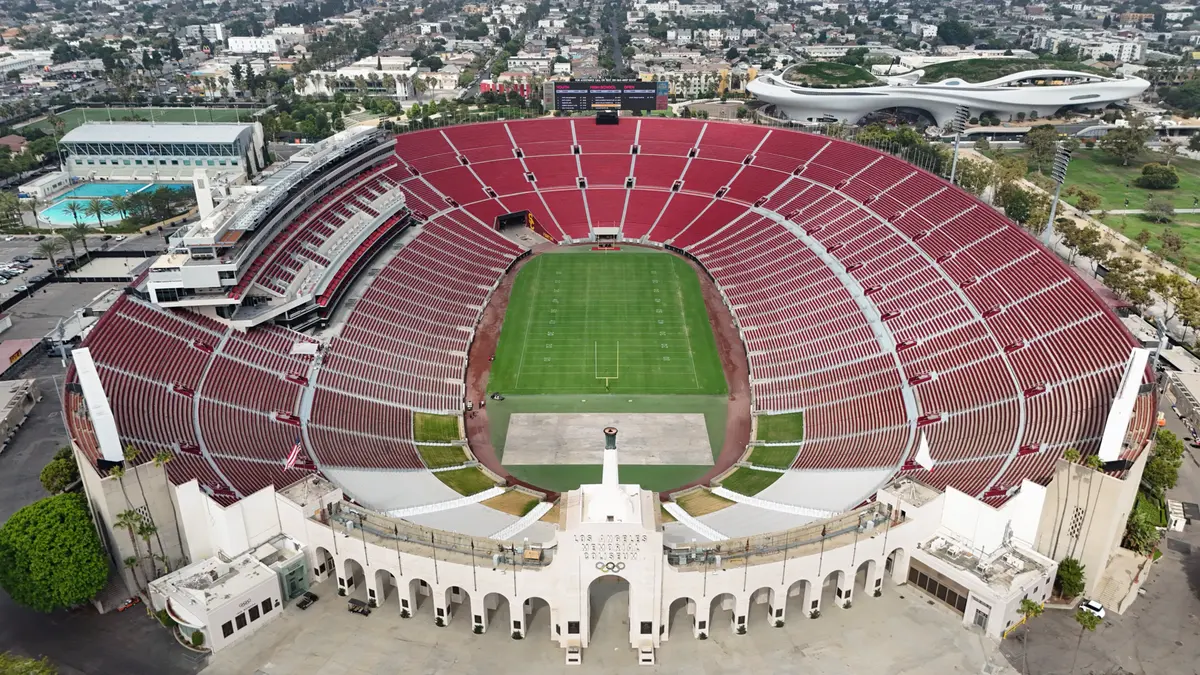
The Games return to Los Angeles on July 14, 2028, and SoFi has two jobs. The first is ceremonial. The opening ceremony is co-hosted by SoFi and the Los Angeles Memorial Coliseum, the first Olympic opening staged across two stadiums at once. The closing ceremony belongs to the Coliseum alone. SoFi then opens the Paralympics on its own on August 15, with that closing ceremony returning to the Coliseum too.
The second job is stranger. SoFi becomes the swimming venue, with a temporary pool dropped into a football bowl and seating set at around 38,000, which would make it the largest swimming venue in Olympic history. Most hosts build an aquatics center and then spend the next thirty years working out what to do with it. Los Angeles is borrowing a stadium for two weeks instead, which is the whole logic of these Games in one venue. Full details of every site are in our Los Angeles 2028 Olympics guide.
Construction & Design
Construction began on November 17, 2016. The design had been awarded to HKS, Inc., with structural engineering by Walter P Moore and the general contracting split between Turner Construction and AECOM Hunt in a joint venture. Project management was handled by Legends Global Planning, which is jointly controlled by the Dallas Cowboys and the New York Yankees. The original budget of $2.66 billion was projected to cover the stadium itself inside the wider Hollywood Park master plan. The number grew.
By May 2020, the cost had climbed past $3.4 billion. Final accounting, including specification upgrades, scope creep during construction, and pandemic-era disruption, landed closer to $5.5 billion for the stadium alone. Counting the surrounding mixed-use district, total investment at the site runs considerably higher, though no developer has published a combined figure. SoFi broke the record for the most expensive stadium in history before the concrete had even cured.
The below-grade excavation was the first major technical challenge. An estimated 7.5 million cubic yards of earth were removed to sink the seating bowl 30 metres (100 feet) below street level, which was necessary because the nearby LAX approach radar capped how tall any structure in the area could rise. Above the bowl sits the canopy, a tensile cable structure anchored on 37 primary columns and built from around 67,000 tons of material, including 20,000 tons of primary steel trusses and 1,400 tons of cables. The canopy is engineered to be independent of the stadium below it. Seismic-capable, since this is Southern California.
The canopy skin is the stadium’s most recognizable element. A total of 302 pillow-shaped ETFE panels form a roughly 75,000 square metre (807,000 square foot) translucent cover. ETFE lets sunlight in while reflecting heat, which eliminates the need for active air conditioning in the bowl. Most of the panels are etched with LEDs that form displays visible from aircraft landing at LAX. A total of 34,789 perforated anodized aluminum panels clad the outer edge and the opaque sections of the exterior, most of them also LED-equipped for night-time use.
Beneath the canopy hangs the Infinity Screen, the stadium’s other record-breaking element. Manufactured by Samsung, it is a dual-sided oval video board suspended over the playing surface. Weight is around 1,000 tons. The display surface measures approximately 70,000 square feet (6,500 square metres), rendering 80 million pixels in 4K HDR. Integrated into the structure are 260 speakers and 56 5G antennas. It is the largest video display ever installed at a sports venue. Visible from every seat in the bowl, including the premium club spaces beneath it.
Total floor space across the facility reaches 3.1 million square feet (288,500 square metres), the largest in the NFL by gross area. 260 luxury suites. 13,000+ premium seats. 12 hospitality clubs and seven suite experiences. Four club-level concourses, two locker room complexes (one each for the Rams and Chargers at opposite ends, plus two visitor rooms), and infrastructure designed for concurrent NFL, MLS, concert, Super Bowl, World Cup, and Olympic ceremony operations. The operational brief was unusually broad for an American venue, and the specification shows it.
Sustainability was layered into the design, although less visibly than in some contemporary venues. The Recycled Water Project, which uses reclaimed water for field irrigation and cooling, received an “Excellence in Action” award. The translucent canopy reduces daytime lighting loads by admitting natural sunlight, and the below-grade bowl benefits from thermal moderation that would not be available in an above-ground structure.
History of SoFi Stadium
The Rams had played in Los Angeles between 1946 and 1994 before moving to St. Louis. The Chargers had been in LA in 1960 before moving to San Diego. Neither city had an NFL team for the next two decades, despite LA being the second-largest metropolitan market in the country. It became something of a running joke among sports columnists. Threaten a move to LA in order to extract a better stadium deal from your home market, and then never actually move.
That changed on January 12, 2016, when NFL owners voted to approve Stan Kroenke’s relocation of the Rams from St. Louis. Chargers owner Dean Spanos was given a one-year option to join the Rams rather than proceed with a competing proposal in Carson. He took it. Both teams became co-tenants of a stadium that had not yet been built.
Groundbreaking followed on November 17, 2016. The original target was to open for the 2019 NFL season. That slipped. Design revisions, cost escalation, and later pandemic disruption pushed the opening to September 8, 2020. The inaugural game was played without fans. Supporters were not permitted inside the venue until the 2021 season, which made the first year of operations feel more like a soft launch than a debut.
The naming rights deal had been finalized well ahead of the opening. Social Finance, Inc. (trading as SoFi), a San Francisco-based consumer lender, signed a 20-year contract reported at more than $30 million a year, with the wider naming and sponsorship commitment later put at around $625 million running to 2040. The largest stadium naming deal signed to that point. The branding has since become shorthand for the venue in most contexts, although it is suspended during FIFA and IOC events under neutral-name tournament policies.
Super Bowl LVI was hosted at SoFi on February 13, 2022. The Rams defeated the Cincinnati Bengals 23-20 in front of 70,048 fans, completing a Matthew Stafford-led late drive in what was Los Angeles’s first Super Bowl hosting role since 1993. The halftime show, headlined by Dr. Dre, Snoop Dogg, Eminem, Mary J. Blige, and Kendrick Lamar, drew 103 million viewers. It was widely interpreted as a West Coast hip-hop coronation, and it became the most-watched halftime performance in Super Bowl history.
The event calendar since then has been dense.
Notable events:
- Super Bowl LVI, February 13, 2022: Los Angeles Rams defeated the Cincinnati Bengals 23-20 in front of 70,048 fans. Kickoff temperature was 82°F (28°C), warmer than typical for February.
- WrestleMania 39, April 1-2, 2023: WWE’s two-night event drew a combined attendance of 161,892, the highest WrestleMania gate in WWE history at that point.
- CONCACAF Gold Cup Final, July 16, 2023: Mexico defeated Panama 1-0 in front of 72,963. The modular grass conversion protocol was successfully executed, which was reused in 2026.
- Taylor Swift, Eras Tour, August 3-9, 2023: Six sold-out shows drew approximately 420,000 fans across the residency, one of the highest-grossing concert runs at the venue.
- Beyoncé, Cowboy Carter Tour, April-May 2025: Multiple performances drew a combined 217,143 fans, with a reported gross of around $55.7 million.
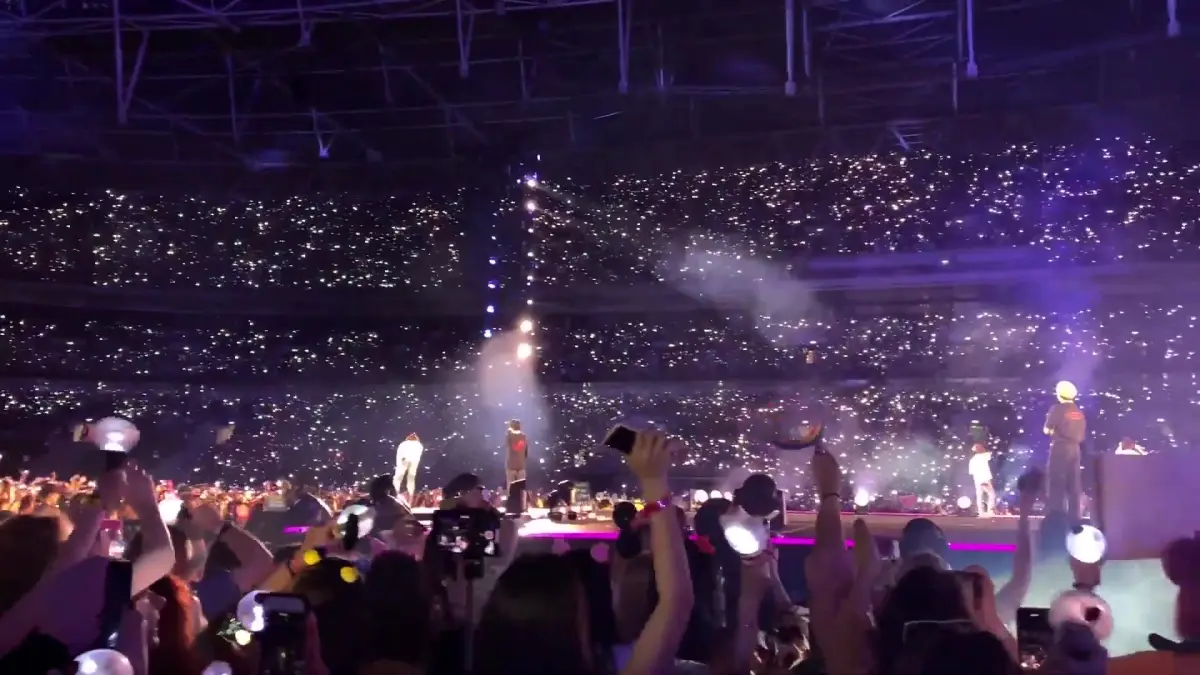
- BTS, Permission to Dance on Stage, November-December 2021: Four sold-out shows drew 213,752 fans in the group’s first major stadium run after pandemic restrictions were lifted.
Looking ahead, SoFi is a primary venue for the 2028 Los Angeles Summer Olympic Games, co-hosting the opening ceremony and staging the swimming in a temporary 38,000-seat configuration. The 2026 World Cup matches served as an operational dress rehearsal for Olympic-scale logistics.
The $5.5 billion headline cost remains a subject of debate. Supporters point to the revenue capacity of the Hollywood Park development, the Infinity Screen’s broadcast profile, and the venue’s role in anchoring Los Angeles’s successful bids for the 2022 Super Bowl, the 2026 World Cup, and the 2028 Olympic Games. Critics note that the cost is roughly double the next most expensive stadium in the world, and that shared-tenancy economics between the Rams and the Chargers may limit standalone returns. The debate will likely outlast the first decade of operations.
Sources & Further Reading
- SoFi Stadium official site: sofistadium.com. Capacity, operations, parking, event calendars, and premium seating information.
- FIFA World Cup 2026 match schedule: fifa.com. Official match assignments and venue information.
- LA Metro event-day service: metro.net. Event-day rail and shuttle guidance for reaching the stadium.
- Wikipedia entry on SoFi Stadium: en.wikipedia.org/wiki/SoFi_Stadium. Comprehensive reference with construction details, events, and attendance records.
- LA 2028 Olympic Games venue plan: la28.org. Information on SoFi Stadium’s role at the 2028 Olympics.
- HKS project page for SoFi Stadium: hksinc.com. The architect’s own account of the FAA height constraint, the 100-foot bowl, the ETFE frit pattern, and the building’s scale.
- Hollywood Park mixed-use development: hollywoodpark.com. Details on the surrounding retail, residential, and entertainment district.
Quick Facts
Everything you need at a glance.
Stadium specs
- Capacity
- 70,240
- Opened
- 2020
- Cost
- $5.5 billion (~$6.75 billion today)
- Roof
- Fixed (ETFE canopy)
- Surface
- Synthetic Turf (Natural Grass for FIFA)
- Tenants
- Los Angeles Rams (NFL), Los Angeles Chargers (NFL)
- WC 2026
- Quarterfinal · 8 matches
- First WC match
- June 12, 2026
Construction & location
- Groundbreaking
- November 17, 2016
- Architects
- HKS, Inc.
- Engineering
- Walter P Moore
- General contractor
- Turner Construction / AECOM Hunt Joint Venture
- Address
- 1001 S. Stadium Drive, Inglewood, CA 90301, USA
- GPS
- 33.9534°N, 118.3392°W
Photo Gallery
Fun Facts
At around $5.5 billion, SoFi Stadium is the most expensive sports venue ever built, costing more than the next two most expensive combined.
The ETFE canopy is made up of 302 translucent panels, 46 of which can open mechanically for ventilation.
The bowl sits about 30 metres (100 feet) below street level. FAA radar restrictions from LAX forced the architects to dig down rather than build up.
Stadium Location
Frequently Asked Questions
- Does SoFi Stadium have a roof?
- Yes. A translucent ETFE canopy covers the bowl and the adjacent 2.5-acre plaza. It is made up of 302 panels, 46 of which can open mechanically for natural ventilation. The venue is the first indoor-outdoor NFL stadium. No air conditioning is required in the bowl. The Southern California climate handles it.
- What World Cup 2026 matches were played at SoFi Stadium?
- Eight, played between June 12 and July 10, 2026: five group stage games, two Round of 32 matches, and one quarterfinal. Under FIFA's branding policy the stadium was temporarily renamed 'Los Angeles Stadium' for broadcasts, signage, and printed materials throughout the tournament.
- How do I get to SoFi Stadium by public transit?
- Take the Metro C or K Line to LAX/Metro Transit Center and pick up the shuttle to the stadium at Bus Bay 8 on game day. Metro moved it here in 2025; it previously ran from Hawthorne/Lennox on the C Line, so older guidance sends you to the wrong station. Several suburban operators also run direct services: GTrans line 7X from Harbor Gateway Transit Center and Torrance Transit both charge about $4 round trip, and Culver CityBus line 99 Express is around $2. The Inglewood Transit Connector people mover, which would have linked the Metro K Line directly to the stadium, was abandoned in 2024 after a funding shortfall; Inglewood is building dedicated bus lanes instead.
- Is there parking at SoFi Stadium?
- More than 9,000 parking spaces are spread across structured garages and surface lots in the Hollywood Park complex. The stadium says fees vary by event; NFL parking has typically run $40-80, and it must be pre-purchased through the SoFi Stadium app or website. Cash is not accepted. Arriving two hours before kickoff is recommended on sold-out event days.
- Why was SoFi Stadium built 100 feet below street level?
- FAA radar restrictions from Los Angeles International Airport, less than 5 kilometres (3 miles) west of the site, limited how tall the stadium could rise. Rather than settle for a shallow bowl, the architects dug down. An estimated 7.5 million cubic yards of earth were removed. Fans descend into the bowl rather than climb up to it. Kroenke also paid around $29 million for airport infrastructure upgrades to avoid radar interference.
- Was SoFi Stadium renamed for the World Cup?
- Yes. FIFA's branding policy replaces corporate venue names with neutral geographic ones for tournament matches, so SoFi was 'Los Angeles Stadium' in official broadcasts, signage, tickets, and printed materials through the 2026 tournament. The corporate name resumed once it ended.
- What is the Infinity Screen at SoFi Stadium?
- A panoramic dual-sided video board suspended above the playing field, manufactured by Samsung. It weighs around 2.2 million pounds (1,000 tons), covers 70,000 square feet (6,500 square metres) of display surface, and renders 80 million pixels in 4K HDR. It is the largest video display ever installed at a sports venue. The structure is integrated with 260 speakers and 56 5G antennas.
- What role will SoFi Stadium play in the 2028 Olympics?
- SoFi co-hosts the opening ceremony of the Los Angeles 2028 Summer Olympic Games with the Los Angeles Memorial Coliseum on July 14, 2028, the first Olympic opening staged across two stadiums at once. The closing ceremony belongs to the Coliseum alone. SoFi then opens the Paralympics on its own on August 15, with that closing ceremony returning to the Coliseum too. SoFi also hosts the swimming, with a temporary pool and seating set at around 38,000, which would make it the largest swimming venue in Olympic history.
- Where are the best seats at SoFi Stadium?
- Not the front rows, despite the price. Sideline staff stand in front of them for most of the game. Regulars point to the 300 level between the 30-yard lines as the best value in the building, and rate the 500s far higher than newcomers expect. Check the view for your exact section before buying; fans use aviewfrommyseat.com for this.
- Is the food good at SoFi Stadium?
- It is the single most common complaint regulars make, and the beer is among the priciest in the league. Plenty of people eat before they arrive or buy from the vendors in the lots. Inside, the pastrami fries near sections 101 to 106 and the Olvera Street stand are the ones fans defend.
- Why are there so many away fans at SoFi Stadium?
- The city went twenty-one years without a team, so a generation of Angelenos adopted other franchises and kept those allegiances when the Rams and Chargers arrived. San Francisco supporters turn up in the largest numbers. American stadiums also do not separate home and away fans into different sections, unlike most European grounds.
- What can I bring into SoFi Stadium?
- One factory-sealed water bottle of 20 ounces or less, or an empty refillable bottle for the hydration stations. Tickets are mobile only and screenshots are rejected at the gate, which is a common cause of delays. Entry is routed to the gate nearest your seats rather than any gate you choose, so check your ticket before you set off.
Last updated: 2026-08-15