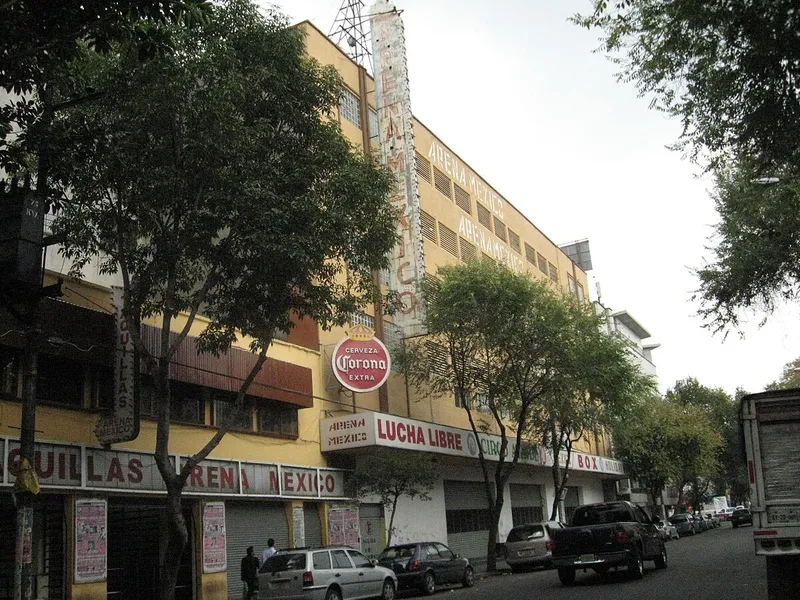
About Arena México
In the Colonia Doctores neighbourhood of Mexico City, a 16,500-seat hall has staged live lucha libre three times a week since 1956, masked wrestlers flying off the top rope for nearly 70 years. Arena México is where a $4 ticket buys you a seat at the oldest continuous professional wrestling show on earth.
They call it the “Cathedral of Lucha Libre,” and the name fits. Built by Salvador Lutteroth, the founder of CMLL, the world’s oldest wrestling promotion (established September 21, 1933), the arena was designed by architect José Francisco Bullman and opened on April 27, 1956, with a sold-out crowd of 16,500 watching El Santo and Médico Asesino face Blue Demon and Rolando Vera. The steel-and-reinforced-concrete structure covers over 11,000 square meters, making it the largest purpose-built professional wrestling venue in the world.
CMLL runs shows every Tuesday at 7:30 PM, every Friday at 8:30 PM (the marquee “Super Viernes”), and every Sunday at 5:00 PM. Friday nights are the draw, top-card matches, mask vs. mask wagers, and crowds that regularly exceed 10,000. Tickets start at 80 MXN (~$4 USD) for the upper balcony. For that price, you get two and a half hours of athletic spectacle, theatrical drama, and a cultural tradition that has shaped Mexican popular culture for nine decades.
The arena also hosted boxing at the 1968 Summer Olympics, staged under the name “Arena 68.” Golden-age boxing champions Rubén Olivares, Carlos Zárate, and Pipino Cuevas fought world title bouts here during the 1960s and 70s.
Getting to Arena México
Public Transit
The Mexico City Metro is the best way to reach Arena México, cheap, fast, and one of the most extensive subway systems in the Americas.
→ Via Metro Line 1 (Pink): Cuauhtémoc station is a 5-minute walk from the arena. This is the recommended stop.
→ Via Metro Lines 1/3: Balderas station (transfer hub for Lines 1 and 3) is a 5-8 minute walk. Useful if coming from the south or west.
→ Via Metrobús Line 2: Doctor Vértiz station is nearby, with buses every 5-7 minutes during peak hours. Fare: 6 MXN.
Metro fare is 5 MXN ($0.25 USD) per ride. The system runs until midnight, Friday Super Viernes shows end around 11 PM, so time your departure carefully.
Driving + Parking
The arena address is Dr. Lavista 189, Colonia Doctores, Cuauhtémoc, 06720, Mexico City.
→ From the Zócalo / Centro Histórico (~3 km): Head south on Eje Central Lázaro Cárdenas, turn onto Dr. Lavista. About 10-15 minutes.
→ From Polanco (~8 km): South on Paseo de la Reforma, continue through Cuauhtémoc toward Colonia Doctores. About 20-35 minutes.
→ From Coyoacán (~10 km): North via Insurgentes or Tlalpan. About 20-30 minutes depending on traffic.
Nearby parking lots charge approximately 100-150 MXN ($5-$8 USD). Seeker Parking offers reservable spots via CMLL’s website. Street parking in Colonia Doctores is limited, use a designated lot or rideshare.
Rideshare
Uber and DiDi are widely available in Mexico City. From Centro Histórico, expect 50-80 MXN ($3-$4 USD). From the airport, 180-250 MXN ($9-$13 USD). After Friday shows end around 11 PM, request your ride 5-10 minutes before the final match to beat the surge.
From the Airport
→ Mexico City International (MEX): About 13 km (8 miles) east, 15-30 minutes by car depending on traffic. Taxi costs 400-600 MXN ($20-$30 USD). By Metro, take Line 5 from Terminal Aérea, transfer at Pantitlán to Line 1, exit at Cuauhtémoc (about 47 minutes, 5 MXN).
→ Felipe Ángeles International (NLU): About 45 km north, 50-75 minutes by car. Not recommended for Arena México visits, MEX is far more convenient.
Construction & Design
When it opened on April 27, 1956, Arena México rose on the Colonia Doctores site of an earlier open-air arena, built for CMLL founder Salvador Lutteroth, where he had staged Mexico City’s first organized lucha libre show on September 21, 1933. That original venue, the Arena Modelo, was a modest roofless building with wooden stands seating roughly 4,500. After the sport’s success, and that of Lutteroth’s roofed Arena Coliseo opened in 1943, proved the business case for a flagship building, the old structure was demolished and replaced by a far larger, fully enclosed arena designed by architect José Francisco Bullman. The new building rose on a site of roughly 11,000 square meters with a capacity around 16,500, making it the largest venue in the world built specifically for professional wrestling. The names of its structural engineer and general contractor are not recorded in available sources.
The interior is organized as a single steep bowl: a central ring surrounded by tiered stands raked so that sightlines converge on the ring from every level. Seating is stratified by proximity, from the premium ringside rows closest to the action, up through the general stands, to the upper balcony that holds most of the capacity. Being fully roofed was the defining break from its open-air predecessor. The enclosed volume protects the crowd, controls the acoustics and artificial lighting, and, crucially for a promotion that grew up alongside Mexican television, created conditions suited to broadcast. Suspended lighting rigs hang above the ring, and the sound system carries the announcer, the entrance music, and the roar of the crowd through the hall.
Beyond its engineering, the arena’s significance is cultural. Nicknamed “La Catedral de la Lucha Libre,” the Cathedral of Lucha Libre, it has been the permanent home of EMLL and CMLL since 1956, hosting weekly cards for nearly seven decades. It served as the boxing venue for the 1968 Mexico City Summer Olympics, and it remains the symbolic global center of the sport.
History of Arena México
Arena México’s history is inseparable from lucha libre itself. Salvador Lutteroth, who witnessed professional wrestling in El Paso, Texas in 1929, founded EMLL (now CMLL) on September 21, 1933, promoting shows in smaller venues before building this arena as the permanent home of Mexican wrestling.
Grand Opening (April 27, 1956): A sold-out crowd of 16,500 watched El Santo and Médico Asesino face Blue Demon and Rolando Vera. The arena was built on the site of the former open-air Arena Modelo, the venue Lutteroth had adapted for his first lucha libre show in 1933.
1968 Summer Olympics (October 1968): Arena México hosted all boxing competitions for the Mexico City Olympic Games, staged under the name “Arena 68.” Mexico won two boxing golds and two bronzes on this floor.
CMLL 64th Anniversary Show (September 19, 1997): El Hijo del Santo vs. Negro Casas in a mask vs. hair match, routinely cited as one of the greatest lucha libre matches of all time.
CMLL 81st Anniversary (September 2014): Atlantis defeated Último Guerrero in an epic mask vs. mask match, one of the most significant unmasking events in modern lucha libre history, witnessed by a capacity crowd.
Modern era: In recent decades the arena has layered in giant video screens, upgraded sound and lighting, and modernized fan amenities, updating the venue for the television era while preserving the atmosphere that makes it sacred to wrestling fans.
From El Santo to Místico to the Friday night regulars who have been coming for decades, Arena México is where lucha libre lives, the Cathedral, the original, the place where masks mean everything and a $4 ticket puts you inside a tradition that has been running three times a week since 1956.
Sources & Further Reading
- CMLL official Arena México page: cmll.com. The promotion’s own page with the address, 1956 inauguration, and weekly schedule.
- Wikipedia entry on Arena México: en.wikipedia.org/wiki/Arena_México. History, capacity, ownership, and notable events.
- Revista Construye, the history of Arena México: revistaconstruye.com.mx. A construction-and-architecture feature on the building.
- Mediotiempo, Arena México facts: mediotiempo.com. A Mexican sports outlet’s profile of the venue.
Quick Facts
Everything you need at a glance.
Stadium specs
- Capacity
- 16,500
- Opened
- 1956
- Cost
- Not separately recorded
- Roof
- Roofed (indoor arena)
- Surface
- N/A
- Tenants
- CMLL
Construction & location
- Groundbreaking
- Not recorded (opened April 27, 1956)
- Architects
- José Francisco Bullman
- Engineering
- Not separately recorded
- General contractor
- Not separately recorded
- Address
- Arena México, Dr. Lavista 189, Colonia Doctores, 06720 Cuauhtémoc, Ciudad de México, Mexico
- GPS
- 19.4215°N, 99.1512°W
Photo Gallery
Fun Facts
CMLL, founded on September 21, 1933, is the oldest professional wrestling promotion still in existence, Arena México has hosted continuous weekly shows since its 1956 opening, with over 10,000 individual events in nearly 70 years of unbroken weekly lucha libre.
Arena México presents live lucha libre three times per week, Tuesdays at 7:30 PM, Fridays at 8:30 PM (the marquee 'Super Viernes'), and Sundays at 5:00 PM, with tickets ranging from just 80 MXN (~$4 USD) for upper balcony to 1,000+ MXN (~$50 USD) for ringside.
At 16,500 capacity and over 11,000 square meters, Arena México is the largest purpose-built professional wrestling venue in the world. It also served as the boxing venue for the 1968 Summer Olympics, staged here as 'Arena 68.'
Stadium Location
Frequently Asked Questions
- What is the capacity of Arena México?
- Arena México has a seating capacity of 16,500 for professional wrestling and boxing events. It is the largest arena in the world built specifically for professional wrestling, covering over 11,000 square meters.
- Where is Arena México located?
- Arena México is at Dr. Lavista 189, Colonia Doctores, Cuauhtémoc, 06720, Mexico City. It is in the Doctores neighbourhood, about 3 km south of the Zócalo and near the border with Colonia Roma.
- How do I get to Arena México by Metro?
- The nearest Metro station is Cuauhtémoc on Line 1 (Pink), about a 5-minute walk from the arena. Balderas station (Lines 1 and 3) is also within a 5-8 minute walk. A single Metro ride costs 5 MXN ($0.25 USD).
- What are Arena México ticket prices?
- Ticket prices range from approximately 80-200 MXN ($4-$10 USD) for upper-level general admission to 500-1,000+ MXN ($25-$50+ USD) for ringside seats. Friday Super Viernes shows are the most expensive. Tickets are available through Ticketmaster Mexico or at the arena box office.
- What nights does Arena México have lucha libre shows?
- CMLL presents live lucha libre three times per week: Tuesdays at 7:30 PM, Fridays at 8:30 PM (the flagship 'Super Viernes' show), and Sundays at 5:00 PM. Friday nights feature the top-card matches and are the most popular with tourists.
- What is lucha libre?
- Lucha libre ('free wrestling') is Mexico's signature style of professional wrestling, characterized by colorful masks, high-flying acrobatic moves, and dramatic storylines of good (técnicos) vs. evil (rudos). Masks are sacred, losing one in a 'mask vs. mask' match is a career-defining moment.
- How far is Arena México from the Mexico City airport?
- Mexico City International Airport (MEX) is approximately 13 km (8 miles) from Arena México. By taxi or rideshare, the trip takes 15-30 minutes and costs 180-400 MXN ($9-$20 USD) depending on traffic. By Metro, the trip takes about 47 minutes with one transfer and costs 5 MXN.
- Is Arena México safe for tourists?
- Arena México is generally safe during events, with security personnel throughout the venue. The Doctores neighbourhood requires standard urban caution, use rideshare apps rather than street taxis for departure, and walk west toward Roma or Condesa after events. Arriving and departing with fellow fans is recommended.
Last updated: 2026-07-06