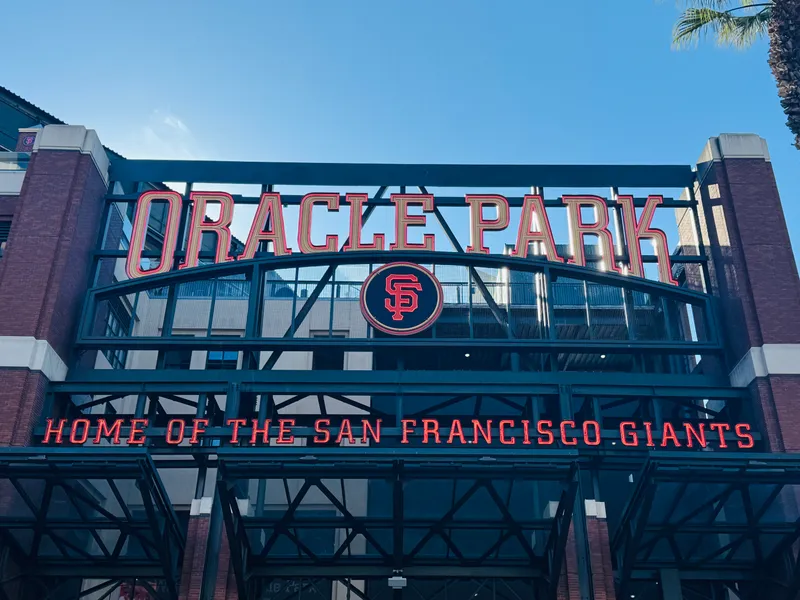
About Oracle Park
On the San Francisco waterfront, a 41,915-seat ballpark hosts Giants baseball with McCovey Cove, the Bay Bridge, and the bay itself as a backdrop. Oracle Park is widely regarded as one of the most beautiful stadiums in all of sports, and on a clear evening with the fog rolling in beyond the outfield walls, there are few better places to watch a game.
The Giants have called this place home since 2000, after four decades at Candlestick Park. Oracle Park was the first privately financed Major League ballpark since Dodger Stadium in 1962, the $357 million project was funded entirely without public tax dollars, a feat that seemed impossible in an era of taxpayer-funded stadiums.
Designed by HOK Sport (now Populous) and built on a former railyard on the South Beach waterfront, the park opened on April 11, 2000. The design takes full advantage of the bayfront setting, the right-field wall sits just feet from McCovey Cove, and home runs that clear it land in the water. The asymmetric outfield, the brick facade, the Willie Mays statue, and the views of the bay and bridge create an atmosphere that no other ballpark can replicate.
Three World Series championships, 2010, 2012, and 2014, cemented Oracle Park as one of baseball’s great stages. Barry Bonds hit his record-breaking 756th career home run here in 2007, and the park has hosted All-Star Games, concerts, and college football bowl games.
Getting to Oracle Park
Public Transit
Oracle Park is one of the most transit-accessible ballparks in baseball, served by Muni, Caltrain, BART, and ferry service.
→ Via Muni Metro: The T-Third and N-Judah lines stop at King & 2nd Street, steps from the ballpark entrance. Trains run every 5–10 minutes on game days. Fare is $2.50 with Clipper card.
→ Via Caltrain: The 4th & King Street station is a 10-minute walk from the park. Caltrain runs from San Jose and Peninsula cities with extra post-game service. Ideal for South Bay fans.
BART does not run directly to the ballpark but connects at Embarcadero and Montgomery stations, where you can transfer to Muni. San Francisco Bay Ferry also operates game-day service from Oakland and Alameda to the nearby Pier 40.
Driving + Parking
The ballpark address is 24 Willie Mays Plaza, San Francisco, CA 94107. I-280 North is the most direct approach from the south.
→ From San Jose (~50 mi): US-101 North or I-280 North into San Francisco. About 1 hour depending on traffic.
→ From Oakland (~15 mi): I-80 West across the Bay Bridge to I-280 South, exit at King Street. About 20–40 minutes depending on traffic.
→ From Sacramento (~90 mi): I-80 West to the Bay Bridge. About 1 hour 45 minutes.
Parking is limited in the South Beach area. Lot A across McCovey Cove costs $40–$55. Nearby garages and lots run $30–$50. The ballpark strongly encourages transit, Muni, Caltrain, and ferry are all excellent options. Pre-purchase through SpotHero.
Rideshare
Uber and Lyft have designated zones on King Street east of the ballpark. From downtown San Francisco, expect $10–$15. From the Mission District, $12–$18. Post-game surge pricing is significant, walk to the Embarcadero or take Muni instead. Traffic congestion after games can double rideshare wait times.
From the Airport
→ San Francisco International (SFO): 13 miles south of the ballpark, about 20–30 minutes by car. Major hub for United Airlines with extensive domestic and international service. BART connects SFO to downtown San Francisco (Embarcadero station) in about 30 minutes for $9.65, then transfer to Muni. Rideshare runs $25–$45.
Construction & Design
HOK Sport, the Kansas City firm now known as Populous, designed Oracle Park, with structural engineering by Thornton Tomasetti and construction by the Hunt-Kajima consortium. Ground was broken on December 11, 1997, and the ballpark opened for regular-season play on April 11, 2000, at a cost of roughly $357 million. Its defining distinction is financial rather than architectural: it was the first privately financed Major League ballpark built since Dodger Stadium in 1962. After San Francisco voters rejected four public-funding measures between 1987 and 1992, the Giants assembled a private package, a team loan of about $170 million plus roughly $172 million in naming-rights and sponsorship revenue, while the ballpark structure itself avoided the direct taxpayer subsidies that defined most stadiums of the era.
The park occupies a former railyard on the China Basin waterfront at the edge of San Francisco Bay, a constrained urban site that shaped its most famous quirks. Right field ends just feet from the water in a channel christened McCovey Cove, after Hall of Famer Willie McCovey, where kayakers gather to chase splash hits. Because the seawall left little room, the right-field foul pole sits only about 309 feet from home plate, among the shortest porches in the majors, so the wall there rises to 24 feet, a nod to Willie Mays’ number, to compensate. Beyond the left-field bleachers sit an 80-foot Coca-Cola bottle with slides and an oversized old-fashioned baseball glove.
The exterior uses a red-brick facade with steel and precast detailing, part of the retro-classic ballpark movement HOK pioneered at Camden Yards, tuned here to echo the brick warehouses of the surrounding neighborhood. The asymmetric field, the intimate seating bowl, and the open-air design frame sweeping views of the San Francisco-Oakland Bay Bridge and the bay beyond the outfield, making the setting itself part of the architecture and helping cement the park’s reputation as one of the most scenic in professional sports.
History of Oracle Park
Oracle Park was built after decades of failed attempts to replace Candlestick Park, where the Giants had played since 1960. After voters rejected four public financing measures between 1987 and 1992, the Giants’ ownership group decided to build the ballpark privately, a $357 million project that made it the first privately financed MLB ballpark since Dodger Stadium in 1962.
First Game (April 11, 2000): The Los Angeles Dodgers spoiled the opener, beating the Giants 6–5, with Dodgers shortstop Kevin Elster hitting three home runs (including the park’s first) before a sellout crowd. The ballpark was an instant sensation, widely praised as the most beautiful new stadium in baseball.
Barry Bonds’ 756th Home Run (August 7, 2007): Bonds broke Hank Aaron’s all-time home run record with a blast to right-center field. The moment was controversial, Bonds was under investigation for performance-enhancing drugs, but the record still stands.
2010 World Series: The Giants defeated the Texas Rangers to win their first championship since moving to San Francisco in 1958. Tim Lincecum, Buster Posey, and a dominant pitching staff carried the team. The city erupted.
2012 and 2014 World Series: The Giants won again in 2012 (sweeping the Tigers) and 2014 (over the Royals in seven games), becoming the first team to win three titles in five years since the Oakland A’s dynasty of the early 1970s. Madison Bumgarner’s five-inning relief performance in Game 7 of the 2014 Series is one of the greatest pitching performances in World Series history.
From a privately built miracle to three championships in five years, Oracle Park rewrote the rules for how a ballpark could be financed, designed, and loved, a waterfront jewel where the fog, the cove, and the roar of the crowd create something that no other stadium in baseball can match.
Sources & Further Reading
- Wikipedia entry on Oracle Park: en.wikipedia.org/wiki/Oracle_Park. Architect, engineers, contractor, cost, the private financing, and dimensions.
- Ballparks of Baseball, Oracle Park: ballparksofbaseball.com. A ballpark reference with the financing breakdown and construction details.
- San Francisco Giants official ballpark page: mlb.com/giants/ballpark. Events, tickets, and visitor information.
Quick Facts
Everything you need at a glance.
Stadium specs
- Capacity
- 41,915
- Opened
- 2000
- Cost
- Around $357 million (2000), privately financed, the first privately funded MLB park since Dodger Stadium (1962)
- Roof
- Open
- Surface
- Natural Grass
- Tenants
- San Francisco Giants (MLB)
Construction & location
- Groundbreaking
- December 11, 1997 (opened April 11, 2000)
- Architects
- HOK Sport (now Populous)
- Engineering
- Thornton Tomasetti
- General contractor
- Hunt / Kajima consortium
- Address
- Oracle Park, 24 Willie Mays Plaza, San Francisco, CA 94107
- GPS
- 37.7786°N, 122.3893°W
Photo Gallery
Fun Facts
McCovey Cove, the body of water beyond the right-field wall, has seen more than 100 Giants 'splash hits' (home runs that land in the water on the fly), with Barry Bonds accounting for 35 of them, the all-time leader.
Oracle Park was the first privately financed Major League ballpark built since Dodger Stadium in 1962, the $357 million project was funded entirely without public tax dollars, a rarity in modern sports.
The park's 24-foot-high right-field wall was originally measured at 309 feet from home plate, one of the shortest distances to any outfield wall in MLB, creating a quirky, hitter-friendly target that Bonds exploited for years.
Stadium Location
Frequently Asked Questions
- What is the seating capacity of Oracle Park?
- Oracle Park seats 41,915 for MLB games. The ballpark regularly sells out, with over 300 consecutive sellouts during the 2010–2014 dynasty years. Standing room and special event configurations can increase capacity further.
- Where is Oracle Park located?
- Oracle Park is at 24 Willie Mays Plaza in San Francisco, California 94107. It sits on the waterfront in the South Beach neighbourhood, at the corner of Third Street and King Street, with McCovey Cove and San Francisco Bay beyond the right-field wall.
- How do I get to Oracle Park by public transit?
- Muni Metro lines T-Third and N-Judah stop at the King & 2nd Street platform, steps from the ballpark. Caltrain's 4th & King station is a 10-minute walk. BART connects to Muni at Embarcadero and Montgomery stations. Golden Gate Transit and AC Transit buses serve the area on game days.
- Is there parking at Oracle Park?
- Lot A (across McCovey Cove) costs $40–$55. Pier 48 surface lot and nearby garages run $30–$50. Street metered parking is available on non-game days. The ballpark strongly encourages transit, parking is limited in the South Beach area. Pre-purchase through SpotHero or the Giants website.
- What is McCovey Cove?
- McCovey Cove is the body of water (part of San Francisco Bay, officially China Basin) beyond the right-field wall, named for Hall of Famer Willie McCovey. Home runs that clear the wall and land in the water are called 'splash hits.' Barry Bonds hit 35 splash hits during his career. Kayakers and boaters gather during games hoping to retrieve home run balls.
- What was Oracle Park called before?
- The ballpark has had four names: Pacific Bell Park (2000–2003), SBC Park (2004–2005), AT&T Park (2006–2018), and Oracle Park (2019–present). The naming rights changes followed corporate mergers, Pacific Bell became SBC, SBC merged with AT&T, and Oracle purchased the rights in 2019.
- Has Oracle Park hosted a World Series?
- Yes. The Giants won three World Series during the park's era, 2010 (vs. Rangers), 2012 (vs. Tigers), and 2014 (vs. Royals). The 2010 championship was the franchise's first since moving to San Francisco in 1958.
- How far is the airport from Oracle Park?
- San Francisco International Airport (SFO) is 13 miles south of the ballpark, about 20–30 minutes by car. BART connects SFO to downtown San Francisco (Embarcadero station) in about 30 minutes, then transfer to Muni. Rideshare runs $25–$45 depending on traffic.
Last updated: 2026-07-08