About Snapdragon Stadium
Two years. That is roughly how long San Diego State needed to tear down the aging concrete bowl that had sat on this Mission Valley land since 1967 and raise a modern 35,000-seat stadium in its place. Snapdragon Stadium opened in 2022 as the anchor of the university’s new Mission Valley campus, and it does not sit idle. SDSU Aztecs football owns the fall Saturdays, San Diego FC brings Major League Soccer, and San Diego Wave FC plays NWSL here. Three primary tenants, one compact bowl, and a calendar the San Diego tourism board puts at roughly 300 events a year.
The building replaced Qualcomm Stadium, the multi-purpose relic that hosted three Super Bowls, the Chargers, and the Padres across 53 years before it was demolished. In a bit of corporate symmetry, Qualcomm came back to name the replacement, this time for its Snapdragon chip brand. Same company, new name, same patch of dirt.
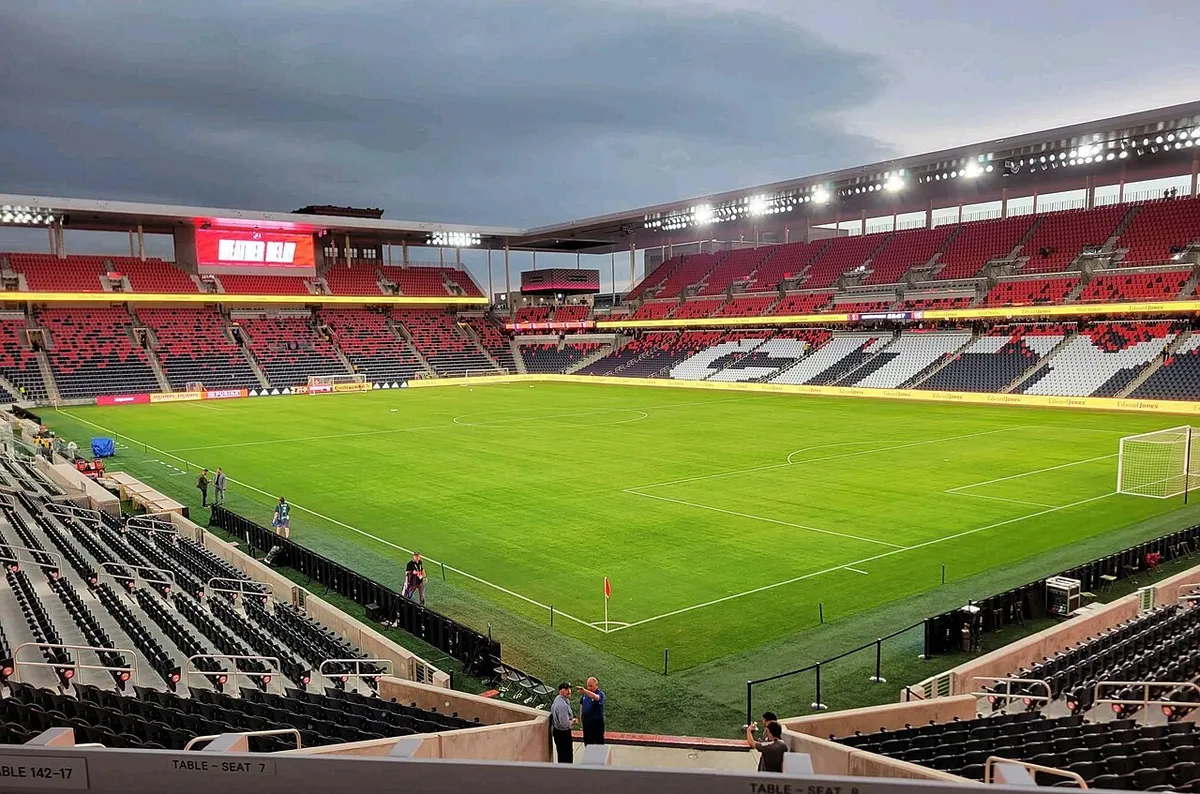
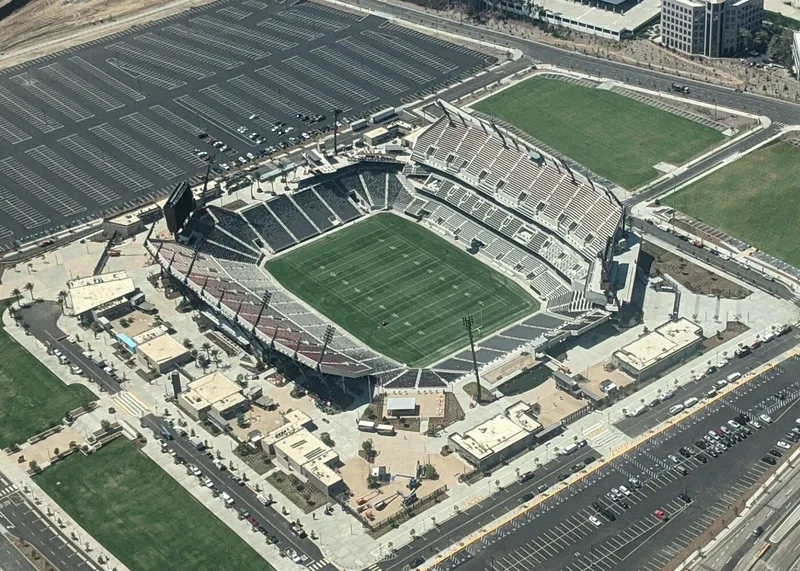
What makes Snapdragon interesting is what it deliberately is not. It is not an oversized NFL cavern retrofitted for college ball. Gensler designed it small and steep, a 35,000-seat venue engineered with the structural ability to grow later if a pro football team ever comes calling. The result feels intimate in a way San Diego’s old stadium never did. Sightlines are tight, the student section is loud, and the concourses read more like a park than a parking structure.
The open bowl is the one design choice that still divides people. San Diego’s reputation for mild weather does not survive a September afternoon kickoff, and the stands were built without overhangs, so there is very little shade anywhere in the building. The transit connection, though, is rare for an American stadium: the MTS Green Line trolley stops at Stadium Station, at the front gate. No shuttle, no long walk. You step off the train and you are basically there.
Getting to Snapdragon Stadium
Public Transit
Snapdragon has one of the best transit connections of any stadium on the West Coast. The trolley drops you at the front door. Use it.
→ Via MTS Green Line: Stadium Station sits right at the stadium entrance. Service runs every 15 minutes or better on event days, with extra trolleys added for large events. Fare is $2.50 one-way via the PRONTO app. The Green Line serves Santee, El Cajon, La Mesa, SDSU, Mission Valley, Old Town, and Downtown.
→ Via Connecting Lines: From Chula Vista, National City, or La Jolla, take the UC San Diego Blue Line to Old Town Transit Center and transfer to the Green Line. From La Mesa or Lemon Grove, take the Orange Line to Grossmont and transfer.
The trolley is the best option here. Cheap, fast, and it skips the parking hassle entirely. From downtown San Diego the ride takes about 20 minutes.
Driving + Parking
The stadium address is 2101 Stadium Way, San Diego, CA 92108. I-8 and I-15 are the primary approaches.
→ From Los Angeles (~118 mi): I-5 South to I-8 East. About 2 hours.
→ From Orange County (~97 mi): I-5 South to I-8 East. About 1 hour 30 minutes.
→ From Tijuana, Mexico (~25 mi): I-5 North to I-8 East. About 30 minutes plus border wait.
The stadium has about 6,200 on-site spaces. General parking starts around $30, up to $50 for concerts. The Orange Lot is the largest and the primary tailgating area. All lots are cashless. Alternatively, park at any trolley station for $3/hour and ride the Green Line in. No traffic, no parking stress.
Rideshare
Uber and Lyft drop off at Mission Village Drive near Gate 1 on the north side. Post-event pickups are in the Purple Lot on the northeast side. Expect surge pricing after events. Walk 10 minutes to Mission Center Road to escape the surge zone and save $10 to $20.
From the Airport
→ San Diego International Airport (SAN): Just 5 miles (8 km) west, about 10 to 15 minutes by car, one of the closest airport-to-stadium distances in American sports. Major domestic hub with service from nearly every carrier. Rideshare runs $12 to $18. You can also reach the Green Line trolley from Old Town Transit Center, which connects to the airport by bus route 992.
Watching a Game at Snapdragon Stadium
Check the kickoff time and the forecast before you check the seat map. Snapdragon was built without overhangs, so almost the whole bowl sits in direct sun. The stadium learned this in public. Its first Aztecs game, on September 3, 2022, landed in a heat wave, the Union-Tribune putting the temperature at 100 degrees (38 C) at kickoff and calling it the hottest game in the program’s recorded history. San Diego State’s athletic director later put the medical requests that afternoon at around 200, the overwhelming majority heat-related, while San Diego Fire-Rescue, counting differently, logged 14 heat responses and five people taken to hospital. Seven engine companies and a battalion chief were on site at one point, and fire chiefs have said they were considering recommending the game be cancelled. A hard first lesson. For an evening kickoff in November none of it matters. For an afternoon start in September it is the one thing to plan around, and the Union-Tribune noted that the east stands, fully exposed, were mostly empty by the fourth quarter.
Everything else about the bowl earns better notices. The compliment that recurs is that there is no bad seat, which is what happens when you stack 35,000 steeply instead of spreading it wide. The trade-off is width rather than distance. Narrow seats, a common complaint from bigger spectators. The student section is the loud end, roughly 5,000 seats with about 2,900 of them safe-standing.
Food is the genuine strength, and it is deliberately local. The program runs through 386 Hospitality, a division of the university’s own Aztec Shops, and the twelve founding partners are San Diego businesses rather than one national caterer: Hodad’s, the Ocean Beach burger institution, alongside The Crack Shack, The Taco Stand, Cali BBQ, Buona Forchetta, Gaglione Bros, The Fish Shop, The Girls Deli, Shawarma Guys, Empanada Kitchen, Batch & Box and Sandbar. Not a national chain among them. Not every vendor opens for every event, so check the stadium app on the day. Fans in the opening season rated the selection well and the beer lines short, and the gripe from that season was the ratio of bars: one public, several private and premium.
Getting in and out beats the old Qualcomm days. Tailgating survives, the Orange Lot is the main scene for it, and fans reported clearing the lots quickly afterward. The trolley remains the shortcut, stopping at the gate and letting you skip the Friars Road traffic that locals say has not improved since the Chargers left.
Construction & Design
The Snapdragon story starts with a real estate deal, not a groundbreaking. In November 2018 San Diego voters approved SDSU’s plan to redevelop the Mission Valley site of the old stadium, and the university then purchased the parcel, about 132 acres, for a price reported between $86.2 million and $88 million. Design kickoff with Gensler and Clark Construction followed in January 2019. Groundbreaking came on August 17, 2020, in the middle of a pandemic, and the finished stadium opened in August 2022. From first shovel to opening day, a shade over two years.
The design team is worth naming. Gensler served as architect, Magnusson Klemencic Associates (MKA) as structural engineer, and Clark Construction as general contractor. The building runs to about 60,000 square meters (650,000 square feet) of stadium, and it was delivered for a reported $310 million, funded through a mix of philanthropic gifts and California State University system revenue bonds rather than a public tax measure. That financing detail matters, because it is why the stadium belongs to the university outright and why day-to-day operations sit with OVG360, the Oak View Group management arm.
Two engineering choices shaped the bowl. The first was seismic. MKA worked with geotechnical engineers on a ground-improvement program that reduced seismic demands and, in turn, foundation costs, useful on a soft Mission Valley river-plain site. The second was the geometry. Gensler stacked three elevated decks over a compact seating bowl and gave the student section around 5,000 seats, including roughly 2,900 safe-standing spots, the loud kind of detail that makes a 35,000-seat venue play bigger than its number. There are 16 suites, expanded Founders suites, and premium clubs, but the concourses were the real flex: landscaped, indigenous plantings, open-air circulation, closer to a park than a stadium hallway.
Sustainability was designed in, not bolted on, and the certification followed. In May 2023 the stadium was awarded LEED v4 BD+C Gold, on the back of a 40 percent cut in potable water use against the LEED baseline, 55 percent outdoors, on-site photovoltaics generating 15 percent of the building’s electricity demand, planting across a quarter of the outdoor space, and a light-pollution strategy written to satisfy local night-sky rules. It is one reason the venue markets itself as a year-round civic destination rather than a football building that goes dark 340 days a year.
And then there is the ghost it replaced. San Diego Stadium opened in 1967, cycled through names (Jack Murphy Stadium, then Qualcomm Stadium from 1997 to 2017, then SDCCU Stadium) and hosted its final event, the 2019 Holiday Bowl, before crews demolished it during 2020 and 2021. Snapdragon rose on the same ground. The bowl was also engineered for future growth, with structural provisions to add seats should a professional football franchise ever return to San Diego. Reports have put that expansion ceiling around 55,000, though the exact number the design can reach is not something the university publishes as a hard figure.
History of Snapdragon Stadium
For 53 years, this corner of Mission Valley meant one building: the big concrete doughnut that opened in 1967 and spent its life as Jack Murphy, then Qualcomm, then SDCCU Stadium. It hosted three Super Bowls, the NFL Chargers, and MLB’s Padres, and by the end it was a tired multi-purpose venue that suited no one. The Chargers left for Los Angeles in 2017. The wrecking crews arrived not long after.
A land deal, then a stadium (2018 to 2020): San Diego voters approved SDSU’s Mission Valley redevelopment in November 2018, the university bought the site for about $86 million, and design work began in January 2019. Groundbreaking followed on August 17, 2020.
First game (September 3, 2022): SDSU Aztecs fell to the Arizona Wildcats 38-20 in the stadium’s competitive debut, played in a heat wave that reached 100 degrees (38 C) at kickoff, described by the Union-Tribune as the hottest game in program history. The university put medical requests at around 200, the overwhelming majority heat-related, and San Diego Fire-Rescue chiefs were considering recommending the game be cancelled. A hard first lesson in what an unshaded bowl means in early September.
NWSL record (September 17, 2022): San Diego Wave FC’s first match at Snapdragon drew roughly 32,000 fans, an NWSL single-game attendance record at the time. Women’s professional soccer in San Diego announced itself in a hurry.
World Lacrosse and rugby (2023 to 2024): The stadium hosted matches of the 2023 World Lacrosse Championship, and it became a rugby venue too. The San Diego Legion of Major League Rugby played here from 2023 through 2024, and a New Zealand versus Fiji test in July 2024 pulled 33,217, the venue’s rugby attendance record.
San Diego FC debut (March 1, 2025): San Diego FC played its first MLS home match in front of 34,506 fans, a 0-0 draw with St. Louis City SC that set the stadium’s soccer attendance record and introduced the city’s newest professional franchise.
The forward calendar is just as busy. Snapdragon hosted the 2024 CONCACAF W Gold Cup Final, where the United States beat Brazil 1-0 before 31,528, and in July 2028 it takes eleven matches of the Olympic football tournament, more than any of the other six venues.
That fixture list is worth reading closely, because it is not the supporting role the match count might imply. San Diego draws women’s group-stage games on July 11, 14 and 17, a women’s quarterfinal on July 21, then a men’s semifinal on July 24, a women’s semifinal on July 25, and both bronze medal matches, the men’s on July 27 and the women’s on July 28. The Rose Bowl takes five in all, a women’s quarterfinal, the other semifinal of each tournament, and both gold medal matches. No men’s group-stage football is scheduled in San Diego; those go to New York, Columbus, Nashville and St. Louis. For the duration of the Games the venue is called San Diego Stadium, since the IOC does not permit sponsor names. Every venue is mapped in our Los Angeles 2028 Olympics guide.
From the rubble of Qualcomm Stadium to two Olympic medal matches in six years, the pace has been the whole point. This is a venue built fast, built small on purpose, and built to stay busy.
Sources & Further Reading
- Official venue site: snapdragonstadium.com. Address, tenants, premium spaces, event calendar, and OVG360 operations.
- SDSU Athletics stadium page: goaztecs.com. University source for capacity, the $310 million cost, financing, and LEED Gold detail.
- Gensler project page: gensler.com. Architect’s own account of the seating bowl, student section, LEED v4 Gold design, and expansion provisions.
- Wikipedia entry on Snapdragon Stadium: en.wikipedia.org. Comprehensive reference for dates, tenants, attendance records, and the predecessor stadium history.
- Official concessions list: snapdragonstadium.com. The twelve founding hospitality partners and the 386 Hospitality operating arrangement.
- SDSU on Mission Valley sustainability: sdsu.edu. The university’s own announcement of the awarded LEED Gold certification and the water, solar and planting figures behind it.
- San Diego FC on the LA28 allocation: sandiegofc.com. The eleven-match breakdown, including the semifinals and both bronze medal games.
Quick Facts
Everything you need at a glance.
Stadium specs
- Capacity
- 35,000
- Opened
- 2022
- Cost
- $310 million
- Roof
- Open
- Surface
- Natural Grass (Latitude 36 Bermuda)
- Tenants
- San Diego State Aztecs (NCAA Mountain West), San Diego FC (MLS), San Diego Wave FC (NWSL)
Construction & location
- Groundbreaking
- August 17, 2020
- Engineering
- Magnusson Klemencic Associates (MKA)
- General contractor
- Clark Construction
- Address
- 2101 Stadium Way, San Diego, CA 92108, USA
- GPS
- 32.7841°N, 117.1224°W
Photo Gallery
Fun Facts
Gensler designed the seating bowl to grow. The structure was engineered with the ability to add seats if a professional football tenant ever arrives, and the figures published differ: Gensler, the architect, says the design allows up to 10,000 additional seats, which puts the ceiling nearer 45,000, while 55,000 is the number that circulates in reporting.
San Diego Wave FC's first match at Snapdragon on September 17, 2022 drew roughly 32,000 fans, an NWSL single-game attendance record at the time and proof that San Diego's appetite for women's professional soccer was real.
The stadium carries the Snapdragon name because Qualcomm came back for a second turn. Qualcomm named the old venue on this land from 1997 to 2017, then bought the naming rights to its replacement in December 2021, this time for its Snapdragon chip brand.
Stadium Location
Frequently Asked Questions
- What is the seating capacity of Snapdragon Stadium?
- Snapdragon Stadium seats 35,000 in its standard configuration. The bowl was designed to be expandable for a potential professional football franchise, though the published ceilings disagree: Gensler, the architect, says the design allows up to 10,000 more seats, putting it near 45,000, while 55,000 is the figure that circulates in reporting. For soccer the usable figure shifts with the setup, and the record stands at 34,506 for San Diego FC's first MLS home match.
- Where is Snapdragon Stadium located?
- Snapdragon Stadium is at 2101 Stadium Way, San Diego, California 92108. It anchors the northwest corner of the SDSU Mission Valley campus, built on the site of the former Qualcomm Stadium, about 8 miles east of downtown San Diego.
- Can you take the trolley to Snapdragon Stadium?
- Yes. The MTS Green Line stops at Stadium Station, right at the stadium entrance. Trolleys run every 15 minutes or better on event days, with extra service added for large events. A one-way fare is $2.50 via the PRONTO app. The trolley is the easiest and cheapest way to reach the stadium.
- What teams play at Snapdragon Stadium?
- Three teams call it home: the San Diego State Aztecs (NCAA FBS football, Mountain West Conference), San Diego FC (MLS, which began play in 2025 as the league's newest expansion club), and San Diego Wave FC (NWSL). The stadium also hosts the Holiday Bowl, concerts, rugby, and international soccer.
- Who owns and operates Snapdragon Stadium?
- San Diego State University owns the stadium and the surrounding Mission Valley campus. Day-to-day operations are handled by OVG360, the venue-management arm of Oak View Group, which runs the event calendar. The roughly 300-events-a-year figure often quoted for the building traces to the San Diego tourism board rather than to the operator.
- Is Snapdragon Stadium the same as Qualcomm Stadium?
- No. Qualcomm Stadium (originally San Diego Stadium, opened 1967) was demolished during 2020 and 2021. Snapdragon Stadium is a brand-new $310 million facility that opened in 2022 on the same land. Qualcomm's Snapdragon brand holds the naming rights to both, but they are completely different buildings.
- When did San Diego FC start playing at Snapdragon?
- San Diego FC joined Major League Soccer as an expansion club and played its first home match at Snapdragon on March 1, 2025, a 0-0 draw with St. Louis City SC in front of 34,506 fans. That crowd set the stadium's soccer attendance record.
- Did rugby's San Diego Legion play at Snapdragon?
- Yes. The San Diego Legion of Major League Rugby used Snapdragon from 2023 through 2024 before moving to Torero Stadium. The stadium has stayed on the rugby map, hosting a New Zealand versus Fiji test in July 2024 that drew 33,217, the venue's rugby attendance record.
- Is there parking at Snapdragon Stadium?
- The stadium has about 6,200 on-site spaces. General parking starts around $30, up to $50 for concerts. The Orange Lot is the largest and the primary tailgating area. All lots are cashless. Alternatively, park at a trolley station for $3/hour and ride the Green Line to the stadium.
- How far is the airport from Snapdragon Stadium?
- San Diego International Airport (SAN) is just 5 miles (8 km) west, about 10 to 15 minutes by car, one of the closest airport-to-stadium distances in American sports. Rideshare runs $12 to $18.
- Is Snapdragon Stadium a green building?
- Yes, and it holds the certificate rather than just the intent. The U.S. Green Building Council awarded Snapdragon LEED Gold in May 2023, citing a 40 percent reduction in potable water use, 55 percent outdoors, on-site solar covering 15 percent of electricity demand, and planting across a quarter of the outdoor space. The concourses are landscaped with indigenous species and circulate in open air.
- Will Snapdragon Stadium host the 2028 Olympics?
- Yes, and more than anywhere else. Snapdragon takes eleven matches in July 2028, the largest allocation of the seven football venues. It gets women's group-stage games on July 11, 14 and 17, a women's quarterfinal on July 21, a men's semifinal on July 24, a women's semifinal on July 25, and both bronze medal matches on July 27 and 28. The Rose Bowl takes five, a women's quarterfinal, the other semifinal of each tournament and both golds. No men's group-stage matches are scheduled in San Diego, and during the Games the venue is called San Diego Stadium.
- Is there shade at Snapdragon Stadium?
- Very little. The stands were built without overhangs, so nearly the whole bowl sits in direct sun. It caught the stadium out at its first game in September 2022, played at around 100 degrees, when the university logged roughly 200 medical requests and San Diego Fire-Rescue considered recommending the match be halted. Fans at the time said there was nowhere in the building to get out of the sun. For evening events it is a non-issue. For an early-season afternoon kickoff, buy away from the east stands, which the Union-Tribune reported were mostly empty by the fourth quarter, and bring water.
Last updated: 2026-08-18