About Al-Awwal Park
Drive west out of central Riyadh and the towers give way to the campus of King Saud University, a low sandstone city of its own. The football ground is in there somewhere, and for the first three years of its life almost nobody went to it. The building was structurally finished in 2014, opened in May 2015, and then waited through three seasons without a tenant or a league fixture. Built, and then left alone.
It holds 26,004 now. King Saud University still owns the place, but the Saudi Media Company has operated it since 2020 under a ten-year commercial contract, and it is the operator rather than the university that sells the name on the front. Mrsool Park from November 2020. Al-Awwal Park from April 2023, when Saudi Awwal Bank bought the rights. The official name, the one the AFC will print in January 2027, remains King Saud University Stadium.
Al-Nassr have played here since 2020, and there is a needle in that. The first club to move in was Al-Hilal, their city rivals, who used the ground from 2018 until they left for King Fahd Sports City in 2020. Al-Nassr took over the house their opponents had just vacated. Cristiano Ronaldo was unveiled on this pitch on January 3, 2023, in front of a full stadium and most of the world’s sports press, which turned a quiet campus ground into one of the most photographed buildings in Saudi football almost overnight.
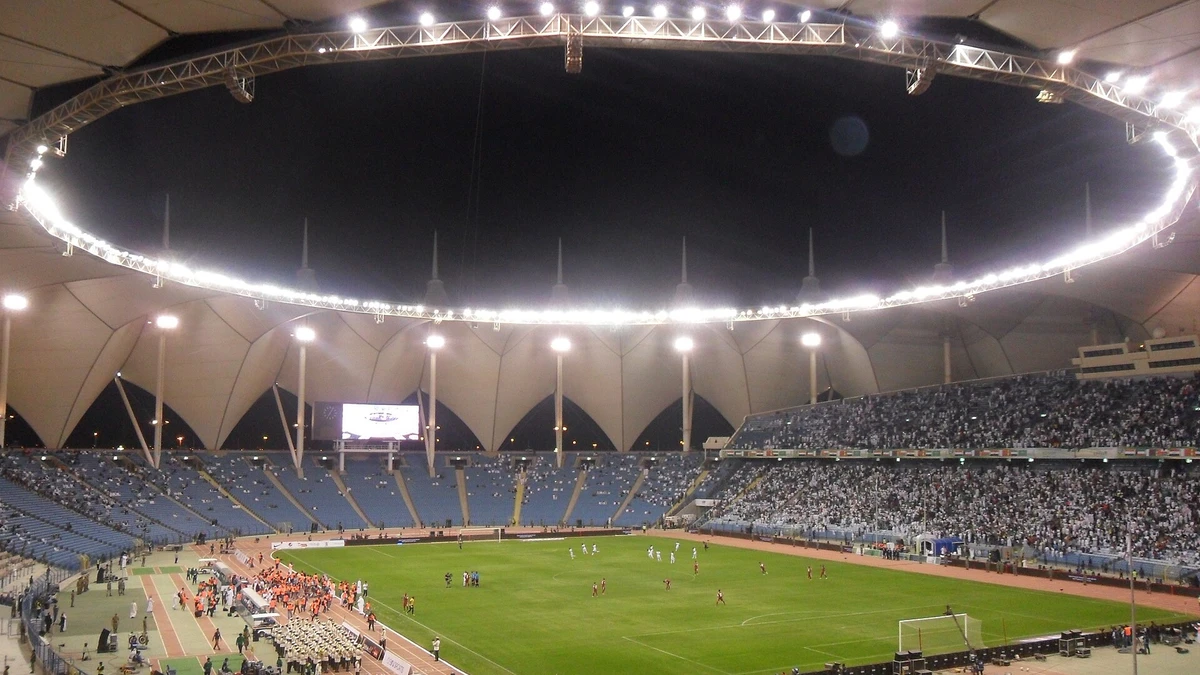
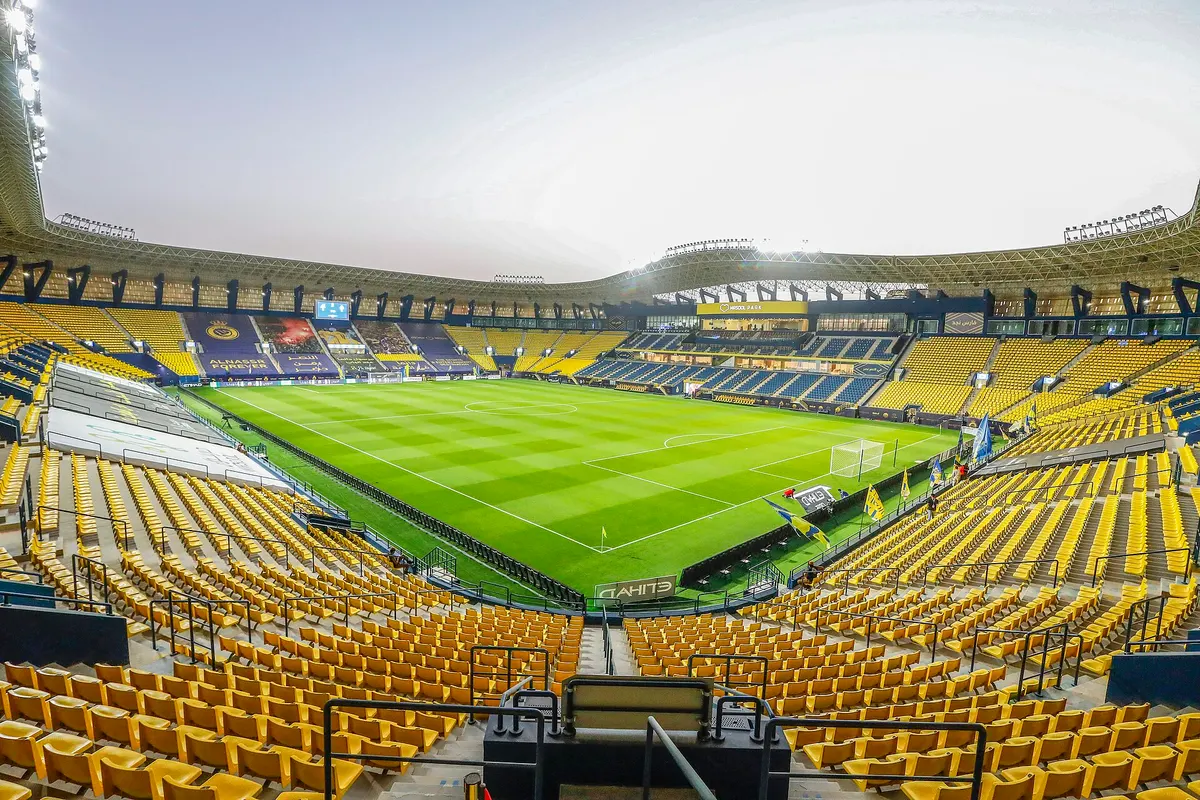
The bowl itself is compact and steep, wrapped tight around a hybrid grass pitch with a playing area of 105 by 68 metres (344 by 223 feet). The seats are Al-Nassr yellow except in the west stand, and the roof covers some of them and not the rest. Thirty-four gates serve the whole thing.
Getting to Al-Awwal Park
Public Transit
Riyadh Metro Line 2, the Red Line, ends at King Saud University. That sounds perfect and is not quite.
→ The line: Line 2 opened on December 15, 2024, runs 25.3 kilometres (15.7 miles) east to west along King Abdullah Road, and has 15 stations in all, the last of them the university. Line 1 crosses it at STC, Line 5 at Ministry of Education, Line 6 at Al-Hamra.
→ The fare: A flat SAR 4 (about $1) buys two hours across metro and bus together, with free transfers between lines. First class is SAR 10. Three-day, seven-day and thirty-day passes run SAR 20, SAR 40 and SAR 140. Buy through the Darb app.
→ The hours: 05:30 to midnight Saturday through Thursday, and 10:00 to midnight on Friday, the later start allowing for Jumu’ah prayers.
The catch is the last stretch. The terminus was sited for the university’s faculties, halls and teaching hospital, not for the stadium, and it leaves about 2.1 kilometres (1.3 miles) of campus between the platform and the gates, a walk usually clocked at 25 minutes. In January, for an Asian Cup evening kickoff, that is a pleasant way to arrive. In July it is not a walk anybody should plan.
Driving + Parking
Almost everybody drives, and the campus setting makes that easier here than at most grounds.
→ From central Riyadh: West on King Khalid Road or King Abdullah Road, then into the university campus off Prince Turki bin Abdulaziz Al Awwal Road. Twenty minutes when the city is quiet.
→ Parking: Five car parks ring the stadium, the biggest to the south and west, with a separate VIP lot. Which one you can use depends on your ticket category. Accessible spaces are reserved at Gate 6.
The roads in are campus roads, which means they are wide, well lit and empty for most of the week. The exit after a sell-out is the part that costs you, and the fix is the same one regulars use at every stadium in the Kingdom: park facing out, and further away than feels necessary.
Rideshare
Uber, Careem and Bolt all cover Riyadh, and a car to the ground is straightforward at any hour. The return leg is the usual scramble: a full house requesting a ride inside the same ten minutes, on a campus with a handful of exits.
Pro tip: Walk five minutes out toward U Walk and order from there. The pin drops somewhere a driver can actually reach, and you are pointed at dinner rather than a car park.
From the Airport
→ King Khalid International (RUH): About 26.5 kilometres (16.5 miles) northeast, 30 to 45 minutes by road depending on the hour. A taxi or a rideshare is the sane option.
→ By metro from the airport: Line 4, the yellow line, serves the terminals but never touches Line 2, so the trip in means two changes and a long ride west. Slower than the car, and immune to the traffic that makes the car slow.
Watching a Match at Al-Awwal Park
The thing that makes this ground work is a decision taken before a single seat went in: no running track. It was the first stadium in Riyadh built that way, and a decade later it is still the reason the place feels different from the bowls elsewhere in the city. The front row is on the touchline. Nobody is watching football across eight lanes of tartan.
That geometry decides where to sit. Category 1 down the sideline is as close to Saudi Pro League football as a ticket gets, and it has run about SAR 60, roughly what a sandwich costs at an English ground. Category 3 behind the goal is where the organized Al-Nassr support collects and where the noise comes from, at around SAR 25. The west stand is the covered one, its seats blue against the yellow of the rest of the bowl, with the royal suite set under the curve where the roof lifts. Cover is partial by design, so an afternoon kickoff and an east-side seat is a combination worth avoiding. Family sections are in Zones A and B.
Then there is the question nobody in the marketing material answers: will it be full? Sometimes, and the pattern is worth knowing. Al-Nassr averaged 17,638 in Ronaldo’s first season and 17,821 in his second, then fell to 16,292 in the third as the team finished without a trophy. The floor was the last home game of that season, against Al-Khaleej on May 27, 2025, which drew about 6,000, roughly a quarter of the ground. The following year the average climbed to 20,707 and the stadium hit 26,003 five separate times, against Al-Khaleej, Al-Najma, Al-Ahli, Al-Hilal and Damac. Buy for a derby and you get a wall of sound. Buy for a midweek fixture in November and you may get a quarter-full stadium and an excellent view.
Food inside is brief and functional: Subway, Jan Burger, a Starbucks. No dish has attached itself to this ground, which is what happens when a stadium is ten years old and spent three of those years empty. The answer is 1.2 kilometres (0.8 miles) northeast, where U Walk runs restaurants and cafes along a 900-metre open-air walkway. Eat there, walk over, and you have solved both dinner and the post-match taxi in one move.
Practical matters, from the operator’s own rules. Power banks do not get in. Neither do professional cameras, and smoking is banned throughout. Accessible entry and its parking are together at Gate 6, with one companion admitted per disabled supporter. Tickets cap at five per account, there are no refunds after purchase, and transfers go through the Alawwal Park app rather than a screenshot.
On a non-matchday there is a tour, which opened on October 30, 2024 and is booked through webook. It takes in the tunnel, the dressing rooms, the press conference room, the pitch and the club museum. The tunnel is the highlight, a hexagonal mouth lined with LED panels that play crowd footage at the players as they walk out. It photographs better than most things in Saudi football.
The 2027 Asian Cup at Al-Awwal Park
Six matches, spread across the group stage and into the first knockout round, make this one of five Riyadh venues at the tournament.
Group stage: Five games between January 8 and January 20, 2027. Kuwait against Oman on the 8th, the UAE against Vietnam on the 10th, Iraq against Australia on the 14th, Oman against Palestine on the 17th, and Korea Republic against the UAE on the 20th.
Knockout: A Round of 16 tie on January 25, pitting the winner of Group E against the runner-up in Group D. The final goes to King Fahd Sports City Stadium on February 5, along with the opening match.
Capacity: The AFC’s published schedule lists this venue at 26,000 rather than 26,004. The gap is the ordinary one, swallowed by broadcast positions and segregation.
Iraq against Australia on January 14 is the fixture to want. It is the heaviest pairing the draw sent to the smallest bowl in Riyadh, and 26,000 seats will not go far between two traveling supports of that size.
Construction & Design
Work began on the university campus in the spring of 2011, and the brief was unusual for the Kingdom at the time: build a football ground, not an athletics stadium that football borrows. Hashem Contracting Company delivered it for SAR 215 million, about $57 million, which in stadium terms is close to nothing. For comparison, the bowl in Jeddah that opened a year earlier cost roughly ten times as much.
The design is credited to Michael KC Cheah and Steph Cheah. Cheah’s name also sits inside the practice credited with King Fahd Sports City across town, Ian Fraser, John Roberts, Michael K.C. Cheah and Partners, the firm that drew the 1987 mast-and-fabric landmark. This ground is the quieter second act. No architectural practice publishes a project page for it, unusually for a stadium of this profile.
What they drew was a rectangular bowl with rounded corners, seats pulled right up to the touchline, and a roof carried on concrete beams at regular intervals. The roof does one expressive thing: over the west stand it swells upward into a curve, and under that curve sit the royal box and the hospitality. Everywhere else the cover is deliberately thin. In a city with almost no rainfall the design shelters a portion of the crowd and leaves the rest of the seats open to the sky, a trade that would be unthinkable in northern Europe and is barely noticed here.
The numbers behind the bowl are mostly small and specific. Thirty-four gates for spectators. Five television and radio broadcast rooms. Eighty-eight VIP seats, three in the royal box, forty-two positions for media, and seventy-six spaces for supporters with disabilities. A playing surface of 105 by 68 metres (344 by 223 feet) inside a pitch area of 125 by 85 metres (410 by 279 feet).
It is also, already, scheduled to be rebuilt and then partly unbuilt. Saudi Arabia’s 2034 World Cup plan puts a refurbishment here between 2030 and 2032, lifting capacity to 46,319 with an elliptical lightweight spoke-wheel roof and a perforated metallic outer skin wrapped around the existing structure. The stadium takes group matches and a Round of 32 tie. Then the extra tier comes out again and the ground settles at roughly 33,000 for the university and the club, which makes it one of the few venues in the tournament designed on paper to get smaller afterward.
History of Al-Awwal Park
For a stadium that now hosts Italian and Spanish silverware, the opening was remarkably quiet. King Saud University finished the building in 2014 and opened it on May 7, 2015, as a university ground on a university campus. Then very little happened. No league tenant, no fixture list, three seasons of an empty stadium sitting in west Riyadh while the clubs played elsewhere.
Al-Hilal ended that. On February 13, 2018 they played Al-Ain of the UAE here in the Asian Champions League group stage, a 0-0 draw that counts as the ground’s first competitive match, and they stayed for two seasons. The high point of that tenancy came on November 9, 2019, when 22,549 watched Al-Hilal beat Urawa Red Diamonds 1-0 in the first leg of the Asian Champions League final, a tie they closed out in Saitama to win the continent.
Then the swap. Al-Hilal moved to King Fahd Sports City in 2020, the Saudi Media Company won a ten-year contract to run the ground after competing against Al-Hilal for it, and Al-Nassr moved into the stadium their rivals had just left. The naming rights went with the operator: Mrsool Park in November 2020, then Al-Awwal Park in April 2023 after Saudi Awwal Bank won the tender. In between, on January 3, 2023, Cristiano Ronaldo walked out onto the pitch in a yellow shirt in front of a packed house and a global broadcast, and the ground’s anonymity ended for good.
Notable events:
- WWE Crown Jewel (November 2, 2018 and November 5, 2022). Two big international nights, staged under two different names four years and three days apart.
- Supercoppa Italiana (December 22, 2019). Lazio beat Juventus 3-1, the first of three Italian Super Cup finals played on this pitch.
- Supercopa de España (January 10 to 14, 2024). All three matches of the Spanish Super Cup, drawing 71,891 in total, an average of 23,964. Real Madrid beat Barcelona 4-1 in the final.
- Supercoppa Italiana (January 6, 2025 and December 22, 2025). Milan beat Inter 3-2 in the first, one of the better finals the competition has produced in Riyadh; Napoli beat Bologna 2-0 in the second.
- PFL 10 (2024). The Professional Fighters League brought a cage to the pitch, one of several combat-sport nights the venue has taken.
- Record crowd (2025-26 season). 26,003, matched five times in a single season, against Al-Khaleej, Al-Najma, Al-Ahli, Al-Hilal and Damac.
The pattern across those eleven years is a building that kept being handed new jobs. A university stadium that became a rival club’s home, then a second rival club’s home, then a neutral venue for other countries’ cup finals, and from January 2027 an Asian Cup ground. The 2034 rebuild will hand it another one. The eight grounds are mapped in our AFC Asian Cup 2027 guide.
Sources & Further Reading
- Alawwal Park official site, run by the Saudi Media Company: victoryarena.com. Ticketing, the gate and accessibility rules, parking categories and the stadium tour.
- AFC Asian Cup Saudi Arabia 2027 official match schedule: the-afc.com. The six-match assignment, fixture dates and the 26,000 tournament capacity.
- Saudipedia entry on King Saud University Stadium: saudipedia.com. The 34 gates, the running-track decision, the facilities list and the 2034 refurbishment.
- Asharq Al-Awsat on the naming-rights award: aawsat.com. The April 2023 Saudi Awwal Bank deal, the SAR 215 million build cost, and the Saudi Media Company’s ten-year operating contract.
- Wikipedia entry on King Saud University Stadium: en.wikipedia.org/wiki/King_Saud_University_Stadium. Capacity, naming history, tenants, design team and the 2034 expansion figures.
Quick Facts
Everything you need at a glance.
Stadium specs
- Capacity
- 26,004
- Opened
- 2015
- Cost
- SAR 215 million (about $57 million)
- Roof
- Partial cover over the stands
- Surface
- Hybrid grass
- Tenants
- Al-Nassr (Saudi Pro League)
Construction & location
- Groundbreaking
- Spring 2011
- Architects
- Michael KC Cheah, Steph Cheah
- Engineering
- Not separately recorded
- General contractor
- Hashem Contracting Company
- Address
- King Saud University Stadium, King Saud University campus, Prince Turki bin Abdulaziz Al Awwal Road, Riyadh 12372, Saudi Arabia
- GPS
- 24.7292°N, 46.6239°E
Photo Gallery
Fun Facts
It was the first stadium in Riyadh built without a running track around the pitch, which is the single reason the seats here feel close when the older bowls in the city do not.
The building was finished and then largely ignored. Opened in May 2015, it waited until February 13, 2018 for its first competitive football match, when Al-Hilal drew 0-0 with Al-Ain of the UAE in the Asian Champions League.
The highest crowd the ground has recorded is 26,003, one seat short of its listed 26,004 capacity, and Al-Nassr hit that exact number five separate times in the 2025-26 season.
Stadium Location
Frequently Asked Questions
- Can I get there on the Riyadh Metro?
- Yes, and then you walk. Line 2, the Red Line, ends at King Saud University station, so the metro does reach the right campus. It does not reach the stadium: the terminus was placed for the university's faculties and hospital, and the gap to the turnstiles is about 2.1 kilometres (1.3 miles), usually quoted as a 25-minute walk. A flat SAR 4 covers two hours across metro and bus, bought through the Darb app, with trains until midnight. For a January kickoff in Asian Cup weather that walk is pleasant. In summer, take the train and then a car for the last stretch.
- Where should I sit?
- There is no running track here, which changes everything about the seat you pick. The front rows sit right on top of the pitch, so Category 1 along the sideline is the closest you will get to the game in Riyadh. Category 3 behind the goal is where the Al-Nassr support gathers and where the noise is. The west stand is the covered one. Family sections sit in Zones A and B.
- Will the stadium actually be full?
- That depends entirely on the fixture, and the honest answer is more interesting than the brochure one. Al-Nassr averaged 17,638 in Cristiano Ronaldo's first season and 17,821 in his second, then slipped to 16,292 in the third as the team went trophyless. The low point was the last home game of 2024-25, against Al-Khaleej on May 27, 2025, which drew roughly 6,000 people, about a quarter of the ground. Then 2025-26 averaged 20,707 and produced five capacity crowds of 26,003. A derby or a visit from Al-Ahli sells out. A midweek league game against a mid-table side does not.
- What can I not bring in?
- The operator's own rules name three things specifically: portable chargers and power banks, professional cameras, and smoking of any kind. Dress is expected to suit a public place in Saudi Arabia. Accessible entry and its reserved parking are both at Gate 6, and one companion is admitted per person with a disability.
- Is there anything to eat?
- Inside, a short and unromantic list: Subway, Jan Burger and a Starbucks. No local signature dish has attached itself to this ground the way it does at older stadiums, and that is partly because the ground is only a decade old and partly because the real food is a walk away. U Walk, about 1.2 kilometres (0.8 miles) northeast, is an open-air strip of restaurants and cafes built along a 900-metre walkway. Eat there first, then walk over.
- How do I buy tickets and what do they cost?
- Through the operator's own platform at tickets.victoryarena.com, or through webook, the national events platform, for tournaments. League prices have run around SAR 60 for Category 1, SAR 40 for Category 2 and SAR 25 for Category 3, which is cheap by any European standard. Accounts are capped at five tickets, there are no refunds or exchanges once bought, and a ticket can be passed to someone else through the Alawwal Park app. Children under two go free if they share your seat.
- Can I visit when there is no match on?
- Yes. A stadium tour launched on October 30, 2024 and runs through the players' tunnel, the dressing rooms, the press conference room and out onto the pitch, finishing at the Al-Nassr museum. The tunnel is the part worth the trip: it is lined floor to ceiling with LED panels, and it is the single most photographed thing in the building after the pitch itself.
- Why does this stadium have three different names?
- Because the university owns it and somebody else sells the name. King Saud University built it and still holds the title, so the official name on tournament paperwork is King Saud University Stadium. The Saudi Media Company won a ten-year contract to operate and commercially exploit the ground from 2020, and promptly sold the naming rights: Mrsool Park from November 2020, then Al-Awwal Park from April 2023, when Saudi Awwal Bank took over. Three names, one building, and the Asian Cup will use the oldest of them.
- Which matches does it host at the 2027 Asian Cup?
- Six. Five group games between January 8 and January 20, 2027: Kuwait against Oman on the 8th, the UAE against Vietnam on the 10th, Iraq against Australia on the 14th, Oman against Palestine on the 17th and Korea Republic against the UAE on the 20th. Then a Round of 16 tie on January 25, between the winner of Group E and the runner-up in Group D. The AFC's published schedule lists the venue at 26,000 rather than its full 26,004, a rounding that quietly absorbs broadcast positions.
- Is it a 2034 World Cup venue, and does it change?
- It is, and it changes twice. The plan is a refurbishment running from 2030 to 2032 that lifts capacity to 46,319 for the tournament, with an elliptical lightweight spoke-wheel roof and a new perforated metallic outer skin. The stadium is slated for group-stage matches and a Round of 32 tie rather than a late knockout. Afterward the added tier comes back out and the ground settles at about 33,000, which is the rarest thing in stadium planning: a venue designed to shrink again.
- Is there parking, and is it a problem?
- There is a lot of it. Five car parks surround the ground, the largest to the south and west, plus a separate VIP lot, and what you get depends on your ticket category. Accessible spaces are held at Gate 6. Because the whole thing sits inside a university campus rather than a dense district, the roads in are wide and the exit is the slow part, as it is at every stadium where almost everybody drives.
Last updated: 2026-09-12