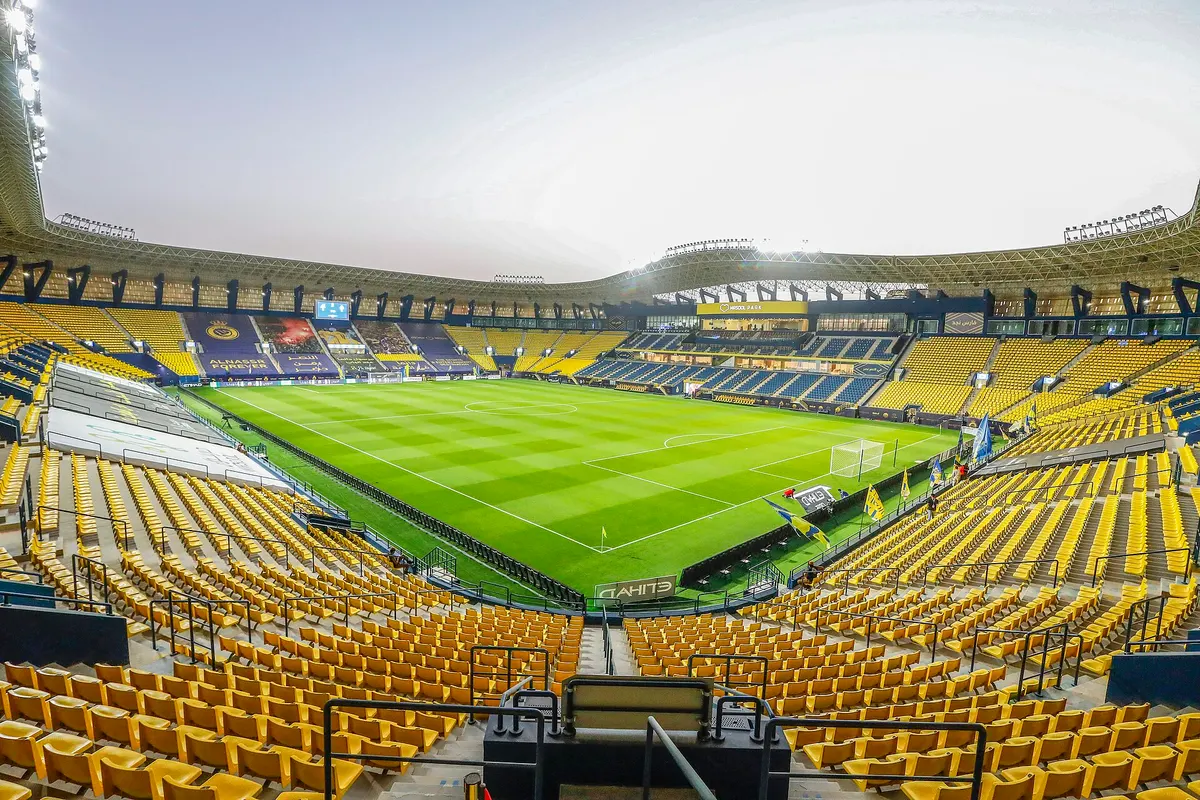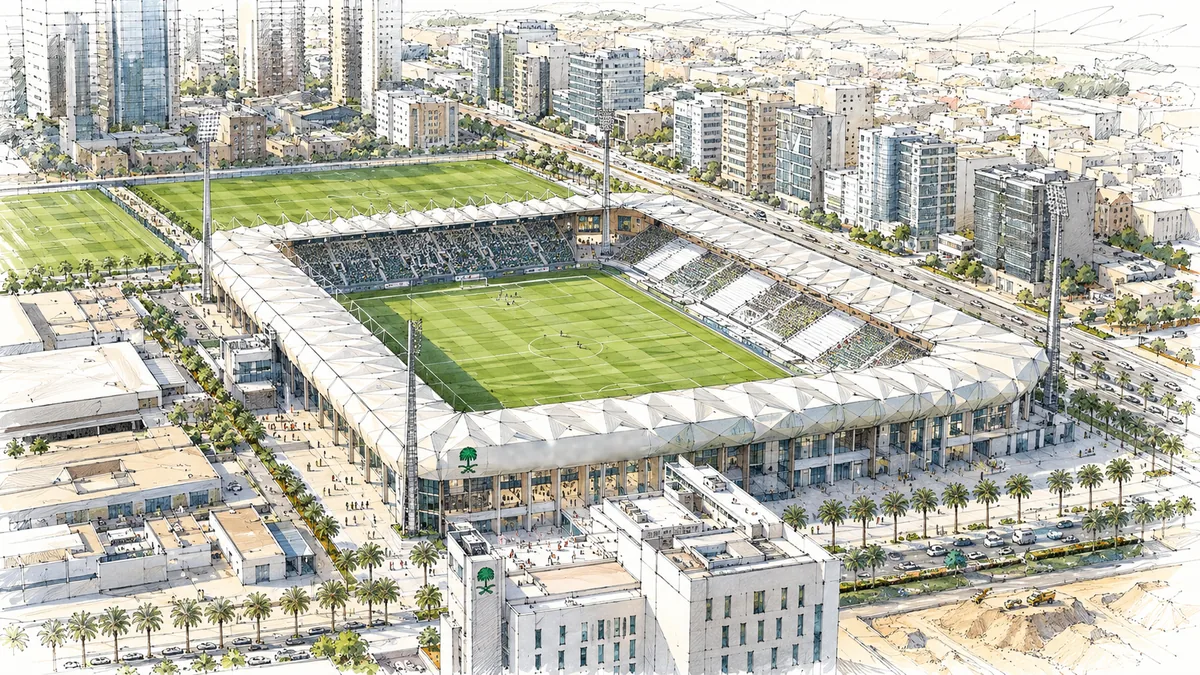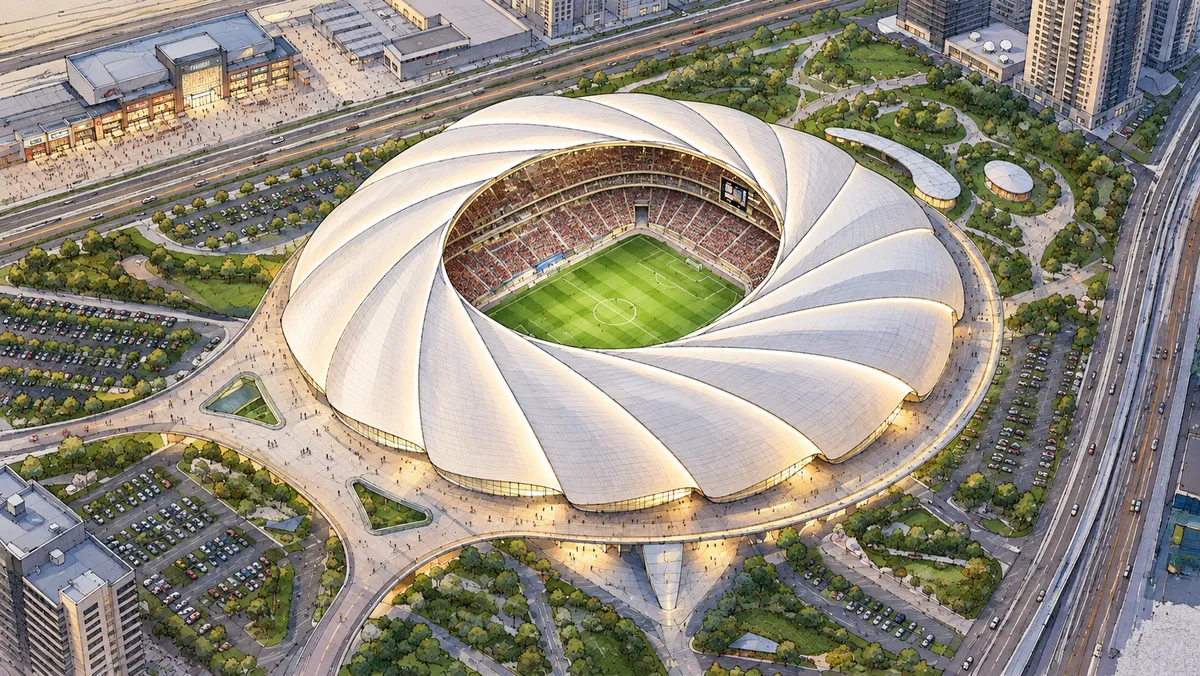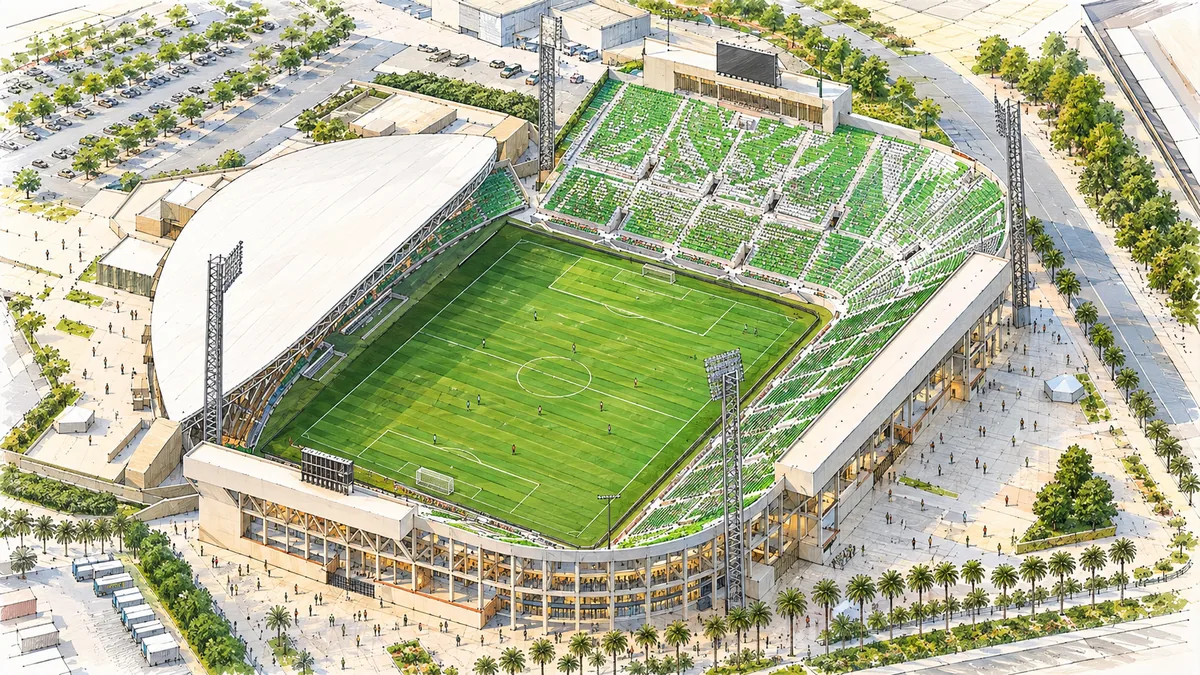
Saudi Arabia has won the Asian Cup three times. It has never won it at home, and the reason is simple: it has never staged one.
That changes on 7 January. Twenty-four teams, 51 matches, eight stadiums, and a final on 5 February in the same Riyadh bowl that opens the thing four weeks earlier. Asia’s oldest national-team tournament, first played in Hong Kong in 1956, arrives in the Kingdom for the first time in its 19th edition.
There’s a complication. Three of those eight stadiums aren’t finished.
8 stadiums · 3 cities · 51 matches · 24 teams. And a capacity range of 5.2x between the biggest ground and the smallest.
Not “being touched up.” Not “having the seats cleaned.” One has been closed since December 2023 and is the venue for both the opening match and the final. Another has never hosted a football match of any kind, and its own website still advertises it as opening in 2026. The third has been a building site since 2024 and is going from 8,500 seats to more than 22,000.
Here’s what the eight actually are, and which ones you can bank on.
The eight Asian Cup 2027 stadiums, by capacity
Every capacity below comes from our own stadium guides rather than the tournament listing. The AFC prints rounded figures that differ from the verified numbers at six of the eight grounds, and it also uses different names for two of them, calling Al-Awwal Park “King Saud University Stadium” and Aramco Stadium simply “Al Khobar.”
| Stadium | City | Capacity | Matches | Opened |
|---|---|---|---|---|
| King Fahd Sports City | Riyadh | 70,200 | 8 | 1987 |
| King Abdullah Sports City | Jeddah | 62,345 | 8 | 2014 |
| Aramco Stadium | Al Khobar | 47,000 | 7 | 2026 |
| Prince Abdullah Al-Faisal | Jeddah | 27,000 | 5 | 1973 |
| Al-Awwal Park | Riyadh | 26,004 | 6 | 2015 |
| Kingdom Arena | Riyadh | 26,000 | 6 | 2023 |
| Imam Mohammed Ibn Saud University | Riyadh | 25,000 | 6 | 2026 |
| Al-Shabab Club Stadium | Riyadh | 13,537 | 5 | 1984 |
The match counts add up to exactly 51. The full bracket, all six groups and every fixture sit on our Asian Cup 2027 hub.
Five of the eight are in one city
Riyadh has five grounds in this tournament. Jeddah has two. Al Khobar has one.
Run the coordinates and the Riyadh five sit within about 24 kilometres of each other. Between them they hold 160,741 seats. A team drawn into the right group can play an entire first round without changing hotel, and a supporter can get to any of the five inside half an hour.
That’s unusual for a tournament this size, and it’s genuinely good news if you’re travelling. Most continental tournaments make you fly. This one mostly makes you drive across town.
The two outposts are the problem. Jeddah is on the Red Sea, Al Khobar is on the Gulf, and the distance between them is 1,229 kilometres. Coast to coast, with the capital inland in between. So the geography is really one city plus two long-haul options, and which one you need depends entirely on the draw.
1,229 km separates the two coastal host cities. The five Riyadh grounds are all within 24 km of each other.
King Fahd Sports City, closed since 2023
The biggest ground in the tournament hasn’t staged a match in nearly three years.
King Fahd Sports City closed on 1 December 2023 for a reconstruction that strips out the athletics track and pulls the stands in toward the pitch, the same operation half of Saudi football seems to be having done. Reported completion is late 2026. That’s this quarter. There is no reopening announcement.
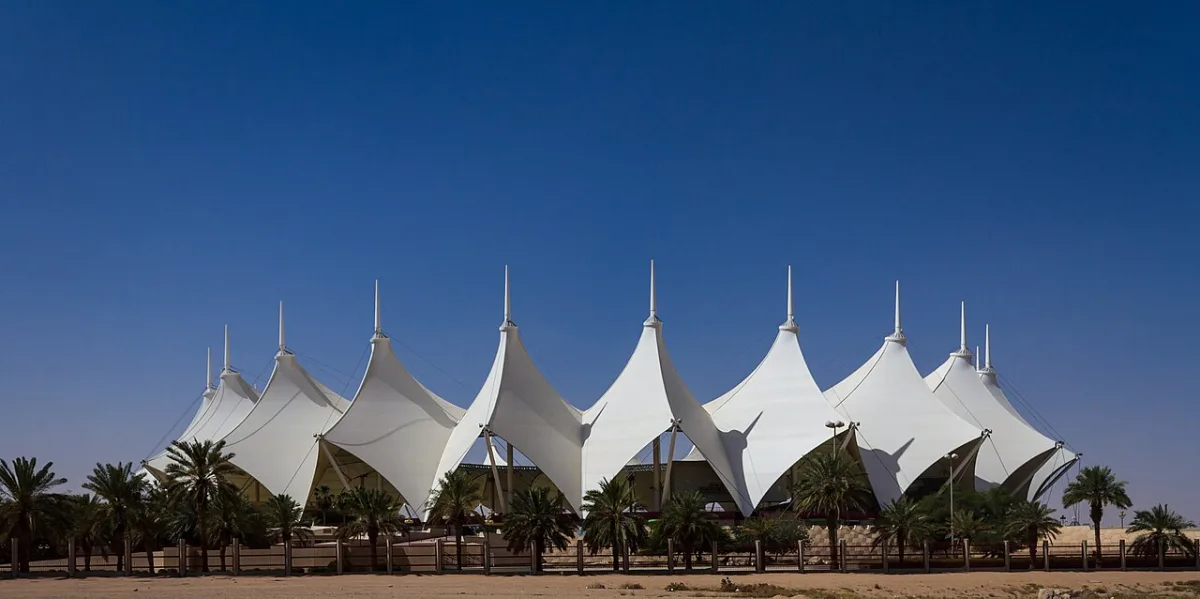
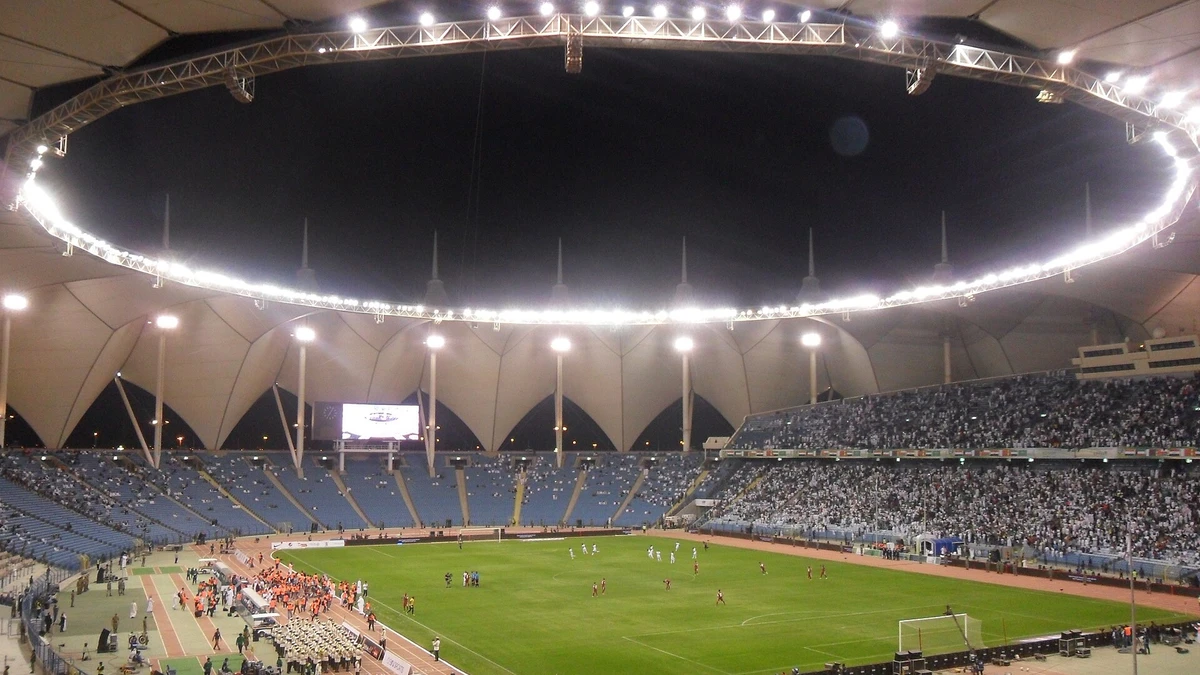
What’s coming back is worth waiting for. The roof here is held up by 24 masts, each 58 metres tall, arranged on a ring roughly 247 metres across, and Guinness World Records lists it as the largest stadium tensile roof in the world. It’s been the most photographed object in Saudi sport for four decades. Schiattarella Associati are handling the rebuild; Ian Fraser, John Roberts and Partners designed the 1983-87 original.
There’s a small piece of timing here that I like a lot. The stadium closed on 1 December 2023. Its own metro station opened on 15 December 2024, a year and two weeks later, to serve a ground that wasn’t open. Which means the first supporters ever to ride Line 2 to a match at King Fahd will be Asian Cup crowds in January.
And a piece of history that says something about how far this tournament has come. The 1992 King Fahd Cup final drew 75,000 people into this bowl. The third-place game, USA against Ivory Coast, played the day before in the same stadium, drew 9,500. FIFA liked the idea enough to take the tournament over and rename it the Confederations Cup in 1997.
The three that aren’t ready
Let’s be precise about this, because precision is the whole value here.
Aramco Stadium, Al Khobar, 47,000. Its own website describes it as opening in 2026 and lists the Asian Cup fixtures as the first events on its calendar. No match has been played there. This is a $1 billion building, reported at SAR 3.7 billion, designed by Populous with interiors by Jump Studios, and its first crowd will be a continental tournament. It takes seven matches including a semi-final.
King Fahd Sports City, Riyadh, 70,200. Closed since December 2023, completion reported as late 2026, no confirmation. Eight matches, including the opening game and the final.
Imam Mohammed Ibn Saud University Stadium, Riyadh, 25,000. Redevelopment started in 2024, taking the ground from 8,500 seats to more than 22,000. The Ministry of Sport is adding more than half again as much seating as the old stadium ever had. New floodlighting is specified at 2,500 lux, the broadcast level the AFC requires. Until the 2024 works it still had a running track around the pitch. It has no permanent club tenant, which makes it the only ground here that isn’t somebody’s home.
I looked for completion announcements on all three and found none. Not a delay, not a warning, just an absence. Saudi construction on this kind of project has generally hit its dates, and four months is a reasonable runway for fit-out. But anyone telling you these are definitely ready is guessing, and so is anyone telling you they aren’t.
The Aramco cooling system nobody has sat on yet
The engineering at Aramco Stadium deserves its own paragraph, because it’s doing something most stadiums don’t.
The cooling isn’t a vent behind you. It’s a vent beneath you. Airflow and noise testing was signed off in 2026 across roughly 57,000 displacement diffusers, one cluster per seating area, pushing cool air up from the floor rather than blasting it across the bowl. It’s a more efficient approach than overhead cooling, and it’s the same basic logic as the systems we looked at in World Cup 2026’s air-conditioned stadiums.
Here’s the part that’s hard to get past: none of those 57,000 diffusers has ever had a crowd sitting over them. Testing is one thing. Forty-seven thousand bodies in January is another.
The roof is unusual too. The standing-seam sheets are roll-formed on site rather than trucked in, in lengths running up to 100 metres, and they can be cold-bent to a radius as tight as 4,000 millimetres to follow the ellipse of the building. The site around it covers 800,000 square metres, with 15 entry gates, 33 retail units and 30 private suites.
Kingdom Arena went up in 60 days
This one’s absurd, and I mean that admiringly.
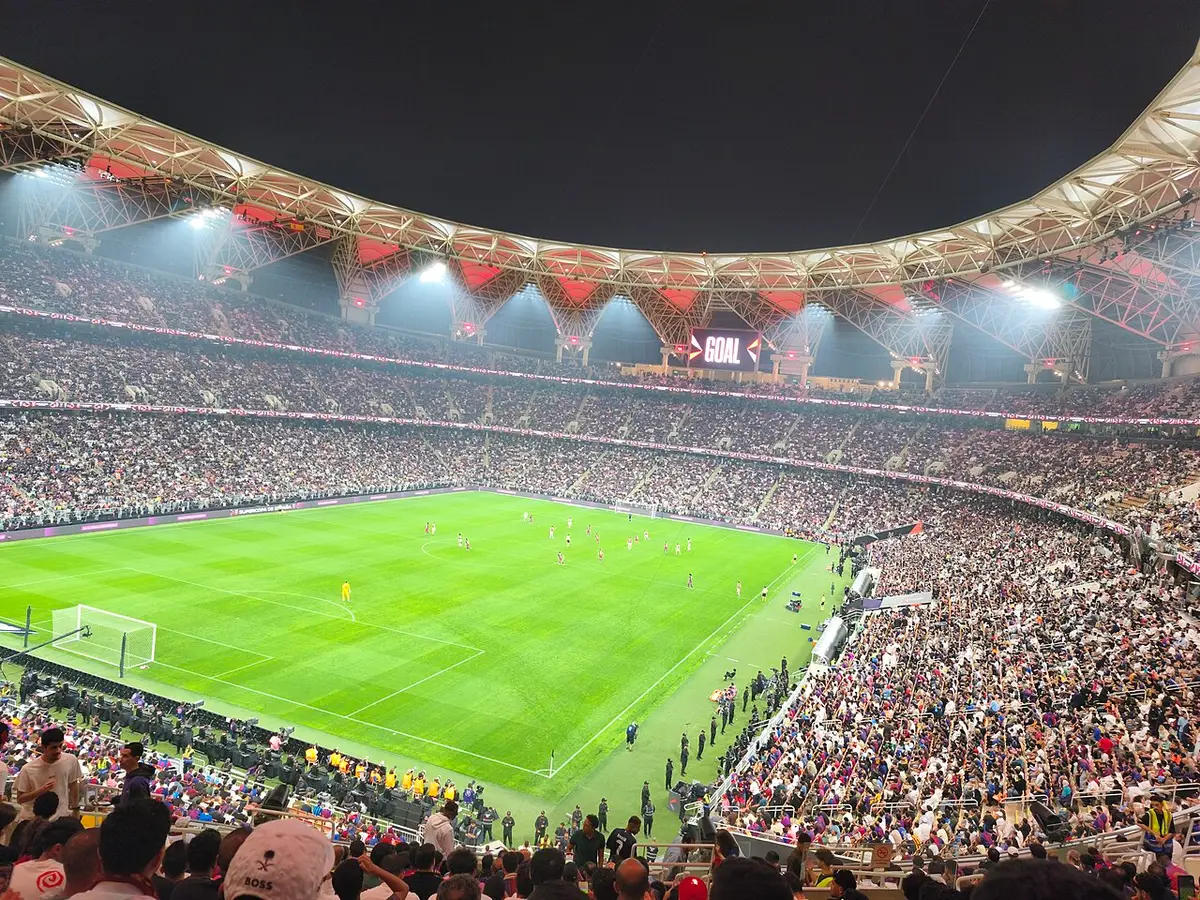
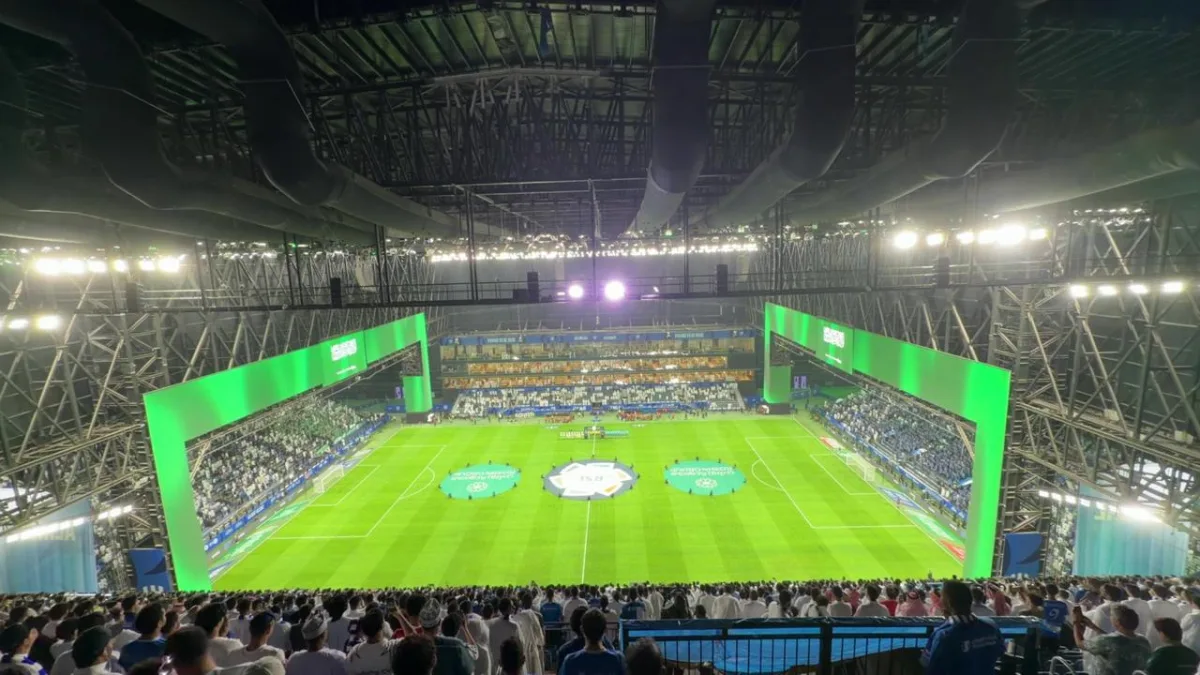
Kingdom Arena was built in 60 days. Ground broken 18 July 2023, finished in time to stage Tyson Fury against Francis Ngannou on 28 October 2023, at which point it had no permanent name, no tenant and no football match in the diary. It got the boxing built around it.
On 8 February 2024 it collected two Guinness World Records on the same day: largest covered football stadium by area at 37,991 square metres, and the highest seating capacity of any indoor covered stadium. It’s the only retractable roof in this tournament, and it’s normally shut.
Which creates a problem you don’t think about until someone points it out. The pitch gets almost no sunlight. So the grass is stitched hybrid turf grown under 18 LED440 and 2 LED120 grow-light rigs, cooled by six turf coolers, and monitored by nine sensor pods buried in the surface. Growing a football pitch indoors, under lamps, in Riyadh.
It takes six matches, including a quarter-final.
60 days from groundbreaking to hosting a heavyweight title fight. Two Guinness World Records collected on a single day in February 2024.
The smaller grounds have the better stories
The two oldest grounds in this tournament have the best stories, which is usually how it goes.
Prince Abdullah Al-Faisal in Jeddah opened in 1973, and even that date is contested, with 1970 and 1976 both in circulation. It’s the oldest venue here by eleven years. In 1989 it took a FIFA World Youth Championship semi-final between Nigeria and the United States, and 40,000 people got into a bowl then listed at 35,000. It holds 27,000 now.
The nine-year redevelopment that followed is best measured in plumbing. 370 toilets where there had been 40. 120 ticket windows where there had been 40. 15 concession stands where there had been four. That’s not a renovation, it’s an admission that the old building was never really built for crowds at all.
Then there’s the emptiness. Its first FIFA Club World Cup match, Leon against Urawa Red Diamonds on 15 December 2023, was watched by 2,525 people in 27,000 seats.
Al-Shabab Club Stadium is the smallest ground in the tournament at 13,537, and it has the strangest history of the eight. It opened in 1984 and did not host a competitive match until 2 January 2019. Thirty-five years as a training pitch. An entire generation of Riyadh football happened somewhere else while this thing sat there.
The 2021-23 redevelopment stripped out the running track, the floodlight masts, the perimeter walls and the buildings underneath the terracing, then rebuilt the stands with restaurants and cafes behind them. The record crowd came on 11 May 2024 against Al-Ahli: 13,475, which is 62 short of capacity. Near enough every seat in the building, and a long way off the biggest crowds ever recorded at a stadium.
In January it becomes an international venue for the first time in its life, with four group games and a Round of 16 tie.
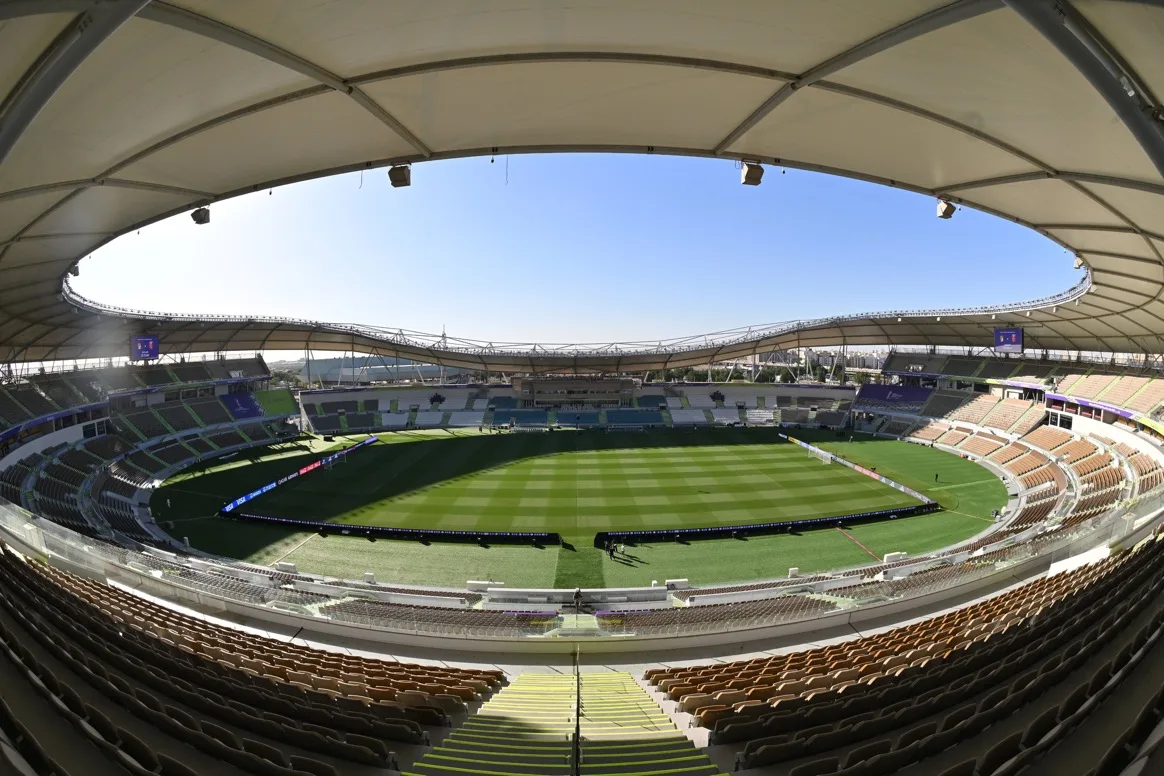
Al-Awwal Park was the first stadium in Riyadh built without a running track around the pitch. That single decision is why the seats here feel close when the older bowls in the city don’t, and it’s the reason it keeps getting picked for finals it has no business hosting.
It was also ignored for three years. Finished in May 2015, it waited until 13 February 2018 for its first competitive match, when Al-Hilal drew 0-0 with Al-Ain in the Asian Champions League.
And then there’s the capacity, which is my favourite number in this whole tournament. The ground is listed at 26,004. The record crowd is 26,003. One seat short. Al-Nassr hit that exact figure five separate times in the 2025-26 season, which means either there’s a seat in that building nobody can sell, or somebody’s counting method has a rounding problem. Nobody has explained it.
What the bracket does to the map
Look at where the knockout rounds go and something odd falls out.
Riyadh has five of the eight stadiums. It has the opening match. It has the final. And it has neither semi-final.
One semi goes to Aramco Stadium in Al Khobar, on the Gulf. The other goes to King Abdullah Sports City in Jeddah, on the Red Sea. That’s 1,229 kilometres between the last four teams, on opposite sides of the country, before the survivors come back to Riyadh for 5 February.
King Abdullah is the better building of the two and the better story. Arup Associates designed it, the main contract was SAR 2 billion in September 2011, and the original scheme was for 100,000 seats before it was cut back in late 2010 to the 60,000 bowl that got built. Arup’s brief on shade came with a catch: cover as many spectators as possible, and put none of that shade on the grass. The canopy solves it by reaching out over the stands on 60-metre girders and stopping dead at the pitch edge.
In 2023 it got 528 LED luminaires fitted into that roof in nine days. Field power draw dropped to 505.44 kW, a 46.3% cut on the metal halide rig it replaced, and the new fixtures throw colour across the bowl.
So will they be ready?
Probably. That’s the honest answer and I’d rather give it than pretend to certainty.
Five of the eight are finished, in use and unremarkable in the best sense. Kingdom Arena, Al-Awwal Park, Al-Shabab, Prince Abdullah Al-Faisal and King Abdullah Sports City are all open and staging football right now. That’s 154,886 seats of confirmed capacity across 30 of the 51 matches.
The other three carry the tournament’s two biggest occasions and its newest building, and none of them has a completion announcement to point at. What I can tell you is what’s verifiable: Aramco’s own site says 2026 and lists the Asian Cup as its first events, King Fahd has been shut since December 2023 with late 2026 as the reported target, and Imam Mohammed Ibn Saud has been under redevelopment since 2024.
Four months is not long. It’s also not short, for fit-out.
The bigger question is the one the buildings can’t answer. Saudi Arabia have reached six Asian Cup finals and won three, in Singapore in 1984, Qatar in 1988 and the UAE in 1996. Every one of them was played somewhere else. In January they get the tournament at home for the first time, in Group A, opening against Palestine at King Fahd on the seventh.
If that ground is finished, it’ll be some night.
Sources
- AFC Asian Cup official site. Tournament dates, the 9 May 2026 final draw, and the official match schedule PDF used for venue allocations and the bracket.
- Aramco Stadium official site. Primary source for the stadium’s construction status, stated 2026 opening and event calendar.
- Saudi Press Agency. The announcement of dates and venues for the 2027 tournament.
- Saudipedia. Venue background, including the disputed opening dates at Prince Abdullah Al-Faisal.
- Parametric Architecture. The King Fahd Sports City reconstruction scope and reported 2026 completion.
- Hero photo: King Fahd International Stadium at the opening of the 2014 Arabian Gulf Cup, by على المزارقه, CC BY-SA 4.0 via Wikimedia Commons. It shows the athletics track that the current reconstruction is removing.
- Capacities, coordinates, construction details and attendance records come from our own stadium guides, each linked above, which are individually sourced and verified.
Figures are cross-referenced across sources where possible. Stadium capacities genuinely vary between listings because of standing areas, media allocations and tournament reconfiguration, so the AFC’s published numbers differ from the verified figures above at six of the eight grounds. Where a date is disputed, as at Prince Abdullah Al-Faisal, the article says so rather than picking one quietly.