About King Fahd Sports City Stadium
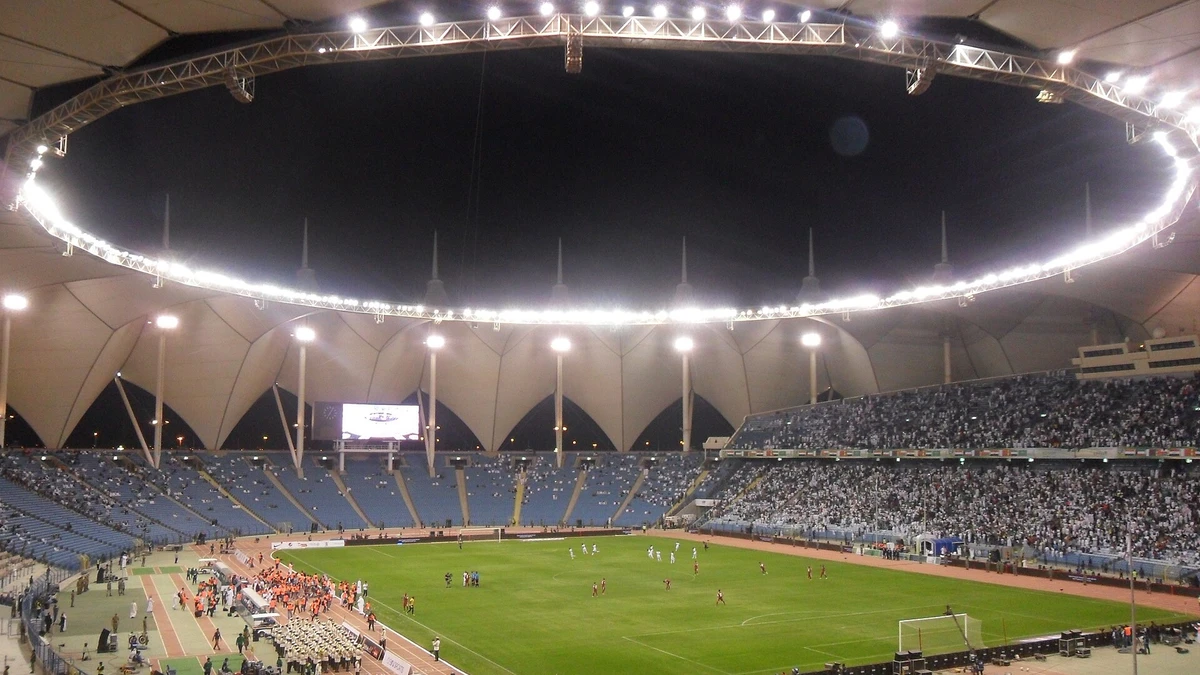
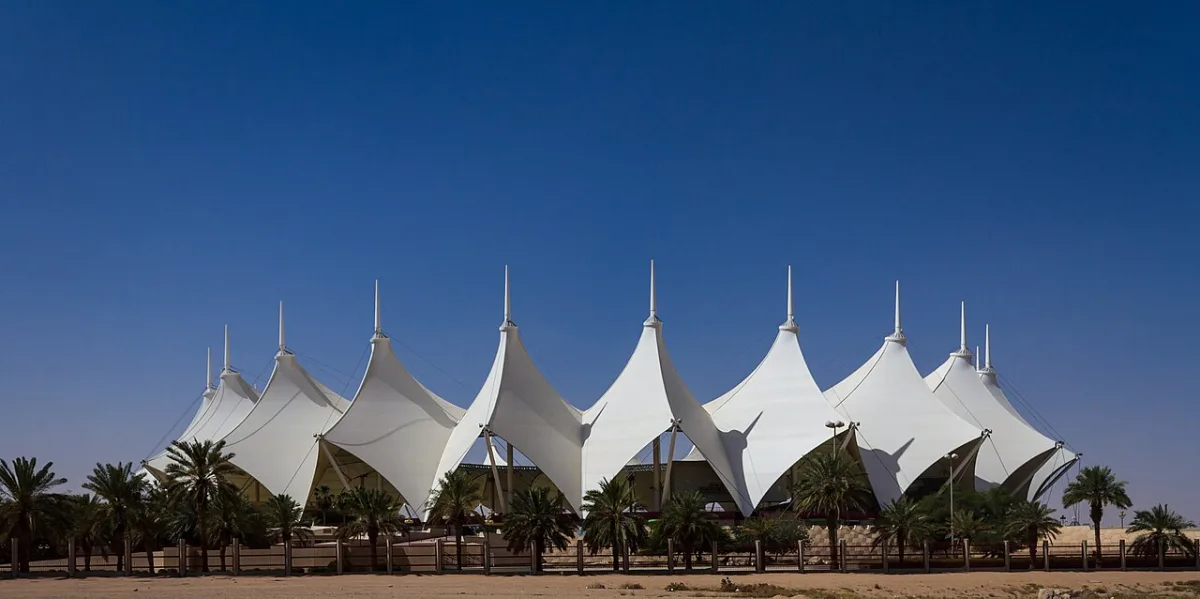
Twenty-four white cones rise out of the sand on the eastern edge of Riyadh, visible from the ring road long before anything else about the building resolves. They are tents, more or less literally: a PTFE-coated fiberglass membrane pulled taut over 24 masts arranged in a circle roughly 247 metres (810 feet) across, engineered in the mid-1980s to throw shade over the seats of a stadium in a place where shade is the whole argument. Saudis call it the Tent Stadium, and also the Pearl of Stadiums. Both nicknames are older than most of the people who will fill it in 2027.
The stadium anchors King Fahd Sports City, a 500,000-square-metre (124-acre) complex in the Al Ma’izilah district that also holds an indoor hall for handball, basketball, volleyball, judo and karate, athletics facilities, a mosque, gardens and parking lots sized for a crowd that arrives by car. It opened in 1987 under the name King Fahd International Stadium and kept it until 2023, when the venue was rebranded to match the complex around it. The Ministry of Sport owns and runs it.
For thirty-six years the bowl carried an eight-lane running track and a seat count nobody agreed on. It ended its life at 58,398. That track is the reason every photograph of the place looks the way it does, with the crowd set back from the touchline and a wide red apron of tartan between them and the game. On December 1, 2023 the stadium closed. Not for a refurbishment: for a reconstruction that stripped the membrane off the roof, took out the seats and dug the floor of the bowl down so a new lower tier could be built where the track used to run.
What reopens should hold 70,200. The AFC’s own tournament documentation says 72,000, and Saudi Arabia’s 2034 World Cup bid book says “70,000+”, so the number is not yet nailed down to the seat. What is settled is the job it has been rebuilt for. The AFC Asian Cup runs from January 7 to February 5, 2027, across eight stadiums in three Saudi cities, and King Fahd takes the opening match and the final, plus six more in between. That is eight games, more than any other venue in the tournament.
Getting to King Fahd Sports City Stadium
Public Transit
Riyadh Metro Line 2, the Red Line, terminates at King Fahd Sports City. Not near it. At it.
→ The line itself: 25.3 kilometres (15.7 miles) and 15 stations, running from King Saud University in the west across the city to the stadium in the east. It opened on December 15, 2024, as part of a six-line, 176-kilometre network.
→ Fares: A flat SAR 4 (about $1) buys two hours across metro and bus, with free transfers between lines. First class is SAR 10. Three-day, seven-day and thirty-day passes run SAR 20, SAR 40 and SAR 140.
→ Tickets: Through the Darb app, or with a Mada or credit card at the gate. Do the app before you travel.
→ Hours: Saturday to Thursday, 05:30 to midnight. Friday, 10:00 to midnight.
The detail worth sitting with: the line opened a full year after the stadium shut. Riyadh built a metro terminus for a building nobody could enter. The first crowd to use it as intended will be an Asian Cup crowd in January 2027, and it will be the first time in the stadium’s history that arriving without a car is the obvious choice.
Driving + Parking
The complex sits off the Eastern Ring Road in Al Ma’izilah, on the far side of the city from Olaya and the financial district. From central Riyadh the route runs south down King Fahd Road or Olaya Street to the Makkah-Khureis Road, then east across the ring road and out.
→ From Olaya / Kingdom Centre: about 19 kilometres (12 miles), 25 to 45 minutes depending on the hour.
→ From Diriyah: about 27 kilometres (17 miles) across the whole city, west to east. Allow an hour on an event night.
Parking is the complaint. It is the complaint in almost every review the old stadium ever collected, and the advice regulars gave each other was blunt: park two kilometres away and walk, or turn up three to four hours before a concert. In its favor, the isolation that makes it a slog to reach also makes it quick to leave, because there is no neighborhood grid to funnel a full house through. Whether the rebuild fixes any of this is unknown; the plans put roughly 1,000 spaces under a new landscaped plaza, which is a start and not an answer.
Rideshare
Uber and Careem both operate across Riyadh and both will take you to the gates. Careem has the deeper local coverage and the better chance of a driver accepting a fare out to Al Ma’izilah at 11pm. Expect the usual post-event surge, and expect it to be worse here than at a downtown venue, because the drop-off is 20 minutes from anywhere a driver would otherwise be sitting.
Pro tip: with a metro terminus at the gates, the rideshare case has largely evaporated for the trip in. Save it for the trip back if the queue at the station looks grim.
From the Airport
→ King Khalid International (RUH): about 24 kilometres (15 miles) northwest of the stadium, 25 to 40 minutes by car. Riyadh’s only commercial airport and the arrival point for essentially every visiting fan.
→ By metro from the airport: Line 4, the yellow line, calls at all three terminal stations, and it never touches Line 2. The trip in is two changes: Line 4 to Line 6 at SABIC, then Line 6 to Line 2 at Al Hamra. Slower than a car, and immune to the traffic that makes a car slow.
Watching a Match at King Fahd Sports City Stadium
Here is the honest position: nobody has watched a match here since 2023, and the building people will walk into in 2027 is not the building anyone remembers. So this is what the old bowl was actually like, and what the rebuild is deliberately changing about it.
The track defined it. Eight lanes of tartan ran between the front row and the touchline, which meant the closest seat in the house was a long way from the game and the noise had a gap to cross before it reached anybody. Look at the photographs from the 2014 Champions League nights and you can see it: a packed white-and-blue wall of Al-Hilal support, then a wide red moat, then the football. The 2024-26 reconstruction rips the track out, drops the pitch and builds a new tier into the recovered space. It is the single change that matters most, and it is the reason only the upper floor of the East Stand is being kept.
The roof does one job and does it well. The canopy covers the stands, not the pitch, so the bowl divides into shade and glare depending on where the sun is, and the whole 1980s design premise was that spectators in Riyadh need cover more than grass does. It is being taken down and put back in the same form, with one addition: a panoramic screen hung from the inner edge of the ring rather than bolted into a corner.
The other thing to understand is whose ground it was. Nobody’s, quite. Al-Hilal, Al-Nassr and Al-Shabab all played here simultaneously, along with the national team, which is a strange way to build an atmosphere and a strange way to build a home. Al-Nassr left in 2020, the other two in 2023. The AFC’s own Great Grounds of Asia profile, written in 2021, called it home to some of the most passionate and colorful fans in Asia, and the photographs of a lower tier turned entirely yellow for Al-Nassr back that up. But a shared stadium never gets the accumulated grudges and rituals that make a small ground loud.
Visitors were kind about the design and unkind about two specific things, consistently. Parking, covered above. And the food: the concessions were the other item people flagged, in the same breath as praising the architecture. The rebuild includes retail units and a sports museum inside the concourse, so somebody has at least considered the two hours before kickoff. Take that as intent, not as a promise.
One practical note for 2027. The Asian Cup runs in January, and in Riyadh that is a decision about heat rather than a quirk of the calendar. Winter football here is the pleasant version of Saudi football, and the tent that was designed to fight July will mostly be decorative.
The 2027 Asian Cup at King Fahd Sports City Stadium
Saudi Arabia hosts the 19th AFC Asian Cup from January 7 to February 5, 2027, with 24 teams across eight stadiums in Riyadh, Jeddah and Al Khobar. King Fahd is the tournament hub, and the schedule shows it plainly.
Matches: Eight. The opening game on January 7, Saudi Arabia against Palestine, then group fixtures on January 9, 12, 15 and 18, a Round of 16 tie on January 24, a quarter-final on January 29, and the Final on February 5.
Not a semi-final. Both semis go elsewhere, to King Abdullah Sports City in Jeddah and to the new stadium in Al Khobar. An unusual split, and one that spreads the tournament’s biggest nights across all three host cities rather than parking them in the capital.
Capacity for the tournament: the AFC lists 72,000 against the venue on its published schedule. Saudi sources give the rebuilt seat count as 70,200 and the 2034 bid book says “70,000+”. The gap is small, and until the stadium reopens it is not resolvable from the public record.
Beyond 2027, the venue is written into Saudi Arabia’s 2034 World Cup plans for group-stage matches, a Round of 32, a Round of 16, a quarter-final and a semi-final. The final goes to King Salman International Stadium, the 92,000-seat new build on the other side of the city.
Construction & Design
The design work started in 1981, at a moment when almost nobody was building large permanent tensile roofs and the handful of engineers who could do the mathematics were mostly in New York and Stuttgart. Saudi Arabia’s General Presidency of Youth Welfare hired the London practice Ian Fraser, John Roberts and Partners for the architecture, and the roof went to Geiger Berger Associates of New York, where Horst Berger led it, working alongside Rudolf Bergermann of schlaich bergermann partner. Philipp Holzmann AG built it. Birdair fabricated and installed the membrane. Construction ran from 1983, the fabric went up in 1985, and the stadium opened in 1987.
The roof is the building. Twenty-four masts, each 58 metres (190 feet) tall, stand on a ring roughly 247 metres (810 feet) across, and from each one a PTFE-coated fiberglass membrane is pulled down into a peaked cone. Cables do the rest: an inner ring cable hanging about 33 metres (108 feet) above the pitch on a circle 134 metres (440 feet) in diameter, upper and lower radial cables running out to the masts, and anchor cables taking the load down to the ground. There is no compression ring. The whole structure pushes its forces outward into anchorages rather than balancing them around a stiff hoop, which is why the thing reads as twenty-four separate tents rather than one continuous canopy.
Guinness World Records lists it as the largest stadium tensile roof in the world, at 47,000 square metres. Schlaich bergermann partner, which engineered it, puts the membrane itself at more than 30,000 square metres. The figures measure different things and both are published; take the record entry as the covered area and the smaller number as fabric.
Cost is the murky part. The figure in circulation is 1.72 billion Saudi riyals, reported as roughly $510 million at the exchange rates of the period, and it has never been restated by an official Saudi source we could locate.
The current work is a different building in the same skin. Schiattarella Associati, the Italian studio whose concept was adopted in 2016 and revised in December 2023, keeps the tent and changes nearly everything under it: the athletics track removed, the pitch lowered, a new lower tier inserted, only the upper floor of the East Stand retained from the old bowl. The playing surface is listed as hybrid grass, on a pitch of 105 by 68 metres (344 by 223 feet) inside a field area of 125 by 85 metres. Outside, a landscaped artificial hill forms a semicircle around the stadium and covers a new public plaza along with about 1,000 parking spaces, and the facade picks up hexagonal motifs the building already carried. A sports museum and retail go inside. AECOM, appointed by the Ministry of Sport, supervises the site. Work started at the end of 2024 with a target of late 2026, which leaves a matter of weeks before the Asian Cup opening ceremony.
History of King Fahd Sports City Stadium
The stadium arrived with an international tournament attached. Saudi Arabia hosted the 1989 FIFA World Youth Championship across four cities, and Riyadh took both the opening match and the final. Seventy thousand came to the opener, the largest crowd of the tournament. Portugal took the final on March 3, 2-0 over Nigeria. Saudipedia dates the formal inauguration to 1988 and names the first match as Saudi Arabia against Oman in the Gulf Cup, with Fahd Al-Harifi scoring the first goal in the building. The dates do not agree. Structurae records completion in 1986, and 1987 is the opening year almost everything else carries. We report the spread instead of picking one.
Then came the tournament that would outgrow it. In October 1992 King Fahd hosted a four-team invitational named after him: Argentina, Saudi Arabia, the United States and Ivory Coast, all four matches in this stadium. Argentina beat the hosts 3-1 in the final in front of 75,000. The third-place game drew 9,500. The 1995 edition was bigger, Denmark beating Argentina 2-0 in the final, and in 1997 FIFA took the competition over, renamed it the Confederations Cup, and retroactively counted both Riyadh editions as official. A tournament that ran until 2017 and served as the dress rehearsal for every World Cup for two decades started life on this pitch.
Notable events:
- 1989 FIFA World Youth Championship final (March 3, 1989): Portugal 2, Nigeria 0. Riyadh was by far the largest of the tournament’s four grounds; Jeddah listed 35,000, Dammam 22,042 and Taif 20,000.
- 1992 and 1995 King Fahd Cup: Argentina 3-1 Saudi Arabia in the first final, 75,000 in the ground; Denmark 2-0 Argentina in the second. Both tournaments were played entirely here, and FIFA absorbed the competition in 1997.
- Record attendance (February 16, 2000): 67,000 for Al-Hilal against Al-Ahli in the Saudi Founder’s Cup. It is the figure the record books carry, though the 1989 and 1992 tournament crowds here were logged higher, in a bowl configured differently at the time.
- 2021 AFC Champions League final (November 23, 2021): Al-Hilal 2, Pohang Steelers 0, watched by 50,171, a fourth continental title for the Riyadh club.
- BTS, Love Yourself: Speak Yourself (October 11, 2019): 31,899 people, and the first stadium concert by an international act in Saudi Arabia. WWE brought Crown Jewel to the same building three weeks later.
- Supercopa de España (2022 and 2023): all three matches of the 2022 edition, including the first competitive Clásico ever played outside Spain, and the 2023 final on January 15. Three days after that, the delayed 2022 Supercoppa Italiana put Milan against Inter on the same grass.
Between those headlines the stadium did ordinary work for three Riyadh clubs at once. Al-Hilal used it from 1987 to 2018 and again from 2020, Al-Shabab from 1987 straight through, Al-Nassr from 1987 until 2020, and the national team throughout. The capacity quoted for it drifted the whole time, listed at 60,000, 64,000, 67,000, 70,000 and 75,000 in various records before settling at 58,398, of which Saudipedia counts 7,500 family seats and 1,545 VIP seats.
The closure on December 1, 2023 ended that era abruptly. Saudi Arabia had by then been awarded the 2027 Asian Cup and was assembling the 2034 World Cup bid it would win in December 2024, and the country’s most recognizable stadium was a 1980s multi-purpose bowl with a running track. The decision was to keep the tent and rebuild everything beneath it. Which is either a conservative choice or an unusually confident one, depending on how you feel about a roof that has been the most photographed object in Saudi sport for four decades. The groups, the bracket and all eight grounds are in our AFC Asian Cup 2027 guide.
Sources & Further Reading
- Saudipedia, the national encyclopedia: saudipedia.com. Site area, the 58,398 seat breakdown, the 70,200 post-renovation figure, nicknames, first match and the closure date.
- schlaich bergermann partner project page: sbp.de. The engineer’s own account of the roof: 24 masts, cable geometry, membrane material and the no-compression-ring design.
- Structurae structural database: structurae.net. Architect, structural engineers, general contractor, construction chronology and dimensions.
- AFC Asian Cup Saudi Arabia 2027 official match schedule: assets.the-afc.com. The eight-match assignment with its dates, the 72,000 tournament capacity and the January 7 to February 5 window.
- Saudi Arabia FIFA World Cup 2034 bid site: saudi2034.com.sa. The venue’s stated 2034 role and capacity, and the wider stadium plan.
- Wikipedia entry on King Fahd Sports City Stadium: en.wikipedia.org/wiki/King_Fahd_Sports_City_Stadium. Tenancy history, the attendance record, the reported construction cost and the event list.
Quick Facts
Everything you need at a glance.
Stadium specs
- Capacity
- 70,200
- Opened
- 1987
- Cost
- SAR 1.72 billion reported (original); 2024-26 rebuild not disclosed
- Roof
- Fixed PTFE tent canopy over the stands
- Surface
- Hybrid grass
- Tenants
- Saudi Arabia national team, Al-Hilal (Saudi Pro League, to 2023), Al-Shabab (Saudi Pro League, to 2023), Al-Nassr (Saudi Pro League, to 2020)
Construction & location
- Groundbreaking
- 1983
- Architects
- Ian Fraser, John Roberts and Partners (1983-87 original), Schiattarella Associati (2016 concept, 2023 revision, 2024-26 rebuild)
- Engineering
- Geiger Berger Associates (Horst Berger) with schlaich bergermann partner (Rudolf Bergermann)
- General contractor
- Philipp Holzmann AG (original); AECOM supervising the 2024-26 rebuild for the Ministry of Sport
- Address
- King Fahd Sports City, Al Ma'izilah District, Riyadh 13233, Saudi Arabia
- GPS
- 24.7883°N, 46.8392°E
Photo Gallery
Fun Facts
The 1992 King Fahd Cup final drew 75,000 people here. The third-place game between the United States and Ivory Coast, played the day before in the same bowl, drew 9,500. FIFA took the tournament over anyway and renamed it the Confederations Cup in 1997.
Twenty-four masts, each 58 metres (190 feet) tall, hold the roof up on a ring roughly 247 metres (810 feet) across. Guinness World Records lists it as the largest stadium tensile roof in the world.
The stadium closed on December 1, 2023. Its own metro station opened on December 15, 2024, one year and two weeks later, which means the first supporters to ride Line 2 to a match here will be Asian Cup crowds in January 2027.
Stadium Location
Frequently Asked Questions
- Can I visit King Fahd Sports City Stadium right now?
- No. The stadium shut on December 1, 2023 and has been a construction site ever since. The tent roof came off, the seats came out, and the bowl was excavated to drop the pitch and add a lower tier. The target for reopening is late 2026, driven entirely by the AFC Asian Cup opening match on January 7, 2027. If you are in Riyadh before then, the sports city around it is still worth the metro ride, but the stadium itself is behind hoardings.
- What matches does it host at the 2027 Asian Cup?
- Eight, more than any other venue in the tournament. The AFC's published schedule gives it the opening game on January 7, four more group fixtures on January 9, 12, 15 and 18, a Round of 16 tie on January 24, a quarter-final on January 29, and the Final on February 5. It does not host a semi-final; those go to Jeddah and Al Khobar.
- How do I get there on the Riyadh Metro?
- Line 2, the Red Line, ends at King Fahd Sports City. That is the whole answer, and it is a new one: the line opened on December 15, 2024, a year after the stadium closed, so nobody has yet arrived at a match this way. A flat SAR 4 buys two hours across metro and bus, tickets come through the Darb app, and trains run until midnight every night.
- Is the parking really as bad as people say?
- It was. The complex has vast lots, and the reviews of the old stadium are close to unanimous that the lots did not help: regulars advised parking two kilometres out and walking, or arriving three to four hours early for a concert. The counterweight, which the same reviews make, is that the stadium sits well away from the city center, so once you are moving the exit is clean. With a metro terminus at the gates, the calculation changes for the first time in the building's life.
- What happened to the running track?
- It is gone, and that is the point of the whole rebuild. For thirty-six years an eight-lane athletics track sat between the front row and the touchline, which is why the old photographs make the crowd look so far away. The 2024-26 reconstruction removes it, lowers the pitch and builds a new lower tier into the space, turning a 1980s multi-purpose bowl into a football-specific one.
- Where are the best seats going to be?
- Nobody can honestly tell you yet, because the bowl is being rebuilt and only the upper floor of the East Stand is being kept. What is known: the new lower tier sits where the track used to be, so front-row seats will be closer to the pitch than at any point in the stadium's history, and a panoramic screen is being hung from the inner edge of the roof rather than parked in a corner. Shade is the other consideration. The canopy covers the stands and leaves the pitch open, so the old bowl split into shaded seats and glare depending on the hour.
- Why is it called the Tent Stadium?
- Because it is one. Twenty-four masts carry a PTFE-coated fiberglass membrane pulled into twenty-four peaked cones arranged in a circle, a shape drawn straight from the Bedouin tent and, from a distance across the sand, closer to a flower than a stadium. Saudipedia records both of its nicknames, the Tent Stadium and the Pearl of Stadiums. AECOM used the second one in its own announcement.
- What is the biggest crowd it has ever held?
- The record on the books is 67,000, for Al-Hilal against Al-Ahli in the Saudi Founder's Cup on February 16, 2000. The 1992 King Fahd Cup final is logged at 75,000, which tells you how much the seating configuration changed over the years: the same bowl has been quoted at 60,000, 64,000, 67,000, 70,000 and 75,000 by different sources at different times, and it settled at 58,398 by the time it closed.
- Will it host the 2034 World Cup final?
- No. Saudi Arabia's bid book assigns the final to the new King Salman International Stadium, also in Riyadh. King Fahd is down for group-stage matches, a Round of 32, a Round of 16, a quarter-final and a semi-final, which still makes it one of the busiest venues in the tournament.
- Whose home ground is it?
- That is the awkward question, and it is part of why the atmosphere here was never quite what the architecture promised. Al-Hilal, Al-Nassr and Al-Shabab all used it at once, along with the national team, so on any given night it belonged to whoever had sold the most tickets. Al-Nassr left in 2020, Al-Hilal and Al-Shabab in 2023 when it closed. Which clubs return after the rebuild has not been announced.
- What food is there?
- Not much, historically. The concession stands are the one thing visitors to the old stadium complained about as consistently as the parking. Whether the rebuild fixes it is an open question, though the plans include retail units and a sports museum inside the concourse, which at least suggests somebody has thought about the hours before kickoff.
Last updated: 2026-09-04