About Great American Ball Park
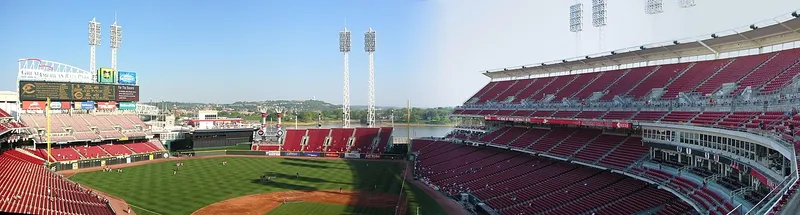
On the banks of the Ohio River in downtown Cincinnati, a ballpark opens onto views of the Kentucky hills, the Roebling Suspension Bridge, and the riverboat traffic that defines the city’s character. With 45,814 seats, Great American Ball Park is the home of the Cincinnati Reds, a franchise whose lineage traces to the 1869 Red Stockings, professional baseball’s first openly all-salaried team, and one of the most visually striking ballparks in Major League Baseball.
The Reds are the sole tenants, and the ballpark was purpose-built to showcase the franchise’s history. The Reds Hall of Fame & Museum is integrated into the building, the Power Stacks in right-center field reference Pete Rose’s #14 with 14 oversized baseball bats mounted on two smokestacks, and a 50-foot Indiana limestone bas-relief greets fans at the main entrance. The Reds’ legendary Big Red Machine era, Pete Rose, Johnny Bench, Joe Morgan, Tony Pérez, is woven into every corner.
HOK Sport (now Populous) and GBBN Architects designed the $290 million ballpark, which opened on March 31, 2003. It replaced Cinergy Field (originally Riverfront Stadium), the multipurpose concrete donut that had served the Reds and Bengals since 1970. The new design reversed the old stadium’s philosophy: instead of closing off the river, it embraced it, with The Gap, a 35-foot-wide break in the stands between home plate and third base, framing views of downtown Cincinnati from inside the park. The asymmetric outfield dimensions (328 feet down the left field line, 404 feet to center, 325 feet to right) favor right-handed power hitters, and the park has consistently played as one of the best hitters’ environments in the National League.
The ballpark has hosted the 2015 MLB All-Star Game, three no-hitters (Homer Bailey in 2013, Jake Arrieta in 2016, Blake Snell in 2024), and some of baseball’s most dramatic moments. Adam Dunn’s 535-foot home run in 2004 cleared the batter’s eye and reportedly bounced off Mehring Way into the Ohio River, the longest blast the park has ever seen.
Getting to Great American Ball Park
Public Transit
Cincinnati’s free streetcar is the easiest way to get to the ballpark from downtown.
→ From downtown Cincinnati: The Cincinnati Bell Connector streetcar is free and stops at The Banks, steps from the ballpark gates. The 3.6-mile loop connects the riverfront, downtown, and Over-the-Rhine.
→ From Northern Kentucky: The TANK Southbank Shuttle connects Covington and Newport to downtown Cincinnati, stopping near the ballpark. $2 per ride.
Metro bus routes 1, 11, 17, 19, 25, 42X, and 78 serve stops near the stadium. Most downtown hotels are within a 15-minute walk.
Driving + Parking
GPS address: 100 Joe Nuxhall Way, Cincinnati, OH 45202.
→ From Columbus (163 km): I-71 South directly into downtown Cincinnati. About 1 hour 40 minutes.
→ From Dayton (93 km): I-75 South into downtown. About 1 hour.
→ From Indianapolis (177 km): I-74 East to I-75 South. About 1 hour 50 minutes.
Parking options include Central Riverfront Garage East ($27), Central Riverfront Garage West ($23), East Garage ($16), and Lot E ($16). Lots open 5 hours before game time. Tailgating is prohibited in GABP lots, the bars and restaurants along The Banks serve as the pre-game alternative.
Rideshare
Uber and Lyft both serve the ballpark. Drop-off near E. Freedom Way and Rosa Parks Street, about a block from the west entrance. From downtown, expect $10-15; from CVG airport about $35-40. After games, walk a few blocks toward The Banks for quicker pickups and lower surge pricing.
From the Airport
→ Cincinnati/Northern Kentucky International Airport (CVG): 22 km south (in Kentucky), about 20 minutes by car. Taxi fare $30-45; Uber/Lyft about $35-40. A TANK bus runs from CVG to downtown every 30 minutes (~24 minutes, $2).
Construction & Design
HOK Sport, now Populous, designed Great American Ball Park with the local firm GBBN Architects, and Hunt Construction Group built it for roughly $290 million, with Geiger Engineers and THP Limited handling the structure. It rose on a 29-acre site on the north bank of the Ohio River, immediately east of the Bengals’ stadium, as the Reds’ half of a two-stadium riverfront plan funded by a 1996 Hamilton County sales-tax measure. Ground was broken on October 4, 2000, and the park opened on March 31, 2003. The design deliberately reversed the philosophy of the multipurpose Riverfront Stadium it replaced: rather than sealing the seating bowl into a concrete ring, HOK opened the structure toward the water and the downtown grid.
The signature move is The Gap, a roughly 35-foot break in the third-base stands aligned with Sycamore Street, which lets fans see the skyline from inside the park and passersby glimpse the field from the street. In right-center stand the Power Stacks, two smokestacks styled after the funnels of the 19th-century steamboats that made Cincinnati a river-commerce hub, carrying oversized bats and wired to shoot flames and fireworks after Reds home runs and wins. Together they tie the building’s riverboat heritage directly to the action on the field.
The ballpark folds the franchise’s history into its materials and detailing. A 50-foot Indiana limestone bas-relief depicting a batter, pitcher, and fielder anchors the main entrance, opaque glass-tile mosaics were fabricated in Ravenna, Italy, and the two-floor Cincinnati Reds Hall of Fame & Museum is built into the Main Street side, celebrating a franchise whose roots run back to the 1869 Red Stockings, professional baseball’s first all-salaried team. Thousands of tons of structural steel frame a Kentucky bluegrass field, and the riverfront siting beside the adjacent Smale Riverfront Park places the Reds squarely back on the Ohio River waterfront that has defined the city since its founding.
History of Great American Ball Park
The Cincinnati Reds’ previous home, Riverfront Stadium, later renamed Cinergy Field, was a multipurpose concrete bowl that opened in 1970. It served the Reds and Bengals for three decades, hosting the Big Red Machine’s back-to-back World Series wins in 1975 and 1976, but by the late 1990s, both teams wanted out. A 1996 Hamilton County sales tax referendum funded new stadiums for both: Paul Brown Stadium for the Bengals and Great American Ball Park for the Reds.
HOK Sport and GBBN Architects designed the $290 million ballpark, breaking ground on October 4, 2000. The naming rights went to Great American Insurance Group for $75 million over 30 years, a deal facilitated by Carl Lindner Jr., who was both the Reds’ majority owner and chairman of Great American’s parent company.
Key moments in the ballpark’s history:
- March 31, 2003: Inaugural game, Pittsburgh Pirates 10, Cincinnati Reds 1. Ken Griffey Jr. recorded the park’s first hit.
- August 10, 2004: Adam Dunn launches a 535-foot home run off José Lima, the longest in GABP history, clearing the batter’s eye into the Ohio River.
- September 28, 2010: Jay Bruce’s walk-off home run clinches the NL Central title, the Reds’ first postseason berth since 1995.
- July 2, 2013: Homer Bailey throws the first no-hitter at GABP, blanking the Giants 3-0.
- July 14, 2015: The 86th MLB All-Star Game. AL defeats NL 6-3; Mike Trout wins ASG MVP.
- August 2, 2024: Blake Snell of the Giants throws a no-hitter, beating the Reds 3-0 with 11 strikeouts.
Cincinnati’s summers are hot and humid, July and August game-time temperatures regularly hit the mid-80s°F with humidity to match. The open-air design means no shelter from afternoon sun in the upper deck, making evening games the preferred choice for most fans. The Ohio River moderates temperatures slightly, and the breeze off the water is noticeable in the riverfront sections. Rain delays are common in April and May, but the Reds play through most weather short of lightning.
Great American Ball Park belongs to the wave of retro-modern ballparks that Camden Yards pioneered in 1992, but it has its own identity. The river views, the Power Stacks, The Gap, and the deep connection to baseball’s oldest professional franchise make it a destination that honors Cincinnati’s place in the sport’s history while giving modern fans one of the most scenic settings in the game.
Sources & Further Reading
- Wikipedia entry on Great American Ball Park: en.wikipedia.org/wiki/Great_American_Ball_Park. Architect, structural engineers, contractor, cost, The Gap, and the Power Stacks.
- Ballparks of Baseball, Great American Ball Park: ballparksofbaseball.com. A ballpark reference for construction history and dimensions.
- Retrosheet, box score for March 31, 2003: retrosheet.org. The primary record of the inaugural game, Pirates 10, Reds 1.
- Cincinnati Reds official ballpark page: mlb.com/reds/ballpark. Events, tickets, and visitor information.
Quick Facts
Everything you need at a glance.
Stadium specs
- Capacity
- 45,814
- Opened
- 2003
- Cost
- Around $290 million (2003)
- Roof
- Open
- Surface
- Natural Grass
- Tenants
- Cincinnati Reds (MLB)
Construction & location
- Groundbreaking
- October 4, 2000 (opened March 31, 2003)
- Architects
- HOK Sport (now Populous), GBBN Architects (associate)
- Engineering
- Geiger Engineers; THP Limited
- General contractor
- Hunt Construction Group
- Address
- Great American Ball Park, 100 Joe Nuxhall Way, Cincinnati, OH 45202
- GPS
- 39.0975°N, 84.5071°W
Photo Gallery
Fun Facts
The Power Stacks in right-center field feature two smokestacks with 7 baseball bats each (14 total), symbolizing Pete Rose's iconic #14, they emit flames on Reds strikeouts and launch fireworks after every home run and win.
In August 2004, Adam Dunn hit a 535-foot home run off José Lima that cleared the batter's eye and bounced off Mehring Way into the Ohio River, the longest home run in the ballpark's history.
Great American Ball Park contains over 10,000 tons of structural steel and features a 50-foot-by-20-foot Indiana limestone bas-relief carving near the main entrance depicting a young player looking up at heroic figures of a batter, pitcher, and fielder.
Stadium Location
Frequently Asked Questions
- What is the capacity of Great American Ball Park?
- 45,814 seats, the current figure used by the Reds. Some sources still cite the roughly 42,000 opening-day capacity, but 45,814 is the ballpark's current listed figure across its three levels.
- Can you bring food into Great American Ball Park?
- Yes. Outside food is permitted if packaged in a clear, gallon-sized plastic bag. Sealed non-alcoholic beverages in clear plastic bottles are also allowed. No glass, cans, or alcohol.
- How do I get to Great American Ball Park without a car?
- The free Cincinnati Bell Connector streetcar stops at The Banks, steps from the stadium. Metro bus routes 1, 11, 17, and others serve downtown. The TANK Southbank Shuttle connects from Northern Kentucky for $2.
- Is there parking at Great American Ball Park?
- Yes. Central Riverfront Garage ($23-27), East Garage ($16), Broadway Ave Lot ($27), and Lot E ($16). Lots open 5 hours before game time.
- Does Great American Ball Park have a roof?
- No, it is an open-air stadium. Games may be delayed or postponed due to rain. Summer games are typically warm, with average temperatures in the 80s°F.
- Is tailgating allowed at Great American Ball Park?
- Tailgating is officially prohibited in GABP garages and lots. The open-air bars and restaurants along The Banks entertainment district serve as the primary pre-game gathering spot.
- When was Great American Ball Park built?
- Construction began October 4, 2000, and the park opened on March 31, 2003, a 10-1 loss to the Pittsburgh Pirates. It replaced Cinergy Field (Riverfront Stadium), which was demolished in 2002.
Last updated: 2026-07-06