About Rate Field
Deep in the working-class heart of Bridgeport, at 35th and Shields on the South Side of Chicago, the White Sox have held court since Charles Comiskey moved the franchise here in 1910. Their current home, Rate Field, holds 40,615 and sits directly on top of a CTA Red Line stop, one of the most accessible ballparks in Major League Baseball.
The White Sox are the sole tenants. The ballpark replaced old Comiskey Park, which stood on the adjacent lot from 1910 to 1990. HOK Sport (now Populous) designed the $137 million stadium, which was entirely publicly funded through the Illinois Sports Facilities Authority. When it opened on April 18, 1991, critics called the upper deck too steep and too far from the field, a problem that more than $100 million in renovations between 2001 and 2007 largely solved by removing 6,600 upper-deck seats and adding fan-friendly features throughout.
The stadium’s defining moment came in October 2005, when the White Sox swept the Houston Astros to win their first World Series in 88 years. Games 1 and 2 were played here, and the South Side celebration that followed remains one of Chicago’s great sports memories. Mark Buehrle added to the ballpark’s legacy with a no-hitter in 2007 and a perfect game in 2009, the latter preserved by DeWayne Wise’s spectacular running catch against the center field wall.
The naming history is a story in itself: New Comiskey Park (1991-2003), U.S. Cellular Field (2003-2016), Guaranteed Rate Field (2016-2024), and now Rate Field (2024-present). Four names in 35 years, but the South Side faithful have always just called it “the ballpark.”
Chicago’s weather is part of the experience. April openers regularly see temperatures in the low 40s°F with wind chill off Lake Michigan making it feel colder. Summer games bring the opposite extreme, July and August afternoons in the upper 80s°F with the sun bearing down on the upper deck’s west-facing sections. The best game-day weather arrives in September, when mid-70s evenings and the glow of the pinwheel scoreboard fireworks make late-season baseball on the South Side hard to beat.
Getting to Rate Field
Public Transit
Rate Field has some of the best transit access of any MLB ballpark, the Red Line stop is literally steps from the gates.
→ From downtown Chicago (the Loop): CTA Red Line southbound to Sox-35th station. About 10 minutes from the Loop. Trains run every 5-10 minutes on game days.
→ From the south suburbs: Metra Rock Island Line to the 35th Street “Lou” Jones station, a short walk to the ballpark.
CTA bus routes #24 (Wentworth) and #35 (31st/35th) also serve the stadium. The Green Line’s 35th-Bronzeville-IIT station is about a 10-minute walk.
Driving + Parking
GPS address: 333 West 35th Street, Chicago, IL 60616.
→ From Milwaukee (150 km): I-94 South to I-90/94 South, exit at 35th Street. About 1 hour 45 minutes.
→ From Indianapolis (296 km): I-65 North to I-90/94 West, exit at 35th Street. About 3 hours.
→ From the Loop (5 km): I-90/94 South (Dan Ryan Expressway) to 35th Street exit. About 10-15 minutes without traffic.
Lots A, B, C, and G are prepaid ($25). Lots F and L accept day-of payment ($30, card only). Sunday games are $10. Tailgating is allowed in Lots A through F, lots open 2 hours before first pitch. The entire stadium is cashless.
Rideshare
Uber and Lyft drop off and pick up at Lot A, off Wentworth Avenue between 33rd and 35th Streets, near Gate 5. From downtown, expect $12-20; from Midway Airport about $15-25; from O’Hare about $35-55. Chicago’s congestion surcharge adds $1.50 for trips during peak hours.
From the Airport
→ Chicago Midway International Airport (MDW): 10 km south, about 15 minutes by car. CTA Orange Line to the Loop, then Red Line south to Sox-35th, about 35 minutes total.
→ Chicago O’Hare International Airport (ORD): 34 km northwest, about 30-50 minutes by car. CTA Blue Line to the Loop, then Red Line south, about 60-75 minutes total.
Construction & Design
When it opened in 1991, the ballpark now called Rate Field was one of the last of the pre-retro designs, an HOK Sport (now Populous) bowl delivered under the tight public budget of the Illinois Sports Facilities Authority for about $137 million. Ground was broken on May 7, 1989, and the park opened barely 23 months later, on April 18, 1991, the season after old Comiskey Park closed on the adjacent lot. Its timing was unkind: a symmetrical double-deck concrete-and-steel bowl with a natural grass field, wide concourses, and large surface parking, it opened just one year before Oriole Park at Camden Yards redefined ballpark taste and made that whole vocabulary look dated overnight.
The defining criticism was the upper deck, pushed high and raked steeply to fit a large seating count on a compact footprint, its back rows famously described as vertigo-inducing and remote from the field. Beginning in 2001, the White Sox and the ISFA brought in Dallas architects HKS to remedy it. Over several phases, HKS removed the top eight rows of the upper deck, dropping capacity by roughly 6,600 seats to today’s 40,615, and added a new flat canopy roof to cap and visually complete the tier. Blue seats were swapped for green in a deliberate nod to old Comiskey, the bullpens were relocated into fan view, and family and premium areas, the FUNdamentals deck, now the Wintrust Kids Zone, and the Scout Seats behind home plate, were carved into the bowl. The renovations, totaling well over $100 million, are widely credited with transforming a much-maligned concrete bowl into a comfortable mid-tier park.
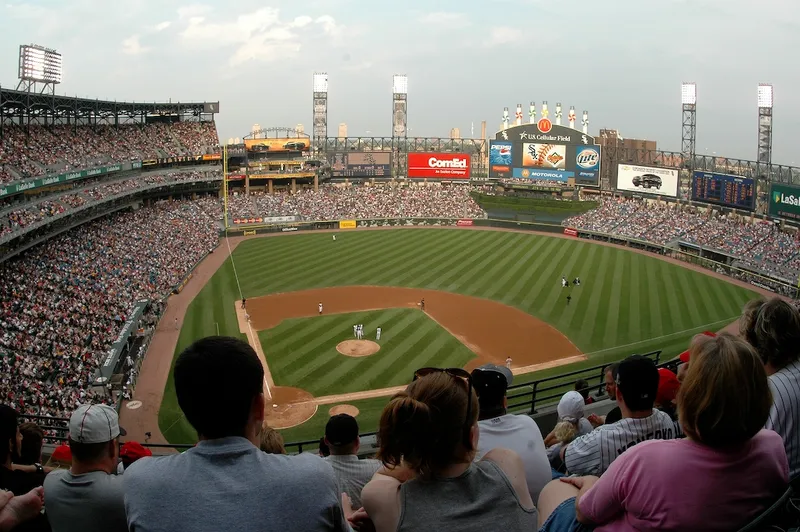
The ballpark’s most cherished inheritance is its exploding scoreboard, a tradition Bill Veeck invented at old Comiskey Park in 1960 as Major League Baseball’s first pyrotechnic scoreboard, complete with spinning pinwheels. The current park carries that lineage forward, its center-field board firing fireworks and lighting up a pinwheel motif after every White Sox home run. The naming-rights money that has cycled through the building was not incidental to its architecture: the U.S. Cellular deal signed in 2003 directly helped underwrite the HKS renovation program, tying the park’s corporate identity to its physical transformation.
History of Rate Field
The White Sox played at old Comiskey Park from 1910 to 1990, one of baseball’s most historic venues. But by the 1980s, the aging stadium was falling apart, and the franchise nearly left Chicago entirely. In 1988, the White Sox were approved to move to St. Petersburg, Florida, where the Suncoast Dome (now Tropicana Field) was being prepared. The Illinois legislature passed the ISFA funding bill at the last minute on June 30, 1988, saving the team for the South Side.
HOK Sport designed the replacement on the lot directly south of old Comiskey. Construction began May 7, 1989, and the $137 million ballpark opened on April 18, 1991. The old park was demolished that same year, its footprint now marked by a parking lot with home plate’s location preserved in the asphalt.
Key moments in the stadium’s history:
- April 18, 1991: First game, Detroit Tigers 16, Chicago White Sox 0. Jack McDowell throws the first pitch.
- July 15, 2003: MLB All-Star Game. AL defeats NL 7-6 before 47,609 fans, the first ASG to determine World Series home-field advantage.
- October 22-23, 2005: World Series Games 1 and 2. The White Sox sweep Houston for their first championship in 88 years.
- April 18, 2007: Mark Buehrle throws a no-hitter against the Texas Rangers, facing the minimum 27 batters.
- July 23, 2009: Mark Buehrle throws a perfect game against the Tampa Bay Rays. DeWayne Wise’s catch preserves perfection.
- August 25, 2020: Lucas Giolito no-hits the Pittsburgh Pirates in an empty pandemic-era stadium, striking out 13.
Rate Field has shed its early reputation as a sterile concrete bowl. The 2001-2007 renovations transformed it into one of baseball’s better mid-tier venues, a park with good sightlines, a lively tailgate scene, and a direct CTA connection that makes getting here as easy as any stadium in the country.
Sources & Further Reading
- Wikipedia entry on Rate Field: en.wikipedia.org/wiki/Rate_Field. Architect, cost, groundbreaking and opening, and the renovation and naming history.
- Ballparks of Baseball, Rate Field: ballparksofbaseball.com. The HOK and HKS work, the upper-deck removal, and capacity.
- SABR, Comiskey Park (Chicago): sabr.org. The South Side ballparks and Bill Veeck’s original exploding scoreboard.
- Chicago White Sox official ballpark page: mlb.com/whitesox/ballpark. Events, tickets, and visitor information.
Quick Facts
Everything you need at a glance.
Stadium specs
- Capacity
- 40,615
- Opened
- 1991
- Cost
- Around $137 million (1991, publicly financed by the Illinois Sports Facilities Authority); about $118 million in 2001-2007 renovations
- Roof
- Open
- Surface
- Natural Grass
- Tenants
- Chicago White Sox (MLB)
Construction & location
- Groundbreaking
- May 7, 1989 (opened April 18, 1991)
- Architects
- HOK Sport (now Populous), HKS Inc. (2001-2007 renovations)
- Engineering
- Not separately recorded
- General contractor
- Not separately recorded
- Address
- Rate Field, 333 West 35th Street, Chicago, IL 60616
- GPS
- 41.8300°N, 87.6346°W
Photo Gallery
Fun Facts
Rate Field's pinwheel scoreboard fires 20 fireworks after every White Sox home run, a tradition honoring Bill Veeck's exploding scoreboard at old Comiskey Park, which debuted in 1960.
The stadium was nearly never built in Chicago. In 1988, the White Sox were approved to move to St. Petersburg, Florida, but the Illinois legislature passed the funding bill at literally the last minute on June 30, 1988, keeping the team on the South Side.
Mark Buehrle threw both a no-hitter (April 18, 2007) and a perfect game (July 23, 2009) at the stadium, the only pitcher to accomplish both feats in the same park since the venue opened.
Stadium Location
Frequently Asked Questions
- What is the capacity of Rate Field?
- 40,615 seats. The stadium opened at 44,321 in 1991 and later grew to about 47,000, but renovations between 2001 and 2007 removed roughly 6,600 upper-deck seats to improve sightlines, bringing it to its current size.
- Why did Guaranteed Rate Field change its name to Rate Field?
- The naming rights sponsor rebranded from 'Guaranteed Rate' to 'Rate' in 2024. Since the deal signed in 2016 was still active, the stadium name updated on December 17, 2024, and applied for the 2025 season.
- How do I get to Rate Field by public transit?
- The CTA Red Line to Sox-35th station is the easiest option, about 10 minutes from downtown. The Metra Rock Island Line stops at 35th Street 'Lou' Jones station. CTA bus routes #24 and #35 also serve the area.
- Is tailgating allowed at Rate Field?
- Yes. Tailgating is permitted in parking Lots A through F. Lots open 2 hours before first pitch, and tailgating ends when the game starts. Alcohol is allowed but kegs are not.
- Is Rate Field cashless?
- Yes. All transactions, parking, concessions, merchandise, and tickets, require credit/debit cards or mobile payment. Tickets are digital via the MLB Ballpark app.
- When was Rate Field built?
- The stadium opened April 18, 1991, as New Comiskey Park. It has also been known as U.S. Cellular Field (2003-2016) and Guaranteed Rate Field (2016-2024). Construction cost $137 million.
- What is the nearest airport to Rate Field?
- Chicago Midway International Airport is just 10 km (6 miles) away, about 15 minutes by car. O'Hare is 34 km (21 miles) away, about 30-50 minutes.
Last updated: 2026-07-04