Everybody knows the oldest ballpark in baseball. It’s Fenway, it opened in 1912, and if that’s all you came for, there’s your answer and a table below it. But spend an hour with the dates behind that table and the question starts to wobble. The famous green wall in Boston didn’t reach its height until 1934 and wasn’t green until 1947. Wrigley’s ivy went in 23 years after Wrigley opened. The fourth-oldest park on the list has been two entirely different buildings. The closer you look at baseball’s oldest places, the less certain you become about what, exactly, is old about them.
So this is a ranking with a trapdoor in it. The order is simple. What the order means takes the rest of the page.
| # | Ballpark | City | Opened | Capacity |
|---|---|---|---|---|
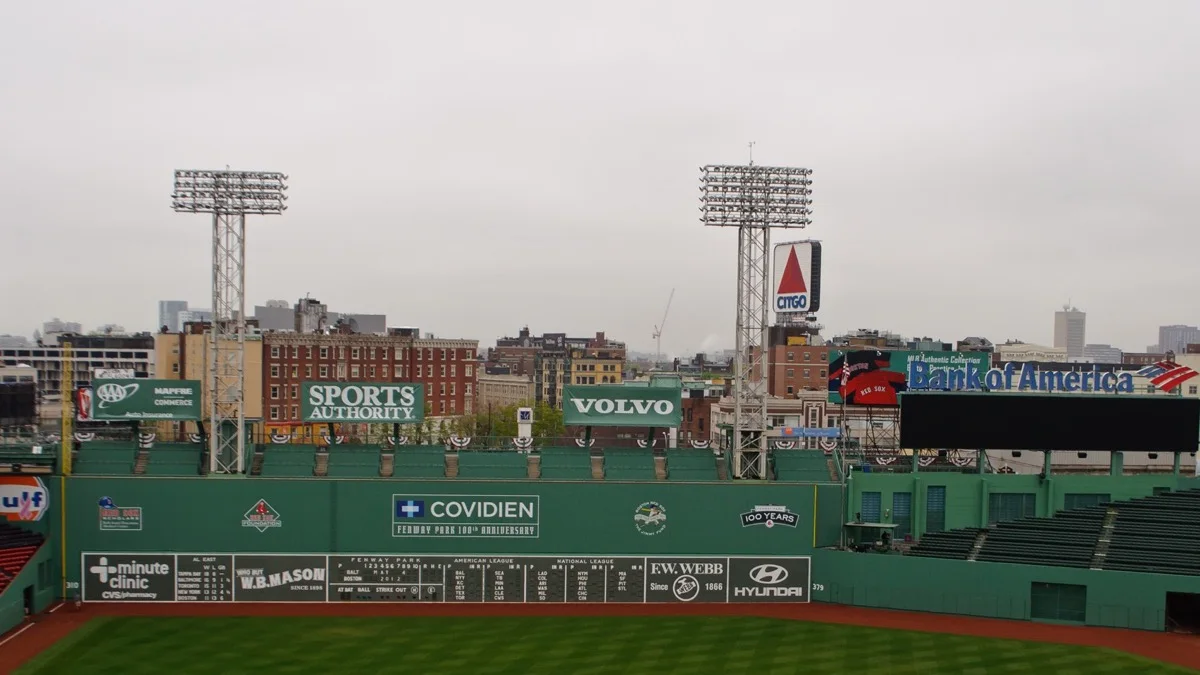
| 1 | Fenway Park | Boston | 1912 | 37,755 |
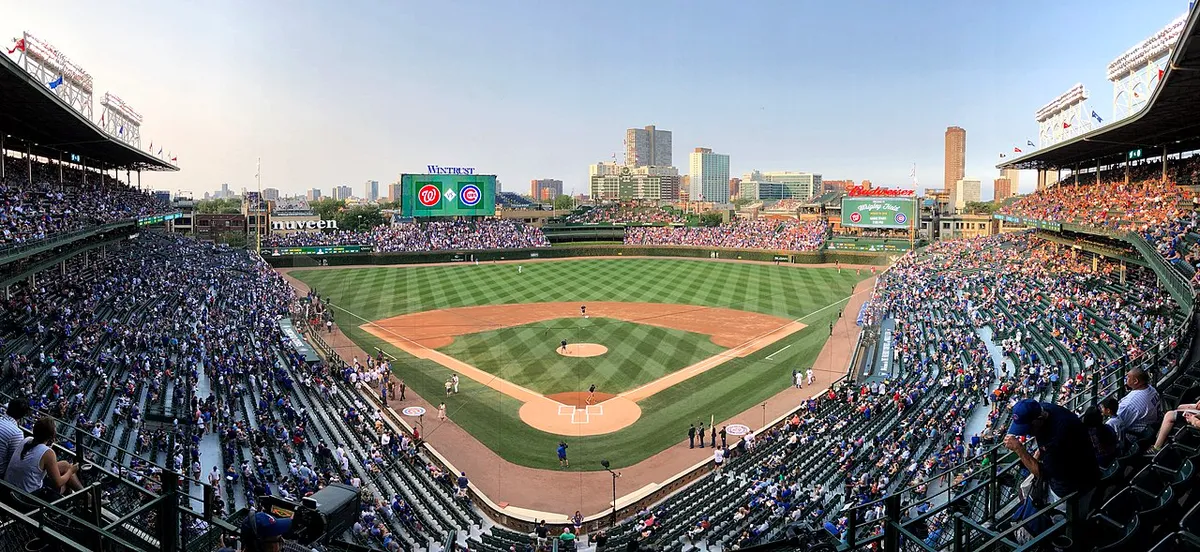
| 2 | Wrigley Field | Chicago | 1914 | 41,649 |
| 3 | Dodger Stadium | Los Angeles | 1962 | 56,000 |
| 4 | Angel Stadium | Anaheim | 1966 | 45,050 |
| 5 | Kauffman Stadium | Kansas City | 1973 | 37,903 |
| 6 | Rogers Centre | Toronto | 1989 | 39,150 |
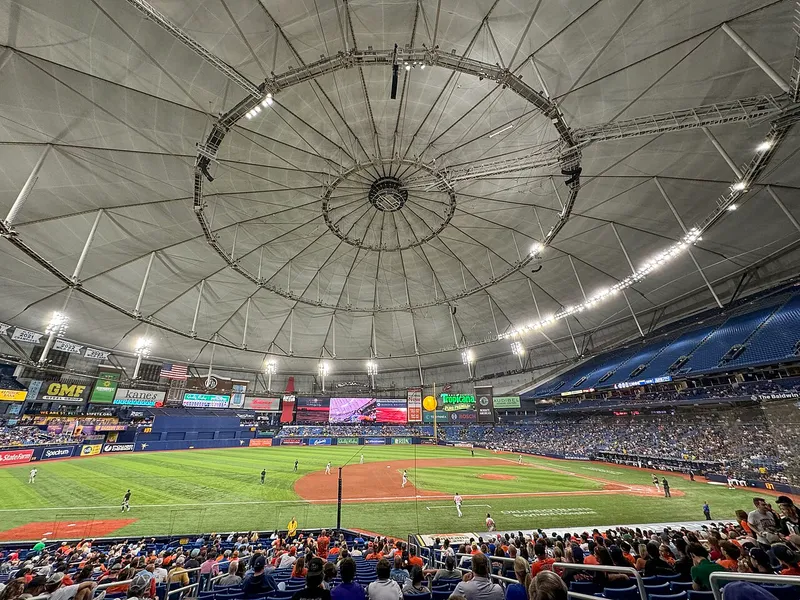
| 7 | Tropicana Field | St. Petersburg | 1990 | 25,025 |
| 8 | Rate Field | Chicago | 1991 | 40,615 |
| 9 | Oriole Park at Camden Yards | Baltimore | 1992 | 44,970 |
| 10 | Progressive Field | Cleveland | 1994 | 34,830 |
Look at the column of years. Two parks from before the First World War, a 48-year hole, then five of the ten crammed into six seasons from 1989 to 1994. The list doesn’t slope downward like you’d expect. It falls off a cliff and bunches up at the bottom. And old doesn’t mean small: the oldest park holds 37,755, while the third-oldest holds 56,000 and is the biggest in the sport. We’ve ranked the biggest MLB ballparks by capacity separately.
A steel column, right in front of you
Buy a cheap seat down the right-field line at Fenway and there’s a fair chance a steel column stands between you and home plate. Not near you. In front of you. You lean left for the pitch, right for the swing, and by the fourth inning your whole row is swaying together like reeds, everyone bending around the same post. In 1912 nobody had figured out how to hang an upper deck over a crowd without something underneath holding it up, so the something is still there, and so are you, dancing with it for nine innings.
That column is the most 1912 thing in the building. James E. McLaughlin drew the park, the Osborn Engineering Corporation handled the structure, the Charles Logue Building Company put it up, and the whole thing cost $650,000, built fast and cheap by men who did not believe they were building a monument.
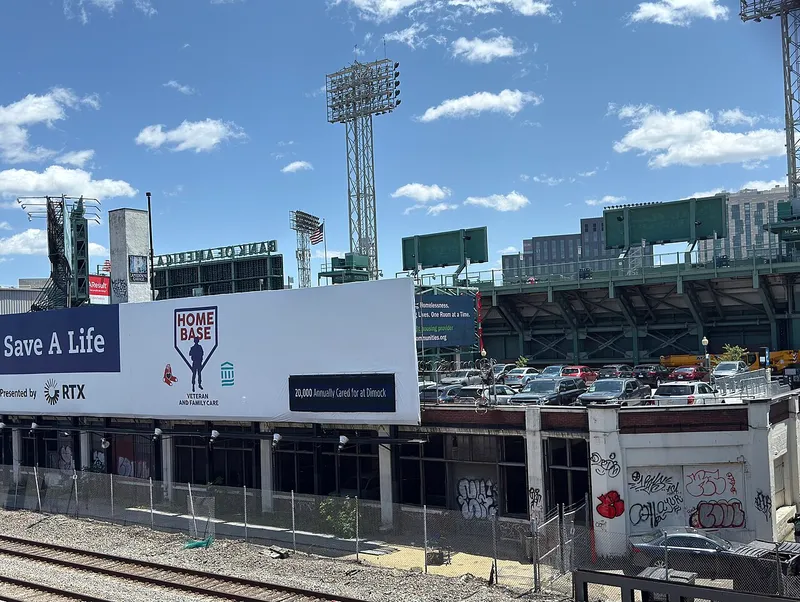
Nearly everything a visitor photographs came later. The left-field wall is tall because the lot was short and the owners didn’t want home runs landing on Lansdowne Street; it reached its full 37 feet in the 1934 rebuild, the same project that redid the wooden bleachers in concrete and flattened Duffy’s Cliff, the ten-foot embankment left fielders used to jog up to make catches. The green paint arrived in 1947, along with the lights. The seats on top of the wall came in 2003, 274 of them at the debut, 269 now. Roughly $285 million of improvements ran through the place between 2002 and 2011.
The scoreboard in the wall is still turned by hand, one of only two left in the majors. During games there’s a person back there, doing a job with no modern equivalent.
The ivy is a renovation
Wrigley Field opened on April 23, 1914 as Weeghman Park, a $250,000, 14,000-seat home for a Federal League club. The Federal League folded in 1915 and the Cubs moved in the following season, which means the team everyone associates with the corner of Clark and Addison arrived two years after the ballpark did. Wrigley has been a tenant’s hand-me-down from the start.
The two things that make it Wrigley are both from 1937. That year Bill Veeck, a man with an itch for spectacle he never did scratch, planted 350 Japanese bittersweet plants and 200 Boston ivy plants along the outfield brick. The hand-turned scoreboard went up the same season. The postcard version of Wrigley Field, ivy below, scoreboard above, is a 1937 renovation of a 1914 building. Remember Veeck. He shows up again at the other end of this list.
The park now holds 41,649, so 27,649 of its seats didn’t exist on opening day, many of them touched by the 1060 Project, the roughly $575 million overhaul named for the address at 1060 West Addison Street that ran from 2014 to 2019. And for most of its life the place simply went dark at sunset. Lights didn’t come to Wrigley until 1988, the last park in the major leagues to get them.
74 years passed between Wrigley Field’s first game and its first night game.
The 48-year hole
Wrigley opened in 1914. The next-oldest park in baseball opened in 1962. Between those dates, American cities built ballparks continuously, for nearly half a century, and not one of them is still in use in the major leagues today. Every park from that entire era has lost its place in the major leagues.
Fenway and Wrigley made it through for the same reason: their cities repaired instead of replacing. Neither park was ever closed and rebuilt from scratch, so the clock never reset. Everywhere else, when the building aged, it came down, and the new one started its count at year one. That’s the whole mechanism of this list. The top of the ranking doesn’t belong to the best buildings or the best-loved ones. It belongs to the two that kept getting fixed.
48 years separate the second-oldest ballpark from the third.
What Dodger Stadium stands on
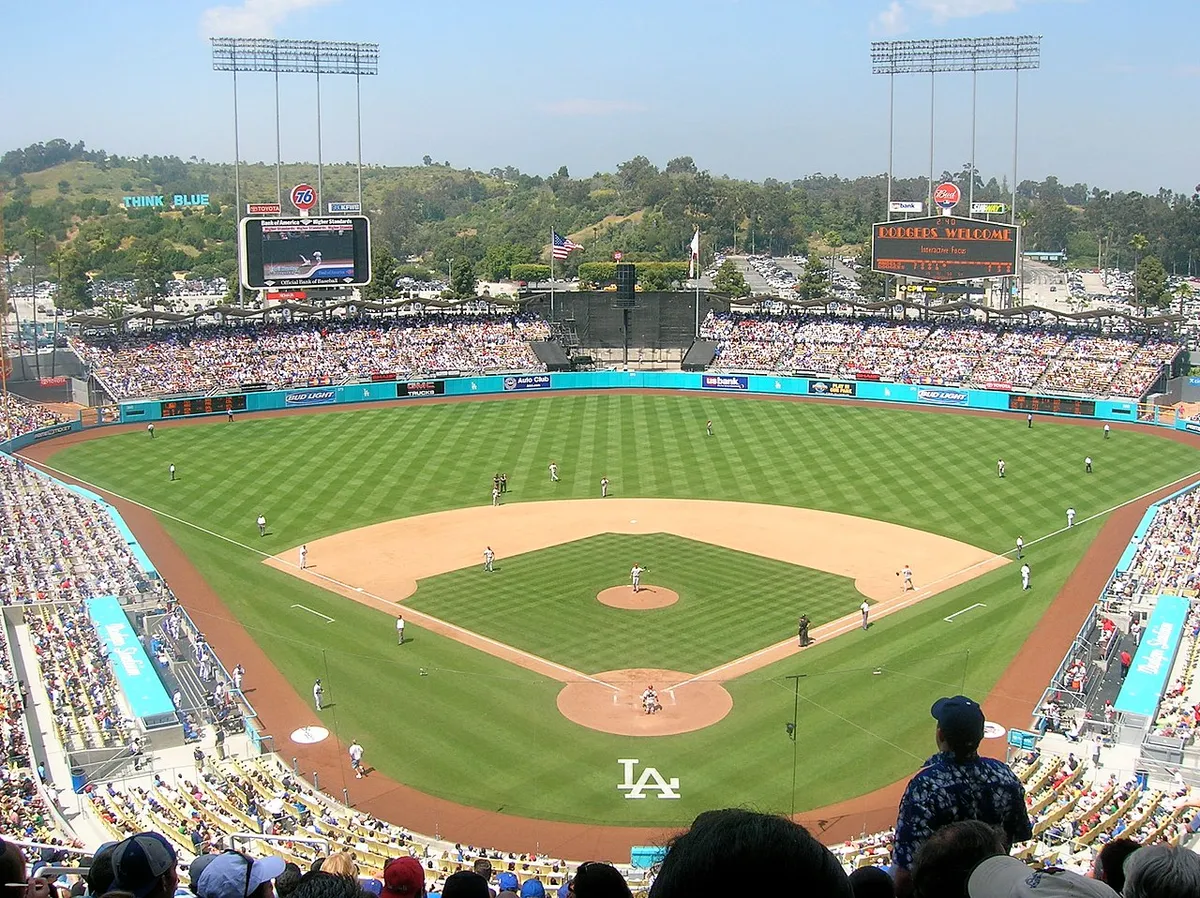
Dodger Stadium opened on April 10, 1962, after nearly three years of construction and eight million cubic yards of earth moved out of Chavez Ravine. Emil Praeger designed it, Walter O’Malley paid the $23 million himself, and it was the first privately financed major league ballpark since Yankee Stadium in 1923. Sixty-four years later it’s still the largest park in baseball at 56,000, a mid-century building that has never needed replacing because O’Malley built it into a hillside like he expected the century to end before it did.
But the land came at somebody’s expense, and it wasn’t O’Malley’s. In the 1950s Los Angeles used eminent domain to clear the Mexican-American neighborhoods of Chavez Ravine, telling residents the land was needed for public housing. The housing was never built. Families who had lived on those hillsides for generations were moved off them, and the ballpark rose afterward on ground the city had emptied for a promise it broke. The stadium is beautiful. The people who lost their homes for a housing project that never existed watched it get built anyway.
The park that got unbuilt
Angel Stadium is fourth on the list, and it’s where the word “oldest” starts to come apart in your hands.
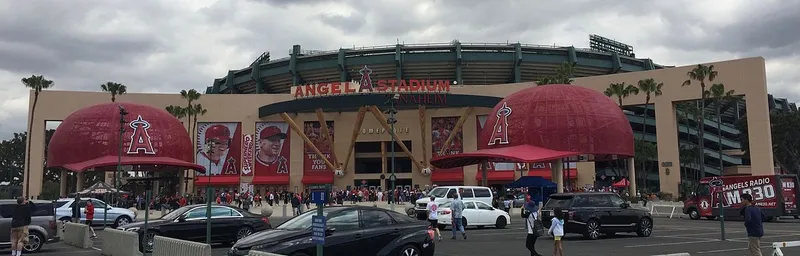
It opened in 1966 holding roughly 43,000, an open-air bowl announced to the freeway by the Big A, a 230-foot, 210-ton scoreboard sign, the tallest structure in Orange County at the time. In 1979 and 1980 the bowl was enclosed to bring in the NFL’s Rams, football capacity climbed to around 69,000, and the Big A was hauled 1,300 feet out to the parking lot, where it still stands. The Rams played 15 seasons and left for St. Louis after 1994. Then, in 1997 and 1998, a $118 million renovation tore the football enclosure back down, with HOK Sport and Robert A.M. Stern restoring an open-air baseball bowl that holds 45,050 today.
Built open, closed for football, opened again. It has answered to three names along the way: Anaheim Stadium until 1997, Edison International Field until 2003, Angel Stadium of Anaheim since 2004. The ribbon was cut sixty years ago, and the ranking honors that date. Stand in it tonight and you’re standing in a 1998 ballpark.
The fountain that ate its budget
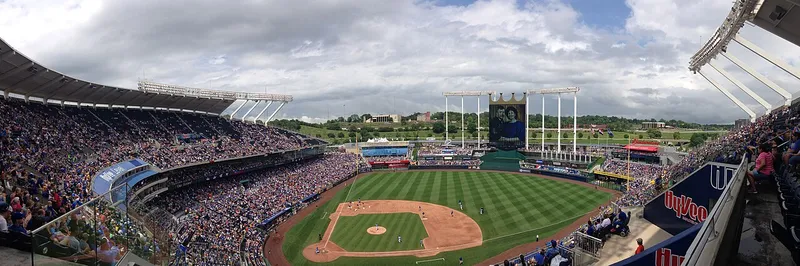
Royals Stadium opened in Kansas City on April 10, 1973: 40,625 seats, $70 million, drawn by Kivett & Myers, and built for baseball only, at the exact moment every other city in America was pouring a round concrete bowl to split between a baseball team and a football team. Kansas City refused, 19 years before Camden Yards got the credit for building for one sport.
Beyond the outfield fence, owner Ewing Kauffman wanted water. The Water Spectacular runs 322 feet wide with jets that reach 70 feet, the largest privately funded fountain in the world. It was budgeted between $150,000 and $250,000 and came in at over $1.5 million, and when the bills arrived Kauffman paid much of the overrun out of his own pocket rather than make the fountain smaller.
The building announced itself fast. On May 15, 1973, in the 20th game the ballpark ever hosted, Nolan Ryan threw a no-hitter there, the first of the seven he’d throw in his career. The park was five weeks old. It holds 37,903 now, and in 1993 it took the name of the man who paid for the water.
Six seasons, five ballparks, one fight
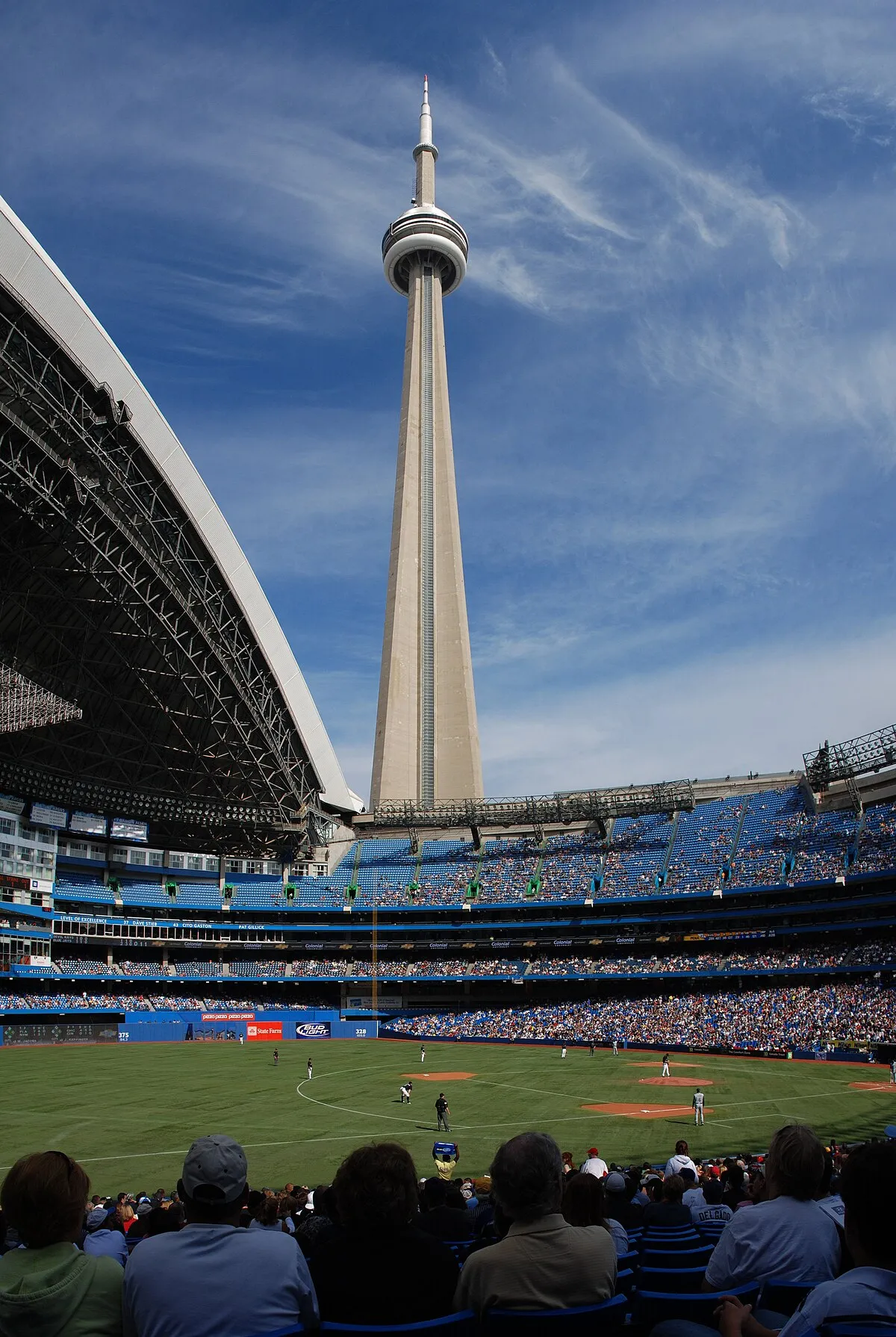
The bottom half of the list arrived almost all at once: Toronto in 1989, St. Petersburg in 1990, the South Side of Chicago in 1991, Baltimore in 1992, Cleveland in 1994. Toronto’s entry opened as SkyDome, with the first fully retractable motorized roof anywhere, 11,000 tonnes of it, 20 minutes to open, designed by Rod Robbie for around CAD$570 million, well over budget. A Populous renovation finished in 2024 gutted the interior, re-angled the seating toward home plate and rebuilt the lower deck. For why venues started putting lids on at all, see why so many stadiums now have roofs.
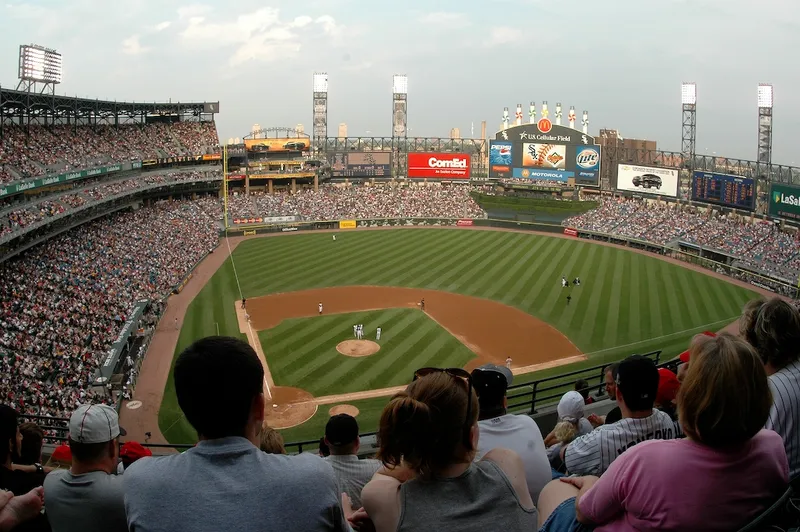
Two of the other four exist because of the same argument. In 1988 the Chicago White Sox had approval to move to St. Petersburg, Florida. On June 30, 1988, at the last minute, the Illinois legislature passed a funding bill and kept them on the South Side, and Rate Field opened on April 18, 1991 as New Comiskey Park, around $137 million of public money, on the lot beside the old Comiskey Park it replaced.
St. Petersburg built its dome anyway. The Florida Suncoast Dome opened on March 3, 1990, $138 million of city money, no team, no promise of one. Then it waited. It courted the White Sox, the Mariners and the Giants, and all three stayed home. It picked up hockey and a new name in 1993, the ThunderDome, when the NHL’s Lightning moved in, became Tropicana Field in 1996, and finally hosted a major league game on March 31, 1998, a 45,369 sellout the Devil Rays lost 11-6 to Detroit. Chicago kept its team by voting at the last possible minute. St. Petersburg got one by sitting in an empty building for eight years until somebody came.
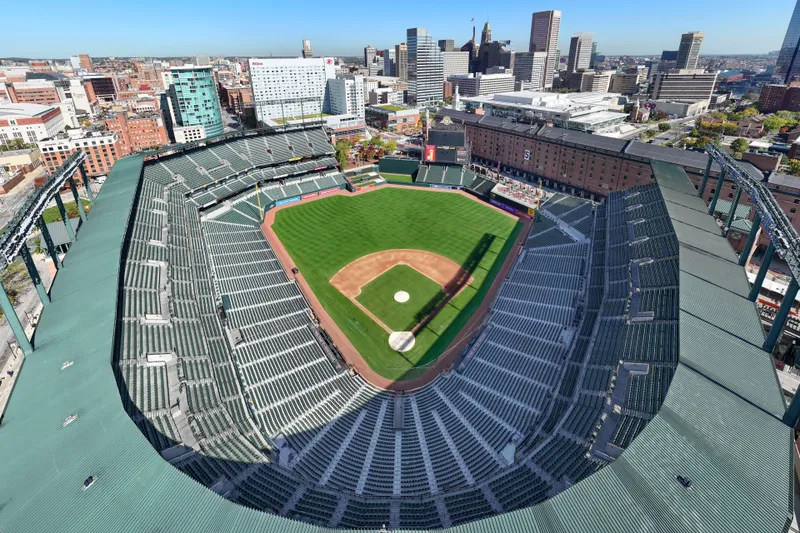
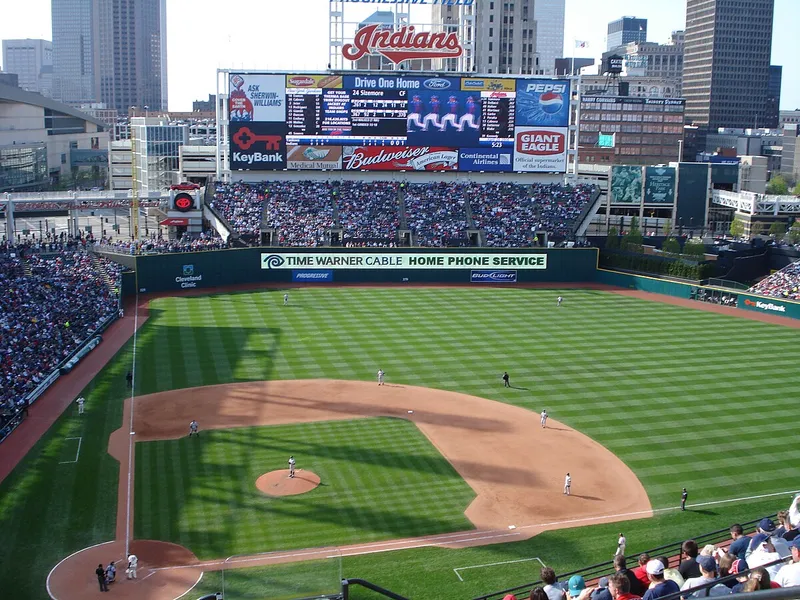
Baltimore and Cleveland closed out the run. Camden Yards, 1992, $110 million, sits under the B&O Warehouse, 1,016 feet long, the longest building on the East Coast when it went up in 1905, and in a game, no player has ever hit it on the fly. On September 6, 1995, Cal Ripken Jr. played his 2,131st consecutive game there, breaking Lou Gehrig’s 56-year-old record. He took a 22-minute lap of the field as the crowd roared, and he hit a home run in the same game. Progressive Field opened April 4, 1994 for around $175 million, and between June 12, 1995 and April 4, 2001 it sold out 455 consecutive home games.
455 straight sellouts in Cleveland, and the club retired the number 455 in honor of the crowd.
And the Veeck thread ties off here. Rate Field’s scoreboard fires 20 fireworks from its pinwheels after every White Sox home run, a copy of the exploding scoreboard Bill Veeck installed at old Comiskey Park in 1960, next door to where Rate Field now stands. The man who planted the ivy at the second-oldest park on this list built the ancestor of the fireworks at the eighth. Half the charm on this page traces to one showman.
So which one is actually oldest?
Fenway, 1912, and it isn’t close. But there are three ways to read the question, and they give different kinds of answers.
By opening date, Fenway wins on the arithmetic you saw in the table. By the age of the structure around you, almost nowhere on this list is old at all: Fenway’s wall is 1934 and its color is 1947, Angel Stadium’s bowl is 1998, Rogers Centre’s lower deck is 2024. The measure that means something is the third one, continuous use. Fenway has hosted baseball every season for 114 years without once closing, and that, not the steel, is the record. What has actually survived since 1912 is a parcel of land, a street grid, an awkwardly short left field, and an unbroken habit of playing ball there while the park was rebuilt around the game, so gradually that nobody ever had to call it new.
Two small codas from the bottom of the table say the rest. The structural engineers on Fenway Park in 1912 were the Osborn Engineering Corporation. The structural engineers on Progressive Field in 1994 were the Osborn Engineering Corporation. The oldest park on this list and the youngest, 82 years apart, same firm.
82 years separate Osborn Engineering’s first job on this list from its last one.
And age, once earned, still has to be defended every year. On October 9, 2024, Hurricane Milton tore open the roof of Tropicana Field while the building was serving as a staging base for first responders. The repair ran roughly $60 million, the Rays spent all of 2025 playing outdoors at George M. Steinbrenner Field, and on April 6, 2026 they came home and beat the Cubs 6-4. That’s how a ballpark gets old. It takes the hit, closes for repairs, and opens again.
Sources
Almost everything on this page comes from our own stadium guides, each of which carries its own sourcing and is linked in the table above. Rather than repeat those citations here, click through to the ballpark you care about.
- Green Monster, Wikipedia. The left-field wall’s construction and paint dates, cross-checked against our own Fenway Park guide.
Hero photo: Fenway Park by InSapphoWeTrust, CC BY-SA 2.0.
Capacities are seated 2026 figures taken from our stadium pages. Clubs revise them most winters, so a figure here and a figure elsewhere can differ by a few hundred seats without either being wrong. “Oldest” itself is contested: this ranking uses the year each ballpark opened, which is the standard measure, but the age of the current structure and the length of continuous use both give different answers, and the article above says where they diverge.