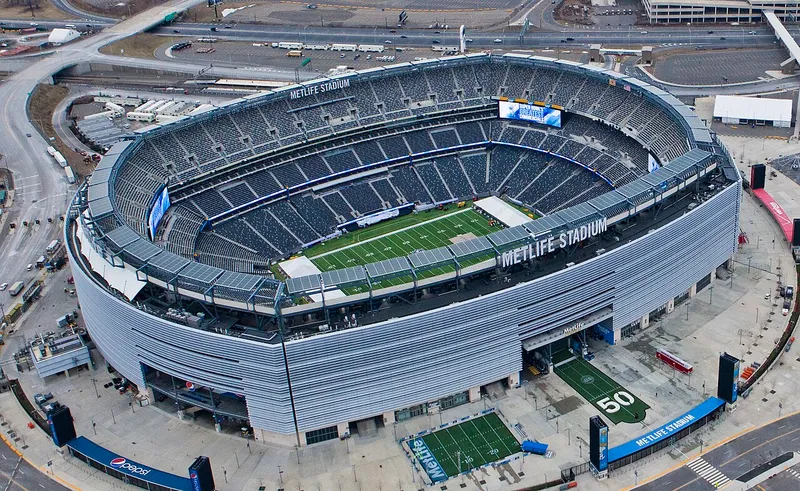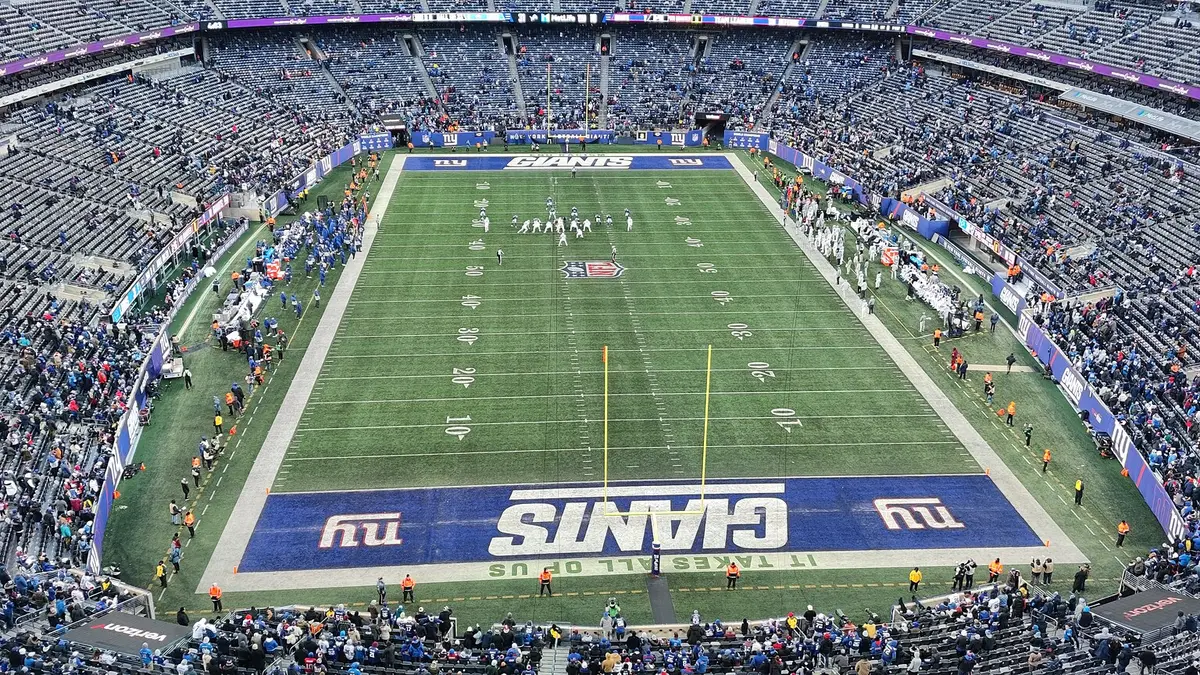
MetLife Stadium doesn’t sell a single obstructed-view ticket, and that’s the most expensive thing about it.
Older stadiums stack their decks, so the upper tier hangs over the lower one like a lid. Sit under the lid and you lose the top of every punt. MetLife’s architects wanted that gone, so they tilted the whole bowl back until no deck hung over another. No pole. No row where the ticket comes with an apology printed on it. It worked completely. But a bill that size doesn’t vanish, it moves, and at MetLife it moved into distance. Every seat can see everything. Some seats can see everything from very far away.
So the seating map here asks a different question from the one most stadiums ask. How far back are you willing to sit, and which way will the sun be pointing when you get there?
That’s what this page is for, and it ends with a section number, because you came here for one.
| Level | What it actually is | Sections | The trade |
|---|---|---|---|
| Plaza | The ground-level concourse. Not a seating tier at all | Opens directly onto 133 to 144 | Where the ticket office, the West Hall and the only legal smoking spot are |
| 100 | Lower bowl | East sideline 108 to 118, west sideline 133 to 144, end zones 121 to 131 and 146 to 106 | The front row at the 50 is about as close as the NFL gets, and that is not the compliment it sounds like |
| 200 | Mezzanine | East 207 to 220 behind the Corona Beach Club, west 232 to 245 behind the Miller Lite MVP Club | Height without the exile. The best-value seats in the building |
| 300 | Upper ring, unbroken | 301 to 350, fifty sections, no gaps | Every view is clear. Every view is also a long way off |
Four levels on the chart, three with seats in them
MetLife Stadium sells you four levels, and only three of them have seats.
The official charts list Plaza, Level 100, Level 200 and Level 300. Four names, three tiers. The Plaza Level is the ground-floor concourse: the ticket office is there, the MetLife West Hall opens off it, and its fence line is the one place in the building where you’re allowed to smoke. The only seats you can reach directly from it are 133 to 144 on the west sideline. Everything else is a climb. It’s also the floor you’ll be sent back down to for a cigarette.
Plenty of references will tell you this is a four-level stadium. The stadium’s own Plaza chart settles it the other way: the only seats on that chart are Level 100 sections, shaded as Level 100 in its own key. The three tiers that do hold seats are in the table above. What separates them is the rest of this page.
82,500 seats, the largest seating capacity in the NFL, and all of them on three tiers.
A bowl has two directions to grow, out and up, and this one has grown in both. The largest capacity in the league is a boast on the stadium’s ledger and a warning on yours. Somebody has to sit at the edge of it.
What sets the 300 apart is the counting. The tiers below it skip numbers. The 300 counts from 301 to 350 without missing one, fifty in a row with nothing taken out, drawn like it was done with a compass. Every club and every hall in this building sits somewhere below it. That is the level built for volume, and it tells you who the architects expected to fill it.
Nobody’s view is blocked, and that’s the whole problem
Every seat at MetLife has a clean view of the field, and the people in the last row paid for it.
In the architects’ own words, the bowl “had to be raked back a bit to eliminate overhangs from the upper decks that would impede views.” An overhang is the deck above you, sitting far enough forward to cover you and to cut off the top of the frame. Older stadiums stack their decks on top of each other, which puts the upper rows close to the field and a slab of concrete over everyone underneath. MetLife refused the slab. Pull the decks back and the overhang goes. So does the cover. The brief was specific: every fan in the building should be able to follow the full arc of a 90-foot punt. Every fan. Including the one in the top row of the corner.
The corners are a separate story, and an inherited one. Plenty of stadiums leave them open for skyline views. MetLife’s bowl rings the entire field without a break, as the old Giants Stadium did before it, and the architects were happy to keep it that way: open corners let crowd noise escape, and they wanted it bottled. So you’re sitting inside a closed drum, tilted outward, with its upper rim pushed as far from the center as it takes for nothing to hang over anything. Loud, and every inch of it visible.
Famous old buildings still sell tickets stamped obstructed view because something structural sits in the way. Fenway Park marks them OV and holds them to a standard: the seat has to sit behind permanent structure blocking home plate, the mound, or both. MetLife has no such ticket. There’s nothing in the building to stamp it for.
A 90-foot punt, visible from first foot to last: the design brief every seat had to pass.
Raked back is the phrase that matters, and the second word matters more than the first. The deck that was hanging over you has to go somewhere, and the only somewhere available is away from the field. That’s the trade. They cleared your sightline by lengthening it.
The worst seat at MetLife Stadium
The worst seat in this building has a perfect view of the field, and that’s exactly what’s wrong with it.
Go looking for it and the geometry sends you to the back rows of the 300 Level corners: furthest from midfield and highest in a bowl that was pushed back on purpose, with nothing above them and a flat marsh behind them. Distance is what’s wrong with them. The one thing a better angle can’t fix.
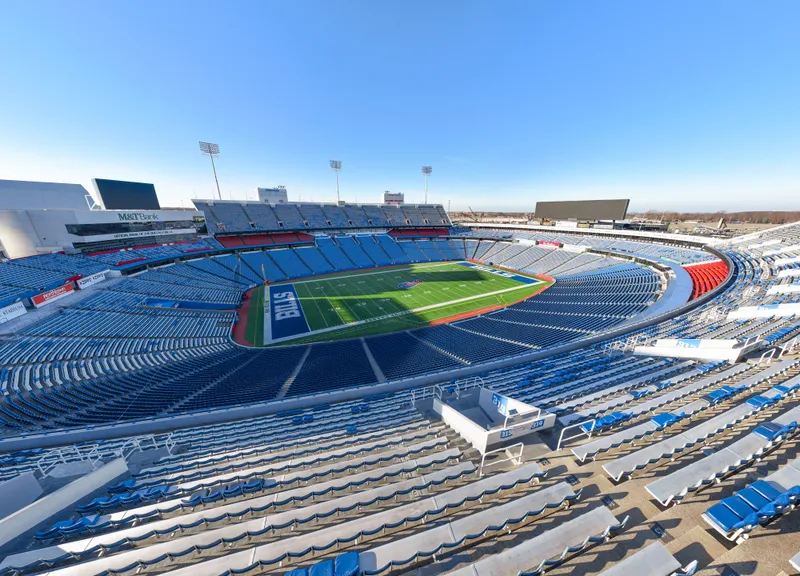
No roof, and that was a choice. The Meadowlands sits in a natural wind corridor and the roof proposals collapsed over funding, so the weather is part of the design. Compare Buffalo, which gets worse weather than this and knows it: the new Highmark Stadium opened in 2026 with a 360-degree canopy over about 64 percent of its seats, specifically to cut the wind. MetLife has nothing over anybody.
The wind at the Meadowlands doesn’t gust so much as lean. It comes across flat marshland with nothing standing in its way, finds the open top of the bowl, and settles into the 300 Level like that was the plan all along. By the fourth quarter in December your feet have stopped being something you can feel. You can’t put an umbrella up, because umbrellas are banned. You can’t sit on a cushion, because cushions are banned too. What you can do is hold a coffee you stopped drinking an hour ago and are now using as a hand warmer, and watch a punt climb up into the dark and come down again, every foot of it perfectly visible, because that part they really did get right.
Umbrellas are prohibited “for safety and line-of-sight reasons,” which is a polite way of saying your umbrella would be the only obstruction in the building and they’d rather you got wet. Seat cushions of any size are banned except for medical needs. The one comfort you might have bought yourself stays in the car.
Nobody publishes a row count for the 300 Level, or the distance from its back row to the field. We looked. We couldn’t find a figure, and this article doesn’t estimate. Anyone who gives you one is guessing.
Binoculars are allowed, handheld and out of the case, and the 300 Level is where people actually use them. That rule is the tell. A stadium that bans umbrellas for line of sight and then goes out of its way to permit binoculars knows precisely how far back its cheap seats are.
Which side the sun is on
At a 4:25pm kickoff, half this stadium is looking across the field into the sun, and the ticket price doesn’t mention it.
This is our own arithmetic, so read it as a calculation rather than a quotation. MetLife’s field runs 166.5 degrees from north, roughly north-northwest to south-southeast. Stand at midfield, face the sideline stands, and you’re looking along bearings of about 76.5 degrees one way and 256.5 the other. That’s why the stadium calls them East and West. They very nearly are.
Now put the sun on that compass, for all eighteen Sundays of the regular season. At a 4:25pm kickoff it sits between 10 and 19 degrees off the west stand’s bearing. The west side has it at their backs the whole time. The east side is looking across the field into it, through the exact window of sky where the ball lives. At 1:00pm the sun is 54 to 73 degrees off that axis and away over the south end, so at lunchtime the side you pick barely matters. Buy on price for the early game. For the late one, the side is the biggest difference between two seats at the same money.
But the number that matters isn’t the angle on its own. It’s the angle and the height together, because a sun that’s nearly on the axis and also high in the sky goes over the top of the stand instead of into your face. Work through the season and the two don’t move together at all.
9.8 degrees off the axis, 4 degrees above the horizon. November 1, the Sunday the clocks go back, by our calculation the worst glare of the MetLife year.
Through October the sun drifts further off-axis every week, from 11.4 degrees on September 20 out to 19.0 on October 25, and it drops lower as it goes. Then the clocks go back, a 4:25pm kickoff becomes an hour earlier in the sky, and the whole thing resets: 9.8 degrees off axis on November 1, and the sun is 4 degrees above the horizon. Nearly down the barrel of the sideline, and nearly at eye level. The following Sunday is 11.3 and 2.6. That fortnight is the worst light of the year in this building, and it isn’t the depth of winter. It’s the week the clocks change.
By December the sun is on the horizon at kickoff, so a late December game in that slot isn’t a glare problem at all. It’s dark, and it’s cold, and the question hands you back to the section above: how high up are you, and what did you wear.
And there is a check on all of this that costs nothing to run. Go to the Giants’ own club seating page, where the team is selling tickets rather than describing geometry, and read how it labels the two sideline clubs. The Corona Beach Club is the “Sunny Side of the field (East Side).” The Miller Lite MVP Club is the “Shady Side of the field (West Side).” We got there from a pitch bearing and a solar almanac; they got there from selling seats to people who come back or don’t. Same answer.
One honest limit. This is the sun’s direction, not a shading model. Stand heights aren’t published, so we can say where the sun will be and not exactly which row it reaches. What the geometry does say without any doubt is which side it comes from. The west side has it behind them. That’s free information, and it’s worth more than most seat upgrades.
The 50-yard line doesn’t have a section
Ask for a seat on the 50 and the stadium has nowhere to put you, because the section doesn’t exist.
Look at the 200 Level and count. On the east side the numbers run 207 to 220. No 214. On the west they run 232 to 245. No 238. The halfway line falls on the gap both times, so midfield on the mezzanine means 213 or 215 on the east and 237 or 239 on the west. The yard line everyone asks for sits on a number nobody assigned, which has one practical use: anyone selling you a 50-yard-line seat in section 214 is selling you a seat that isn’t there.
Closeness is a different question. The front row at the 50 is among the closest seating in the NFL, close enough that the game has a sound to it, and close enough that you’re watching from bench level. At field height the play is a wall of bodies: you see the collision and not the shape of it, and the far sideline might as well be in Secaucus. From the mezzanine it’s a diagram.
Bench level is where the closest seats in the house put you, and it is the worst height in the building for reading a play.
The East Hall opens onto sections 111c to 115c, the middle of the east sideline; the MetLife West Hall onto 133 to 144, the whole of the west. Know which door is yours and you save a lap of the building.
So the closest row in the league buys you proximity and the worst angle in the building. Being near the action and seeing the action are different purchases, and the ticket only prices one of them. The front row is for feeling football. The seats a level up are for watching it. Which puts the front row at the far end of the same problem as the back row. Rake a bowl back and you push the top away from the field; leave the bottom where it is and it sits below the play. Too far and too close are both bad in the same building, for opposite reasons, and the good seats are somewhere in between.
Five clubs, and they aren’t five versions of one idea
MetLife has five clubs and sells them as if they were a tier. They aren’t. Only one of them is unusual.
The five are the EY Coaches Club, the Moody’s Commissioners Club, the Corona Beach Club, the MetLife 50 Club and the Miller Lite MVP Club. Where each one sits is the whole product, so here they are.
The EY Coaches Club is the one genuinely unusual product in the building: a climate-controlled lounge at field level on the east side, with patio access out onto the field edge and the run of the field after the whistle. You’re buying nearness to the players rather than a view of the game, close enough to watch a coach’s Sunday unravel in real time. Buy it for that. The play is better from upstairs.
The two mezzanine clubs are the ones most people are actually choosing between. The Corona Beach Club runs the east sideline on the 200 Level and covers 207c to 220c. The Miller Lite MVP Club runs the west sideline on the same level and covers 232c to 245c. Same height, same relationship to the field. Opposite sidelines.
The last two sit lower, and both on the west: the Moody’s Commissioners Club along the west sideline of the 100 Level behind sections 133 to 144, and the MetLife 50 Club at west midfield off the Plaza Level, beside the West Hall. Add them up and three of the five clubs in this building are on the west side, two on the east.
Which is where the sun comes back in. Two mezzanine clubs, one tier, facing each other across the field, at the same price for the same product. The Giants call one of them the sunny side and the other the shady side, and they are not being poetic. You already know which one to buy.
The walk is part of the seat
The seating chart doesn’t show the part of the ticket you spend on your feet, and the rake-back is in that part too.
Start at the gates. MetLife has five: AMEX, HCLTech, Verizon, MetLife and Moody’s. Public escalators run at all five. Elevators are more particular. The ones for guests with disabilities are at the HCLTech, Verizon and Moody’s corners, three of the five entrances, so the AMEX and MetLife gates will send you looking. There are more at the premium entrances on the east and west sides, but those serve the Miller Lite MVP Club, the Corona Beach Club and the suites, which means they are only yours if your ticket says so. Check the gate before you pick the seat.
Three of five gates have an elevator for guests with disabilities: HCLTech, Verizon and Moody’s. The east and west premium entrances have their own, for club and suite tickets.
Then the climb, and here the stadium is more honest than most. There are ten stairways, five east and five west, and the ones in the corners reach every level. What there are not many of is ramps. The whole building has two, both in the end zones, and they are the only step-free way up. Two, for a ring of fifty sections and everything below it. The deck that got pushed away from the field got pushed away from the exits at the same time, and if stairs are not an option for you, that is where you feel it. Arrival is manageable. The final whistle is the problem, when everyone taking the gentle route is taking the same two.
Accessible seating, wheelchair, low-mobility and companion, is on every level, so needing it doesn’t close off the choice of tier. The stadium also runs a Kulture City sensory program, and here the detail is worth having exactly right: there are two sensory pods, and they are rooms, not something you collect. One is in the HCLTech Elevator Lobby on the Plaza Level, the other in the Moody’s Elevator Lobby on the third floor. What you check out at a Guest Services booth is a sensory bag, with noise-canceling headphones, fidget toys and weighted lap pads. In a bowl deliberately closed at the corners to keep the noise in, knowing where the quiet room is counts as seating information.
Two ramps for the whole building is the most honest thing the seating map says. It doesn’t say it in words. It says it in slopes.
What you can’t bring, and which team decides
The rules at MetLife change depending on which home team is playing, which is what happens when one building has two of them.
Start with the door. At a Giants game there’s no re-entry: walk out and you’re out. At a Jets game you may re-enter up to one hour before kickoff. Same building. Same week. Different rule.
A club ticket does not buy you out of that. What it buys is movement inside the building: guests in the Miller Lite MVP Club and the Corona Beach Club can go down to the bowl and back up to their own ticketed area, with the ticket scanned each time, and suite guests need a pass to get back to the suite floors. The gate is still the gate. Premium or not, at a Giants game, out is out.
The rest of the list runs the same whoever’s playing, and it is stricter than you might expect, because gameday rules vary more between stadiums than anyone tells you: Buffalo publishes a different set entirely. Strollers stay in the car with the umbrella and the cushion. Smoking is allowed in one place, along the fence line on the Plaza Level, so a cigarette from the top tier is a full descent and a climb back up one of two ramps. It’s a long way to go.
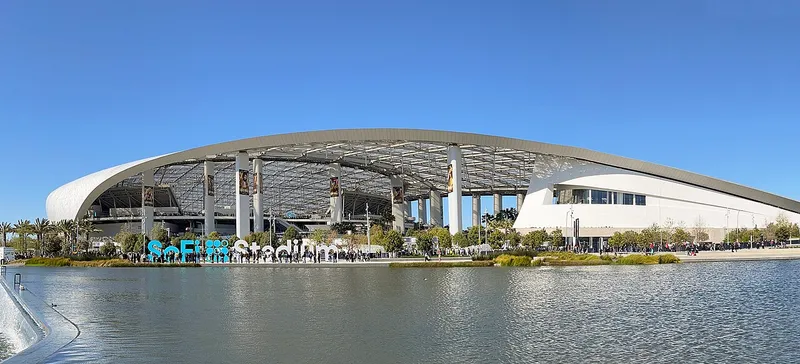
The re-entry split is the sharpest reminder of what this place is: two stadiums wearing one roofline, with two rulebooks. Only SoFi Stadium runs the same arrangement, and the Rams and Chargers at least agree on the door. The seat you buy is the same seat either Sunday. The door isn’t.
Where to sit at MetLife Stadium
Buy the west sideline, as low in the 200 Level as the budget reaches. Sections 235 to 241.
The architects tilted the bowl back, and the price was distance, charged most heavily at the top. The mezzanine is where that trade stops costing you and starts paying you: high enough to watch a play open up instead of a wall of shoulders, the thing the front row can’t buy, and low enough that you’re still in the game rather than watching it through binoculars. West, because at the 4:25pm kickoffs that are hardest to watch from anywhere else, the sun is behind you and in the eyes of the people who paid the same money across the field, which is a fact the ticket market doesn’t price because nobody had run the bearings. And 235 to 241, because that’s the halfway line with three sections either side of it, the stretch of mezzanine built symmetrically around a number that was never assigned.
This is the bowl that staged the 2026 World Cup Final and eight matches of the tournament, and the seat map it used that night is the one it uses on a wet Sunday in November. Every seat in this building can see the whole field. The architects made sure of it, and they sent the bill to the top corners. Buy the seat where their geometry works for you instead: west side, mezzanine, the sun at your back, straddling a 50-yard line that officially isn’t there. And let the east side squint.
Sources
- MetLife Stadium: the Plaza, 100, 200 and 300 seating charts, dated March 2026, the A to Z Guide. Every section number, the missing 214 and 238, hall access and club positions come off the charts; the umbrella, cushion, binocular, stroller, smoking, re-entry, stairway, ramp, elevator and Kulture City sensory entries all come off the guide.
- New Meadowlands Stadium, The Architect’s Newspaper. Aaron Seward’s 2010 account of the design, and the origin of the line about the bowl being raked back to eliminate overhangs, plus the decision to close the corners for noise.
- New York Giants: the 2025 stadium upgrades release, the club seating page. The club’s own figure of 82,500 and the largest capacity in the NFL, the five named clubs and the sensory pods; then the clubs in their own words, including the EY Coaches Club’s field-level patio and the line that corroborates our sun finding, the Corona Beach Club as the “Sunny Side of the field (East Side)” and the Miller Lite MVP Club as the “Shady Side of the field (West Side)”.
- The playing surface, OpenStreetMap way 180559973. The field geometry the sun calculation in this article is built on.
- Week 1 of the 2026 season, NFL. Fixes the start of the eighteen-week domain the sun calculation runs over: Week 1 opens Wednesday September 9 and its Sunday is September 13.
Hero photo: MetLife Stadium from the 300 Level during New York Giants versus Detroit Lions, 20 November 2022, by Elbert Hampton, CC0.
Figures here are cross-referenced across the stadium operator, the two clubs and the published design record. Where sources disagree, and on suite counts, club-seat counts and video-board dimensions they do, this article leaves the number out rather than quietly picking one.