About Fenway Park
A century ago, the land between Lansdowne Street and Jersey Street in Boston’s Fenway-Kenmore neighborhood was marshland. Today it holds Fenway Park. With 37,755 seats it is one of the smallest parks in Major League Baseball, and the intimacy is real, but so is the catch that comes with it: this is a 1912 building, and it is held up by steel columns standing in the middle of the seating bowl. Where you sit matters here more than at any other ballpark in America.
The park is home to the Boston Red Sox, who have played here since April 20, 1912. That makes Fenway the oldest active ballpark in Major League Baseball, now in its 115th season. It was added to the National Register of Historic Places in 2012.
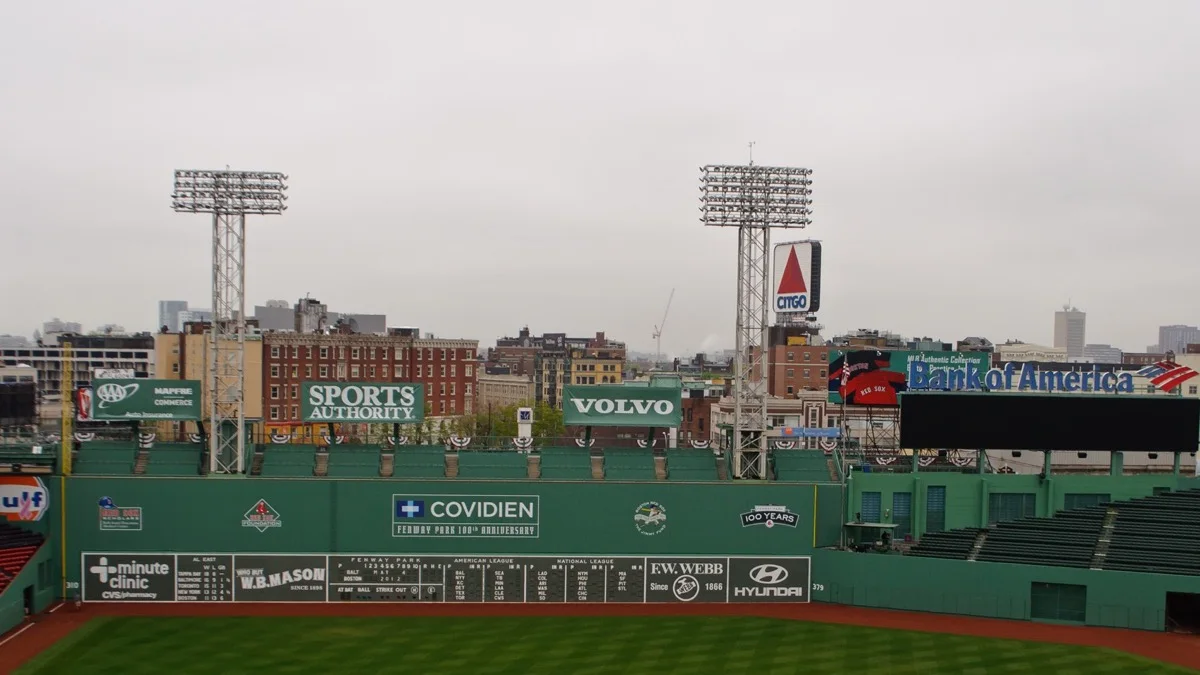
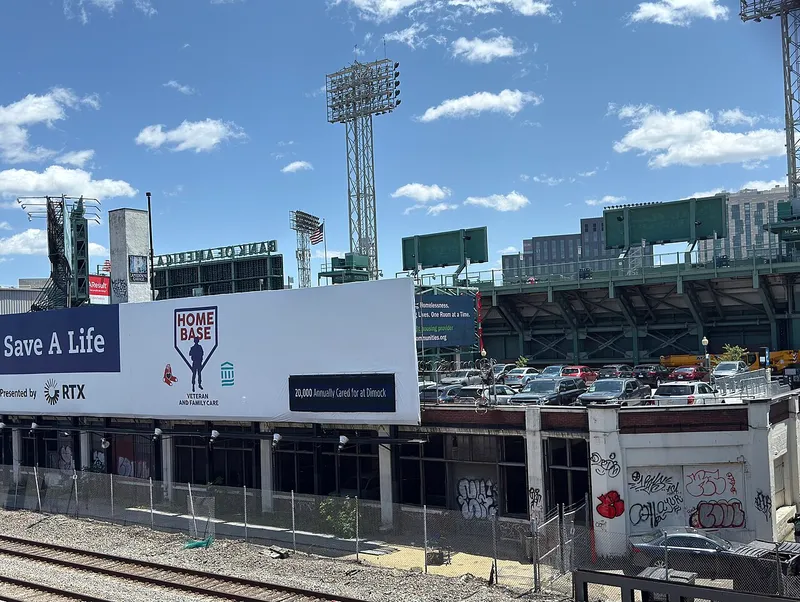
The defining feature is the Green Monster: a 37-foot-2-inch left-field wall that turns routine fly balls into doubles and line drives into outs. The wall still houses a hand-operated scoreboard, one of only two remaining in MLB, where operators work inside the wall, sliding 2-pound metal number plates by hand. Premium seating atop the Monster, added in 2003, quickly became the most coveted tickets in baseball.
The field is 100% Kentucky Bluegrass, completely replaced in 2005 with new sand-based growing medium and laser-leveled drainage. The outfield dimensions are wildly asymmetric: 310 feet down the left-field line, 390 to center, and just 302 to Pesky’s Pole in right, creating a playing surface unlike any other in the sport.
Getting to Fenway Park
Public Transit
The MBTA is the best way to reach Fenway Park. Two stations serve the park directly, and the Green Line gets you there from almost anywhere in Boston.
→ From Downtown Boston: Take the Green Line (B, C, or D branch) to Kenmore Station, a 5-minute walk from the main gates on Jersey Street.
→ Via Commuter Rail: The Framingham/Worcester Line stops at Lansdowne Station, directly across the street from the park. One of the most convenient commuter rail-to-stadium connections in baseball.
The Green Line gets extremely crowded on game days. Arriving early makes a real difference, and gives you time to walk Lansdowne Street, which comes alive with bars and street vendors on game nights.
Driving + Parking
Fenway Park is located at 4 Jersey Street, Boston, MA 02215. The park sits in a dense urban neighborhood, street parking is essentially nonexistent on game days.
→ From the West (I-90): Take I-90 East (Mass Turnpike) to the Cambridge/Allston exit. Bear right toward Storrow Drive East, take the Fenway exit.
→ From the North (I-93): Take I-93 South to Storrow Drive West. Continue to the Fenway exit, turn left onto Boylston Street.
The closest garages are the Fenway Triangle Garage (180 Brookline Ave, $45-55) and Lansdowne Garage on Lansdowne Street ($40-55). Both fill quickly. The Prudential Center Garage (800 Boylston St) offers a $20 rate when you scan a same-day Red Sox ticket at exit, it’s a mile walk but the best deal around. Pre-book through SpotHero to guarantee a spot.
Rideshare
Uber and Lyft have designated pickup and drop-off zones at Boylston Street and Kilmarnock Street, enforced 5:00 PM to 8:00 AM daily. A ride from downtown Boston runs $12-20; from Logan Airport, $25-40. Post-game surge pricing is common, grabbing a meal on Lansdowne Street first can save you real money.
From the Airport
→ Boston Logan (BOS): 5 miles, 15-25 minutes by car. By transit: Blue Line from Airport station to Government Center, transfer to Green Line to Kenmore, about 35 minutes total.
→ T.F. Green Airport (PVD): 62 miles, approximately 75 minutes by car from Providence.
→ Manchester-Boston Regional (MHT): 55 miles, approximately 70 minutes by car from New Hampshire.
Obstructed Views and Where to Sit
Here is the thing nobody tells you before you pay: Fenway is held up by poles, and some of them are standing between you and the game.
The ballpark went up in 1912, before engineers could cantilever a second deck out over a crowd. So the upper level, the press box, the premium seats, all of it rests on steel columns planted right in the middle of the seating bowl. The Red Sox have never published a count. The most careful tally by the people who study this ballpark puts it at 26 columns, each about sixteen inches wide, scattered through the grandstand and touching roughly three percent of its seats. The Boston Globe once put the problem about as bluntly as it can be put: “It has poles. Poles mean obstructed-view seats. Lots and lots of them.”
Only two grandstand sections have no pole at all: 19 and 21. Both sit behind home plate. Everywhere else in the grandstand, a column is standing somewhere near the front corner of your section, and whether it ruins your afternoon comes down to your seat number, not your section.
The trap: “not marked obstructed” does not mean clear
This is the part that costs people money. The Red Sox do label some seats Obstructed View, stamped OV on the ticket, and their standard is a high one: the seat has to sit behind a permanent structure blocking the home plate area, the pitching mound, or both. Sit slightly off to the side of a column, with a steel post eating a third of your sightline, and the ticket may go on sale as an ordinary seat with no warning at all.
So an unmarked ticket is not a promise of a clear view. It is only a promise that the club did not consider it bad enough to say so.
The seats to think twice about
- Rows 1 to 4 of any grandstand section. The columns stand at the front of the sections, which is precisely where the cheapest “close to the field” grandstand seats are.
- The rear of grandstand sections 15, 16, 26, 27 and 28. These are the notorious double-pole seats, with one column in front of you and another behind.
- Grandstand 2 and 3. Seating guides single these out as the worst gamble in the park, with pole trouble almost wherever you land and no clear look at the big scoreboards.
- Under the grandstand roof. An obstruction nobody prices in. The roof cuts off the sky, so you lose the ball in flight on anything hit high, and you may lose the scoreboard too.
- Right field boxes (sections 87 to 97). No poles here, but a stranger problem: the seats are bolted square to the straight right-field facade rather than swivelled toward the plate, so you spend the game turned to your left. The Globe’s advice to anyone sitting past first base is practical, if grimly funny: check that your neck turns comfortably. These are also among the last seats in the park to fall into shade, which matters at a July day game.
What is actually worth the money
The Green Monster seats (M1 to M10, perched 37 feet up since 2003, 274 of them when they opened and 269 by the club’s current count) are the ones everyone wants, and they are worth doing once. Just know what you are buying. ESPN’s own review from up there is honest about the cost: the left fielder vanishes beneath you as soon as he nears the warning track, anything hit into the left-center gap disappears entirely, and you have no angle on two of Fenway’s three video boards, so you do not even get the replay. It is an experience seat, not a baseball-watching seat. If you want one, M1 and M2 nearest the foul line give the best of it.
For actually watching a game, the loge boxes (sections 98 to 165) are the price-to-value sweet spot in the ballpark, though rows AA to CC sit on a walkway and get traffic across your view. And the sleeper pick is the bleachers (sections 34 to 43): the cheapest tickets in the house, no poles anywhere, and while they are a long way from the plate, the low-numbered seats in section 34 look straight down the line at home plate with the Green Monster running away to your right.
One last piece of advice worth more than any of the above. The Red Sox publish a 3D virtual venue map that renders the actual view from an actual seat. In a ballpark with a 1912 steel skeleton, the seat number is the whole ballgame. Look before you pay.
Construction & Design
Fenway was thrown up fast, not built as a monument. Ground broke on September 25, 1911. The architect James E. McLaughlin drew the plans, the Osborn Engineering Corporation handled the structure, and the Charles Logue Building Company put the thing together for about $650,000, in time for Opening Day the following April. Nobody involved thought they were building something that would outlive them all.
And the Fenway most people picture is not the one they built. After Tom Yawkey bought the club the park was largely rebuilt for the 1934 season: the wooden bleachers came back in concrete, and the left-field wall went up to its finished height of 37 feet. Tall, because the lot was short and the owners did not fancy home runs landing on Lansdowne Street. That is the whole origin of the most famous wall in sports. A property-line problem.
The rest of the design is a run of accidents that hardened into scripture. Pesky’s Pole is listed at 302 feet down the right-field line, the shortest porch in baseball, a number the wall itself declines to confirm, while dead center recedes into the Triangle and the far corner of it is 420 feet from the plate. The field is asymmetric because the city block was asymmetric, and in a hundred and fourteen years nobody has ever seriously proposed straightening it out.
What did get fixed was everything else. Between 2002 and 2011 the new ownership spent roughly $285 million improving the park rather than replacing it: a concourse spilling out onto Jersey Street, new clubhouses, and a quiet structural overhaul meant to buy the building another forty years. The bet was that an old ballpark, done properly, is worth more than a new one. Every empty replacement stadium built in that era says the bet was right.
Legacy of Fenway Park
The single most important fact about Fenway Park is that it is still standing, and that was very nearly not the case.
In 1999 the club announced it would knock the place down and build a replacement next door. The plan was serious, it was funded, and by the logic of the 1990s it was obvious: the park was cramped, the seats were narrow, the poles were in the way, and every other team in baseball was cashing in a new stadium. What stopped it was a grassroots campaign called Save Fenway Park!, a group of people with no leverage whatsoever except the argument that you cannot build this twice. They were right, and they won. When John Henry’s group bought the Red Sox in 2002 they scrapped the demolition and hired the architect Janet Marie Smith to renovate instead, a decision that now looks like the shrewdest business call in modern baseball. Every club that replaced its old park got a building. Boston kept the thing people fly here to see.
The music helped make the case. Bruce Springsteen played the first major concert on the field in 2003, and the summer series that followed has brought the Rolling Stones, Paul McCartney and Taylor Swift onto the outfield grass. Lady Gaga headlined in 2017, the first woman to do it. A ballpark that was supposed to be too old to be useful now sells out nights when there is no baseball at all.
History of Fenway Park
The first crowd through the gates in April 1912 watched the Red Sox beat the New York Highlanders 7-6 in eleven innings. Almost nobody outside Boston noticed. The Titanic had gone down five days earlier and the newspapers had other business.
What followed was a century of the park being shaped by its own accidents. A fire during the 1934 rebuild took out the wooden left-field wall, and Tom Yawkey put back the tin-and-timber structure that the world eventually learned to call the Green Monster. It was not green yet. That came in 1947, the same year the lights went up and Fenway finally got night baseball. Duffy’s Cliff, the ten-foot embankment that left fielders used to climb, was flattened and never missed.
Then came the moments that made the place. Ted Williams homered in his final career at bat on September 28, 1960, and would not tip his cap, an act John Updike immortalized with a line about how gods do not answer letters. Carlton Fisk waved a fly ball fair with his whole body in the twelfth inning of Game 6 of the 1975 World Series, and the shot of him doing it is still the most-replayed clip in baseball. In October 2004 the Red Sox were down three games to none to the Yankees in the ALCS, and Dave Roberts stole second base, and everything that had been true about this ballpark for eighty-six years stopped being true. Nine years later, in 2013, they clinched a World Series on this field for the first time since 1918.
The park has survived fires, a demolition plan, and a curse. A $1.6 billion mixed-use development called Fenway Corners is going up on the land next door, construction starting in 2026. The ballpark itself is not going anywhere.
Sources & Further Reading
- Wikipedia entry on Fenway Park: en.wikipedia.org/wiki/Fenway_Park. Construction, the 1934 rebuild, the Green Monster, dimensions, and the renovation history.
- Boston Red Sox official ballpark page: mlb.com/redsox/ballpark. The team’s ballpark history and tours.
- Boston Red Sox official facts and figures: mlb.com/redsox/ballpark/facts-figures. The club’s own capacity, wall heights, and outfield dimensions, used here in preference to any secondary tally.
- SABR, Fenway Park: sabr.org. The Society for American Baseball Research profile.
- Boston Globe on Fenway’s flaws: bostonglobe.com. The poles, the roof, and the right-field seats that face the wrong way.
- ESPN on the Green Monster seats: espn.com. An honest account of what you can and cannot see from up there.
- Boston’s Pastime on the poles: bostonspastime.com. Which grandstand sections have columns, and how many seats they affect.
Quick Facts
Everything you need at a glance.
Stadium specs
- Capacity
- 37,755
- Opened
- 1912
- Cost
- $650,000 (1912 original); 2002-2011 improvements around $285 million
- Roof
- Open
- Surface
- Natural Grass (Kentucky Bluegrass)
- Tenants
- Boston Red Sox (MLB)
Construction & location
- Groundbreaking
- September 25, 1911
- Architects
- James E. McLaughlin (original, 1912)
- Engineering
- Osborn Engineering Corporation (original)
- General contractor
- Charles Logue Building Company (original)
- Address
- Fenway Park, 4 Jersey Street, Boston, MA 02215
- GPS
- 42.3463°N, 71.0975°W
Photo Gallery
Fun Facts
The Green Monster stands 37 feet 2 inches tall and still features a hand-operated scoreboard, one of only two remaining in MLB, with the initials of former owners Tom and Jean Yawkey encoded in Morse code.
Section 42, Row 37, Seat 21, the lone red seat in a sea of green, marks where Ted Williams landed a home run on June 9, 1946, announced that day at 502 feet and still the longest ever hit at Fenway. When MLB later measured the seat with lidar it came out at 496 feet from the plate, which tells you something about how home runs got measured in 1946.
Pesky's Pole, the right-field foul pole, is listed at 302 feet from home plate, the shortest outfield distance in Major League Baseball. No distance is actually painted on it, and Johnny Pesky, the man it is named for, reckoned it was closer to 295. He hit only 6 career home runs at Fenway.
Stadium Location
Frequently Asked Questions
- Which seats at Fenway Park are behind a pole?
- Fenway is held up by steel columns planted in the grandstand, because the 1912 design predates cantilevered upper decks. The club does not publish a count, but the careful tallies put it at 26. Only grandstand sections 19 and 21, both behind home plate, have no pole at all. The columns stand near the front corner of each section, so rows 1 to 4 are the biggest risk, and the rear of sections 15, 16, 26, 27 and 28 can leave you with a pole in front and another behind.
- If my Fenway ticket is not marked Obstructed View, does that mean I have a clear view?
- No, and this is the trap that costs people money. The Red Sox only stamp a ticket OV when the seat sits behind a permanent structure blocking the home plate area, the pitching mound, or both. A steel column can eat a large part of your sightline and the seat may still be sold as an ordinary ticket with no warning. An unmarked ticket only means the club did not consider it bad enough to say so.
- Are the Green Monster seats worth it?
- Worth doing once, but understand what you are buying. From 37 feet above left field the left fielder disappears beneath you as he nears the warning track, anything hit into the left-center gap vanishes, and you have no angle on two of the three video boards, so you do not even get the replay. It is an experience seat, not a baseball-watching seat. Sections M1 and M2, nearest the foul line, give the best of it.
- Why do Fenway's right field seats face the wrong way?
- The right field boxes, sections 87 to 97, are bolted square to the ballpark's straight right-field facade instead of being angled toward home plate, so you spend the game turned to your left. The Boston Globe's advice to anyone sitting past first base is to check that your neck turns comfortably. There are no poles out there, but the sections are also among the last to fall into shade on a day game.
- What are the best value seats at Fenway Park?
- The loge boxes, sections 98 to 165, are the price-to-value sweet spot, though rows AA to CC sit on a walkway with people crossing your view. The sleeper pick is the bleachers, sections 34 to 43: cheapest in the park, no poles anywhere, and the low-numbered seats in section 34 look straight down the line at home plate with the Green Monster running away to your right.
- Why is Fenway Park's capacity different for day and night games?
- Fenway seats 37,755 at night but only 37,305 during the day. The 450-seat difference is the batter's eye: a section of center field seats is covered with a black tarp for day games so hitters can pick up the ball against a dark background instead of a crowd of white shirts.
- Where is the lone red seat at Fenway Park?
- Section 42, Row 37, Seat 21, out in the right field bleachers. It marks where Ted Williams hit a home run off Detroit's Fred Hutchinson on June 9, 1946, still the longest ever hit at Fenway. The ball landed on a fan named Joe Boucher, punching straight through his straw hat. The famous 502 feet is the figure the Red Sox announced that afternoon rather than a measured one: when MLB went back with lidar, the seat turned out to sit 496 feet from home plate.
- How can I check my exact seat's view before buying a Fenway ticket?
- The Red Sox publish a 3D virtual venue map that renders the actual view from an actual seat. In a ballpark with a 1912 steel skeleton, the seat number matters more than the section number, so this is the single most useful thing you can do before paying.
- How do I get to Fenway Park by public transit?
- Take the MBTA Green Line to Kenmore station, about a five-minute walk from the ballpark, or to Fenway station on the D branch. The Framingham/Worcester commuter rail also stops at Lansdowne, which sits right behind the Green Monster.
- Are Fenway Park tours available?
- Yes. The Red Sox run guided ballpark tours year-round, including on most game days before first pitch, taking in the Green Monster, the press box, and the dugout areas depending on the schedule.
Last updated: 2026-07-14