About Paycor Stadium
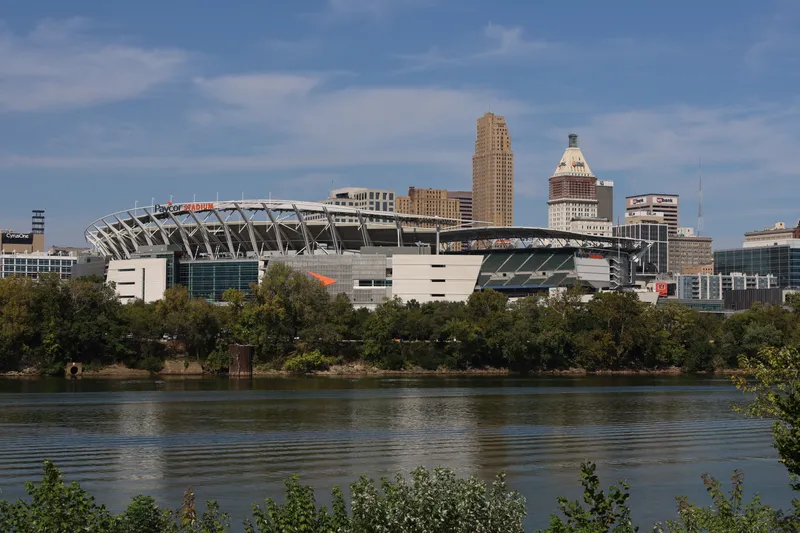
On the Ohio River waterfront in downtown Cincinnati, a 65,515-seat open-air stadium gives the Cincinnati Bengals one of the prettiest settings in the NFL, the river, the Roebling Suspension Bridge, and the Kentucky hills filling the view beyond the far stands. Paycor Stadium has been the Bengals’ home since 2000, and after two decades of frustration it has finally become a fortress.
The Bengals had spent three decades sharing Riverfront Stadium, later Cinergy Field, with the Reds before this became their own home in 2000. It opened named for Hall of Fame coach and team founder Paul Brown. On fall Sundays the “Who Dey” chant fills the Banks district as fans stream in from both Ohio and Kentucky across the river bridges.
Designed by NBBJ under lead architect Dan Meis, the $449.5 million stadium opened on August 19, 2000, and became the first NFL facility to win an American Institute of Architects design award, praised for its sleek, asymmetrical bowl and its connection to the riverfront. The field started as natural grass and has been artificial turf since the mid-2000s, currently a FieldTurf surface.
The Bengals’ 2021 playoff run, culminating in Super Bowl LVI, changed how the place feels. Joe Burrow’s arrival turned Paycor Stadium into one of the NFL’s most electric venues, and the Banks entertainment district around it has grown into a year-round destination linking the ballpark, the stadium, and the river.
Getting to Paycor Stadium
Public Transit
Paycor Stadium sits in Cincinnati’s riverfront district, accessible by streetcar and bus.
→ Via Cincinnati Bell Connector: The free streetcar circuit has a stop at Second and Main Streets, about four blocks from the stadium. The Connector loops through downtown and Over-the-Rhine.
→ Via Southbank Shuttle: The trolley runs from northern Kentucky’s Newport and Covington neighborhoods to the Banks area, steps from the stadium. A convenient option if you’re staying across the river.
Metro operates additional bus service on game days. If staying downtown, the stadium is a 10-minute walk from most hotels along the riverfront.
Driving + Parking
The stadium address is 1 Paycor Stadium, Cincinnati, OH 45202. I-71 and I-75 converge just north of downtown.
→ From Columbus (~110 mi): I-71 South directly to downtown Cincinnati. About 1 hour 45 minutes.
→ From Indianapolis (~110 mi): I-74 East to I-75 South into Cincinnati. About 1 hour 50 minutes.
→ From Louisville (~100 mi): I-71 North to Cincinnati. About 1 hour 30 minutes.
Approximately 20,000 parking spaces surround the stadium. Official lots cost $25–$40. The Banks garages between the stadium and Great American Ball Park are the most convenient. Newport on the Levee in Kentucky offers cheaper options ($10–$20) with a short walk across the Taylor-Southgate Bridge. Pre-purchase through SpotHero.
Rideshare
Uber and Lyft are widely available in downtown Cincinnati. Drop-off zones are along Pete Rose Way near the stadium entrance. Post-game pickup zones shift to reduce congestion, check the Bengals app. From downtown hotels, expect $6–$10. Surge pricing after games is moderate, walk to the Banks or across the Roebling Bridge and wait 10–15 minutes.
From the Airport
→ Cincinnati/Northern Kentucky International (CVG): 13 miles south of the stadium in Hebron, Kentucky, about 15–20 minutes by car. Major hub for DHL and Frontier Airlines with growing domestic service. Rideshare runs $25–$35. TANK bus route 2X connects CVG to downtown Cincinnati.
Construction & Design
The Bengals spent 30 years as tenants before they got a house of their own. From 1970 they shared Riverfront Stadium, later Cinergy Field, with the Reds, and when Hamilton County voters approved a sales tax in 1996 to build separate homes for both teams, the football stadium was the marquee project. NBBJ, with the young designer Dan Meis leading, broke ground in April 1998, and the $449.5 million stadium opened in 2000. Public money covered nearly all of it.
What set it apart was the look. Meis gave it an asymmetrical, sculptural bowl, open toward the river, ribbed in exposed steel and stripped of fussy ornament. The first NFL stadium ever to win an American Institute of Architects design award. A statement, from a franchise that badly needed one. It was named not for a sponsor but for Paul Brown, the Hall of Fame coach who founded the team, an honor that held until Paycor bought the rights in 2022.
The stadium is not standing still. In 2025 Hamilton County and the Bengals agreed to a roughly $470 million renovation, about $350 million from the county and $120 million from the team, to run through 2027 as part of a new long-term lease. The work adds new suites, clubs, and technology while keeping the riverfront bowl the city has known for a quarter-century.
History of Paycor Stadium
Paycor Stadium was built to replace Cinergy Field (formerly Riverfront Stadium), which the Bengals shared with the Cincinnati Reds from 1970 to 1999. In 1996, Hamilton County voters approved a sales tax to fund new stadiums for both teams. The $449.5 million project was designed by NBBJ and broke ground in 1998. The stadium was named for Paul Brown, the Hall of Fame coach who founded the Bengals in 1968.
First Game (August 19, 2000): The Bengals hosted the Chicago Bears in a preseason game before a sellout crowd. The first regular-season game came on September 10, a 24–7 loss to the Cleveland Browns.
First College Football Game (September 21, 2002): Ohio State defeated the University of Cincinnati 23–19 before 66,319 fans, the stadium’s all-time attendance record.
First Home Playoff Win (January 15, 2022): The Bengals beat the Las Vegas Raiders 26–19 in a Wild Card game, their first playoff win since the 1990 season and the first ever at this stadium. It launched a run, through road wins at Tennessee and Kansas City, to Super Bowl LVI, the franchise’s first appearance since 1988.
Naming Rights Change (August 2022): After 22 years as Paul Brown Stadium, the venue was renamed Paycor Stadium in a 16-year deal with the Cincinnati-based human capital management company.
The Burrow era rewrote the building’s reputation. For most of its first two decades the stadium hosted a team that reached the playoffs but almost never won there, and fans grew used to leaving early. Joe Burrow ended that. Drafted first overall in 2020, he turned a perennial also-ran into a contender within two seasons, delivering the franchise’s first Super Bowl run in a generation and its first home playoff win in 31 years. “Who Dey,” the Bengals’ call-and-response chant, is now one of the most recognizable home-field sounds in the NFL, and a stadium that once emptied at halftime routinely sells out.
Beyond football, Paycor Stadium anchors one of the most walkable game-day settings in the league. The Banks, the mixed-use district between the stadium and Great American Ball Park, packs bars, restaurants, and riverfront into a few blocks, and fans cross the Ohio River from Kentucky on foot over the historic Roebling Suspension Bridge. It has hosted international soccer friendlies, NCAA showcases, and stadium tours from Kenny Chesney to the Rolling Stones, and it sits at the heart of a riverfront that Cincinnati has spent two decades rebuilding around its two stadiums.
From decades of frustration to a Super Bowl run that electrified a city, Paycor Stadium has witnessed the full arc of the Bengals’ story, and with Joe Burrow under center, the best chapters may still be ahead.
Sources & Further Reading
- Stadiums of Pro Football, Paycor Stadium: stadiumsofprofootball.com. Capacity, cost, the design team, and history.
- Paycor, naming-rights announcement: paycor.com. The 2022 naming deal.
- WCPO, Hamilton County–Bengals lease and renovation: wcpo.com. The ~$470M renovation and lease.
- Wikipedia, Paycor Stadium: en.wikipedia.org/wiki/Paycor_Stadium. Naming history, the surface history, and events.
Quick Facts
Everything you need at a glance.
Stadium specs
- Capacity
- 65,515
- Opened
- 2000
- Cost
- $449.5 million (2000) (~$830 million (2025 dollars) today)
- Roof
- Open
- Surface
- Artificial Turf (FieldTurf)
- Tenants
- Cincinnati Bengals (NFL)
Construction & location
- Groundbreaking
- April 25, 1998
- Architects
- NBBJ (Dan Meis, lead), Glaser Associates, Moody Nolan
- Address
- 1 Paycor Stadium, Cincinnati, OH 45202, USA
- GPS
- 39.0955°N, 84.5161°W
Photo Gallery
Fun Facts
Paycor Stadium was the first NFL facility to win an American Institute of Architects (AIA) design award, architect Dan Meis of NBBJ created a sleek, asymmetrical bowl that remains one of the most visually striking stadiums in the league.
The Bengals won 12 of their first 13 home games at the stadium after opening in 2000, establishing an immediate home-field advantage that erased the franchise's losing reputation.
During the Bengals' 2021 Super Bowl run, 'Who Dey' chants from Paycor Stadium registered on seismographs at the University of Cincinnati, the first time fan noise from the stadium was scientifically measured.
Stadium Location
Frequently Asked Questions
- What is the seating capacity of Paycor Stadium?
- Paycor Stadium seats 65,515 for NFL games. The all-time attendance record is 66,319, set during the first college football game at the stadium on September 21, 2002 (Cincinnati vs. Ohio State).
- Where is Paycor Stadium located?
- Paycor Stadium is at 1 Paycor Stadium in Cincinnati, Ohio 45202. It sits on the Ohio River waterfront in the Banks entertainment district, adjacent to Great American Ball Park and a short walk from downtown.
- How do I get to Paycor Stadium by public transit?
- The Cincinnati Bell Connector streetcar stops at Second and Main Streets, about four blocks from the stadium. The Southbank Shuttle trolley runs from northern Kentucky to the Banks area. Metro bus routes also serve downtown on game days. WeGo provides free game-day shuttles from select locations.
- Is there parking at Paycor Stadium?
- Approximately 20,000 parking spaces are available near the stadium. Official stadium lots cost $25–$40. The Banks garages, Newport on the Levee (across the river in Kentucky), and downtown garages offer additional options at $15–$30. Pre-purchase through SpotHero.
- What was the stadium called before Paycor Stadium?
- The stadium opened as Paul Brown Stadium in 2000, named after the Hall of Fame coach and Bengals founder. In August 2022, the naming rights were sold to Paycor, a Cincinnati-based human capital management company, in a 16-year deal.
- What major events has Paycor Stadium hosted?
- The January 2022 Wild Card playoff win over the Raiders during the Bengals' Super Bowl LVI run, international soccer friendlies, NCAA college football games, concerts from Kenny Chesney to The Rolling Stones, and the annual University of Cincinnati football games.
- Can you walk to Paycor Stadium from Northern Kentucky?
- Yes. The Roebling Suspension Bridge and Taylor-Southgate Bridge connect Covington and Newport, Kentucky to the Banks district, about a 15-minute walk to the stadium. Many fans park in Kentucky for cheaper lots and walk across.
- Is Paycor Stadium being renovated?
- Yes. In 2025 Hamilton County and the Bengals agreed to a roughly $470 million renovation, about $350 million from the county and $120 million from the team, tied to a new long-term lease and scheduled to run through 2027. It adds new suites, clubs, and technology while keeping the existing riverfront bowl rather than building a new stadium.
Last updated: 2026-07-10