About Estadio Osvaldo Domínguez Dibb
For sixty years, Club Olimpia played on the same patch of ground in the Barrio Las Mercedes, a compact bowl ringed by tall trees that fans called Para Uno. Now that ground is gone. In its place, on the same land off Avenida Mariscal López a few kilometres east of central Asunción, Olimpia is building a new stadium and naming it for a former club president: Estadio Osvaldo Domínguez Dibb.
The headline number is 46,000 seats. If the plan holds, that would make it the largest stadium in Paraguay, edging past the national Estadio Defensores del Chaco a short distance away. The design calls for hospitality levels stacked with executive boxes, pitch-level suites, fan zones and food courts, a club store and a museum, all wrapped in a curved, roofed facade. On the newest version of the drawings, a tiger’s face stares out from the shell, a nod to Domínguez Dibb’s nickname, El Tigre.
There is one reason above all for the ambition. Paraguay is due to host one of the three centenary opening matches of the 2030 World Cup, shared with Uruguay and Argentina to mark 100 years since the first tournament in 1930. This is the ground meant to stage it, which is why a proud but modest club stadium is being rebuilt into something on a World Cup scale.
For now, it is a cleared site rather than a stadium. The old Manuel Ferreira was demolished starting in 2024, and through the first half of 2026 the lot still sat mostly empty, its foundations yet to rise. Everything described here is the plan on paper, not a building you can yet walk into.
Getting to Estadio Osvaldo Domínguez Dibb
The site is close to the center of Asunción, on one of the city’s main avenues, so reaching it is straightforward even if the stadium itself is a work in progress.
Public Transit
Asunción has no metro or tram, so the local bus network does the heavy lifting, and plenty of lines run along Avenida Mariscal López.
→ By city bus: Numerous routes serve Mariscal López, linking the stadium area to the microcentro downtown and the bus terminal. Fares are cheap, though buses are crowded and slow in traffic.
→ On foot: The last approach is through quiet residential streets in the Barrio Las Mercedes, so most fans finish the trip on foot whatever transport they take.
Driving + Parking
The ground sits right on Mariscal López, an easy road to find, though the surrounding streets are narrow.
→ From downtown: Roughly 10 to 15 minutes east along Mariscal López in normal traffic.
→ Parking: The old ground had very little parking of its own, and street space in Las Mercedes is tight. The new design allows for around 600 vehicles, but until the stadium is finished, plan to park further out and walk in.
Rideshare
Ride-hailing apps such as Bolt and Uber operate in Asunción alongside the regular taxis, and a car from the center to Las Mercedes is quick and inexpensive. For visitors it is the simplest way in and out, especially heading back after an event when buses fill up.
From the Airport
→ Silvio Pettirossi International (ASU): Paraguay’s main airport is in Luque, northeast of the city, about 30 minutes from the stadium site by road.
→ Into the city: A taxi or rideshare is the practical option, as there is no direct transit link from the airport to the ground.
The Bosque de Para Uno
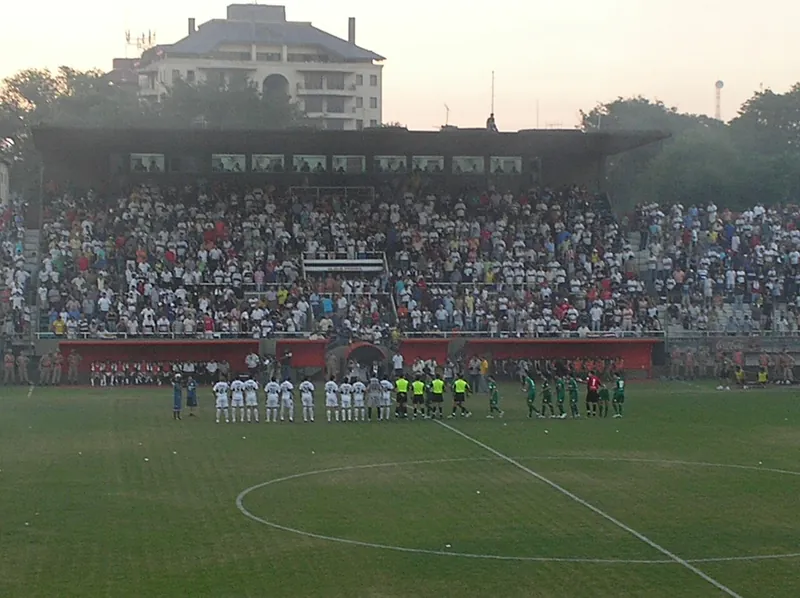
Before there was a World Cup project here, there was Para Uno, and it is worth understanding what the new stadium replaces. The name, roughly “Stop One,” came from a transport stop the leafy neighborhood was once known by, and the tall trees around the ground earned it a second nickname, El Bosque de Para Uno, the Forest of Stop One. It was the home of Olimpia, Paraguay’s most successful club and a three-time champion of South America, from 1965 until the bulldozers arrived.
It was never a giant. The old Manuel Ferreira was a tight, aging concrete bowl that held around 32,000 by the end, grown from roughly half that when it opened, and Olimpia’s biggest occasions, the fierce derbies against Cerro Porteño, were long ago moved to the larger national stadium across town. What Para Uno had instead was history and intimacy. The stands sat close to the pitch, the crowd was almost on top of the players, and the surrounding trees gave it a character no modern arena sets out to build in.
The defining day came at the very start. On May 15, 1965, the ground opened with a friendly against Santos and their 24-year-old forward Pelé. A barrier holding back the crowd gave way, spectators were hurt, and Pelé leapt the fence to help the injured before play resumed and the match ended 2-2. Six decades later that scene is still the first thing many Paraguayans mention about the place.
What a matchday will feel like in the new bowl, nobody can honestly say yet. There are no seats, no chants, no worn concourses to describe, because the stadium does not exist. That is the gap between a plan and a place, and it is the gap Olimpia has until 2029 to close. The prize, if it does, is a home ground fit to open a World Cup.
Construction & Design
The design belongs to two practices working together: PATH URBAN, an Argentine architecture firm, and Nicole Hellmers Arquitectura, with structural engineering by RDA Estructuras and a wider technical committee of more than two dozen engineers and architects. Among them, according to the club, are engineers who worked on the redevelopment of Rio de Janeiro’s Maracanã for the 2014 World Cup, a useful pedigree for a stadium built to FIFA’s standards.
The concept has already changed once. An initial 2024 design was revised after a 2026 review with CONMEBOL into a squarer, more enclosed bowl, with a roof drawn over every seating tier rather than only part of the stands. The published plans describe a large hospitality program, with reports of up to 338 executive boxes, plus VVIP areas, pitch-level suites, several fan zones, eight food-court patios, an official store and a club museum, and parking for about 600 vehicles. The newest facade carries a tiger motif for Domínguez Dibb, and the club has pointed to LED lighting integrated into the exterior and green technology aimed at international environmental standards. How much of that survives to the finished building is the open question with any stadium still on the drawing board.
The money and the calendar tell the harder story. The reported budget is around US$80 million, a large sum for a Paraguayan club project. Demolition of the old ground began in 2024, but the site then stalled: through the first half of 2026 the cleared lot still showed weeds, mud and standing water rather than foundations, and the retaining-wall and foundation phases had slipped past their planned dates. Structural work was scheduled to begin in mid-2026, with completion pushed from an original 2027 target to the second half of 2029. That date matters most, because FIFA wants the venue ready roughly a year before the 2030 tournament it was designed to serve.
History of Estadio Osvaldo Domínguez Dibb
The story starts with a club that needed a home. Olimpia, founded in 1902 and the only Paraguayan side to win the Copa Libertadores, built its own ground in the Barrio Las Mercedes and opened it in 1965 as the Estadio Manuel Ferreira, named for the club president of the era. For the next sixty years it was simply Para Uno to the people who filled it.
The modern chapter is about a name and a tournament. In 2024 the club renamed the stadium after Osvaldo Domínguez Dibb, a former president remembered as El Tigre and the father of CONMEBOL president Alejandro Domínguez, with the banking group Ueno attached as a sponsor, so that the full title reads Estadio ueno Osvaldo Domínguez Dibb. In the same year, with Paraguay lined up to host a centenary opening match at the 2030 World Cup, demolition of the old ground began. The plan was bold: knock down the historic bowl and raise a 46,000-seat arena on exactly the same footprint.
Progress since has been slow. A first design was presented in December 2024, then reworked in 2026 after talks with CONMEBOL, while the physical site sat largely untouched into the middle of 2026, drawing pointed local coverage of a World Cup stadium that was still an empty lot. Structural work was set to start only then, against a completion target that had already moved to 2029.
The chapters that count are still unwritten. No seat has been fixed, no crowd counted in the new stands, no opening match played. If the schedule holds, Olimpia will have a year or so to settle into the ground before the world arrives in 2030. A stadium conceived for a single centenary night, its greatest day is still years off, and everything until then is preparation on the land where Para Uno used to stand.
Sources & Further Reading
- Wikipedia entry on Estadio Osvaldo Domínguez Dibb: en.wikipedia.org. Names, coordinates, the 1965 opening, ownership and the demolition and rebuild plan.
- ABC Color on the cost and timeline: abc.com.py. The US$80 million budget, the 2029 opening target and the design team.
- Xinhua on the stadium unveiling: english.news.cn. Capacity, cost, the Maracanã engineers and the naming for Osvaldo Domínguez Dibb.
- PATH URBAN project page: pathurban.com. The design practice’s own account of the roofed bowl, the sightlines and the hospitality program.
- Club Olimpia official page on the stadium: olimpia.com.py. The club’s presentation of the Estadio ueno Osvaldo Domínguez Dibb project.
Quick Facts
Everything you need at a glance.
Stadium specs
- Capacity
- 46,000
- Opened
- 2029
- Cost
- About US$80 million
- Roof
- Canopy
- Surface
- Grass
- Tenants
- Club Olimpia
Construction & location
- Groundbreaking
- 2024 (demolition); structural works from 2026
- Architects
- PATH URBAN, Nicole Hellmers Arquitectura
- Engineering
- RDA Estructuras
- General contractor
- Not separately recorded
- Address
- Avenida Mariscal López, Barrio Las Mercedes, Asunción, Paraguay
- GPS
- 25.2914°S, 57.6086°W
Photo Gallery
Fun Facts
The ground it replaces opened on May 15, 1965 with Olimpia against Pelé's Santos. A crowd barrier collapsed and injured spectators, and Pelé himself jumped the fence to help the hurt fans, before the match finished 2-2.
At a planned 46,000 seats it is designed to become the largest stadium in Paraguay, overtaking the national Estadio Defensores del Chaco a couple of kilometres away.
It is named after Osvaldo Domínguez Dibb, a former Olimpia president nicknamed El Tigre and the father of CONMEBOL president Alejandro Domínguez. The latest design puts a tiger's face on the facade in his memory.
Stadium Location
Frequently Asked Questions
- Is Estadio Osvaldo Domínguez Dibb finished?
- No. As of 2026 the old Estadio Manuel Ferreira has been demolished and the new stadium is still to be built on the same site. Structural foundation work was scheduled to start in mid-2026, and completion is targeted for the second half of 2029, ahead of the 2030 World Cup. The 46,000-seat figure and the design described here are the published plans, not a finished, measured building.
- Where is Estadio Osvaldo Domínguez Dibb located?
- On Avenida Mariscal López in the Barrio Las Mercedes, a few kilometres east of central Asunción, Paraguay. It sits on the exact site of Club Olimpia's historic Manuel Ferreira ground, long known by the nickname Para Uno.
- What is Para Uno, and why is the ground being rebuilt?
- Para Uno, roughly 'Stop One,' was the nickname of Olimpia's old Estadio Manuel Ferreira, taken from a transport stop the leafy area was once known by. By the 2020s the compact, tree-ringed bowl was too small and too old for a World Cup, so Olimpia chose to demolish it and build a modern 46,000-seat stadium on the same land rather than move away from home.
- Will Estadio Osvaldo Domínguez Dibb host the 2030 World Cup?
- That is its purpose. Paraguay is set to stage one of the three centenary opening matches of the 2030 tournament, shared with Uruguay and Argentina to mark 100 years since the first World Cup in 1930, and this stadium is the intended Paraguayan venue. FIFA confirms the exact fixtures closer to the event.
- Who is Osvaldo Domínguez Dibb?
- A former president of Club Olimpia, nicknamed El Tigre, remembered for a successful era in the club's history. He is also the father of Alejandro Domínguez, the president of CONMEBOL, South America's football confederation. The stadium was renamed in his honor in 2024, replacing the old Manuel Ferreira name.
- How big will Estadio Osvaldo Domínguez Dibb be?
- The plan is 46,000 seats, which would make it the largest stadium in Paraguay, ahead of the national Estadio Defensores del Chaco. The design also includes hospitality levels with a large number of executive boxes, pitch-level suites, fan zones and food courts, along with a club store and museum.
- How much is the new stadium costing?
- The reported investment is around US$80 million. The project is led by Club Olimpia, with the design by the architecture practices PATH URBAN and Nicole Hellmers Arquitectura, structural engineering by RDA Estructuras, and a technical team that includes engineers who worked on the redevelopment of Rio de Janeiro's Maracanã.
- Why has construction been delayed?
- The stadium was first announced for completion around 2027, but the timeline has slipped. Through the first half of 2026 the cleared site remained largely an empty lot, and the target moved to the second half of 2029. FIFA has set a deadline of roughly one year before the World Cup, so the schedule leaves little margin.
- Can I watch Olimpia play at the stadium right now?
- Not at this site while it is being rebuilt. With the old ground demolished, Olimpia are playing their home fixtures elsewhere in Asunción during construction, and their biggest matches have long been staged at the larger Estadio Defensores del Chaco anyway. Check the club's schedule for the current home venue.
- How do you get to the stadium site?
- It is on Avenida Mariscal López in the Barrio Las Mercedes, close to central Asunción. City buses run along the avenue, and a taxi or rideshare from downtown takes 10 to 15 minutes. From Silvio Pettirossi International Airport in Luque, allow about 30 minutes by road.
Last updated: 2026-07-23