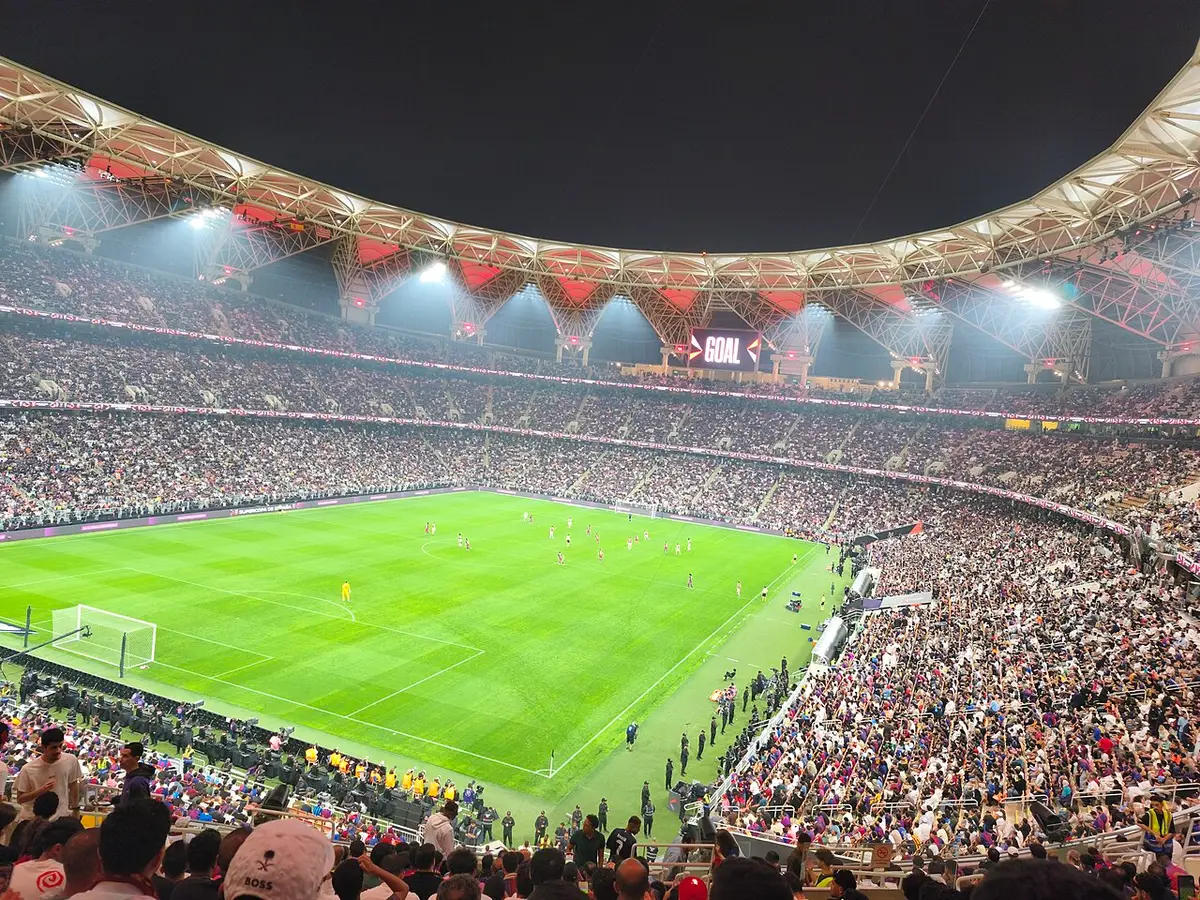
About King Abdullah Sports City Stadium
Drive 30 kilometres (19 miles) north out of Jeddah, past the airport, and the city thins into scrub and half-finished compounds until a white perforated drum appears on its own on the coastal plain. Locals call it Al-Jawhara, the Jewel, and the nickname is not marketing: the cladding is a diamond lattice drawn from the rawashin, the carved wooden window screens of old Jeddah, and from a distance in flat light the whole thing reads as a cut stone sitting in sand.
It holds 62,345, which makes it the largest stadium in Jeddah and the second largest in Saudi Arabia. The Ministry of Sport owns and runs it. Since February 2025 the naming rights have belonged to Alinma Bank, so the official name on a ticket is now Alinma Stadium, a deal that runs to 2029. The building itself has answered to four names in twelve years and nobody in the city uses more than one of them.
Two clubs share it, and they are not friendly. Same city, same building, opposite ends of it. Al-Ahli and Al-Ittihad have both played here since it opened, so the ground stages the Jeddah derby as a home game for whichever of them sold the tickets. The Saudi Arabia national team uses it for selected fixtures. The stadium anchors a sports city of roughly 3 million square metres that also holds seven natural-grass training pitches, five artificial ones, six tennis courts and the Onyx Arena, an indoor hall its operator sizes at up to 12,000 standing.
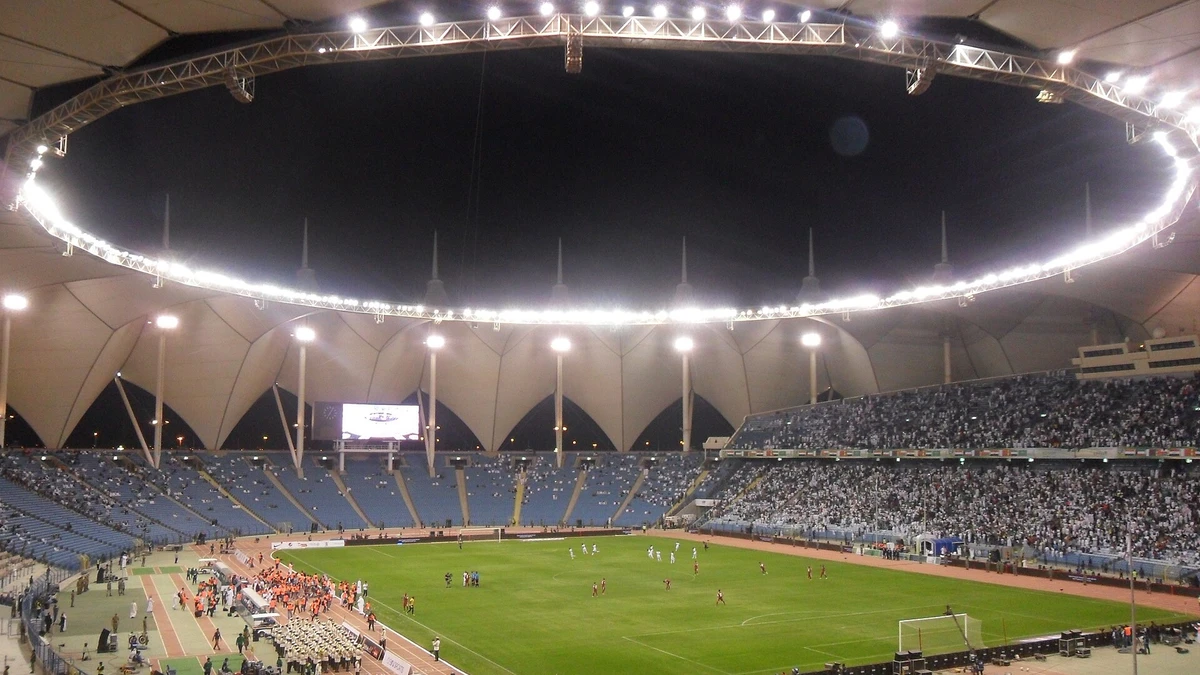
The bowl is four connected stands in three tiers, raked steeply, with a fixed steel canopy over the seats and the pitch left open to the sky. Almost every match here kicks off at night, for the obvious reason. The surface is a seeded paspalum. Chosen for salt and heat tolerance, not for looks.
It opened on May 1, 2014 with the King’s Cup final, in front of 62,241 people, and Al-Shabab beat the home side Al-Ahli 3-0 in it. Since then it has taken the 2023 FIFA Club World Cup final, three editions of the Spanish Super Cup, an Italian Super Cup, two WWE stadium shows, a world heavyweight title rematch and the 2025 AFC Champions League Elite finals. From January 2027 it hosts eight matches of the AFC Asian Cup, including a semi-final. Every ground is mapped in our AFC Asian Cup 2027 guide.
Getting to King Abdullah Sports City Stadium
Public Transit
Jeddah has no metro. Not a closed one, not a delayed one. None.
→ The rail that does not exist yet: The Jeddah Metro stalled in the middle of the last decade and came back to life in January 2026, when a design tender went out for a 35-kilometre (22-mile) Blue Line joining King Abdulaziz International Airport to the Haramain high-speed station. It is talked about as a 2034 World Cup deliverable. It will not carry anyone to the Asian Cup.
→ The city buses that do not come here: Jeddah Transport Company and SAPTCO run six routes and 72 stations on a SAR 3.45 smart card, from 05:30 to 22:30. Routes 9 and 9B run furthest north and terminate in Al Marwah, well short of the sports city.
→ Event shuttles, which do: For the January 2026 Spanish Super Cup the transport company ran fan buses from five collection points, Al Yasmin Mall Gate 1, Aziz Mall Gate 3, Haifa Mall Gate 4, the south front of U Walk and the Ministry of Education Stadium on Madinah Road, departing between 17:00 and 20:30 and returning 15 minutes after the whistle.
The practical reading is simple. For a Saudi Pro League fixture you drive or you take a taxi. For a tournament, watch for the shuttle plan, because it is the only thing that resembles mass transit at this address.
Driving + Parking
The complex is flanked by two roads, Prince Talal bin Mansour to the north and Prince Khaled bin Abdullah to the south, with numbered gates off both. Gates 2 and 3 come off the southern road.
→ From central Jeddah: North on Madinah Road or the parallel expressway, then east at the airport. About 40 minutes when the roads are clear, considerably more when 60,000 people are heading the same way.
→ Parking: More than 25,000 spaces, spread radially around the bowl and served by a ring road. Free, plentiful, and the single worst part of the night.
Take the local advice on the exit rather than the entrance. Fans who go regularly park further out on purpose: one described walking ten minutes in for the Super Cup and being out of the area in roughly five minutes afterward while the stadium lots were still solid. Parking close buys you a shorter walk and an hour in a queue.
Rideshare
Uber, Careem and Bolt all operate in Jeddah and all of them will get you to the ground without trouble. Getting one back is a different question, and the answer visiting fans keep being given is to rent a car instead. Drivers do not sit and wait at a stadium 30 kilometres from anywhere, and 60,000 people request a ride within the same ten minutes.
Pro tip: Sort a local SIM before matchday. Regulars on the Jeddah forums point visitors at STC or Mobily, and an app you cannot load is the same as no ride at all.
From the Airport
→ King Abdulaziz International (JED): Roughly 20 minutes by road, directly north. A taxi runs about SAR 75 to 200 depending on the hour and how you book it. The drive is short enough that landing on matchday and going straight to the ground is a realistic plan.
→ Haramain High Speed Railway, Jeddah: The Al Sulimaniyah station is about 22 kilometres (14 miles) south of the ground, with no connecting service. Arriving from Makkah or Madinah for a match means a train and then a taxi.
Watching a Match at the Jewel
The building is not what people remember. The noise is.
Three compact tiers, steeply raked, wrapped tight around the pitch with no running track and no dead space. That is the single biggest reason this ground works where older Saudi bowls do not. Sightlines are good from everywhere, so the seat you want is chosen for what is happening around it rather than for the view. The organized supporters take a full end and fill it top to bottom through all three levels, drums included. Sit there for the atmosphere; sit opposite if you want to photograph it.
Derby day is the reason to come. Al-Ahli against Al-Ittihad is the oldest rivalry in the Gulf and both ends produce hand-painted displays across entire stands: at the 2-2 draw on April 5, 2025 Al-Ittihad hung a conquistador in yellow and black, Al-Ahli answered with a card mosaic of a dragon and the word Caution across the bottom tier, and Alex Mott, covering the game for OneFootball, could not hear the colleague in the next seat. Curva Gold, Al-Ittihad’s supporters’ association, and the club’s regional fan committees run to around 10,000 members between them, by GQ Middle East’s count. The Saudi Pro League logged 52,546 through the gates.
Practical matters, all of them learned the hard way by people who have been searched at these gates. Doors open around three hours before a marquee kickoff, so a 22:00 start prints 19:00 on the ticket. Lighters, perfume, bottles of water or juice, outside snacks and chunky power banks in the 20,000 mAh range come out of bags at the search. Backpacks pass if there is nothing on that list inside them. Nobody has yet found lockers outside the ground, which matters if you are heading to the airport straight afterward, and enough visitors do exactly that for it to be a recurring question online.
Food is the flat part of the evening. Outside food is not permitted, the concourse offer is the standard international mix, and there is no local dish the stadium is known for. Eat before you drive out: the strip south of the complex has the chains and a buffet, the strip north has a bakery and a shawarma counter, and the honest recommendation is south.
One more thing worth knowing, and it belongs to this ground alone. On January 12, 2018 Al-Ahli played Al-Batin here and women were admitted to a Saudi league match for the first time, with 14,000 seats turned over to family sections and separate gates, parking, prayer rooms and restrooms fitted for the occasion. Family areas are still built into the bowl rather than tacked onto it. That is unusual, and it changes what the stands look like on an ordinary Tuesday.
The 2027 Asian Cup at King Abdullah Sports City Stadium
This stadium takes eight matches at the AFC Asian Cup between January 8 and February 2, 2027, and it is the only one of Jeddah’s two venues with a semi-final on its sheet.
Group stage: Five games. Uzbekistan against Jordan on January 8, Korea Republic against Yemen on January 10, Jordan against Bahrain on January 13, hosts Saudi Arabia against Kuwait on January 17, and Thailand against Indonesia on January 20.
Knockouts: A Round of 16 tie on January 25, a quarter-final on January 28, and the second semi-final on February 2. The final goes to King Fahd Sports City Stadium in Riyadh on February 5.
Capacity: The AFC’s published schedule lists the venue at 60,000 rather than 62,345. The gap is the usual one, absorbed by broadcast positions, segregation and hospitality.
The tournament has already pushed one fixture off the calendar. The Spanish Super Cup, which has been played in Saudi Arabia every year since 2020 except 2021 and in this stadium in 2020, 2025 and 2026, moves to Istanbul for its 2027 edition because the Asian Cup occupies the country for the whole of January.
Construction & Design
The stadium that got built is a good deal smaller than the one that was drawn. MEED reported that the scheme was cut back in late 2010 from an original 100,000-seat plan, and the main construction contract that went out the following year was for a 60,000-seat bowl. Six Construct, the Middle East arm of the Belgian contractor BESIX, took it in joint venture with Al-Muhaidib Trading and Contracting on September 19, 2011, at SAR 2 billion, about $533 million. The client was not the Ministry of Sport but Saudi Aramco, developing the whole sports city on the government’s behalf.
Arup Associates designed it, and Arup also carried the structural and services engineering, which is unusual and shows in how tightly the architecture and the climate strategy are welded together. Jeddah is brutally hot for most of the year, so the design problem was never the seats. Shade for 60,000 people, airflow off the Red Sea, and sunlight for the grass. Three requirements that pull against each other.
The answers are all visible from the car park. The cladding is a perforated openwork skin descended from the mashrabiya, doing what a mashrabiya does: cutting the sun while letting air through. Warm air is drawn in low, rises through the bowl and exits, a stack effect the engineers modeled rather than hoped for. And because almost every match here kicks off after dark, the same perforations that keep light out during the day let it out at night, which is when the building looks like its nickname.
The roof is cantilevered steel trusses arranged as a run of isosceles triangles, a tessellation lifted from Islamic geometric pattern, with PTFE panels set between them. Individual roof girders run 60 metres (197 feet). Martifer fabricated and erected the roof steel. Six and a half thousand tonnes of it. The seating geometry is angled at the lower levels and rounds off toward the top, a compromise that buys intimacy close to the pitch and sightlines high up.
The schedule was the other headline. Arcadis, which ran project and commercial management, put the build at 24 months from early 2012 with a hard deadline of the 2014 King’s Cup, and at peak had more than 8,000 workers on site across two 12-hour shifts, alongside 25,000 square metres (269,000 square feet) of support facilities.
The 2023 upgrade before the Club World Cup was mostly invisible and mostly electrical. Musco installed 528 LED luminaires in nine days for the Ministry of Sport and the Saudi Football Federation, taking field power draw down to 505.44 kW, a 46.3% reduction on the metal halide system they replaced, and meeting FIFA Lighting Standard A. Some of the fixtures are RGBW, so the bowl can be washed in color for an entrance. Media facilities and the players’ entrance were expanded in the same round of work.
History of King Abdullah Sports City Stadium
King Abdullah bin Abdulaziz opened the stadium named after him on May 1, 2014, and the first fixture was the King’s Cup final in front of 62,241 people, still the largest crowd the building has held. Al-Shabab of Riyadh beat Al-Ahli of Jeddah 3-0 in it, which is a hard way to inaugurate your own ground. Al-Ahli and Al-Ittihad both moved in that year and have shared it since.
What followed was less a domestic history than a booking calendar. Finals, mostly, and bought ones.
Notable events:
- First Saudi league match women could attend (January 12, 2018). Al-Ahli against Al-Batin, with family sections and separate entrances laid on for the night. Two further matches followed on January 13 and January 18 in Riyadh and Dammam.
- WWE Greatest Royal Rumble (April 27, 2018) and Super ShowDown (June 7, 2019). The first drew a reported crowd above 60,000 for a 50-man Royal Rumble, a format invented for the occasion and never repeated.
- Supercoppa Italiana (January 16, 2019). Juventus 1, Milan 0, Cristiano Ronaldo on 61 minutes, 61,235 in. It was also the most contested event the stadium has staged: women were restricted to family sections amounting to roughly 15% of capacity, Italian politicians called the arrangement disgusting on the record, and Amnesty International urged a boycott three months after the murder of Jamal Khashoggi.
- Usyk against Joshua II (August 20, 2022). Billed as Rage on the Red Sea. Oleksandr Usyk kept the unified heavyweight titles on a split decision.
- FIFA Club World Cup final (December 22, 2023). Manchester City 4, Fluminense 0, attendance 52,601, Julián Álvarez scoring inside a minute and again on 88.
- AFC Champions League Elite finals (April 25 to May 3, 2025). The whole knockout stage was played here as a centralized mini-tournament. Al-Ahli beat Kawasaki Frontale 2-0 in the final in front of 58,281 to win the club’s first Asian title, on its own pitch.
The Spanish Super Cup has been the most regular visitor. It came here in 2020, when Real Madrid beat Atlético Madrid on penalties, went to Riyadh for three editions, and returned in 2025 and 2026, both times for a Barcelona win over Real Madrid. The 2027 edition, in Istanbul, is the first since 2021 to be played outside Saudi Arabia.
The naming and the numbers have kept moving. The stadium was renamed King Abdullah Sports City Stadium in 2023 to match the complex, and on February 6, 2025 the Ministry of Sport awarded naming rights to Alinma Bank through 2029, the first sale in a program the ministry says will extend to stadiums in sports cities across the Kingdom. Financial terms were not disclosed. Saudi Arabia’s 2034 World Cup plan lists the venue at 58,432 seats after a refurbishment due by 2032, hosting group matches, a Round of 32 tie, a Round of 16 tie and a quarter-final. Twelve years old and already scheduled for its second life.
Sources & Further Reading
- Saudi Ministry of Sport venue page: mos.gov.sa. Capacity, the facilities inside the sports city, and the February 2025 Alinma naming-rights award.
- Arup project page: arup.com. The designer’s own account of the mashrabiya cladding, the shading and ventilation strategy, and the roof geometry.
- AFC Asian Cup Saudi Arabia 2027 official match schedule: the-afc.com. The eight-match assignment, the fixture dates and the 60,000 tournament capacity.
- MEED construction reporting: meed.com. The SAR 2 billion contract award of September 2011, Saudi Aramco as client, and the downsizing from the original 100,000-seat plan.
- Musco Sports Lighting project page: musco.com. The 2023 floodlight retrofit: 528 luminaires, nine days, 505.44 kW and the FIFA standard met.
- Wikipedia entry on King Abdullah Sports City Stadium: en.wikipedia.org/wiki/King_Abdullah_Sports_City_Stadium. Capacity, tenancy, naming history, and the event list with attendances.
Quick Facts
Everything you need at a glance.
Stadium specs
- Capacity
- 62,345
- Opened
- 2014
- Cost
- SAR 2 billion ($533 million) main construction contract, awarded September 2011
- Roof
- Open (steel canopy over the stands)
- Surface
- Natural grass (seeded paspalum)
- Tenants
- Al-Ahli (Saudi Pro League), Al-Ittihad (Saudi Pro League), Saudi Arabia national team (selected matches)
Construction & location
- Groundbreaking
- 2012
- Architects
- Arup Associates
- Engineering
- Arup
- General contractor
- Six Construct (BESIX) with Al-Muhaidib Contracting
- Steel supplier
- Martifer (6,500 tonnes of roof steel)
- Address
- King Abdullah Sports City, Prince Khaled bin Abdullah Road, North Jeddah, Makkah Province, Saudi Arabia
- GPS
- 21.7626°N, 39.1651°E
Photo Gallery
Fun Facts
The original scheme was for a 100,000-seat stadium. MEED reported the plan was cut back in late 2010, and the contract Six Construct and Al-Muhaidib signed on September 19, 2011 was for a 60,000-seat bowl instead.
The 2023 floodlight retrofit put 528 LED luminaires into the roof in nine days. Field power draw fell to 505.44 kW, a 46.3% cut on the metal halide rig it replaced, and the new fixtures can throw color across the bowl.
Arup's brief on shade had a catch in it: cover as many spectators as possible, and put none of that shade on the grass. The canopy reaches out over the stands on 60-metre (197-foot) girders and stops at the pitch.
Stadium Location
Frequently Asked Questions
- Why does this stadium have so many names?
- Because it has collected one every few years. The complex is King Abdullah Sports City. The stadium inside it was King Abdullah Stadium from 2014, became King Abdullah Sports City Stadium in 2023, and since February 6, 2025 has carried a naming-rights deal that makes it Alinma Stadium until 2029. Everyone in Jeddah calls it Al-Jawhara, the Jewel, and always has. A visitor posting on the Jeddah subreddit before the 2026 Super Cup wrote the venue out as "the Inma/Jawhara/king Abdullah sport city stadium (so many names)," which is about the size of it. All four refer to the same building.
- How early should I get there?
- Earlier than you think, and the reason is the road rather than the queue. Gates for a big fixture open about three hours before kickoff, so a 22:00 start means a 19:00 door time printed on the ticket. Fans who have done it advise leaving at least an hour for the drive on a marquee night, and the advice from locals is blunter still: move early, because the gates and the crush are the slow part. There is nothing around the ground to fill time with, so early arrival means sitting in your seat, not exploring.
- What can I not bring into the stadium?
- Supporters who have been searched at the gates list lighters, perfume, water and juice bottles, outside snacks, and large power banks around the 20,000 mAh mark as the things security pulls out. Backpacks are not banned outright and do get through after a search, and a small waist bag is uncontroversial. Nobody has been able to point to left-luggage lockers outside the ground, so if you are flying out straight after the match, keep it to what you can carry through a search.
- How do I get back to the city after the final whistle?
- This is the hard part, and it is worth planning before you go. Ride-hailing coverage collapses at the ground after a big match, and visitors coming in from abroad are routinely told to rent a car rather than count on an Uber back. The trick regulars use is to park somewhere with a clean exit rather than somewhere close: one fan described parking a ten-minute walk out for the Super Cup and being clear of the area in about five minutes while the stadium lots were still gridlocked. Event shuttles run back to their pickup points 15 minutes after the whistle when a tournament lays them on.
- Where should I sit?
- The bowl is four connected stands in three compact tiers, and the rake is steep enough that there is no bad sightline in the building. The canopy covers the seats and leaves the pitch open, so shade is not really the question at a night kickoff, which is nearly every kickoff here. The question is atmosphere. The organized supporters take a full end and stack it through all three tiers. That end holds the drums and the tifos, and it is where you sit if you want the noise. If you are bringing family, the family sections are a deliberate, separate part of the ground rather than an afterthought.
- What is there to eat?
- Concessions inside, and outside food is not allowed through the gates, so that is the whole menu. There is no signature stadium dish here in the way older grounds accumulate one, and the concourse offer is the ordinary international mix. The better plan is to eat before you drive out. South of the complex there is a cluster of familiar chains and a buffet restaurant; the strip immediately north is thinner, mostly a bakery and a shawarma counter. Red Sea Mall, about 20 kilometres (12 miles) back toward the city, is the nearest full food court.
- Can women and families attend matches?
- Yes, and this is the stadium where that changed. On January 12, 2018 Al-Ahli played Al-Batin here in the first Saudi league match women were permitted to attend, with 14,000 seats given over to family sections, separate entrances and parking, and prayer rooms and restrooms added for the occasion. One woman told Arab News that day: "I always watched games on TV while my brothers went to the stadiums. Today, things have changed." Family sections remain part of how the bowl is laid out.
- Which matches does it host at the 2027 Asian Cup?
- Eight, and the run gets steadily bigger. Five group games between January 8 and January 20, including Uzbekistan against Jordan on the 8th, Jordan against Bahrain on the 13th, hosts Saudi Arabia against Kuwait on the 17th and Thailand against Indonesia on the 20th. Then a Round of 16 tie on January 25, a quarter-final on January 28, and a semi-final on February 2. The final itself is in Riyadh. The AFC's published schedule lists the venue at a tournament capacity of 60,000 rather than its full 62,345, which is normal once broadcast and segregation requirements eat into a bowl.
- Do Al-Ahli and Al-Ittihad really share the ground?
- They do, and have since it opened in 2014. Two clubs from the same city, the oldest derby rivalry in the Gulf, one stadium. On derby day the home club takes the full end and the visitors get a smaller allocation to the side, and both bring enormous hand-made displays: at the 2-2 draw on April 5, 2025 Al-Ittihad unfurled a conquistador in yellow and black and Al-Ahli answered with a dragon. The Saudi Pro League counted 52,546 in for that fixture.
- Where do I buy tickets?
- For Saudi Pro League fixtures, through the clubs' own ticketing sites. For the tournaments that come through Jeddah, the Spanish Super Cup and the Asian Cup among them, sales run through webook, the national events platform, and they move fast: fans hunting semi-final seats for the 2026 Super Cup found the lower tier gone within days and only upper-level seats left. Buy when the on-sale date is announced rather than after.
- Is it hosting the 2034 World Cup final?
- No. Saudi Arabia's bid puts the final at the new King Salman International Stadium in Riyadh. Jeddah's role is group-stage matches, a Round of 32 tie, a Round of 16 tie and a quarter-final, with the stadium listed at a World Cup capacity of 58,432 after a refurbishment planned to finish by 2032. That is a smaller number than it holds today, which is what happens when a 2014 bowl is fitted out to 2034 broadcast and hospitality standards.
Last updated: 2026-09-04