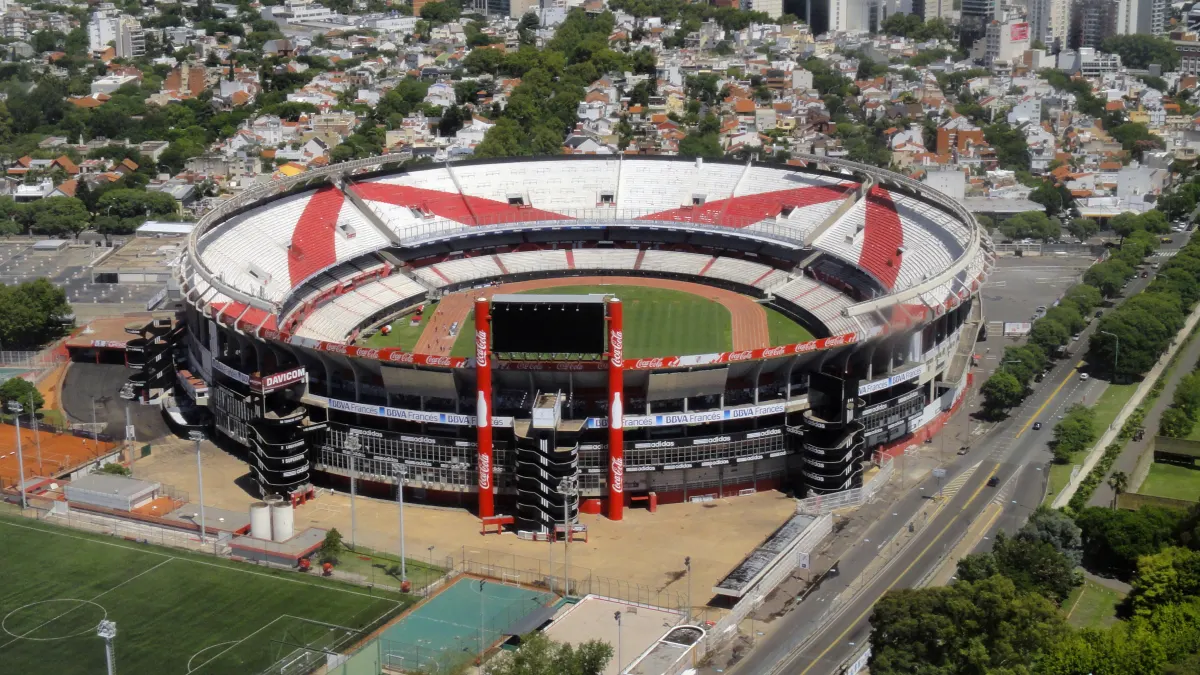
About Estadio Monumental
The full, formal name is a mouthful, and it keeps changing. The ground opened in 1938 as the Monumental, gained the name Antonio Vespucio Liberti in 1986 after the club president who willed it into being, and since 2022 has carried the commercial title Estadio Más Monumental. To everyone in Buenos Aires it is simply el Monumental.
It is the home of Club Atlético River Plate and, since 1942, the historic home of the Argentina national team. It sits in the Núñez area on Avenida Figueroa Alcorta, near the river, and it is owned and run by River Plate itself. The playing surface is natural grass, laid on a reinforced hybrid system, and the bowl is open to the sky. Only the San Martín stand carries a partial roof, added back in 1978.
With a capacity of about 85,018, it is comfortably the biggest stadium in the country. A remodel completed in 2023 removed the athletics track and lowered the pitch by roughly 1.8 metres, adding seating and, more importantly, closing the gap between the fans and the field. That work pushed it past Rio’s Maracanã to become the largest stadium in South America.
There is more to come. River have announced a separate, future project to add a second tier and roof the whole ground for the 2030 World Cup, a plan that would lift capacity toward 100,000. That build has not started yet, so the stadium you visit today is the roughly 85,000-seat version.
Getting to Estadio Monumental
The Monumental sits away from the subway network, so most visitors combine a train or bus with a short walk, or simply take a taxi.
Public Transit
There is no subway station at the stadium door, which surprises first-time visitors. Public transit gets you close, then you walk.
→ Via Subte (subway): Take Line D, the green line, to its terminus at Congreso de Tucumán, then walk the final stretch to the ground, roughly 15 to 20 minutes.
→ Via train: The Belgrano Norte line stops at Ciudad Universitaria and the Mitre line at Núñez, each a walk of several blocks toward the river.
→ Via colectivo (bus): Many bus lines pass near the stadium, including the 15, 29, 42 and 107. All public transit needs a rechargeable SUBE card.
Driving + Parking
Driving to a match is not recommended. Parking near the ground is limited and difficult on game days, and traffic in the surrounding streets is heavy for hours before and after kickoff.
→ From downtown: A drive of roughly 20 to 25 minutes in normal traffic, along Avenida del Libertador or the Costanera, though match-day congestion stretches that considerably.
→ Parking: Expect to park some distance away and walk. Most visitors find public transport or a rideshare simpler.
Rideshare
Uber, Cabify, InDriver and ordinary taxis all operate in Buenos Aires and all recognize the Estadio Monumental de River Plate. For visitors it is often the most comfortable option, dropping you close to the ground without the transit puzzle. Book early on match days, because roads around Núñez clog well before kickoff and drivers can be scarce afterward.
From the Airport
→ Aeroparque (AEP): Jorge Newbery airport is the closest, only a few kilometres along the river, roughly a 10 to 15 minute drive in light traffic.
→ Ezeiza (EZE): The main international airport, Ministro Pistarini, is about 35 kilometres south. Allow 45 minutes to well over an hour by car depending on traffic, especially on a match day.
Watching a Match at the Monumental
A game at the Monumental is regularly described as one of the most intense experiences in world football, and the intensity starts outside. The pre-match ritual is choripán and a beer at a street carrito in Núñez, elbow to elbow with River fans in red and white. Give yourself at least a couple of hours before kickoff, both to soak up that street atmosphere and because the stands fill fast.
Inside, the food is simple and the rules are firm. Vendors sell choripán, empanadas and snacks, but no alcohol is sold inside the stadium, and it is worth carrying cash because not every vendor takes cards. What you wear matters too: dress in River’s red, white and black, and never in Boca Juniors’ blue and yellow. Away supporters are effectively banned from Argentine league games, so for most matches there is no visiting end at all.
Where you sit shapes the day. The Sívori stand is the standing, singing core of the support, the loudest and most passionate section, though comfort is not the point there. The Centenario stand is calmer and more family-friendly. The seated San Martín and Belgrano stands offer the best views, and the lower Belgrano Baja seats are the ones tour operators most often sell to visitors. When the bowl is full it becomes a near-vertical wall of color, with drums and giant banderas going from the first minute, and the noise for a Superclásico against Boca is the stuff people travel across the world to hear.
Getting a ticket is the hard part. League tickets are largely reserved for club members, so most tourists go through a matchday-experience operator that bundles a seat, transport and a bilingual host. On a non-match day there is an easier way in: the River Plate museum and a stadium tour of about 45 minutes, walking you through the stands, the dressing room, the tunnel and out to the pitch. One last piece of local color that regulars pass on: fans do a particular wrist-flicking “agite” as they jump and sing, and newcomers are cheerfully coached on getting the motion right.
Construction & Design
The ground rose out of a riverside marsh. Before a single grandstand could go up, the soft banks of the Río de la Plata had to be stabilized with thousands of concrete pylons driven into the mud. Onto that reclaimed land the Argentine architects José Aslan and Héctor Ezcurra set their design, construction began in 1936, and the stadium was inaugurated on May 26, 1938, with River Plate playing Peñarol in the opening match.
It did not open finished. Money ran short, and the northern end was left incomplete for years, giving the stadium its distinctive open-horseshoe shape until the bowl was eventually closed. That unfinished-then-completed story is part of why the Monumental grew in stages across the twentieth century, expanding through the 1950s and adding the partial roof over the San Martín stand for the 1978 World Cup.
The most dramatic change is recent. Between 2019 and 2023, River rebuilt the lower reaches of the ground, removing the athletics track that had long kept spectators back from the pitch and lowering the playing surface by roughly 1.8 metres. New lower stands went in, capacity rose to about 85,018, and the Monumental overtook the Maracanã to become the largest stadium in South America. A further, separately announced project would add a second tier and a full roof to take it toward 100,000 seats for the 2030 World Cup, engineered with the German firm Schlaich Bergermann Partner, though that build lies in the future.
History of Estadio Monumental
Since it opened in 1938, the Monumental has been the home of River Plate and, for over eighty years, the fortress of the Argentina national team. Its history is measured in the biggest nights the Argentine game has produced.
The greatest of them came on June 25, 1978. With the country hosting the World Cup and the Monumental as its centerpiece, Argentina beat the Netherlands 3-1 after extra time to lift the trophy for the first time. The image of the stadium buried in ticker tape became one of the defining pictures of Argentine football.
The ground had already set its attendance mark three years earlier. On August 17, 1975, a crowd of about 100,000 crammed in to see River beat Racing 2-0 and win a league title after an 18-year drought, an outpouring that remains the stadium’s record. The Monumental has also hosted the Copa América, including the 1987 tournament, and a string of Copa Libertadores finals over the decades.
Beyond football, it has long been one of Buenos Aires’s great concert venues. The Rolling Stones played five sold-out nights here on the 1995 Voodoo Lounge Tour, and Madonna, Paul McCartney and others have filled the bowl since. Through all of it the name kept evolving, from plain Monumental to Antonio Vespucio Liberti in 1986 and to Más Monumental in 2022, but the place has only grown in stature. A stadium that opened unfinished on a riverside marsh is now the largest in South America, and it is about to get bigger still.
Sources & Further Reading
- Wikipedia, Estadio Monumental (Buenos Aires): en.wikipedia.org. Capacity, architects, opening date, ownership, surface and naming history.
- Wikipedia, 1978 FIFA World Cup Final: en.wikipedia.org. The June 25, 1978 final and the stadium’s tournament role.
- ESPN, River Plate’s Monumental expansion: espn.com. The announced future expansion toward 100,000 and its engineering.
- Football First, Estadio Monumental history: footballfirst.com. Construction story, architects and the open-horseshoe design.
- Vamos Spanish, guide to seeing River Plate live: vamospanish.com. Matchday food, stands, tickets and visitor advice.
Quick Facts
Everything you need at a glance.
Stadium specs
- Capacity
- 85,018
- Opened
- 1938
- Cost
- Not separately recorded
- Roof
- Open
- Surface
- Natural Grass
- Tenants
- River Plate, Argentina national team
Construction & location
- Groundbreaking
- 1936
- Architects
- José Aslan, Héctor Ezcurra
- Engineering
- Not separately recorded
- General contractor
- Not separately recorded
- Address
- Av. Figueroa Alcorta 7597, Núñez, Buenos Aires, Argentina
- GPS
- 34.5453°S, 58.4497°W
Photo Gallery
Fun Facts
The record crowd was about 100,000, packed in on August 17, 1975 to watch River Plate beat Racing 2-0 and clinch a first league title in 18 years.
A 2019 to 2023 remodel lowered the pitch by roughly 1.8 metres and removed the old athletics track, pulling fans closer to the field and making the Monumental the largest stadium in South America.
The Rolling Stones played five sold-out nights here on the 1995 Voodoo Lounge Tour, part of a long run of stadium concerts that also included Madonna and Paul McCartney.
Stadium Location
Frequently Asked Questions
- How can a tourist get tickets to a River Plate match at the Monumental?
- It is not straightforward. General league tickets are largely reserved for club members (socios), so most visitors go through a matchday-experience operator that bundles a seat, transport and a bilingual host. Buy well ahead for big games, and expect the Superclásico against Boca to sell out months in advance at premium prices.
- What is the best place to sit at Estadio Monumental?
- For atmosphere, the Sívori stand is the standing, singing heart of the crowd, though it is not for comfort. For the best combination of view and calm, the seated San Martín and Belgrano stands are what tour operators sell to visitors, with the lower Belgrano Baja seats a common tourist choice. The Centenario stand is the more family-friendly option.
- What food should I get at the Monumental?
- The signature matchday food is choripán, a grilled chorizo sausage in a roll, sold from street carts around the ground before kickoff. Inside, vendors sell choripán, empanadas and snacks. Note that no alcohol is sold inside the stadium, and it is worth bringing cash because card payment is not always accepted.
- Is it safe to go to a match at the Monumental as a tourist?
- Fans and guides describe the experience as intense but manageable with basic precautions: keep your belongings secure in the crowd, avoid large bags, and use public transport or a rideshare rather than driving. Wear River Plate colors of red, white and black, and do not wear Boca Juniors blue and yellow. Away fans are effectively banned from Argentine league games, so there is usually no visiting section.
- Can you tour Estadio Monumental on a non-match day?
- Yes. The River Plate museum traces the club from its 1901 origins, and a guided stadium tour of around 45 minutes takes in the stands, the dressing room, the players' tunnel and the pitch. Both run on non-match days and are a popular visit in their own right.
- What is the capacity of Estadio Monumental?
- About 85,018, which makes it the largest stadium in Argentina and, since a 2019 to 2023 remodel, the largest in South America. A separately announced future project would add a second tier and a roof to push capacity toward 100,000 for the 2030 World Cup, but that expansion has not yet been built.
- Why is it called the Más Monumental?
- The ground opened in 1938 simply as the Monumental, and in 1986 it was formally named the Estadio Monumental Antonio Vespucio Liberti after the club president who drove its construction. Since 2022 it has carried the commercial name Estadio Más Monumental under a naming-rights deal, though fans still call it the Monumental.
- When was the 1978 World Cup final played at the Monumental?
- On June 25, 1978. Argentina beat the Netherlands 3-1 after extra time to win their first World Cup, in front of a packed home crowd. The stadium had served as the tournament's centerpiece, hosting the opening match and several other games.
- How do you get to Estadio Monumental?
- There is no subway stop at the stadium. The usual routes are Subte Line D to Congreso de Tucumán followed by a walk, a suburban train to Núñez or Ciudad Universitaria, or one of many colectivo bus lines. All public transit needs a SUBE card. Rideshare and taxis know the ground, but book early on match days because traffic is heavy.
Last updated: 2026-07-17