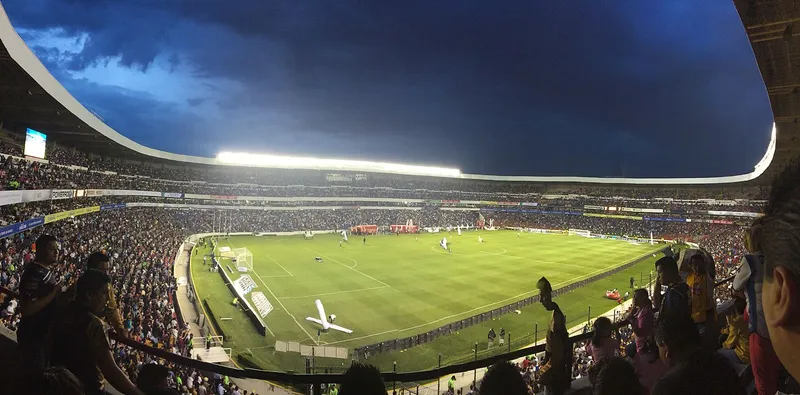
About Estadio Corregidora
In March 1983, crews broke ground on a rise at the southern edge of Querétaro, chasing a deadline that had little to do with local football. Mexico had inherited the 1986 World Cup after Colombia pulled out, and the country needed venues fast. Twenty-two months later, on February 5, 1985, President Miguel de la Madrid cut the ribbon on Estadio Corregidora, and the national team christened it by thumping Poland 5-0. Querétaro FC, the Gallos Blancos, moved in and has never left.
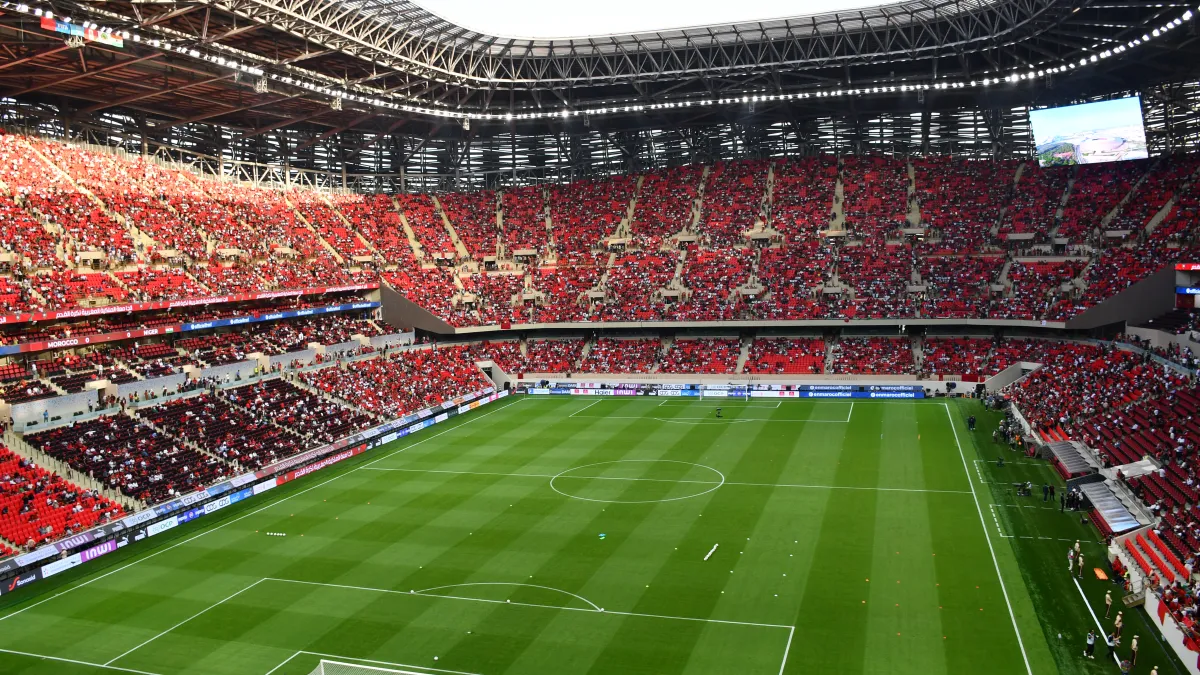
The bowl seats about 35,575, one of the ten largest football grounds in the country. That number comes with an asterisk. Most current sources cite 35,575 after later seating work, while older English-language references settle on 34,130, so the “true” capacity floats within a thousand or so depending on who you ask. What everyone agrees on is the shape: an oval, three fully enclosed tiers, wrapped tight enough that the noise has nowhere to go but back down onto the pitch.
The name carries weight. Josefa Ortiz de Domínguez, “La Corregidora,” was the magistrate’s wife who tipped off the conspirators and helped light the fuse of Mexico’s 1810 independence movement. Naming a colossus after her makes this one of the few major stadiums anywhere dedicated to a woman. Locals rarely use the full title anyway. To them it is the Corregidora, or “El Coloso del Cimatario,” the Colossus of the Cimatario, after the hill that rises just beyond the stands.
Geography does the rest of the work. The stadium sits roughly 211 km (131 miles) north of Mexico City, in a metropolitan area that has swelled past 1.3 million as manufacturing and aerospace money poured into the Bajío. The natural grass pitch runs 105 by 70 meters (344 by 230 feet). The concrete design, oval and steep, was drawn for sightlines first, and even from the top tier the field feels close.
Querétaro FC has never won a Liga MX championship, and for most of its history the club won nothing at all. The exception came in 2016, when the Gallos took the Copa MX at home on penalties. Before that, the closest brush with glory was the Clausura 2015 final, lost to Santos Laguna even with Ronaldinho pulling strings in midfield. The fan base stuck around through all of it, and on a good night the white shirts still fill the place.
The darkest chapter arrived on March 5, 2022. During a match against Atlas, fans broke through security and onto the pitch around the hour mark, and what followed was a brawl that spilled across the stands and the field on live television. The game was suspended. Authorities counted 26 people injured, three of them seriously, and held firmly to the position that no one was killed, walking back the early rumors of deaths. Liga MX shut the stadium to fans for a full year and handed down heavy sanctions to the club’s leadership. The Corregidora welcomed crowds back in 2023, and the tragedy reshaped how Mexican football thinks about crowd safety.
Getting to Estadio Corregidora
Public Transit
Querétaro runs a bus network, but there is no metro and no rail. The stadium sits on the city’s southern edge, which keeps direct transit options thin. Plan for a bus plus a short hop, or skip straight to a rideshare.
→ Via City Bus: Several routes run along Avenida Luis Vega Monroy and the nearby boulevards. Ask for “Estadio Corregidora.” Drivers know the stop.
→ Via Intercity Bus: First-class buses from Mexico City’s Terminal Norte reach Querétaro’s TAQ terminal in about 2.5 hours. From TAQ, a taxi or rideshare covers the last stretch to the stadium in roughly 15 minutes (80-120 MXN).
Rideshare is the most practical option on match days. Uber and DiDi both operate across the city.
Driving + Parking
The stadium address is Avenida Luis Vega Monroy 409-4, Santiago de Querétaro. Highway 57D is the main artery in and out.
→ From Mexico City (~211 km): Highway 57D (Autopista México-Querétaro) north. About 2 hours 30 minutes.
→ From Guadalajara (~350 km): Highway 45D east to Highway 57D south. About 3 hours 30 minutes.
→ From San Luis Potosí (~200 km): Highway 57D south. About 2 hours 15 minutes.
Parking sits in lots around the ground and on the surrounding streets. Arrive at least an hour early. Spaces go fast on match days, and traffic near the stadium bunches up in the last half hour before kickoff.
Rideshare
Uber and DiDi both run in Querétaro. From downtown (Centro Histórico), budget 80-150 MXN ($4-$8 USD) and about 15 minutes. From the TAQ bus terminal, 80-120 MXN. After the final whistle, walk a few blocks away from the gates before requesting a car. It clears the congestion and usually cuts the wait.
From the Airport
→ Querétaro International Airport (QRO): About 30 km (19 miles) northeast, roughly 30 minutes by car. Rideshare runs 200-300 MXN ($10-$15 USD).
→ Mexico City International (MEX): About 240 km (149 miles) southeast. Drive via Highway 57D (around 3 hours) or take a first-class bus into Querétaro and grab a car from TAQ.
Construction & Design
The push for a big stadium in Querétaro started with a competition, not a football club. Governor Rafael Camacho Guzmán wanted a venue worthy of the 1986 World Cup, and the winning design came from a local architect, Luis Alfonso Fernández Siurob. His plan beat the field, and ground was formally broken on March 17, 1983. Work wrapped by December 31, 1984, which left just enough runway to open in February and stress-test the place before the world arrived.
What went up was an oval of three fully enclosed tiers, laid out for a footprint of some 261,174 square meters. The original design seated around 32,000. A later section pushed that higher, which is where the 34,130 and 35,575 figures both come from, depending on the source and the year of the count. The pitch measures 105 by 70 meters (344 by 230 feet), and the natural grass has been the surface from day one.
Ownership sits with the state, not the club. The Gobierno del Estado de Querétaro built the Corregidora and still holds it, with Querétaro FC operating out of it rather than owning the bricks. That arrangement is common in Mexico, where municipal and state governments financed much of the 1986 World Cup building boom. The exact construction cost was never made public in a way that survives in the record, so the price tag stays a blank, and inventing one would be worse than admitting the gap.
The building has been touched up more than once. Ahead of the 2011 FIFA U-17 World Cup, the venue got upgraded lighting and technology work to meet the tournament’s broadcast standards. The most consequential changes, though, were not architectural at all. After the 2022 tragedy, the club and league layered in a fan-registration program and visiting-supporter restrictions that changed the experience of walking through the gates. The concrete is the same. The rules around it are not.
One detail that never changed is the setting. The stands press up against the slope of the Cerro del Cimatario, and the nickname wrote itself. From the upper tier the hill fills the horizon behind one goal, a reminder that this colossus was dropped onto a landscape that was there long before the football.
History of Estadio Corregidora
Mexico did not plan to host the 1986 World Cup. Colombia was awarded the tournament and then withdrew in 1982 over cost, and FIFA turned to a country that had run the 1970 edition smoothly. That decision sent construction crews to cities like Querétaro, and the Corregidora is what they left behind.
Opening (February 5, 1985): President Miguel de la Madrid inaugurated the stadium, and Mexico beat Poland 5-0 in the first match played on the new grass. Querétaro FC took up residence as the anchor tenant, a role it has held ever since, sharing the ground over the years with clubs like Cobras, Atlante, Tampico Madero, and briefly Pumas.
1986 FIFA World Cup (June 1986): The Corregidora hosted four matches. Uruguay drew West Germany 1-1, West Germany edged Scotland 2-1, and then came the night that defined the venue: Denmark’s 2-0 win over West Germany on June 13 in front of 36,000, the high point of the “Danish Dynamite” side that tore through Group E. The stadium closed out its tournament with a Round of 16 tie, Denmark 1-5 Spain, watched by 38,500.
Clausura 2015 final: Querétaro reached its first Liga MX final with a squad built around Ronaldinho. Santos Laguna won it on aggregate, and the Gallos fell one step short, but the run put the club and the stadium on the national map like never before.
2016 Copa MX title: On November 2, 2016, Querétaro beat Chivas 3-2 on penalties after a scoreless final at the Corregidora, ending a long trophy drought. It is still the only major title in the club’s history, and it happened at home.
March 5, 2022 tragedy: Late in a match against Atlas, fans broke onto the pitch and the afternoon collapsed into a brawl across the stands and the field. Authorities reported 26 injured, three seriously, and maintained that no one died. Liga MX barred fans from the stadium for a year, fined the club, suspended its directors for five years, and pushed the franchise back toward a forced sale. The images went around the world and forced a reckoning across Mexican football.
2023 reopening: After the one-year ban, crowds returned in 2023 under tighter security and new fan-registration rules. The stadium that had become shorthand for a national failure went back to being what it had always been, the home of the Gallos Blancos.
From a World Cup deadline in 1983 to a title in 2016 and a tragedy in 2022, the Corregidora has held four decades of Querétaro’s football memory, good and bad, at the foot of the Cimatario.
Sources & Further Reading
- Estadio Corregidora overview: en.wikipedia.org. Capacity, opening details, architect, and the full list of 1986 World Cup matches and results.
- Construction and 40th-anniversary history: nmas.com.mx. Timeline of the 1983-1985 build, the design competition, and the February 1985 inauguration.
- The 2022 tragedy and its aftermath: espn.com.mx. How the March 5, 2022 violence unfolded and how it changed Mexican football.
- Sanctions after the riot: milenio.com. The one-year fan ban, fines, director suspensions, and ownership consequences imposed on Querétaro FC.
Quick Facts
Everything you need at a glance.
Stadium specs
- Capacity
- 35,575
- Opened
- 1985
- Cost
- Not publicly documented
- Roof
- Open
- Surface
- Natural Grass
- Tenants
- Querétaro FC (Liga MX)
Location
- Address
- Avenida Luis Vega Monroy 409-4, Santiago de Querétaro, Querétaro, Mexico
- GPS
- 20.5778°N, 100.3664°W
Photo Gallery
Fun Facts
The stadium's signature night came on June 13, 1986, when Denmark beat West Germany 2-0 in front of 36,000 fans, the peak of the 'Danish Dynamite' run through the group stage.
Named after Josefa Ortiz de Domínguez, known as 'La Corregidora,' the independence heroine who helped set Mexico's 1810 revolution in motion, one of the few major stadiums anywhere named for a woman.
Querétaro FC's only major trophy came here: the 2016 Copa MX, won on penalties against Chivas after a scoreless final, ending decades without silverware.
Stadium Location
Frequently Asked Questions
- What is the seating capacity of Estadio Corregidora?
- Estadio Corregidora holds about 35,575 for Liga MX matches, the figure now most commonly cited after later seating work. Older English-language references list 34,130, so published capacities vary by a little over a thousand. Either way it ranks among the ten largest football stadiums in Mexico.
- Where is Estadio Corregidora located?
- The stadium sits at Avenida Luis Vega Monroy 409-4 on the southern edge of Santiago de Querétaro, roughly 211 km (131 miles) north of Mexico City. It stands near the Cerro del Cimatario, which earned it the nickname 'El Coloso del Cimatario,' the Colossus of the Cimatario.
- How do I get to Estadio Corregidora from Mexico City?
- Drive north via Highway 57D (Autopista México-Querétaro), about 211 km and 2.5 hours. You can also take a first-class bus from Terminal Norte to Querétaro's central bus station (TAQ), then a taxi or rideshare to the stadium, roughly 15 minutes.
- Was Estadio Corregidora a World Cup venue?
- Yes. The stadium was built for the 1986 FIFA World Cup and hosted four matches: three Group E games (Uruguay 1-1 West Germany, West Germany 2-1 Scotland, and Denmark 2-0 West Germany) plus a Round of 16 tie, Denmark 1-5 Spain. It later hosted matches at the 2011 FIFA U-17 World Cup.
- What happened at Estadio Corregidora on March 5, 2022?
- During a Liga MX match between Querétaro and Atlas, spectators breached security and invaded the pitch around the hour mark, and the violence between rival fans grew into a brawl. The match was suspended. State authorities reported 26 people injured, three of them seriously, and consistently stated that no one died, despite early unverified reports to the contrary. Liga MX banned fans from the stadium for one year and sanctioned the club's directors.
- Has Querétaro FC won any titles at Estadio Corregidora?
- One. Querétaro FC won the 2016 Copa MX at home, beating Chivas 3-2 on penalties after a 0-0 final on November 2, 2016. It remains the club's only major trophy. Querétaro also reached the Liga MX Clausura 2015 final, with Ronaldinho in the squad, but lost to Santos Laguna on aggregate.
- Is there parking at Estadio Corregidora?
- Yes. The stadium has lots around the venue, and street parking is available in the surrounding neighborhoods. Spaces fill quickly on match days, so arrive early. Rideshare through Uber or DiDi is a practical alternative.
- How far is Estadio Corregidora from the airport?
- Querétaro International Airport (QRO) is about 30 km (19 miles) from the stadium, roughly a 30-minute drive. Mexico City International Airport (MEX) is around 240 km (149 miles) away, close to three hours by car.
- Who built Estadio Corregidora and when?
- Construction ran from March 1983 to the end of 1984 under a design by queretano architect Luis Alfonso Fernández Siurob, whose plan won a competition convened by the state government. President Miguel de la Madrid inaugurated the stadium on February 5, 1985, and Mexico beat Poland 5-0 in the first match. The venue is owned by the Querétaro state government.
Last updated: 2026-07-10