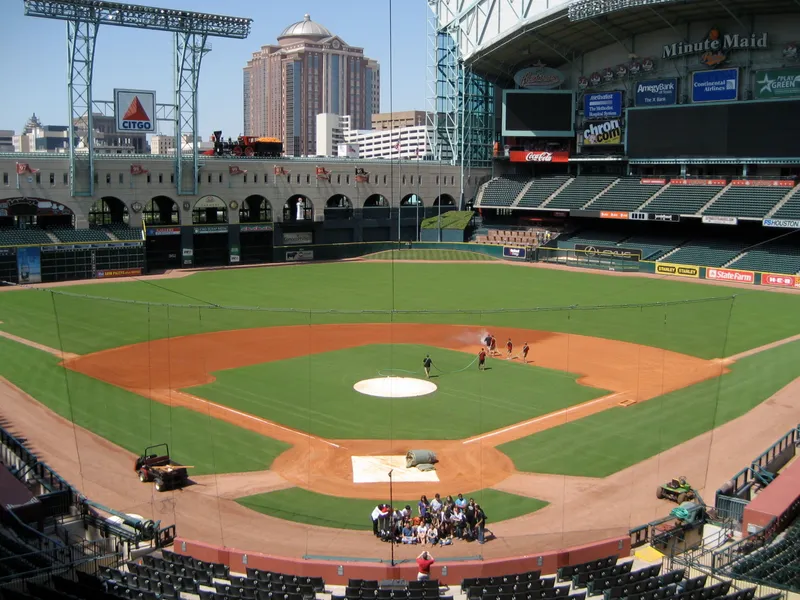
About Daikin Park
The Houston Astros spent 35 seasons under the Astrodome’s roof before they moved downtown in 2000, trading the Eighth Wonder of the World for a ballpark that has since worn four different names. Enron Field, then Astros Field, then Minute Maid Park, and, since January 2025, Daikin Park. The building has changed less than its signage. It remains a 41,168-seat ballpark on the eastern edge of downtown Houston, home of the Astros, with a retractable roof, a converted 1911 train station for a front door, and a left-field wall close enough to make sluggers grin.
The roof is the whole reason the park exists in its current form. Houston summers are punishing, with heat and humidity that make open-air afternoon baseball an endurance test, so the Astros built the first covered natural-grass ballpark the city had ever had. The roof stays closed for most games from June through September, keeping the interior air-conditioned while translucent panels let real grass grow underneath. When the weather cooperates, usually in April or on cool autumn nights, it slides open to frame the downtown skyline.
Then there are the Crawford Boxes. The left-field seats sit just 315 feet (96 m) from home plate, a notoriously short porch named for Crawford Street behind the wall, and they have shaped the ballpark’s offensive character since opening day. Routine fly balls become souvenirs. The other signature is the Union Station entrance, where the restored 1911 terminal’s marble concourse serves as the main lobby, making this one of the few ballparks in America built around a working piece of historic architecture.
The naming saga reads like a corporate morality play, but the baseball underneath it has been the best in franchise history. Two World Series titles, in 2017 and 2022, plus five pennants in eight years. The record crowd, 44,203, packed in on September 26, 2001. Through every logo swap on the outfield wall, the team on the field kept getting better.
Getting to Daikin Park
Public Transit
Daikin Park is served by METRORail, Houston’s light rail system. The Convention District station is a 10-minute walk from the ballpark.
→ Via METRORail Red Line: Convention District station is the closest stop, about a 10-minute walk east on Texas Avenue to the ballpark. From the Texas Medical Center, the ride takes about 20 minutes. Fare is $1.25 with a METRO Q Card.
→ Via Bus: Several METRO bus routes serve downtown Houston stops within walking distance, including routes 40, 41, and 44 along major downtown corridors.
Houston is a car city, and most fans drive to games. METRORail works if you are staying along the Red Line corridor, but the walk from Convention District station is not short. Plan accordingly, especially in the summer heat.
Driving + Parking
The ballpark address is 501 Crawford Street, Houston, TX 77002. I-69/US-59 and I-45 are the primary approaches.
→ From the Galleria/West Houston (~10 mi): I-69/US-59 South to the Crawford Street exit. About 20 to 30 minutes depending on traffic.
→ From Sugar Land (~25 mi): US-59 North to downtown Houston. About 30 to 40 minutes.
→ From The Woodlands (~30 mi): I-45 South to downtown. About 35 to 45 minutes.
Downtown garages and surface lots cost $20 to $40 on game days. Official Astros lots on Texas Avenue and La Branch Street are closest. Metered street parking fills early. This is Houston, so most people drive, and parking is a planned expense.
Rideshare
Uber and Lyft have designated zones on Texas Avenue near the Union Station entrance. From Midtown Houston, expect $8 to $12. From the Galleria, $15 to $22. Post-game surge is moderate. Walk a few blocks toward Discovery Green for a faster pickup.
From the Airport
→ George Bush Intercontinental (IAH): 23 miles north, about 30 to 40 minutes by car. Major United Airlines hub with extensive domestic and international service. No practical transit connection to the ballpark. Rideshare runs $30 to $45.
→ William P. Hobby Airport (HOU): 12 miles south, about 20 minutes by car. Hub for Southwest Airlines. Rideshare runs $18 to $25. The more convenient airport for game-day visitors.
History of Daikin Park
By the late 1990s the Astrodome had run out of road. The domed stadium that opened in 1965 and earned the “Eighth Wonder of the World” nickname could no longer sustain modern baseball economics, so Houston voters and Harris County backed a new downtown ballpark. Ground broke on November 1, 1997, on a site anchored by the century-old Union Station terminal, and the park opened for regular-season play on April 7, 2000.
The debut did not go to plan. Philadelphia spoiled the party, beating the Astros 4-1 in the first regular-season game at Enron Field, with Randy Wolf out-pitching Octavio Dotel. The name came from Enron, the Houston energy giant that had paid a reported $100 million for 30 years of naming rights. That deal would become one of the shortest-lived in sports.
Enron collapses (2001 to 2002). When Enron’s accounting fraud unraveled and the company filed for bankruptcy, the Astros scrambled to strip the tainted name off their ballpark. The club bought back the rights for roughly $2.1 million, briefly branded the place Astros Field, and then sold naming rights to Coca-Cola’s Minute Maid brand in mid-2002, a 28-year deal reported at more than $100 million (around $170 million counting pouring rights and the wider sponsorship package). The name stuck for 22 of those years, until Daikin took over early.
Two moments early on framed the park’s reputation. In October 2005, the Astros reached the first World Series in franchise history and hosted Games 3 and 4, the only World Series games played in Houston to that point. Game 3 ran 14 innings and stands as the longest World Series game ever played. The White Sox swept the series anyway.
Then came the golden era. In 2017 the Astros beat the Los Angeles Dodgers in seven games for Houston’s first championship, a title later shadowed by the sign-stealing scandal that drew suspensions and years of scrutiny, though the celebration inside the ballpark was real. Two more pennants followed. The 2019 team lost a seven-game Series to the Washington Nationals, who won all four games in Houston, an oddity in a Series where the road team took every game. In 2021 the Braves closed out the title on Houston’s field. Redemption arrived in November 2022, when the Astros beat the Philadelphia Phillies four games to two, clinching the second championship at home in Game 6.
The ballpark’s non-baseball résumé is thinner but real. Mike Fiers threw the park’s first no-hitter on August 21, 2015, a 3-0 win over the Dodgers. WWE brought the Royal Rumble here on January 26, 2020. And on January 1, 2025, the marquee changed one more time, to Daikin Park, under a 15-year deal reported to run through 2039.
From Union Station’s marble lobby to the Crawford Boxes to two championship trophies, this is the home of a franchise that has weathered scandal and found redemption. The name on the wall keeps changing. The baseball keeps getting better.
Construction & Design
The design problem was straightforward and unforgiving: build a ballpark where people would actually want to sit through a July afternoon in Houston. HOK Sport, the Kansas City firm now known as Populous, took the commission with Molina & Associates as associate architect, Walter P. Moore as structural engineer, and a joint venture of Brown & Root, Barton Malow, and Empire handling the build. The Harris County-Houston Sports Authority owns the finished ballpark, which cost about $248 million, or roughly $465 million in today’s dollars.
The answer was a retractable roof. Three steel panels ride on rails above the seating bowl and can be drawn open or shut in roughly 12 to 20 minutes, backed by a glass wall of about 50,000 square feet behind left field that keeps the downtown skyline in view even when the roof is closed. The translucent construction was deliberate. It lets natural grass grow indoors, so the field stays real even during the months when the roof rarely opens. The playing surface today is Platinum TE Paspalum, a heat-tolerant grass suited to the closed-roof climate.
The design’s boldest move was folding a landmark into the ballpark. Rather than demolish the 1911 Union Station terminal, the architects preserved its main concourse and made it the park’s grand entrance, so fans walk through a restored railroad hall on their way to left field. The original quirks did not all survive. Tal’s Hill, the sloped center-field incline with a flagpole in play, was pulled out after the 2016 season, leaving the current outfield dimensions of 315 feet down the left-field line, 409 to center, and 326 to right. Left field stayed short. Center field got a little saner.
The signage has proven less permanent than the concrete. Enron’s 30-year, $100 million naming deal died with the company in 2002; Minute Maid’s 28-year deal, reported at more than $100 million, then held the rights for over two decades; and on January 1, 2025, Daikin, a Japanese air-conditioning conglomerate that owns Houston-area manufacturer Goodman Global, took over under a 15-year agreement reported to run through 2039 and valued at up to $140 million. For a ballpark whose defining feature is climate control, an air-conditioning company on the marquee is a fitting last twist.
Sources & Further Reading
- Daikin Park on Wikipedia: en.wikipedia.org. Naming history, capacity, construction team, and World Series results.
- Ballparks of Baseball, Daikin Park: ballparksofbaseball.com. Field dimensions, roof mechanics, and ballpark background.
- Houston Astros official ballpark page: mlb.com. Tickets, tours, parking, and event-day information.
- Harris County-Houston Sports Authority: houstonsports.org. The public agency that owns and finances the ballpark.
Quick Facts
Everything you need at a glance.
Stadium specs
- Capacity
- 41,168
- Opened
- 2000
- Cost
- $248 million (~$465 million today)
- Roof
- Retractable
- Surface
- Natural Grass (Platinum TE Paspalum)
- Tenants
- Houston Astros (MLB)
Construction & location
- Groundbreaking
- November 1, 1997
- Architects
- HOK Sport (now Populous), Molina & Associates
- Engineering
- Walter P. Moore
- General contractor
- Brown & Root / Barton Malow / Empire Joint Venture
- Address
- 501 Crawford Street, Houston, TX 77002, USA
- GPS
- 29.7573°N, 95.3555°W
Photo Gallery
Fun Facts
The Crawford Boxes in left field sit just 315 feet (96 m) from home plate, a notoriously short porch that turns catchable fly balls into home runs and ranks among the coziest targets in the majors.
The ballpark's main entrance is the restored 1911 Union Station train terminal, whose original marble concourse now funnels fans toward left field, making Daikin Park one of the few ballparks built around a working piece of historic architecture.
The ballpark has carried four names in 25 years: Enron Field (2000 to 2002), a brief run as Astros Field in 2002, Minute Maid Park (2002 to 2024), and Daikin Park from January 2025, with the Enron name dropped after the energy company's 2001 bankruptcy and fraud scandal.
Stadium Location
Frequently Asked Questions
- What is the seating capacity of Daikin Park?
- Daikin Park seats 41,168 for Astros games, a number that includes 5,197 club seats and 63 luxury suites. The retractable roof lets the park stay air-conditioned during Houston's brutal summers while still growing natural grass under translucent panels.
- Where is Daikin Park located?
- Daikin Park is at 501 Crawford Street in Houston, Texas 77002, on the eastern edge of downtown. It sits next to the George R. Brown Convention Center, about a mile east of the Main Street theater district.
- How do I get to Daikin Park by public transit?
- METRORail's Red Line stops at Convention District station, about a 10-minute walk from the ballpark. From the Texas Medical Center, the ride takes roughly 20 minutes. Several METRO bus routes also serve downtown stops within walking distance.
- Is there parking at Daikin Park?
- Surrounding downtown garages and surface lots cost $20 to $40 on game days. The Astros operate official lots on Texas Avenue and La Branch Street. Metered street parking fills early. Most fans drive, since Houston is a car city and transit use for games runs low.
- What are the Crawford Boxes?
- The Crawford Boxes are the left-field seating sections just 315 feet (96 m) from home plate, one of the shortest left-field porches in the majors. Named for Crawford Street behind the wall, they turn routine fly balls into home runs and rank among the most sought-after seats in the ballpark.
- Does Daikin Park have a retractable roof?
- Yes. The roof is built from three moving panels and takes roughly 12 to 20 minutes to open or close, paired with a glass wall of about 50,000 square feet behind left field. It stays closed for most games between June and September to beat the heat and humidity, and opens to reveal the downtown skyline on cooler nights.
- Why has the stadium changed names?
- The park opened as Enron Field in 2000 under a reported $100 million, 30-year deal. After Enron's 2001 fraud scandal and bankruptcy, the Astros bought back the rights for about $2.1 million and briefly called it Astros Field before Minute Maid took over in mid-2002. Daikin, a Japanese air-conditioning maker, secured naming rights beginning January 1, 2025.
- Who designed and built Daikin Park?
- The ballpark was designed by HOK Sport, now Populous, with Molina & Associates as associate architect. Walter P. Moore served as structural engineer, and a Brown & Root, Barton Malow, and Empire joint venture handled construction. It opened in 2000 at a cost of about $248 million and is owned by the Harris County-Houston Sports Authority.
- Has Daikin Park hosted a World Series?
- Yes, several times. The Astros won the World Series here in 2017 against the Los Angeles Dodgers and again in 2022 against the Philadelphia Phillies. They also reached the Series in 2005 (lost to the White Sox), 2019 (lost to the Nationals), and 2021 (lost to the Braves).
- How far is the airport from Daikin Park?
- George Bush Intercontinental Airport (IAH) is 23 miles north, about 30 to 40 minutes by car. William P. Hobby Airport (HOU) is 12 miles south, about 20 minutes. Hobby is the more convenient option for domestic Southwest flights. Rideshare from IAH runs $30 to $45; from HOU, $18 to $25.
Last updated: 2026-07-10