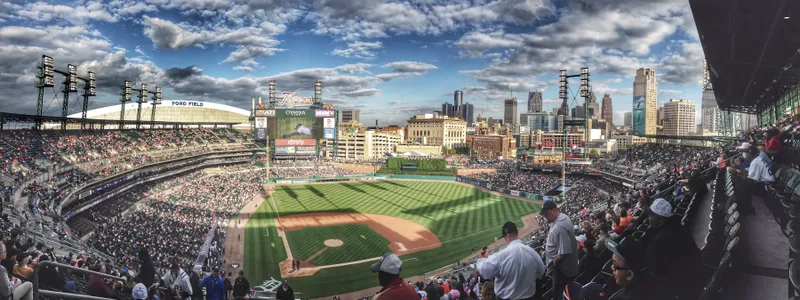
About Comerica Park
On Woodward Avenue in downtown Detroit, a ballpark guarded by tiger statues doubles as an amusement park. Comerica Park seats 41,083, and behind its outfield sit a hand-painted carousel and a Ferris wheel with baseball-shaped cars. Nine tigers stand watch. It may be the most family-friendly venue in Major League Baseball.
The Tigers moved here in 2000 after 88 years at Tiger Stadium, on the corner of Michigan and Trumbull, one of the most storied addresses in baseball. Eighty-eight seasons on one corner, then gone. Built for $300 million and designed by HOK Sport, now Populous, the park anchored Detroit’s downtown revival beside Ford Field across Woodward Avenue, in what became The District Detroit. The move was bitter, and Tiger Stadium’s faithful never fully forgave it, but the new ballpark pulled the Tigers into the modern era.
The park’s defining feature is its tiger theme. A 15-foot tiger stands at the main entrance on Woodward Avenue. Two tigers prowl atop the left-field scoreboard, their eyes lighting up and a growl playing after every Tigers home run or victory. Nine tiger statues total are scattered throughout the venue. Beyond the tigers, a hand-painted carousel with 30 rideable tiger figures and a 50-foot Ferris wheel with baseball-shaped cars sit behind section 131, giving Comerica Park a carnival atmosphere that no other ballpark in the majors can match.
The outfield opens onto the Detroit skyline, glass towers rising behind the scoreboard, a reminder that this ballpark is also a civic anchor for a city that has fought its way back.
Getting to Comerica Park
Public Transit
Comerica Park is one of the best-connected ballparks in the American League, with streetcar, people mover, and bus service.
→ Via QLINE Streetcar: The Montcalm stop on Woodward Avenue is directly at the main entrance. The QLINE is free and runs a 6.6-mile loop along Woodward from New Center to downtown.
→ Via Detroit People Mover: Grand Circus Park station is a 5-minute walk south. The People Mover runs a continuous elevated loop through downtown for $0.75.
The QLINE is the easiest option, it drops you at the front door. If you’re staying downtown, Comerica Park is walkable from most hotels in under 15 minutes.
Driving + Parking
The ballpark address is 2100 Woodward Avenue, Detroit, MI 48201. I-75 and M-10 (Lodge Freeway) are the primary approaches.
→ From Ann Arbor (~43 mi): I-94 East to M-10 (Lodge Freeway) North. About 1 hour.
→ From Toledo (~60 mi): I-75 North to downtown Detroit. About 1 hour.
→ From Lansing (~87 mi): I-96 East to M-10. About 1 hour 30 minutes.
Olympia Development operates about 4,500 spaces within The District Detroit, ranging from $5 to $25. The budget option is the $5 lot at Grand River and West Elizabeth (five blocks away). Greektown Casino Hotel offers free parking with casino validation, a well-known local hack.
Rideshare
Uber and Lyft have a designated zone north of the I-75 service drive between John R Street and Brush Street. From downtown Detroit hotels, expect $5–$8. From DTW airport, about $50. Post-game surge is moderate, walk a few blocks toward Greektown for a faster pickup.
From the Airport
→ Detroit Metropolitan Wayne County Airport (DTW): 21 miles southwest, about 29 minutes by car. Major Delta Air Lines hub with extensive domestic and international service. No direct transit connection to the ballpark. Rideshare runs about $50. Rental car is convenient if you’re exploring metro Detroit.
Construction & Design
Tiger Stadium was a cathedral, and Comerica Park was never going to be one. The Tigers had spent 88 years at Michigan and Trumbull in a double-decked box where the upper deck hung right over the field, and when they left it in 1999 the fan base split down the middle. The replacement went up two miles east, on Woodward Avenue, as part of a bet that a new ballpark and a new football stadium could pull downtown Detroit back to life. Ground broke on October 29, 1997.
HOK Sport, now Populous, designed it with the Detroit firm SmithGroup, and it opened in April 2000 at a cost of $300 million. The Tigers and the Ilitch family, who own the team, went the other way from Tiger Stadium’s tight geometry: a wide-open bowl with the downtown skyline framed beyond center field and, at first, an outfield so deep that hitters nicknamed it Comerica National Park. The left-center fence was hauled in before the 2003 season, and adjusted again in 2023.
Then there is the carnival. A Ferris wheel with baseball-shaped cars, a hand-carved tiger carousel, and nine tiger statues whose eyes glow after home runs, features borrowed more from a theme park than a ballpark. It is unabashedly themed, unapologetically for families, and nothing like the reverent old barn it replaced. Whether that is a gain or a loss depends on which Detroit fan you ask.
History of Comerica Park
Comerica Park was built to replace Tiger Stadium, one of baseball’s most historic venues, where the Tigers had played since 1912 on the corner of Michigan and Trumbull. The $300 million project, designed by HOK Sport, broke ground on October 29, 1997 and was part of a deliberate effort to anchor downtown Detroit’s revival around sports and entertainment.
First Game (April 11, 2000): The Tigers defeated the Seattle Mariners 5-2 before 39,168 fans on a cold, snowy Detroit afternoon. The new ballpark divided the fan base, many mourned the loss of Tiger Stadium’s intimate charm, but Comerica Park’s downtown location and modern amenities won converts over time.
2005 MLB All-Star Game (July 12, 2005): The American League defeated the National League 7-5 before 41,617 fans. The game brought national attention to the new ballpark and showcased Detroit’s downtown renaissance.
2006 World Series (October 2006): The Tigers reached the World Series for the first time since 1984 but fell to the St. Louis Cardinals in five games. Comerica Park hosted its first Fall Classic, Games 1 and 2, and the atmosphere was electric even in defeat.
2012 World Series (October 2012): The Tigers returned to the World Series but were swept by the San Francisco Giants. Miguel Cabrera had won the Triple Crown that season, the first in 45 years, but the Giants’ pitching was too much.
A Pitcher’s Park by Accident: When Comerica Park opened, its outfield was so cavernous, 420 feet to dead center and a left-center gap that seemed to swallow fly balls, that hitters nicknamed it “Comerica National Park.” The Tigers pulled the left-center fence in before the 2003 season and adjusted it again in 2023, but the place has never fully lost its reputation as kinder to pitchers than to sluggers. It has hosted real pitching history: Justin Verlander no-hit the Brewers here in June 2007, and a combined Tigers no-hitter followed in July 2023. Add the Ferris wheel, the carousel, and the nine glowing-eyed tigers, and Comerica manages to be both a serious ballpark and the most amusement-park-like venue in the majors.
From Tiger Stadium’s ghost to the roaring tigers on the scoreboard to a Ferris wheel spinning behind the outfield, Comerica Park is where Detroit baseball lives, a ballpark that traded history for modernity and built its own identity inside a city that refuses to quit.
Sources & Further Reading
- Ballparks of Baseball, Comerica Park: ballparksofbaseball.com. Capacity, cost, dimensions, and design.
- Detroit Historical Society, Comerica Park: detroithistorical.org. Cost, opening day, and the Tiger Stadium succession.
- Wikipedia, Comerica Park: en.wikipedia.org/wiki/Comerica_Park. Design team, features, and World Series history.
Quick Facts
Everything you need at a glance.
Stadium specs
- Capacity
- 41,083
- Opened
- 2000
- Cost
- $300 million (2000) (~$560 million (2025 dollars) today)
- Roof
- Open
- Surface
- Natural Grass (Kentucky Bluegrass)
- Tenants
- Detroit Tigers (MLB)
Construction & location
- Groundbreaking
- October 29, 1997
- Architects
- HOK Sport (now Populous), SmithGroup (SHG)
- Address
- 2100 Woodward Avenue, Detroit, MI 48201, USA
- GPS
- 42.3389°N, 83.0485°W
Photo Gallery
Fun Facts
Comerica Park features 9 tiger statues throughout the venue, including a 15-foot-tall tiger at the main entrance, and the eyes of the two tigers atop the left-field scoreboard light up and a growling sound plays after every Tigers home run or victory.
The ballpark has a hand-painted carousel with 30 rideable tiger figures and a 50-foot Ferris wheel with 12 baseball-shaped cars, making it one of the most kid-friendly stadiums in Major League Baseball, with rides costing just $2 each.
Comerica Park's video board, installed for the 2024 season, measures 15,688 square feet, among the largest in all of Major League Baseball, dominating the outfield view from nearly every seat in the house.
Stadium Location
Frequently Asked Questions
- What is the seating capacity of Comerica Park?
- Comerica Park seats 41,083 for MLB games. The park opened in 2000 as the replacement for historic Tiger Stadium and was designed by HOK Sport (now Populous) at a cost of $300 million.
- Where is Comerica Park located?
- Comerica Park is at 2100 Woodward Avenue in Detroit, Michigan 48201. It sits in The District Detroit, the city's sports and entertainment hub, directly across Woodward Avenue from Ford Field (home of the Detroit Lions).
- How do I get to Comerica Park by public transit?
- The QLINE streetcar stops at the Montcalm station right at the main entrance, a free ride along Woodward Avenue. The Detroit People Mover's Grand Circus Park station is a 5-minute walk. DDOT bus Route 4 (Woodward) also stops directly in front of the park.
- Is there parking at Comerica Park?
- Olympia Development operates about 4,500 spaces within The District Detroit, ranging from $5 to $25 depending on proximity. The budget option is the $5 lot at Grand River Avenue and West Elizabeth Street. Greektown Casino Hotel offers free parking with casino validation.
- Is Comerica Park kid-friendly?
- Very. The park features a hand-painted tiger carousel ($2/ride, free for kids on Sundays), a 50-foot Ferris wheel with baseball-shaped cars ($2/ride), and a kids' run-the-bases program after every Sunday home game for children ages 4–14.
- What replaced Tiger Stadium?
- Comerica Park replaced Tiger Stadium in 2000. The Tigers played their final game at Tiger Stadium on September 27, 1999, and Comerica Park opened on April 11, 2000. Tiger Stadium was demolished in 2009 after a decade of abandonment and preservation debates.
- Is Comerica Park a cashless venue?
- Yes. Comerica Park is entirely cashless and accepts Visa, Mastercard, American Express, and Discover at all concession stands and retail locations. All parking lots are also cashless.
- How far is the airport from Comerica Park?
- Detroit Metropolitan Wayne County Airport (DTW) is 21 miles southwest, about 29 minutes by car. DTW is a major Delta Air Lines hub with extensive domestic and international service. Rideshare runs about $50.
Last updated: 2026-07-10