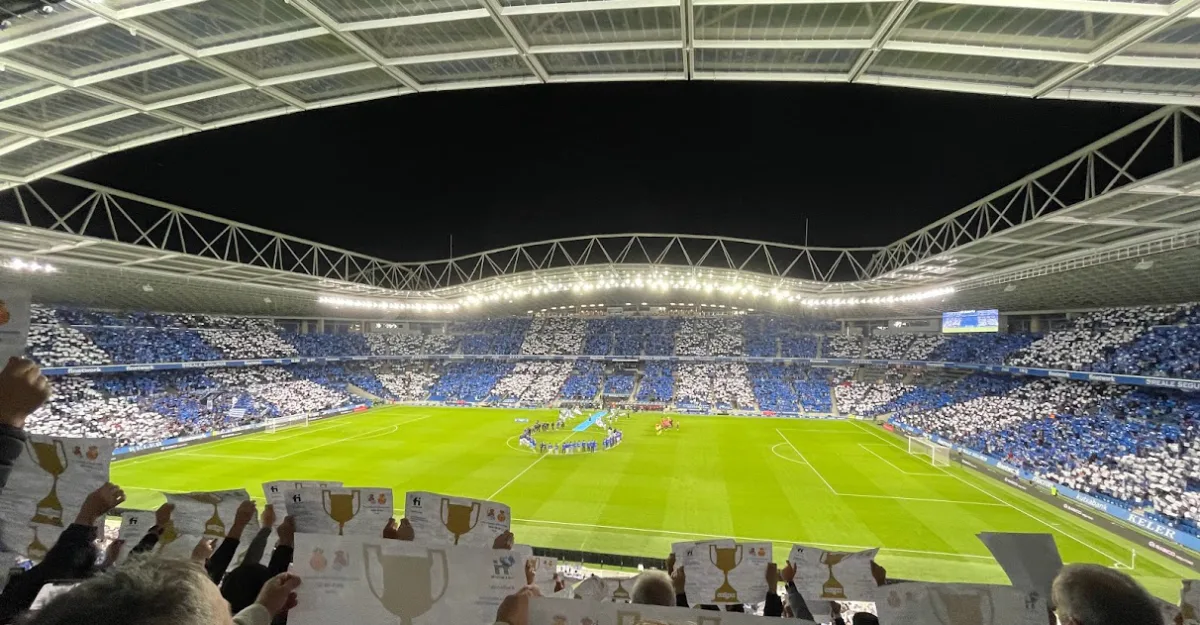
About Anoeta
The most important thing about Anoeta is a thing that is no longer there. For twenty-four years a running track ringed this pitch, holding the crowd at arm’s length and giving Real Sociedad’s home a reputation as one of the coldest atmospheres in Spain. Then, between 2017 and 2019, they tore it out. The stands came down toward the grass, and a ground that fans had quietly resented became one they queue up to get into.
It sits in the Amara district of San Sebastián, a compact and beautiful city on the Basque coast, and holds about 40,000. The pitch is natural grass, and the whole building is wrapped in a continuous translucent ETFE skin that runs from facade into roof, so from the street it reads as one soft volume rather than a concrete bowl. The roof shelters the stands and leaves the pitch open to the Cantabrian sky.
The name has moved around. It was the Estadio de Anoeta from 1993, became the Reale Arena in 2019 when an insurer bought the naming rights, and reverted to plain Anoeta in July 2025 when that deal ended. Locals never bothered with the sponsor’s name anyway. One more quirk worth knowing: Real Sociedad do not own the place. San Sebastián city council does, which is why the club spent fifteen years asking permission before it could finally remove that track.
Getting to Anoeta
San Sebastián is small, and Anoeta is close in. Here is how to reach it however you are traveling.
Public Transit
The train drops you at the door. Anoeta station, on the Euskotren network that everyone here calls the Topo, sits immediately beside the ground, two or three minutes from the turnstiles, on lines E2 and E5. Be careful with the name, though: there is a completely separate Renfe station called Anoeta, and it is more than 20 kilometres inland near Tolosa. It will not help you. For buses, Dbus city lines 17, 24, 26, and 28 stop on Paseo de Anoeta, and on match days the operator runs special services, with line 28 leaving the Boulevard every five minutes from an hour before kickoff.
Driving + Parking
Driving is the worst of the four ways in, and that is not a close call. The AP-8 along the coast, the N-1, and the GI-20 belt road all funnel toward Amara, but the streets around the ground are a narrow grid under paid parking rules, and the stadium’s own car park has very few spaces open to matchgoers. The pragmatic answer is the Illunbe park-and-ride just above the stadium, which has around 494 free surface spaces and a ten-minute walk down to the bus stop. Better still, leave the car at the hotel.
Rideshare
Do not plan around it. Uber only arrived in San Sebastián in February 2026, with a fleet of roughly thirty electric cars, and the licenses those vehicles hold were issued in a neighboring province and are disputed for city trips. Cabify and Bolt do not operate here at all. The honest advice is to use a licensed taxi, take the Topo, or simply walk, which in a city this size is usually quicker than any of it.
From the Airport
San Sebastián has its own airport at Hondarribia, about 22 kilometres out, but it is small and mostly domestic; the E21 bus runs into the city in around 45 minutes for under three euros. Most international visitors land at Bilbao instead, roughly 100 kilometres west, and take the direct Pesa coach, which reaches San Sebastián in about 75 minutes. Biarritz, just across the French border, is a third option, and it comes with a nice trick: the Topo runs from Hendaia all the way to Anoeta station itself, one train from the border to the turnstile.
Construction & Design
Anoeta was born compromised. It went up between 1991 and 1993 as a municipal multi-sport stadium rather than a football ground, because the city wanted an athletics venue, and it opened not with a match but with the European Junior Athletics Championships. Real Sociedad moved in from cramped, beloved Atotxa and never quite settled. The track held the front row 42 metres from the goal line, and the atmosphere went flat.
Fixing it took fifteen years of rejected plans, because the club does not own the building. What finally worked was the Basque architect Izaskun Larzabal’s design, and its virtue was restraint: keep the two original main stands, demolish only the ends and the lower tier, lower the pitch, and rebuild the terracing inward over the ground the track had wasted. The contractors, a joint venture of Altuna y Uria and Moyua, did the whole thing without the club leaving home, playing on through the works. The final bill came to about 78.6 million euros, up from a 47 million budget, and Real Sociedad shouldered roughly 64.6 million of it.
The numbers tell the story better than any adjective. Behind the goals the crowd moved from 42 metres out to 8.5. Down the sides, from 25 metres to 10.5. Turnstiles went from 66 to 126. Season-ticket holders climbed from about 24,000 to more than 38,000 with a waiting list three thousand deep. Over the top of it all went that ETFE envelope, some 22,000 square metres on the facade and nearly 6,000 more on the roof, hung on around 1,077 tonnes of tubular steel. In December 2020 the rebuild won the Prix Versailles for sports architecture, beating Tottenham Hotspur Stadium and the Puskás Aréna.
History of Anoeta
July 29, 1993: the stadium opened, and not for football. The European Junior Athletics Championships came first. Two weeks later, on 13 August, Real Sociedad finally played here, drawing 2-2 with Real Madrid in a friendly.
The oddest chapters came from other sports and other countries. French rugby’s Biarritz Olympique adopted Anoeta as their European home ground, because it was the closest stadium to Biarritz that met the Heineken Cup’s 20,000-seat rule for knockout ties, and they won quarterfinals and semifinals here. In 2013 Athletic Club, Real Sociedad’s fiercest rivals, had to play a “home” league match at Anoeta while the new San Mamés was finished.
September 14, 2019: the rebuilt stadium reopened, Real Sociedad beating Atlético Madrid 2-0 in front of 33,374. Less than a year later, on 30 August 2020, Anoeta staged the Women’s Champions League final, Lyon beating Wolfsburg 3-1 in an empty ground after the pandemic moved the game from Vienna. Its record crowd, oddly, still belongs to rugby: 39,314 for a Top 14 semifinal in June 2023.
Between the football, Anoeta has been one of the north’s reliable concert stops, hosting Pink Floyd in 1994, the Rolling Stones in 2007, U2 twice, and Bruce Springsteen so often that he came back again in June 2025. And the rebuild has been quietly influential: the glass-walled hospitality boxes that look straight down onto the players’ tunnel were copied into Barcelona’s Camp Nou renovation.
The building is not finished changing. A fresh expansion started in May 2026, adding an upper ring on the side stands to lift capacity toward 42,247 and clear FIFA’s seat minimum for the 2030 World Cup, though San Sebastián’s place among the final host cities remains, for now, unsettled.
Sources & Further Reading
- Real Sociedad official site: realsociedad.eus. The club’s own pages on the stadium and its facilities.
- Wikipedia entry on Anoeta Stadium: en.wikipedia.org/wiki/Anoeta_Stadium. Capacity, the renovation, naming history, and events with sourcing.
- Izaskun Larzabal architecture studio: izaskunlarzabal.com. The architect’s own account of the Anoeta renovation.
- Moyua: moyua.eus. The contractor’s project page, with the steel and ETFE material figures.
- Dbus match-day services: dbus.eus. Special bus routes and timings for Real Sociedad home matches.
Quick Facts
Everything you need at a glance.
Stadium specs
- Capacity
- 40,000
- Opened
- 1993
- Cost
- €78.6 million (2017-2019 renovation)
- Roof
- Roof over stands (open pitch)
- Surface
- Natural grass
- Tenants
- Real Sociedad (La Liga)
Construction & location
- Groundbreaking
- 1991
- Architects
- Izaskun Larzabal (2017-2019 renovation)
- Engineering
- Not separately recorded
- General contractor
- UTE Altuna y Uria - Moyua (2017-2019 renovation)
- Address
- Anoeta Pasealekua 1, 20014 Donostia-San Sebastián, Gipuzkoa, Spain
- GPS
- 43.3014°N, 1.9736°W
Photo Gallery
Fun Facts
A French rugby club used Anoeta as its European home ground: Biarritz Olympique crossed the border to play its biggest Heineken Cup knockout ties here, because Anoeta was the nearest stadium that met the competition's 20,000-seat minimum.
The 2017 to 2019 rebuild moved the crowd 33.5 metres closer to the action. Behind the goals the front row went from 42 metres out to 8.5, and the ground later won the Prix Versailles for sports architecture, beating Tottenham Hotspur Stadium.
The stadium's record crowd is not for football. A Top 14 rugby semifinal in June 2023 drew 39,314, the biggest attendance the ground has ever held.
Stadium Location
Frequently Asked Questions
- What is the capacity of Anoeta?
- Anoeta holds about 40,000 after the 2017 to 2019 rebuild. A further expansion that began in May 2026 is set to raise it to 42,247, largely to clear FIFA's 40,000-seat minimum for the 2030 World Cup.
- Who plays at Anoeta?
- It is the home of Real Sociedad, who have played there since 1993. The stadium is owned by San Sebastián city council, not the club, which is why the famous renovation needed council approval.
- Is Anoeta still called the Reale Arena?
- No. It carried the name Reale Arena from 2019 until the Reale Seguros deal ended at the close of the 2024-25 season, and the signage came off the facade in July 2025. It is Anoeta again, which is what locals called it all along.
- When did Anoeta open?
- It opened on 29 July 1993 with the European Junior Athletics Championships, and hosted its first football match two weeks later, a 2-2 friendly draw with Real Madrid on 13 August 1993.
- Why did Anoeta remove its running track?
- The track was built because the city wanted an athletics venue, but it pushed the crowd so far back that the ground became a byword for a flat atmosphere. The 2017 to 2019 rebuild ripped it out and rebuilt the stands over the space it had occupied.
- How do I get to Anoeta?
- The Euskotren Anoeta station is right beside the ground. Dbus city lines 17, 24, 26, and 28 also serve it, with special services on match days. From central San Sebastián the walk takes about 25 to 30 minutes.
- Can I use Uber to get to Anoeta?
- Not reliably. Uber only launched in San Sebastián in February 2026 with a fleet of about 30 cars, and the licenses those cars hold are disputed for urban trips. Cabify and Bolt do not operate here. Use a taxi, the train, or walk.
- Will Anoeta host 2030 World Cup matches?
- It is on the Spanish federation's list of candidate venues and is being expanded to meet FIFA's seat minimum, but San Sebastián's place in the final line-up is still reported as uncertain. Nothing is settled.
Last updated: 2026-07-13