About ScottsMiracle-Gro Field
For twenty-two years the Columbus Crew played in the stadium that started it all, the first soccer-specific ground an MLS team ever built. Then, in July 2021, they moved downtown. ScottsMiracle-Gro Field opened at the western edge of Columbus’s Arena District, a downtown home built to replace a venue the Crew had outgrown but never stopped honoring.
The building is compact and loud by design. A black steel canopy, roughly 220,000 square feet of it, covers every seat while leaving the pitch open to the sky. That single choice does two things at once. It keeps fans dry, and it traps the noise, funneling crowd sound straight back down onto the field. Behind the north end sits the Nordecke, the Crew’s supporters’ section, with room for 3,362 fans standing on a steep rake that runs to 37 degrees. Visiting teams tend to mention it afterward.
The Crew are the only tenants, and everything about the place is tuned to them. The pitch is natural grass, 115 by 75 yards (105 by 69 meters). The whole footprint runs to about 460,000 square feet on a roughly 12-acre site, which is tight for a modern stadium and deliberately so. There is a club bar, a suite-level lounge, and a beer garden, but the point of the design is proximity. Seats sit close, the canopy holds the sound in, and the sightlines pull the crowd toward the play rather than spreading it out.
The name on the building changed in late 2025. For its first five seasons the stadium was Lower.com Field, after a Columbus-based online mortgage lender that signed on just before opening. Then the Crew and the ScottsMiracle-Gro Company, headquartered in nearby Marysville, Ohio, announced a new naming rights deal on November 25, 2025, extending a partnership that had already run more than fifteen years. The venue became ScottsMiracle-Gro Field for the 2026 season.
The Crew’s timing could hardly have been better. In December 2023, in their first full run at the new ground, they beat LAFC 2-1 to win MLS Cup, their third league championship. The Arena District setting ties the stadium into Nationwide Arena, the North Market, and the Short North just north of High Street, so a match here is a downtown night out rather than a suburban parking-lot errand. That contrast, downtown versus fairgrounds, is the whole story of how this club got here.
Getting to ScottsMiracle-Gro Field
Public Transit
Columbus has no rail transit, which surprises visitors from bigger cities. The COTA bus network covers the Arena District well, and the free CBUS circulator loops through downtown all day.
→ From downtown Columbus: The free CBUS circulator runs a loop through the Arena District. Several COTA routes stop within a short walk of the stadium.
→ From the Ohio State University area: COTA buses run down High Street toward downtown, roughly a 15-minute ride into the district.
On match days the Arena District sidewalks fill with fans walking in from downtown hotels. Most of central Columbus sits within a 15-minute walk, which is the real transit story here. Skip the bus if you are already downtown and just walk.
Driving + Parking
GPS address: 96 Columbus Crew Way, Columbus, OH 43215.
→ From Cleveland (225 km): I-71 South directly into downtown Columbus. About 2 hours 15 minutes.
→ From Cincinnati (172 km): I-71 North into downtown. About 1 hour 45 minutes.
→ From Pittsburgh (265 km): I-70 West to Columbus. About 2 hours 45 minutes.
The stadium has limited dedicated parking. Arena District garages and surface lots are plentiful within a 10-minute walk, and you should expect $15 to $25 on match days. ParkMobile advance purchase is worth it. Free bike parking is available at the stadium.
Rideshare
Uber and Lyft both operate in Columbus. Drop-off is near the stadium gates. A ride from most downtown hotels runs under $10, and from the airport roughly $15 to $25. Post-match surge is normal, so walk a few blocks toward the Short North for a better fare.
From the Airport
→ John Glenn Columbus International Airport (CMH): About 13 km east, roughly 15 minutes by car or rideshare ($15 to $25). There is no direct bus to the Arena District, so driving or rideshare is the practical option.
Watching a Match at ScottsMiracle-Gro Field
Regulars will tell you there is no bad seat, and the structure backs them: the bowl is pulled tight around the touchlines and the canopy covers every row. The dissent is narrow but worth hearing. Some supporters find the lowest rows too flat to read the game and would rather sit high for the depth perception. And the canopy does not solve everything, because fans warn repeatedly that the east side takes the afternoon sun, with the lower rows of sections 236 to 240 singled out as the hottest. For a summer afternoon kickoff, the west side is the safer buy.
The loud end is the Nordecke behind the north goal, 3,362 standing supporters on a rake that runs to 37 degrees. Visiting teams tend to mention it afterward.
What dominates supporter conversation now is not where to sit. It is what the day costs. The club does not publish a price list, but supporters do, and the 2026 season opened with something close to revolt on their own forums. Fans reported a bratwurst at $17.49, beer around $15 and a soda at $9.99 in a refillable souvenir cup. “Three fifty for the brat,” one wrote. “Fourteen dollars for the branding.” Another noted that a well-liked quesadilla stand had been replaced by a sandwich counter at $17, and there was open talk of boycotting concessions for a match to make the point. Treat the figures as fan reports rather than published prices, but the direction of travel is not in dispute.
The stands themselves lean local. The club’s own concession map puts Schmidt’s at section 128, Donatos at 107 and 132, Dirty Frank’s out on the Chase Plaza by 143, Condado in the southwest corner, Swensons at 124, Endeavor Brewing at 127 and a barbecue counter at 130. Supporters are quick to note you can visit the actual Schmidt’s beforehand and get more, and better, sausage for about the same money. The North Market, a little over a kilometer east, is the other standard pre-match stop. Worth knowing that the roster turns over: Dos Hermanos, the taco stand supporters followed across from the old ground, no longer appears on the club’s list.
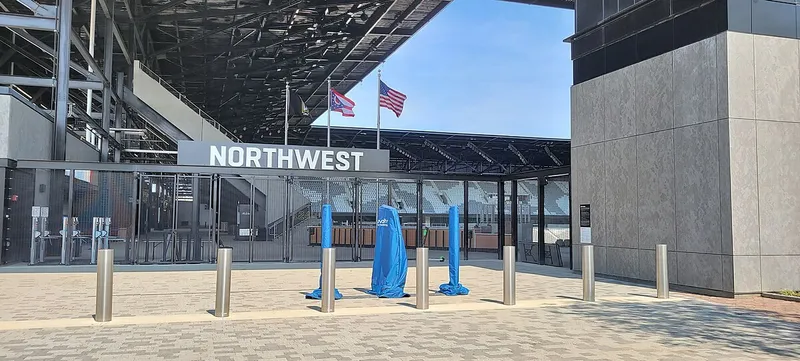
One thing worth knowing before buying for 2026. The Crew hit their season-ticket membership cap in both 2024 and 2025, the only times in the club’s history, and answered it by adding roughly 400 seats across three premium areas: the Skyview Club on the east side, all-inclusive food and drink with a view over downtown; the Northwest Lofts, outdoor seats that are both heated and air-conditioned, sold as private eight-person boxes or singly; and Patio 96, an extension of the party decks in the northwest corner with its own concession stand and bathrooms.
Construction & Design
The Crew broke ground on October 10, 2019, and got the keys a little over eighteen months later, in time for a July 2021 opening. That is a fast build for a stadium of this size, and it held even as COVID-19 scrambled construction schedules across the country. HNTB drew up the design. Turner Construction managed the build as part of a joint venture, working a roughly 12-acre site at the western end of the Arena District, the anchor of a mixed-use development called Astor Park.
The price tag came in at $314 million. The financing was a public-private split, and the shares are worth knowing. Pinning down the split is harder than it looks, because the published figures cover different projects. The deal that kept the club in Columbus, struck when the Haslam and Edwards families took over in 2018, bundled this stadium with the conversion of the old ground into a community sports park. Against that wider project, reporting at the time put the ownership contribution around $233 million and the combined public commitment near $140 million: $50 million from the City of Columbus, roughly $45 million secured against a Franklin County pledge, $20 million from the State of Ohio and $25 million through a new public authority, with at least $64 million more in surrounding utilities and a parking garage. None of those totals maps cleanly onto the $314 million quoted for the stadium alone, and no source we found reconciles them. Ownership of the finished stadium runs through the Confluence Community Authority, a public entity governed by the city and Franklin County. The Crew operate the ground on a 30-year lease at $10 a year, with an option to buy it outright in 2047 for 30 percent of its market value. A dollar a month, roughly, for a downtown stadium.
The signature feature is the canopy. Roughly 220,000 square feet (about 20,000 square meters) of black steel wraps the top of the bowl, covering every seat while the pitch stays open. It is one of a small group of MLS grounds whose roof covers every seat, alongside Children’s Mercy Park and Geodis Park. The engineering payoff is acoustic. The roof reflects noise downward instead of letting it escape, and the Crew treat that as a competitive edge as much as a comfort. The seating bowl is pulled in tight around the touchlines, and the Nordecke behind the north goal runs to a 37-degree rake, steep enough to stack 3,362 standing supporters almost on top of the action.
The whole building covers about 460,000 square feet. Inside there are 35 suites, 2,492 club seats, a club bar, a beer garden, and a suite-level lounge, the usual modern amenities, but the design keeps circling back to closeness rather than sprawl. It is a stadium built to feel full and sound loud, and on that count it works.
History of ScottsMiracle-Gro Field
To understand this stadium you have to start with the last one. On May 15, 1999, the Crew opened Columbus Crew Stadium, the first soccer-specific stadium built by a Major League Soccer club, with a capacity of 22,555. It was a genuine turning point. Before it, MLS teams rented cavernous NFL stadiums and looked lost in them. After it, the soccer-specific stadium became the template, and nearly every purpose-built MLS ground since owes something to that fairgrounds venue off I-71. It still stands, now called Historic Crew Stadium, home to the Crew’s training facility and their MLS Next Pro side.
By the mid-2010s that pioneering ground was showing its age, and then the club nearly left town entirely. In 2018 the Crew’s then-owner moved to relocate the team to Austin, Texas. What followed was “Save the Crew,” one of the most effective fan campaigns in American sports, a mix of protests, political pressure, and sheer stubbornness that refused to let the franchise go quietly. It worked. The Haslam and Edwards families took over the club in a deal that kept it in Columbus and committed, almost immediately, to building a new stadium downtown.
Groundbreaking came on October 10, 2019. The stadium opened on July 3, 2021, first as Lower.com Field, and the Crew marked the occasion with a 2-2 draw against the New England Revolution before a sellout crowd. The bigger night came two and a half years later.
Key moments in the stadium’s history:
- July 3, 2021: Inaugural match, Columbus Crew 2, New England Revolution 2, before a sellout crowd.
- December 9, 2023: The Crew beat LAFC 2-1 in the MLS Cup Final in front of 20,802 fans, taking their third league championship at home.
- November 25, 2025: The Crew and the Marysville, Ohio-based ScottsMiracle-Gro Company announce the naming rights deal that renames the ground ScottsMiracle-Gro Field for the 2026 season.
The next headline is already on the calendar. Columbus takes nine matches of the 2028 Olympic football tournament, one of seven venues across the country. The Crew’s own announcement sets out the shape of it: eight combined men’s and women’s group-stage games across July 10-11, 13-14 and 16, then a men’s quarterfinal on July 20, 2028. Only four venues get men’s group-stage football, and this is one of them. During the Games the IOC’s clean-venue rules will strip the corporate name off, and the ground will simply be Columbus Stadium for a few weeks. Every venue is mapped in our Los Angeles 2028 Olympics guide.
The “Save the Crew” saga gives this place a weight that architecture alone cannot. It is proof, sitting in concrete and steel, that a city’s refusal to lose its club can change the ending. The Nordecke fills every match. The canopy holds the noise in. And the Crew play in one of the best atmospheres in MLS, in a stadium that came close to never being built here at all. From the top rows you can see the downtown skyline over the open pitch, a reminder of exactly whose team this is.
Sources & Further Reading
- Columbus Crew naming rights announcement: columbuscrew.com. Official confirmation of the November 25, 2025 ScottsMiracle-Gro Field name change and the 2026 effective date.
- ScottsMiracle-Gro Field encyclopedia entry: en.wikipedia.org. Comprehensive reference for capacity, address, ownership structure, lease terms, and the 2028 Olympics role.
- Turner Construction project page: turnerconstruction.com. Construction management details, the 460,000-square-foot footprint, and design partner HNTB.
- Columbus Crew on the LA28 allocation: columbuscrew.com. The club’s own nine-match breakdown, the group-stage dates and the July 20 men’s quarterfinal.
- LA28 venue page for Columbus Stadium: la28.org. LA28’s own confirmation of the Games-time venue name.
- Columbus Crew concessions map: columbuscrew.com. The current vendor list and section locations.
- LA28 football tournament match dates: la28.org. The official round-by-round grid, the source for the Columbus allocation and the Games-time venue name.
- 614NOW on the 2026 seating additions: 614now.com. The Skyview Club, Northwest Lofts and Patio 96 expansion after consecutive season-ticket sellouts.
- Forbes on the stadium and Astor Park: forbes.com. Reporting on the canopy design, the downtown site, and the $314 million build.
Quick Facts
Everything you need at a glance.
Stadium specs
- Capacity
- 20,808
- Opened
- 2021
- Cost
- $314 million
- Roof
- Partial Canopy
- Surface
- Natural Grass
- Tenants
- Columbus Crew (MLS)
Construction & location
- Groundbreaking
- October 10, 2019
- Architects
- HNTB
- General contractor
- Turner Construction (joint venture)
- Address
- 96 Columbus Crew Way, Columbus, OH 43215, USA
- GPS
- 39.9684°N, 83.0169°W
Photo Gallery
Fun Facts
The canopy covers every one of the 20,808 seats while leaving the pitch open to the sky, roughly 220,000 square feet of black steel, putting it in the small group of MLS grounds that cover every seat.
The Crew won MLS Cup 2023 here, beating LAFC 2-1 in front of 20,802 fans on December 9, 2023, the stadium's record crowd, and their third league title.
The predecessor, Historic Crew Stadium, opened in 1999 as the first soccer-specific stadium ever built by an MLS team. The Crew went from launching that idea to replacing it with a $314 million downtown ground two decades later.
Stadium Location
Frequently Asked Questions
- What was ScottsMiracle-Gro Field called before?
- It opened in July 2021 as Lower.com Field, named for a Columbus-based online mortgage lender. That deal ran for five seasons. The Columbus Crew and the Marysville, Ohio-based ScottsMiracle-Gro Company announced the new naming rights agreement on November 25, 2025, and the stadium became ScottsMiracle-Gro Field for the 2026 season.
- What is the capacity of ScottsMiracle-Gro Field?
- 20,808, per the club's own stadium page, after roughly 400 seats were added for the 2026 season in three new premium areas. Haslam Sports Group, the owner, lists 20,585 on its facilities page, and older references still carry the pre-expansion 20,371, so expect to see all three. The current breakdown is 35 suites, 2,492 club seats and 3,362 safe-standing places in the Nordecke. The canopy covers every seat while the pitch stays open.
- What team plays at ScottsMiracle-Gro Field?
- The Columbus Crew of Major League Soccer. The Crew won the 2023 MLS Cup here, their third league title, in their first full season at the new downtown stadium.
- How do I get to ScottsMiracle-Gro Field?
- The stadium is in downtown Columbus at the western edge of the Arena District, 96 Columbus Crew Way. COTA buses serve the area and the free CBUS circulator loops through downtown. From most downtown hotels it is a 5 to 15 minute walk.
- Is there parking at ScottsMiracle-Gro Field?
- On-site parking is limited. Arena District garages and surface lots sit within a 10-minute walk and typically run $15 to $25 on match days. Advance purchase through ParkMobile is the safe bet.
- When did ScottsMiracle-Gro Field open?
- July 3, 2021, with a 2-2 draw against the New England Revolution before a sellout crowd. It replaced Historic Crew Stadium, which had opened in 1999 as the first soccer-specific stadium built by an MLS team.
- Does ScottsMiracle-Gro Field have a roof?
- A partial canopy, not a full roof. Roughly 220,000 square feet of black steel covers every seat and leaves the pitch open. The design shelters fans from rain and sun and bounces crowd noise back down toward the field.
- What surface does ScottsMiracle-Gro Field use?
- Natural grass, laid out to a pitch of 115 by 75 yards (105 by 69 meters).
- Where are the best seats at ScottsMiracle-Gro Field?
- Regulars will tell you there is no bad one, which is what happens when the bowl wraps tight around the pitch and the canopy covers every row. Pick for atmosphere and for sun instead. The Nordecke behind the north goal is the standing supporters' end, 3,362 of them on a 37-degree rake. The east side catches the afternoon sun, with the lower rows of sections 236 to 240 named by fans as the hottest, so the west side is safer for a summer afternoon. New for 2026 are three premium areas: the Skyview Club, the Northwest Lofts and Patio 96.
- What is the best food at ScottsMiracle-Gro Field?
- The stands lean local: the club maps Schmidt's to section 128, Donatos to 107 and 132, Dirty Frank's to the Chase Plaza by 143, plus Condado, Swensons, Endeavor Brewing and a barbecue counter at 130. The honest caveat is that supporters talk more about the prices than the menu, reporting a bratwurst at $17.49 and beer around $15 for 2026, though the club publishes no price list. Many locals eat first, either at the actual Schmidt's or the North Market a little over a kilometer east. Note the roster changes: Dos Hermanos, long a fan favorite, is no longer on the club's list.
- Who owns ScottsMiracle-Gro Field?
- The Confluence Community Authority, a public entity governed by the City of Columbus and Franklin County. The Columbus Crew operate the stadium under a 30-year lease at $10 a year, with an option to buy it outright in 2047 for 30 percent of market value.
- How much did ScottsMiracle-Gro Field cost to build?
- About $314 million. Roughly $217.5 million came from private funds tied to the Crew's ownership, with the City of Columbus adding around $50 million for surrounding infrastructure. HNTB designed the stadium and Turner Construction managed the build as part of a joint venture.
- Will ScottsMiracle-Gro Field host the 2028 Olympics?
- Yes, nine matches. The Crew's own announcement sets out eight combined men's and women's group-stage games across July 10-11, 13-14 and 16, then a men's quarterfinal on July 20, 2028. Columbus is one of seven venues staging Olympic football, and one of only four hosting men's group-stage matches. Under the IOC's clean-venue policy the ground is called Columbus Stadium for the duration of the Games.
Last updated: 2026-08-18