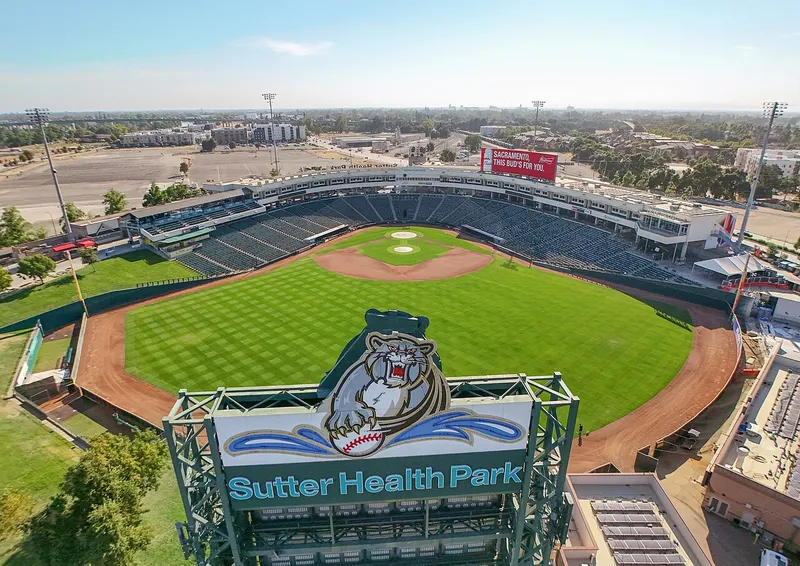
About Sutter Health Park
For twenty-four years this was a minor league yard and nothing more. Raley Field opened in 2000 for the Sacramento River Cats, a Triple-A club, and quickly earned a reputation as one of the best small ballparks in the country. Then the Athletics arrived. After their Oakland Coliseum lease ran out following the 2024 season, the franchise moved about 130 kilometers (80 miles) up Interstate 80 and turned a 14,014-seat riverfront park into its temporary major league home, easily the smallest venue in MLB.
The branding is the first thing that trips people up. During the Sacramento years the club is not the Sacramento Athletics, or the Sacramento A’s, or anything with a city on it. It is simply the Athletics, the A’s, no place name at all, a team between homes. Sacramento is a waystation, occupied from 2025 through 2027, with an option for a fourth year, while a roughly $1.5 billion ballpark rises in Las Vegas for a planned 2028 opening.
What makes the setup stranger still is that the River Cats never moved out. The Athletics are temporarily sharing one field with the River Cats, the San Francisco Giants’ minor league team, in a city that spent years trying to land a big-league club of its own and finally got one on loan. The result is intimate in a way no other MLB ballpark can match. With 10,624 fixed seats plus lawn and standing room, every fan sits close to the action, and the front rows behind home plate are unusually near the batter. The Sacramento River runs beyond the outfield berm, and the Tower Bridge glows gold at sunset past the right-field stands. Restaurants along the River Walk have widened their patios, food trucks line Ballpark Drive on game nights, and the pedestrian crossing over the Tower Bridge has turned a plain commute into a social event.
Getting to Sutter Health Park
Public Transit
The stadium sits across the river from downtown Sacramento, which makes walking the simplest option for a lot of fans.
→ From downtown Sacramento: Walk across the Tower Bridge, about 15 minutes from the Capitol Mall area. The bridge is pedestrian-friendly and the walk is half the fun on game night.
→ By bus: SacRT routes serve downtown Sacramento, with connections to West Sacramento. Yolobus routes 42A and 42B also reach the area from Davis and Woodland.
SacRT light rail stations at Sacramento Valley Station and 7th & Capitol are the closest rail stops, each roughly a 20-minute walk to the stadium by way of the Tower Bridge.
Driving + Parking
GPS address: 400 Ballpark Drive, West Sacramento, CA 95691.
→ From San Francisco (140 km): I-80 East through Davis to the Jefferson Blvd exit. About 1 hour 30 minutes.
→ From Reno (220 km): I-80 West over Donner Pass. About 2 hours 15 minutes.
→ From downtown Sacramento (3 km): I-5 South to I-80 West, exit at Jefferson Blvd. About 5 to 10 minutes, though walking the Tower Bridge is often faster on game nights.
On-site lots hold roughly 4,000 vehicles, and general parking runs $20 to $30. Overflow lots operate along Riverwalk Drive south of the stadium. Pre-purchasing through the A’s app is the smart move, because lots sell out for most games and the walk-up scramble is real.
Rideshare
Uber and Lyft drop off and pick up at the main entrance on Ballpark Drive. From downtown Sacramento, expect $10 to $15; from Sacramento International Airport, about $25 to $35. After games, walk south along Riverwalk Drive for faster pickups, since the main entrance clogs up fast.
From the Airport
→ Sacramento International Airport (SMF): 19 km northwest, about 20 minutes by car. Uber/Lyft $25 to $35. SacRT bus route 142 connects the airport to downtown, followed by a walk across the Tower Bridge.
Construction & Design
Sutter Health Park was a bet that Sacramento would show up. In the late 1990s the River Cats’ ownership group financed a ballpark with no public money, hired HNTB to design it and the JR Roberts Corporation to build it, broke ground on October 28, 1999, and opened the gates on May 15, 2000. The whole thing went up in under nine months for $46.5 million, which is closer to $86.9 million in today’s dollars. The bet paid off immediately. The River Cats drew more than 800,000 fans in their first season.
A minor league park, full stop, and for twenty-four years that is exactly what it stayed: owned by a public financing authority, operated by the team, with two seating decks, 36 luxury suites, and grass berms behind the outfield walls. Then the Athletics needed a place to land. With Oakland behind them and Las Vegas years away, the A’s turned a 14,000-seat Triple-A field into a major league one across a single offseason.
The conversion was less about size than about plumbing the building up to big-league spec. Crews built a two-story home clubhouse behind the left-field wall, packed with a dressing room, training space, a full gym, coaches’ offices, a kitchen, a dining room, and dual batting cages. They rebuilt the video and audio systems, upgraded the premium seating, and installed MLB-standard bullpens. The left-field fence was pushed back to reach major league dimensions, giving the park lines of 100 meters (330 feet) to left, 123 meters (403 feet) to center, and 99 meters (325 feet) to right, with a 58-foot backstop. Artificial turf was floated during planning, but the club relaid natural grass instead and layered in AirPAT technology to oxygenate the root zone and regulate subsurface temperature, because keeping grass alive through a Central Valley summer turned out to be the hardest problem of all.
That intimacy is the whole appeal. Most MLB stadiums seat 35,000 to 45,000. Sutter Health Park holds a third of that, with the concourse wrapped so tightly around the bowl that the field stays visible from nearly every concession stand. The trade-off is the weather. There is no roof and no shade, so summer day games bake, while evenings cool fast once the river breeze reaches the berm.
History of Sutter Health Park
The stadium opened on May 15, 2000, as Raley Field, named for Raley’s, the Sacramento-area supermarket chain, which had paid about $15 million over 20 years for the rights. The Sacramento River Cats, then the Triple-A affiliate of the Oakland Athletics in an early hint of things to come, drew over 800,000 fans in year one. The park quickly established itself as one of the best minor league venues anywhere, and it hosted the Triple-A All-Star Game in 2005.
The A’s connection to Sacramento deepened unexpectedly in 2024, when the franchise, unable to secure a new stadium in Oakland, announced a move to Las Vegas anchored by a planned domed ballpark costing roughly $1.5 billion. The Las Vegas venue would not be ready until 2028, leaving the club without a home for three seasons. Sacramento, which had lost its own bid to land the A’s permanently, became the interim solution instead.
Key moments in the stadium’s history:
- May 15, 2000: Inaugural game as Raley Field, Vancouver Canadians 5, River Cats 4.
- 2005: The ballpark hosts the Triple-A All-Star Game, a nod to its status among minor league venues.
- 2020: Raley Field is renamed Sutter Health Park under a new naming-rights deal.
- November 2024: MLB approves Sutter Health Park as the A’s temporary home, and renovations begin at once.
- March 31, 2025: First MLB home opener. The Athletics host the Chicago Cubs in front of 12,192 fans.
- 2025 season: Home games routinely sell out, validating Sacramento’s appetite for major league baseball.
What makes the arrangement stranger still is that the River Cats never left. For the first time in modern memory, a major league team and a Triple-A team share the same field full time, stacking well over 150 home dates onto a single grass surface across one Sacramento summer. Keeping that field alive through the load and the heat became the grounds crew’s defining task, and the reason the A’s leaned on outside turf specialists and root-zone technology.
The A’s tenure here is temporary, with Las Vegas waiting in 2028, yet the intimacy of a 14,014-seat major league ballpark has produced something rare. The smallest MLB stadium generates one of the loudest atmospheres per capita in the sport, and Sacramento fans have made a persuasive case that this city deserves permanent major league representation of its own.
Sources & Further Reading
- MLB Athletics ballpark information: mlb.com. Gameday details, seating, and policies for Sutter Health Park.
- Sutter Health Park official site: sutterhealthpark.com. Events, tickets, parking, and directions for both tenants.
- Ballpark reference and history: ballparksofbaseball.com. Construction cost, dimensions, and the MLB conversion.
- Wikipedia entry on Sutter Health Park: en.wikipedia.org. Construction history, ownership, naming, capacity, and the Athletics arrangement.
Quick Facts
Everything you need at a glance.
Stadium specs
- Capacity
- 14,014
- Opened
- 2000
- Cost
- $46.5 million (2000) (~$86.9 million (2025) today)
- Roof
- Open
- Surface
- Natural Grass
- Tenants
- Athletics (MLB), Sacramento River Cats (Triple-A)
Construction & location
- Groundbreaking
- October 28, 1999
- Architects
- HNTB
- General contractor
- JR Roberts Corporation
- Address
- 400 Ballpark Drive, West Sacramento, CA 95691, USA
- GPS
- 38.5803°N, 121.5139°W
Photo Gallery
Fun Facts
Sutter Health Park is the smallest venue in Major League Baseball at 14,014, roughly a third the capacity of a typical MLB park. Athletics home games in the 2025 season routinely sold out.
The ballpark went up in under nine months without a single dollar of public funding, a $46.5 million private investment that opened as Raley Field in 2000 for the Triple-A Sacramento River Cats.
For the Athletics' arrival, the left-field fence was pushed back to major league dimensions, the natural grass was relaid with AirPAT root-zone technology, a new videoboard went up, and MLB-standard bullpens were added, all in a single offseason.
Stadium Location
Frequently Asked Questions
- What is the capacity of Sutter Health Park?
- 14,014, the smallest in Major League Baseball. That figure combines 10,624 fixed seats with lawn and standing-room areas, and sellout nights push the crowd toward 15,000.
- Why are the Athletics playing in Sacramento?
- The A's lease at the Oakland Coliseum ran out after the 2024 season, so the club is using Sutter Health Park as a temporary home from 2025 through 2027, with an option for a fourth year, while its roughly $1.5 billion permanent ballpark is built in Las Vegas, expected to open in 2028.
- Are they called the Sacramento Athletics?
- No. During the Sacramento years the franchise is branded simply as the Athletics, or the A's, with no city name attached. Broadcasts and box scores list them the same way.
- How do I get to Sutter Health Park from downtown Sacramento?
- Walk across the Tower Bridge, about a 15-minute stroll from the Capitol Mall area. SacRT bus routes also serve stops near the stadium. By car, take I-80 to the Jefferson Blvd exit.
- Is there parking at Sutter Health Park?
- Yes. On-site lots hold roughly 4,000 vehicles. General parking runs $20 to $30. Overflow lots operate along Riverwalk Drive. Pre-purchasing through the A's app is recommended, since lots sell out for most games.
- Was Sutter Health Park always an MLB stadium?
- No. It opened in 2000 as Raley Field, a Triple-A ballpark for the Sacramento River Cats. Work in 2024 and 2025 prepared it for MLB use, including outfield changes, a natural grass relay, upgraded clubhouses, and new bullpens.
- What was the old name of Sutter Health Park?
- The stadium was Raley Field from 2000 to 2019, named for the Raley's supermarket chain, which paid about $15 million over 20 years. It became Sutter Health Park in 2020 under a new naming-rights agreement.
- Who built Sutter Health Park?
- The architecture firm HNTB designed the ballpark, and the JR Roberts Corporation built it after groundbreaking on October 28, 1999. It opened on May 15, 2000, under nine months later, financed entirely with private money.
- What changed to make Sutter Health Park ready for the A's?
- The conversion added a two-story home clubhouse behind the left-field wall, rebuilt video and audio systems, upgraded premium seating, added MLB-standard bullpens, and introduced technology to keep the grass alive through Sacramento's heat. The left-field fence was pushed back to reach major league dimensions.
- Who owns and operates Sutter Health Park?
- The ballpark is owned by the River City Regional Stadium Financing Authority and operated by River City Stadium Management, the company tied to the Sacramento River Cats.
- Is Sutter Health Park grass or turf?
- Natural grass. Artificial turf was floated during planning for the A's, but the club relaid natural grass instead, and keeping it healthy through 100-degree Central Valley summers is one of the grounds crew's biggest challenges.
- What is the smallest stadium in MLB?
- Sutter Health Park, at 14,014. Most major league parks seat 35,000 to 45,000, so this one is roughly a third of the typical size, which is why every seat feels close to the field.
- Does Sutter Health Park have a roof?
- No. It is a fully open-air ballpark with no cover, so day games in summer can be brutally hot. Evening games cool off once a breeze comes off the Sacramento River.
- Can you still see the River Cats play at Sutter Health Park?
- Yes. The Sacramento River Cats, the Triple-A club, share the ballpark and play their home dates here when the Athletics are on the road.
- Is Sutter Health Park hosting any 2026 FIFA World Cup matches?
- No. Sutter Health Park is a baseball park and not a 2026 World Cup venue. The nearest 2026 host stadiums are Levi's Stadium in the San Francisco Bay Area and SoFi Stadium in Los Angeles.
Last updated: 2026-09-11