About Estadio Azteca
There is no stadium on earth with a resume like Estadio Azteca. Built through the early 1960s and perched 7,200 feet above sea level in southern Mexico City, it is the only venue in history to host three FIFA World Cups, and in 2026 it stages the Opening Match for a record third time. For the full story behind that distinction, see our journal article on the only stadium to host three World Cup openers.
This is where Pelé lifted his third World Cup trophy in 1970. Where Maradona scored both the “Hand of God” and the “Goal of the Century” against England in 1986. Where the Mexican national team has built a fortress that visiting teams fear. The altitude alone is a weapon. At 2,200 meters, the thin air saps stamina from opponents who aren’t acclimatized.
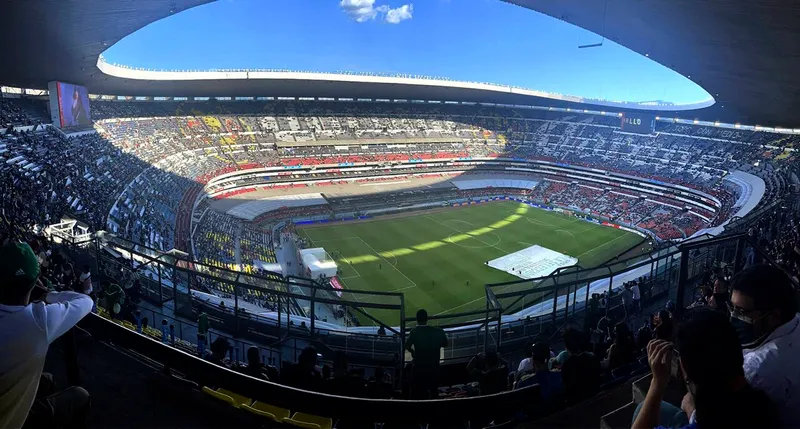
Estadio Azteca holds 87,523 spectators, the largest stadium in Mexico and in Latin America. It’s the permanent home of Club América, Mexico’s most successful club, and the de facto home of El Tri. On match days the atmosphere is overwhelming, more than 87,000 voices forming a wall of sound in the Mexico City basin. The crowds were once even bigger. Before the bowl was converted to all-seater, a 1968 Mexico vs Brazil match packed 119,853 people in.
A renovation completed in early 2026 brought the 60-year-old venue up to current standards: a hybrid GrassMaster pitch, new video screens, LED lighting, a refurbished facade, new locker rooms, and replaced seating throughout. The stadium reopened on March 28, 2026, with a Mexico vs Portugal friendly. It wasn’t a flawless reopening. Crews were still finishing details as the World Cup approached, and early visitors noted unfinished work in places. But the bones of the building, the steep bowl and the sightlines that made it famous, are exactly as they were.
One naming note worth clearing up. The stadium took the commercial name Estadio Banorte in 2025 under a sponsorship deal, and for the World Cup itself FIFA’s non-sponsor policy means it gets branded Estadio Ciudad de México. To everyone who has ever watched football here, it is and always will be the Azteca.
Construction & Design
Estadio Azteca was an act of national ambition. Mexico wanted a stadium worthy of hosting a World Cup, and in the late 1950s it did not have one. Construction began in 1961 on a bed of volcanic rock in the south of the city, the kind of ground that makes engineers nervous and foundations expensive.
Architects Pedro Ramírez Vázquez and Rafael Mijares Alcérreca designed a steep, single-purpose football bowl rather than the multi-use ovals common elsewhere. The angle of the upper deck puts the back row closer to the pitch than at most modern stadiums, which is part of why the noise feels like it’s pressing down on the field. The original construction cost ran to MXN$260 million, a serious figure for Mexico in the 1960s.
It opened on May 29, 1966, with a friendly between Club América and Italy’s Torino F.C. The name honors the Aztec civilization that built Tenochtitlán, the city beneath modern Mexico City. From day one it was the largest and most modern venue in Latin America, and it has stayed at or near the top of that list for 60 years.
The reinforced concrete structure has been tested in ways few stadiums ever are. It came through the magnitude 8.0 earthquake of 1985 and the magnitude 7.1 quake of 2017 with only minor damage, standing intact while buildings around the city fell. That durability is not an accident. It was built to last, and it has.
Getting to Estadio Azteca
Public Transit
Mexico City has one of the most extensive and affordable metro systems in the world, and it goes directly to the stadium.
Metro: Take Line 2 (Blue Line) to the Estadio Azteca station. The station exit puts you within a 10-minute walk of the gates. From the city center (Zócalo), the journey takes approximately 30 minutes and costs 5 pesos (~$0.30 USD).
Metrobús: Line 1 runs along Insurgentes Avenue with a stop at Doctor Gálvez, about a 15-minute walk from the stadium. The Metrobús costs 6 pesos per ride.
Important for World Cup visitors: The metro gets extremely crowded on match days. Arrive at least 2 hours before kickoff. After the match, expect significant congestion at the metro station, so consider walking to an adjacent station or waiting 30-45 minutes for crowds to thin.
Driving + Parking
Estadio Azteca is accessible via the Periférico (ring road) and Calzada de Tlalpan, but driving in Mexico City on match days is not recommended. Traffic around the stadium becomes gridlocked hours before kickoff.
If you must drive, parking is available in the stadium lots and surrounding streets. Official lot parking costs vary by event. Street parking in the surrounding neighborhood carries theft risk, so use official lots only.
Rideshare
Uber and Didi both operate in Mexico City. A ride from the city center to the stadium costs approximately 100-200 pesos ($6-12 USD) under normal conditions. Surge pricing on match days can push this to 300-500 pesos.
Pro tip: Have your driver drop you 2-3 blocks from the stadium to avoid the worst traffic congestion near the gates.
From the Airport
→ Mexico City International Airport (MEX): 14 miles from the stadium, 30-60 minutes by car depending on the notorious Mexico City traffic. The metro connects the airport (Terminal Aérea station, Line 5) to the stadium with one transfer, taking about 45 minutes.
→ Felipe Ángeles International Airport (NLU): The newer airport is 30 miles north. Budget 60-90 minutes by car or use the Mexibús to connect to the metro system.
FIFA World Cup 2026 at Estadio Azteca
On June 11, 2026, Estadio Azteca hosts the Opening Match of the FIFA World Cup, Mexico vs South Africa, and becomes the first stadium in history to stage three World Cup openers. No other venue could carry that honor with the same weight.
The matches: 5 total. The Opening Match on June 11, additional group stage games, and a Round of 32 knockout fixture. The tournament name for the venue is Estadio Ciudad de México, since FIFA does not use sponsor or historic names.
Historic significance: This is Azteca’s third World Cup. In 1970, Brazil beat Italy 4-1 in the Final here, Pelé scoring the opener. In 1986, Argentina beat West Germany 3-2 in another Final, with Maradona running the tournament. The 2026 opener continues a legacy no other building on the planet can claim. For the deeper history, see our piece on Estadio Azteca’s three-opener record.
Altitude factor: At 7,200 feet, the thin air is a genuine competitive weapon. Players who haven’t acclimatized fatigue faster, and the ball flies farther with less swerve. Teams scheduled for Mexico City would be wise to arrive early for altitude training. FIFA is expected to favor earlier kickoff times here to manage heat and player load.
Renovations: The 2026 overhaul raised capacity to 87,523 and added a hybrid GrassMaster pitch, new video screens, LED lighting, a refurbished facade, new locker rooms, and a new player tunnel. The venue reopened in March 2026, with crews still finishing details close to kickoff.
Fan zones: FIFA Fan Festivals will set up at central Mexico City locations, with the Zócalo (the main square) expected to anchor the celebrations. The city’s food scene and nightlife will carry a large share of the tournament experience here.
History of Estadio Azteca
Estadio Azteca opened on May 29, 1966, the largest and most modern venue in Latin America from its first day. The name honors the Aztec civilization that built Tenochtitlán, the ancient city upon which Mexico City stands. What followed was six decades of football history that no other stadium can match.
1970 FIFA World Cup: Azteca hosted 10 matches including the Final, where Brazil, fielding Pelé, Jairzinho, Tostão, and Carlos Alberto, beat Italy 4-1. Pelé’s header and Carlos Alberto’s thunderous closing goal remain two of the most replayed moments in the sport.
1986 FIFA World Cup: Sixteen years later came a second World Cup. Diego Maradona’s Argentina faced England in the quarterfinal here on June 22, 1986, a match that produced both the “Hand of God” goal and the “Goal of the Century,” a 60-meter solo run past half the England team. Argentina went on to beat West Germany 3-2 in the Final, also at Azteca.
Beyond the World Cup: Azteca has hosted NFL regular-season games in the Mexico City Series, major concerts from U2 to Paul McCartney to The Rolling Stones, and thousands of Liga MX matches. It is the spiritual home of Club América and the most important sporting venue in Mexico.
At 60 years old in 2026, Estadio Azteca is the oldest World Cup venue by decades. Age is part of its power. The ghosts of Pelé and Maradona are everywhere here. When the Opening Match kicks off on June 11, more than 87,000 fans will be connected to 60 years of the most important moments in football history.
Notable Events at Estadio Azteca
- 1970 World Cup Final (June 21, 1970): Brazil 4, Italy 1. Widely regarded as the greatest team performance in World Cup history.
- 1986 World Cup quarterfinal (June 22, 1986): Argentina 2, England 1. The “Hand of God” and the “Goal of the Century” in a single match.
- 1986 World Cup Final (June 29, 1986): Argentina 3, West Germany 2, sealing Maradona’s tournament.
- Mexico vs Brazil (July 7, 1968): The football attendance record of 119,853, set in the standing-terrace era.
- Chávez vs Haugen (February 20, 1993): A boxing card drew 132,247, the largest crowd in the stadium’s history.
- NFL Mexico City Series: Regular-season NFL games have drawn capacity crowds, part of the league’s longest-running international effort.
- March 28, 2026: Reopening after renovation, a Mexico vs Portugal friendly, ahead of the venue’s third World Cup.
Sources & Further Reading
- Wikipedia entry on Estadio Azteca: en.wikipedia.org/wiki/Estadio_Azteca. Capacity, the three World Cups, the renovation, and attendance records.
- Estadio Azteca official site: estadioazteca.com.mx. Venue information, events, and visitor details.
- MeetStadium journal: Estadio Azteca, the only stadium to host three World Cup openers. The history behind the three openers.
- MeetStadium journal: Mexico City at 7,200 feet. How altitude shapes the game at the Azteca.
Quick Facts
Everything you need at a glance.
Stadium specs
- Capacity
- 87,523
- Opened
- 1966
- Cost
- MXN$260 million (1966)
- Roof
- Open
- Surface
- GrassMaster (Hybrid)
- Tenants
- Club América (Liga MX), Mexico National Team
- WC 2026
- Opening Match · 5 matches
- First WC match
- June 11, 2026
Construction & location
- Groundbreaking
- 1961
- Architects
- Pedro Ramírez Vázquez, Rafael Mijares Alcérreca
- Address
- Calzada de Tlalpan 3465, Santa Úrsula Coapa, Coyoacán, 04650 Mexico City, CDMX, Mexico
- GPS
- 19.3029°N, 99.1505°W
Photo Gallery
Fun Facts
Estadio Azteca is the only stadium in the world to host three FIFA World Cups (1970, 1986, 2026), and the only one to stage three World Cup opening matches. No other venue has hosted even two.
At 7,200 feet (2,200 meters) above sea level, it's one of the highest-altitude major stadiums in the world. Visiting teams often struggle with the thin air, which earned the venue its 'Fortress' reputation.
Its football attendance record is 119,853, set when Mexico played Brazil on July 7, 1968. The bowl held standing terraces then, long before modern seated capacity brought the number down to 87,523.
Architect Pedro Ramírez Vázquez also designed Mexico City's National Museum of Anthropology. Both opened in the 1960s and both are considered landmarks of modern Mexican architecture.
Stadium Location
Frequently Asked Questions
- What is the seating capacity of Estadio Azteca?
- Estadio Azteca holds 87,523 after its 2026 renovation, making it the largest stadium in Mexico and in Latin America. FIFA lists the same 87,523 figure for the 2026 World Cup. Among all 2026 host venues it trails only AT&T Stadium's roughly 94,000. Historic crowds were far larger when the bowl held standing terraces, peaking at a football record of 119,853 in 1968.
- Where is Estadio Azteca located?
- Estadio Azteca is at Calzada de Tlalpan 3465, in the Santa Úrsula Coapa neighborhood of the Coyoacán borough, southern Mexico City. It sits at 7,200 feet (2,200 meters) above sea level, a significant factor for player performance. The Estadio Azteca metro and light-rail stations are within a 10-minute walk.
- How many World Cups has Estadio Azteca hosted?
- Three: 1970, 1986, and 2026. It is the only stadium in the world to host three World Cup tournaments and the only one to stage three opening matches. It also hosted the 1970 and 1986 Finals, witnessing Pelé's last World Cup triumph and Maradona's 'Hand of God' and 'Goal of the Century.'
- What World Cup 2026 matches will be played at Estadio Azteca?
- Estadio Azteca hosts 5 World Cup 2026 matches: the tournament's Opening Match on June 11, 2026 (Mexico vs South Africa), additional group stage games, and a Round of 32 knockout fixture. The opener makes Azteca the first stadium in history to host three World Cup opening matches, after 1970 and 1986.
- Is Estadio Azteca now called Estadio Banorte?
- Yes, in commercial terms. In 2025 the stadium took the name Estadio Banorte under a naming-rights deal, though it remains universally known as Estadio Azteca. FIFA bans sponsor names at the World Cup, so for the 2026 tournament the venue is branded Estadio Ciudad de México (Mexico City Stadium).
- What will Estadio Azteca be called during the 2026 World Cup?
- Estadio Ciudad de México, often rendered in English as Mexico City Stadium. FIFA requires non-sponsor names for World Cup venues, so neither the historic 'Azteca' nor the commercial 'Banorte' name is used in official tournament broadcasts, signage, and ticketing.
- How do I get to Estadio Azteca by public transit?
- Take Mexico City Metro Line 2 to Tasqueña, then the Tren Ligero light rail to the Estadio Azteca station, a short walk from the gates. Metrobús Line 1 also stops nearby at Doctor Gálvez. Mexico City's transit is cheap, with a metro ride costing 5 pesos (about $0.30 USD), but it gets extremely crowded on match days, so arrive at least two hours early.
- What is the altitude at Estadio Azteca?
- Estadio Azteca sits at 7,200 feet (2,200 meters) above sea level. The thin air reduces stamina for players who aren't acclimatized and changes how the ball flies, traveling farther with less swerve. FIFA has long acknowledged altitude as a competitive factor at the venue, and visiting teams typically arrive early to adjust.
- When did Estadio Azteca open and how old is it?
- Estadio Azteca opened on May 29, 1966, with an inaugural match between Club América and Torino F.C. of Italy. Construction began in 1961. At 60 years old in 2026, it is the oldest venue at the World Cup by decades.
- Who designed Estadio Azteca?
- Architects Pedro Ramírez Vázquez and Rafael Mijares Alcérreca designed Estadio Azteca, building it as a steep concrete bowl optimized for football sightlines. Ramírez Vázquez also designed Mexico City's National Museum of Anthropology. The original construction cost was MXN$260 million.
- What is the record attendance at Estadio Azteca?
- The football attendance record is 119,853, set when Mexico played Brazil on July 7, 1968, when the bowl still held large standing terraces. A 1993 boxing match between Julio César Chávez and Greg Haugen drew an even larger 132,247. Modern seated capacity is 87,523.
- What was renovated at Estadio Azteca for the 2026 World Cup?
- The renovation raised capacity to 87,523 and added a hybrid GrassMaster pitch, new video screens, LED lighting, a refurbished facade, new locker rooms, and a new player tunnel, along with replaced seating throughout the bowl. The stadium reopened on March 28, 2026, with a Mexico vs Portugal friendly. Early reports noted some unfinished work at the reopening, with crews still completing details as the tournament approached.
- What is the playing surface at Estadio Azteca?
- Estadio Azteca uses a GrassMaster hybrid surface, which stitches synthetic fibers into natural grass for durability. The pitch measures the standard 105 by 68 meters required for World Cup matches. The groundskeeping team has six decades of experience maintaining grass at high altitude.
- Who owns Estadio Azteca?
- Estadio Azteca is owned by the Mexican media company Televisa and operated by Ollamani, S.A.B., a sports and entertainment company spun out of Televisa's holdings. The stadium has been part of the Televisa group since its construction in the 1960s.
- What teams play at Estadio Azteca?
- Estadio Azteca is the home of Club América, Mexico's most successful club, and the de facto home of the Mexican national team (El Tri). It has also hosted NFL regular-season games in the Mexico City Series, plus major concerts from U2, Paul McCartney, and The Rolling Stones.
Last updated: 2026-06-04