There’s a photograph that explains high-altitude football better than any number. It’s from La Paz, and it shows Lionel Messi bent over at halftime, being sick on the pitch, while a teammate takes oxygen on the bench. The best player of his generation, undone by the air.
And here’s the strange part. La Paz isn’t even the highest place they play.
Ask most fans where football’s altitude record lives and they’ll say La Paz, Bolivia, home of the fortress where the national team humbles the giants of South America. They’re wrong, and the real answer is stranger: a shrinking silver-mining town in the Peruvian Andes, on the rim of an open pit, where a second-division side plays higher than anyone else on Earth. Here’s every high-altitude ground that matters, ranked, and what the thin air actually does to the teams who climb up to play in it.
4,338 metres: the elevation of Estadio Daniel Alcides Carrión in Peru, the highest ground where professional football has been played.
The highest-altitude football stadiums in the world, ranked
The list runs almost entirely through the Andes, and it splits into three tiers: the extreme Bolivian and Peruvian grounds above 3,800 metres, the famous middle at La Paz, and the “merely high” venues around 2,200 to 2,800 metres that most fans picture as the altitude parks.
| Rank | Stadium | City, Country | Altitude | Known for |
|---|---|---|---|---|
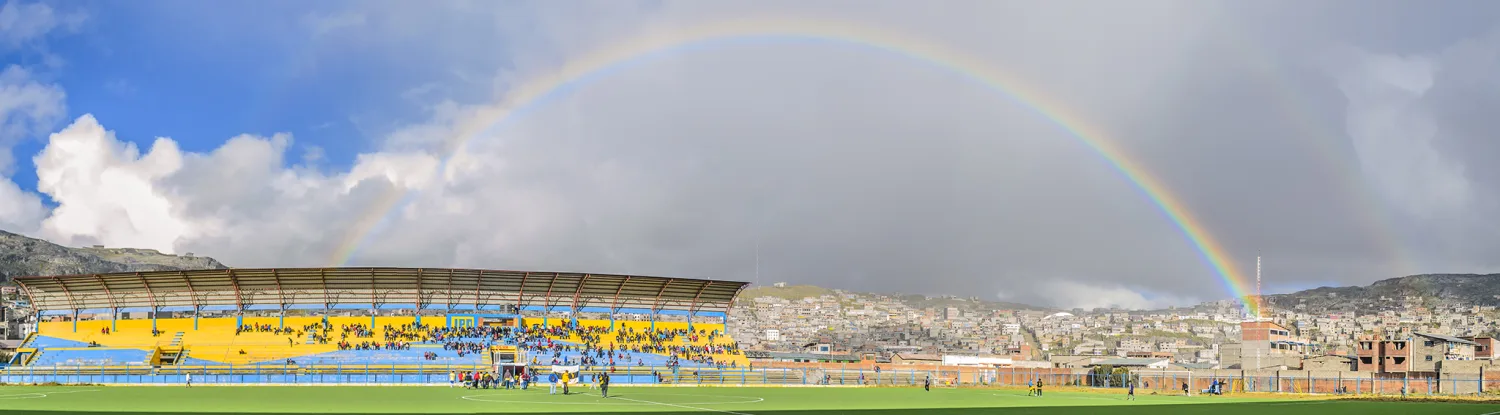
| 1 | Estadio Daniel Alcides Carrión | Cerro de Pasco, Peru | ~4,338 m (14,232 ft) | The highest of all |
| 2 | Estadio Municipal de Villa Ingenio | El Alto, Bolivia | ~4,090 m (13,400 ft) | Highest Copa Libertadores match |
| 3 | Estadio Víctor Agustín Ugarte | Potosí, Bolivia | ~3,890 m (12,760 ft) | The bottled-oxygen ground |
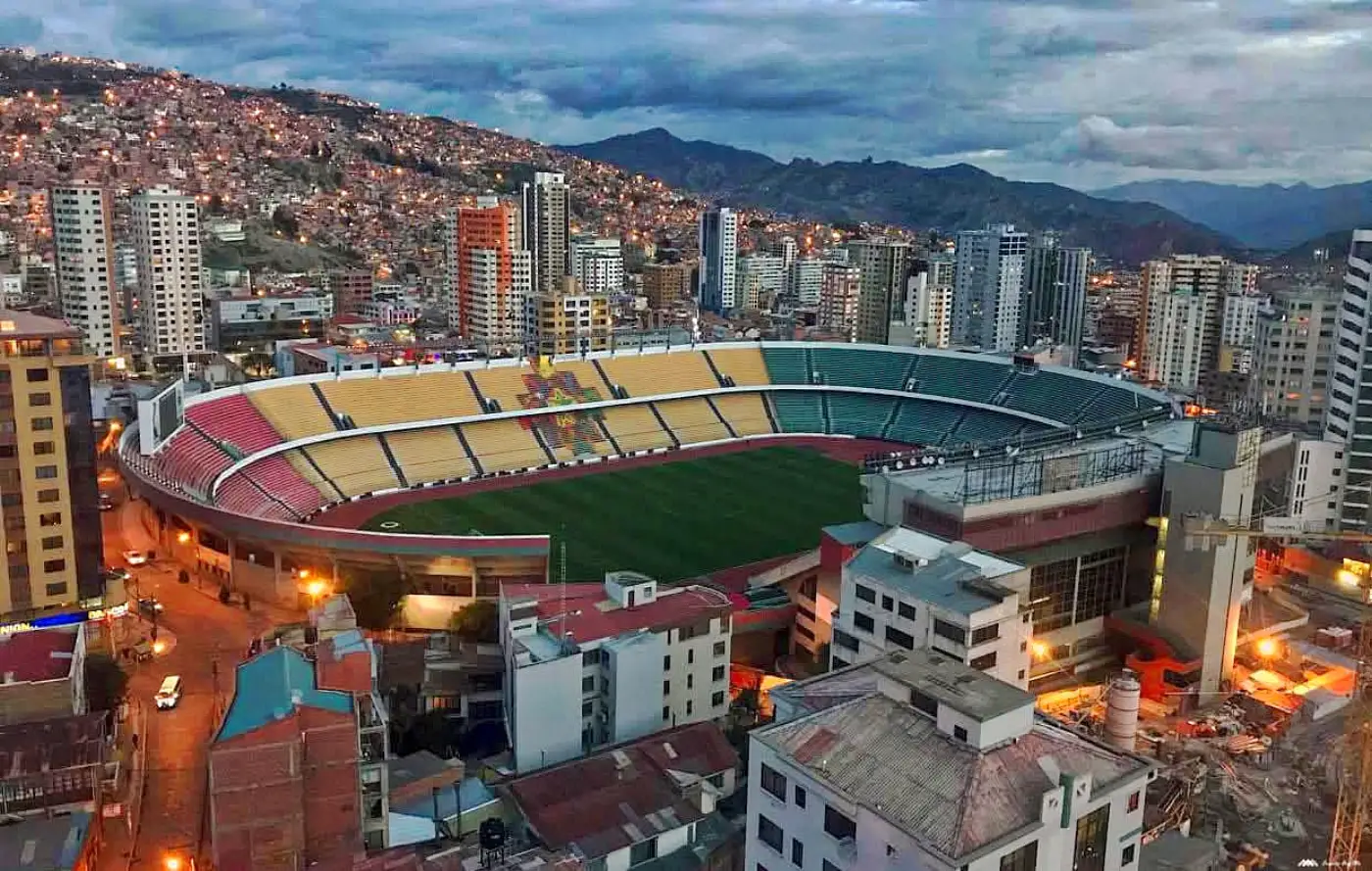
| 4 | Estadio Hernando Siles | La Paz, Bolivia | ~3,600 m (11,800 ft) | The famous fortress |
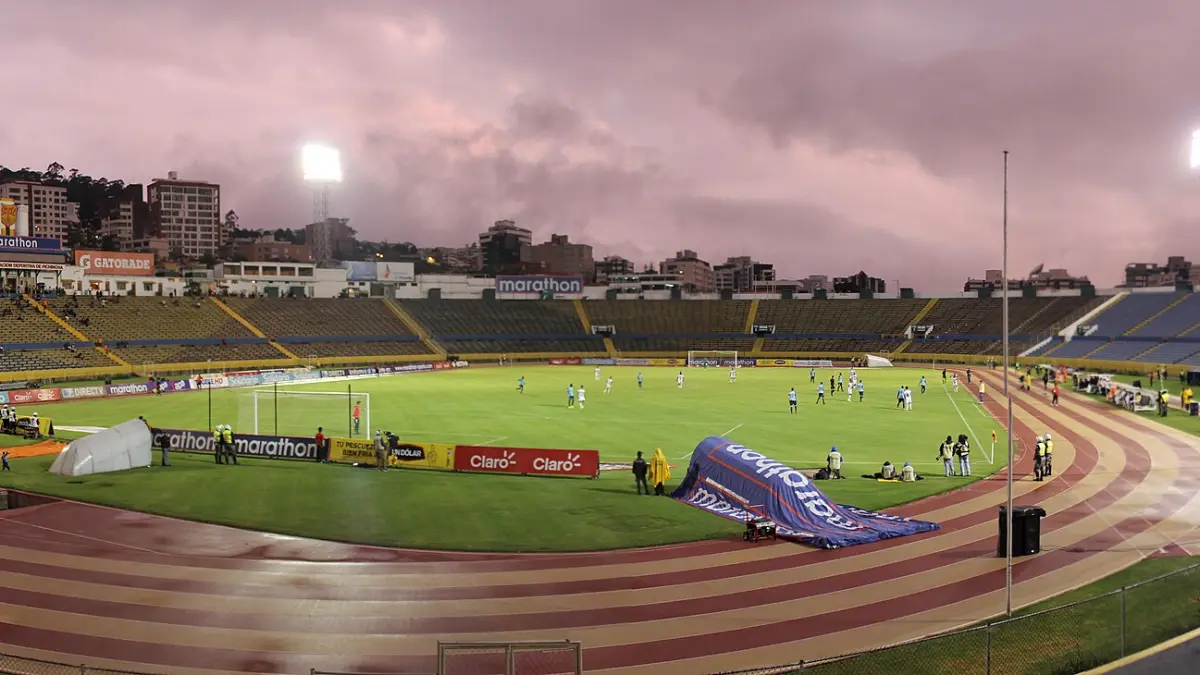
| 5 | Estadio Olímpico Atahualpa | Quito, Ecuador | ~2,800 m (9,200 ft) | Ecuador’s altitude home |
| 6 | Estadio El Campín | Bogotá, Colombia | ~2,550 m (8,370 ft) | Colombia’s capital ground |
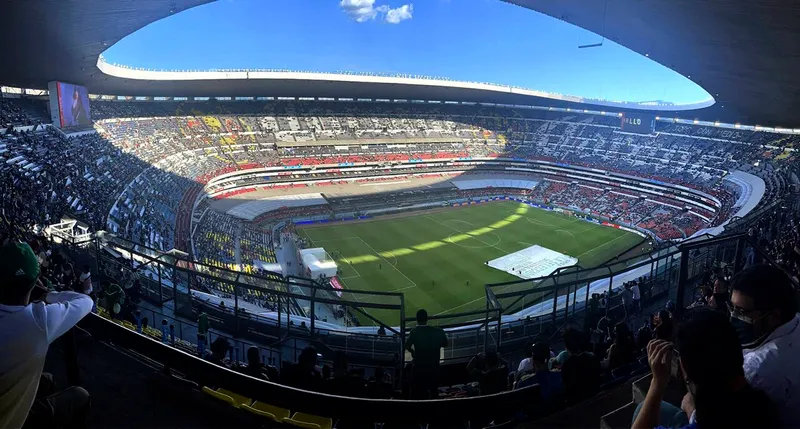
| 7 | Estadio Azteca | Mexico City, Mexico | ~2,200 m (7,200 ft) | The 2026 World Cup venue |
Three names do most of the work in any argument about altitude, and people constantly mix them up. Estadio Daniel Alcides Carrión is the highest. Estadio Hernando Siles is the most famous. And Estadio Azteca is the one that matters for the World Cup. Keep those three straight and the rest of the story falls into place.
The highest of all sits on the edge of a mine
Estadio Daniel Alcides Carrión is a modest 12,000-seat municipal ground in Cerro de Pasco, a Peruvian mining city so high that the town itself, at around 4,330 metres, sits level with the pitch. It’s widely regarded as the highest place professional football has ever been played, and FIFA’s own official magazine has said as much. Worth being precise, though: that’s a magazine note, not a certified world record, and there’s no Guinness entry.
The football here isn’t glamorous. The pitch is synthetic, because grass can’t survive the cold and the ultraviolet light at this height. The main tenant, Unión Minas, spent about 25 years out of the professional game before climbing back into Peru’s second division in 2026, its first taste of the pro ranks in a generation. But the number on the elevation sign is real, and for a visiting player arriving from sea-level Lima, the effect is savage. More on exactly why in a moment.
The setting is as extreme as the altitude. Cerro de Pasco is a shrinking mining city built on and around one of the richest silver deposits ever found, with a vast open pit cut into the middle of town that has slowly swallowed the old streets, to the point that there have been serious proposals to relocate the entire city somewhere else. The ground takes its name from Daniel Alcides Carrión, a local medical student who in 1885 deliberately infected himself with a Peruvian disease to chart how it killed, and died doing it, becoming Peru’s national medical hero. So this is the picture: a stadium at the top of the world, perched on the rim of a mine that is eating its own town, named after a man who gave his life to science. Nothing about the place is ordinary, and the football on its plastic pitch is the least strange thing about it.
About 40 percent: how much less oxygen the air holds at 4,300 metres than at sea level.
Bolivia owns the rest of the top of the list
Look at ranks two through four and you’re looking at Bolivia. Three of the four highest football grounds on the planet sit within its borders, which is why no country has turned altitude into a home advantage quite like it.
Just above La Paz, the satellite city of El Alto has the Estadio Municipal de Villa Ingenio at roughly 4,090 metres. In February 2024 it hosted the highest match in Copa Libertadores history, when Bolivia’s Always Ready played Peru’s Sporting Cristal above 4,000 metres, a fixture that CONMEBOL had to specifically approve. Further south, Potosí’s Estadio Víctor Agustín Ugarte sits near 3,890 metres. It was at a Bolivian ground around this altitude that a visiting Copa Libertadores side was once filmed sucking on bottled oxygen, the image that first got FIFA worried.
Then there’s the famous one. Estadio Hernando Siles in La Paz, at about 3,600 metres, isn’t the highest, but it’s the one the world knows, because it’s where Bolivia has beaten the biggest teams in South America. This is the fortress, and it has the results to back the reputation.
Why the thin air wins football matches
Altitude isn’t a gimmick. It changes the physics of the game and the physiology of the players, and the evidence is measurable.
Start with the ball. The higher you go, the thinner the air, and thinner air means less drag on anything moving through it. A struck shot keeps its speed longer and dips later. A goal kick sails toward the final third. A goalkeeper who has spent a career learning exactly when a cleared ball starts to fall finds his timing off by a fraction that becomes a yard. That part hits in the first ten minutes, before anyone is even tired.
Then there’s the body. Above roughly 1,500 metres, an unacclimatized player’s aerobic capacity starts to drop, and by 3,600 or 4,000 metres a visiting team is running on a slice of its usual engine. The legs still work. What fails is recovery: the short window between sprints no longer refills the tank, so the second half turns into a slow drowning. Coaches who know these grounds plan their substitutions around the hour mark, when the wall arrives.
Is it a real edge, or just folklore? The data says real. An Oxford researcher, Patrick McSharry, analyzed more than 1,400 South American internationals for the British Medical Journal in 2007 and found a clear, statistically significant pattern: the bigger the altitude gap between two teams, the more the high-altitude side scored, conceded fewer, and won. It held home and away. Altitude wasn’t a tiebreaker. It was an advantage you could put a number on.
Teams have tried everything to beat it, and the sports science offers only two decent options, both awkward. Fly in less than a day before kickoff and play before the body fully registers the thin air, banking on adrenaline and one hard match. Or arrive around two weeks early and let the blood build the extra oxygen-carrying capacity that altitude demands. The trap is the middle window, three to five days out, when acute mountain sickness symptoms peak and a squad plays at its physical worst. Get that call wrong and you’ve lost before kickoff.
6-1: Bolivia’s win over Argentina at La Paz in 2009, Argentina’s heaviest defeat in around 60 years.
The nights that made La Paz a legend
You don’t earn a reputation like Hernando Siles from theory. You earn it from results, and La Paz has produced some of the most shocking in the history of World Cup qualifying.
On July 25, 1993, Bolivia beat Brazil 2-0 here, handing Brazil their first-ever defeat in World Cup qualifying. Brazil went on to win the 1994 World Cup anyway, but the aura had cracked, and it cracked up in the thin air. Sixteen years later, on April 1, 2009, Bolivia demolished Argentina 6-1, with Joaquín Botero scoring a hat-trick. It was Argentina’s worst defeat in around six decades and Diego Maradona’s first loss as their coach. Much of the Argentine squad had flown in only hours before kickoff, gambling against the altitude and losing badly.
Then, in 2013, came the image at the top of this article: Messi sick at halftime, Ángel Di María on oxygen, Argentina scraping a 1-1 draw. Critics call Bolivia football’s great cheats for hosting teams this high. Bolivians point out, fairly, that they didn’t choose where to build their country. Either way, the record speaks. Take Bolivia to sea level and they’re ordinary. Bring the world’s best up to La Paz and, for ninety minutes, the gap closes. It’s why the ground routinely lands among the most intimidating atmospheres in world football.
Ecuador embraced the altitude. Colombia walked away from it.
Bolivia gets the headlines, but it isn’t the only country perched on thin air, and its two neighbors to the north made opposite choices about what to do with it.
Ecuador leaned all the way in. The national team plays its home World Cup qualifiers at the Estadio Olímpico Atahualpa in Quito, at around 2,815 metres, and the altitude helped turn a historically minor side into a World Cup regular. At that ground Ecuador has beaten Brazil twice and Argentina twice. In the qualifying campaign for 2026 it lost only two matches, both to Argentina and Brazil, and conceded just five goals across eighteen games, the meanest defensive record in the entire South American round. The thin air didn’t do all of that on its own. But it built the fortress the rest was based on.
Colombia had the same card and refused to play it. Bogotá sits at about 2,640 metres, high enough to punish visitors, and the capital’s Estadio El Campín is a genuine altitude ground. Yet Colombia’s national team hasn’t staged a competitive home qualifier there since the run-up to the 2010 World Cup, a campaign that ended in elimination. Instead the team decamped to Barranquilla on the Caribbean coast, barely 13 metres above the sea, and traded thin air for thick heat. Every one of Colombia’s World Cup qualifications since 1990 has been sealed in Barranquilla’s humidity, not Bogotá’s altitude. It’s the rare case of a country with a mountain fortress deciding the coastal swamp was the scarier weapon.
The time FIFA tried to ban the mountains
Football’s governing body once decided the Andes were too high for the game, and the fight that followed shows how much altitude really matters.
In May 2007, FIFA banned international matches above 2,500 metres, a line that would have outlawed qualifiers in La Paz, Quito, Bogotá and Potosí at a stroke. The trigger had been that bottled-oxygen image from a Bolivian ground. The backlash was ferocious. Bolivian president Evo Morales played an exhibition match at altitude in protest, Maradona called the rule discriminatory against Latin America, and within weeks FIFA raised the limit, then granted a specific exemption for Estadio Hernando Siles, then scrapped the ban entirely in 2008. The mountains won.
2,500 metres: the altitude ceiling FIFA tried to impose in 2007, before backing down within a year.
What all this means for the 2026 World Cup
Most of the grounds on this list will never host a World Cup match. They’re too small, too remote, or in countries that didn’t win the right to host. But altitude still walks onto the biggest stage in 2026, through one venue.
Estadio Azteca in Mexico City sits at about 2,200 metres. That’s low next to the Andean extremes, but it’s the highest of the 16 World Cup 2026 venues by a wide margin, and it’s high enough to bend a match. Mexico has treated Azteca as an edge for over half a century, and any team drawn to play there will feel the difference around the hour mark, the same way visitors do at every ground on this list. We broke down exactly what 7,200 feet does to a game in our piece on how altitude changes the World Cup at Estadio Azteca.
So no, the World Cup won’t be decided at 4,338 metres on the rim of a Peruvian mine. But the same invisible force that lives up there, the thin air that flatters the locals and empties the legs of everyone else, will be sitting quietly in the stands in Mexico City, doing what it has always done.
Sources
- GiveMeSport: The Highest Altitude Football Stadiums in the World. Ranked altitudes for the Andean grounds.
- CNN: Copa Libertadores record match at 4,150m. The El Alto / Villa Ingenio record and CONMEBOL approval.
- Wikipedia: Estadio Daniel Alcides Carrión and Hernando Siles Stadium. Altitudes, capacities, tenants and history.
- ScienceDaily: high-altitude teams have a significant advantage. Summary of Patrick McSharry’s 2007 British Medical Journal study of 1,400-plus internationals.
- FIFA: historic firsts for Bolivia and Brazil. The 1993 qualifier that ended Brazil’s unbeaten qualifying record.
- Hero photo: Estadio Olímpico Atahualpa, Quito, by ground.hopper, CC BY-SA 2.0.
Altitudes vary slightly between sources, especially for grounds measured from different points. The figures here reflect the most commonly cited values and are given as approximate where sources disagree.