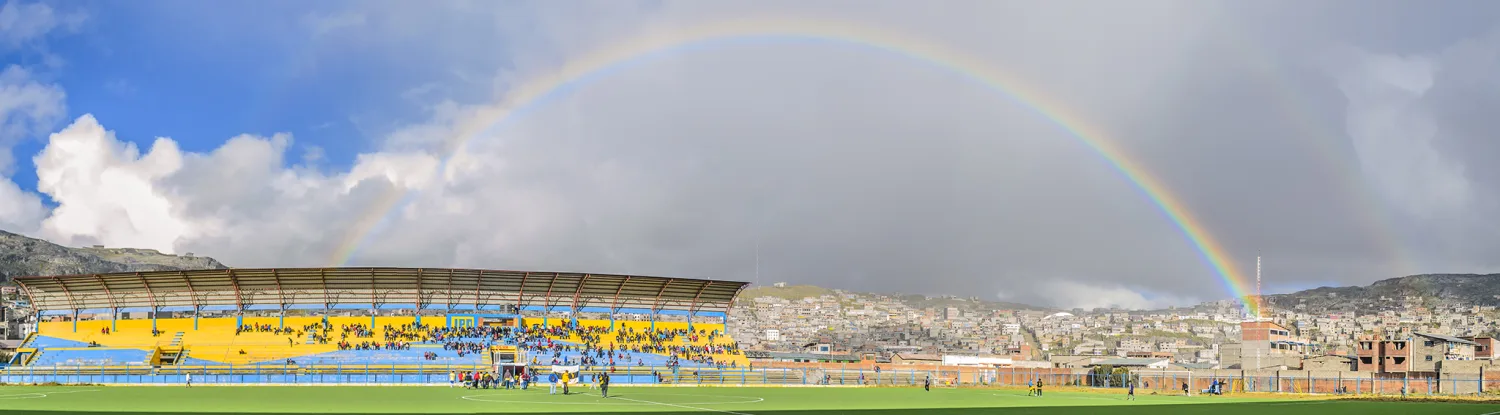
About Estadio Daniel Alcides Carrión
The most remarkable thing about Estadio Daniel Alcides Carrión is not on the field. It is the number on the elevation sign: about 4,338 metres, roughly 14,232 feet, above sea level. That makes this modest municipal ground in the Peruvian mining city of Cerro de Pasco the highest place where professional football has been played anywhere on Earth.
FIFA’s own official magazine has noted that no football pitch sits at a greater altitude. That is worth stating carefully. It is a magazine mention, not a codified FIFA record, and there is no Guinness World Records entry, so the honest claim is that it is the highest, not that it is a certified world record. It does not need the certificate. Cerro de Pasco sits so high that the city itself, at around 4,330 metres, is roughly level with the pitch, and for the players who grew up here the thin air is simply ordinary life.
The stadium holds about 12,000 people and its surface is synthetic turf, not grass. It is home to Unión Minas, back in Peru’s professional second division in 2026 after roughly a quarter of a century away, and to Ecosem Pasco. The stands are open to a hard, cold, high-Andean sky.
For a visiting team, none of that is ordinary. They arrive from the coast, from Lima at sea level, and within an hour their legs stop refilling between sprints. The number on the sign is the whole story of the place.
Getting to Estadio Daniel Alcides Carrión
Reaching this stadium means reaching one of the highest cities on the planet, and there is no shortcut by air.
Public Transit
Long-distance buses are the main way in. Services run from Lima’s Plaza Norte terminal to Cerro de Pasco in around 9 hours, climbing the Carretera Central through La Oroya. Fares are inexpensive, in the region of 40 to 70 soles. Within the compact city, the stadium is a short taxi or walk from the center.
→ Via bus from Lima: About 9 hours, departing Plaza Norte. The road climbs steadily from sea level to over 4,300 metres, so the altitude arrives with you.
→ Local taxi: Cerro de Pasco is small and walkable, and taxis are cheap. There is no formal metro or light rail.
Give yourself time to acclimatize before doing anything strenuous. Soroche, altitude sickness, is common for arrivals from the coast.
Driving + Parking
Driving from Lima takes about 5 to 6 hours in good conditions, following the Carretera Central through La Oroya and north to Cerro de Pasco.
→ From Lima (~300 km): 5 to 6 hours via the Carretera Central and La Oroya. The route is one long climb into the Andes.
→ From Huánuco (~85 km): Roughly 2 hours south on the mountain roads.
Street parking around the ground is informal. This is a small city, not a major-league metropolis, and the logistics are correspondingly simple.
Rideshare
App-based rideshare is not a reliable option in Cerro de Pasco. Local taxis, hailed on the street or arranged through your accommodation, are the practical way to move around town, and fares are low.
From the Airport
→ Huánuco (HUU): The nearest airport, about 85 kilometres north, roughly a 2 hour drive. It has limited domestic service.
→ Lima (LIM): The main international gateway, about 300 kilometres and a full day of travel away by road. Nearly every visitor arrives through Lima first.
Playing Football at 4,338 Metres
To understand what the altitude does here, measure it against the grounds already famous for it. Estadio Azteca, where World Cups were partly decided in the thin air of Mexico City, sits at about 2,200 metres. Bolivia’s fortress in La Paz, where visiting players have reached for oxygen on the bench, is near 3,600 metres. Cerro de Pasco is higher than both, at roughly 4,338 metres, where the air holds around 40 percent less oxygen than at sea level.
At that height the effect on a player who is not used to it is not subtle. The heart races, the legs empty early, and decisions get harder as the match wears on, while a struck ball carries faster and drops later through the thin air. It is the reason the surface is synthetic, because grass barely survives up here, and the reason the ground has drawn its share of controversy over whether football should be played this high at all. For the local sides who live at this altitude, none of it registers. That is the entire advantage of the highest football ground on the planet, and it cannot be bought, only lived at.
Construction & Design
Estadio Daniel Alcides Carrión was built as a municipal ground in the 1960s, though the exact year and the detailed construction record are not reliably documented. Who designed it, who built it and what it cost are not separately recorded in the available sources, which is not unusual for a mid-century regional stadium in a remote Andean city. What is clear is its purpose: a home for football in a town whose life has always been dominated by the mine at its center.
The single design decision that defines the place today is the surface. The original pitch was natural grass, but in a 2012 renovation it was replaced with synthetic turf, and the capacity was raised from about 8,000 to roughly 12,000. The reason for the switch is the altitude itself. Above 4,300 metres, grass fights a losing battle against cold nights, punishing ultraviolet light and thin, dry air, and a reliable playing surface matters more than tradition. It is a compromise that many high-altitude Andean grounds have made.
Everything else about the stadium is shaped by where it stands. The stands are open. The light is harsh and the air is cold. Beyond the terraces lies a city built on and around one of the world’s richest silver deposits, with a vast open-pit mine cut into its very center. The ground is named for Daniel Alcides Carrión, the local-born medical student who in 1885 infected himself with a Peruvian disease to trace its course and died doing so, becoming the country’s great medical martyr. A stadium at the edge of an open pit, named after a man who gave his life to science, is a fittingly severe monument for the highest football in the world.
History of Estadio Daniel Alcides Carrión
For a small municipal ground, the stadium has had a real top-flight history, almost all of it written by one club.
Unión Minas, the team of the mining city, rose into Peru’s Primera División and played there through much of the period from the mid-1980s into 2001. At altitude, they were an awkward proposition, and every visiting coach knew it before the coach even left Lima. Across 1991 and 1992 the club was reported to have gone unbeaten at home, the thin air doing to visitors what it has always done. Top-flight opponents came up from the coast, spent ninety minutes fighting for breath at more than four kilometres above the sea, and left with nothing.
The most cited single result came late in that era. On June 25, 2000, Universitario de Deportes won 2-1 in Cerro de Pasco, a victory that helped the Lima giants toward the Torneo Apertura that season. It was the kind of fixture the ground was built for, a big club forced to solve the altitude problem for ninety minutes.
Then came the lean years. Unión Minas dropped out of the top division around 2001, and for the next quarter of a century the stadium’s football was mostly Copa Perú and the local Cerro de Pasco league, kept alive rather than celebrated. That changed in the mid-2020s. Ecosem Pasco climbed into the semi-professional Liga 3 in 2025, and in 2026 Unión Minas returned to professional football in Liga 2, bringing the professional game back to the highest ground in the world after about 25 years away. A regional renovation of the stadium has been reported to match the club’s ambitions.
It is a modest history by the standards of a national cathedral, but that is the point. This is not a monument. It is a working stadium at the top of the world, and after a long quiet spell, the serious football has come back to it.
Sources & Further Reading
- Wikipedia, Estadio Daniel Alcides Carrión: en.wikipedia.org. Altitude, capacity, surface, tenants and the renovation timeline.
- Wikipedia (Spanish), Estadio Daniel Alcides Carrión: es.wikipedia.org. The FIFA-magazine altitude note and the club history.
- Fútbol Peruano: futbolperuano.com. Peruvian coverage of the ground as the highest in the world.
- Mayo Clinic Proceedings, Daniel Alcides Carrión: mayoclinicproceedings.org. The life and self-experiment of the stadium’s namesake.
- CNN, high-altitude football record: cnn.com. Context on record-altitude Andean matches.
Quick Facts
Everything you need at a glance.
Stadium specs
- Capacity
- 12,000
- Opened
- 1960
- Cost
- Not separately recorded
- Roof
- Open
- Surface
- Artificial Turf
- Tenants
- Unión Minas, Ecosem Pasco
Construction & location
- Groundbreaking
- Not separately recorded
- Architects
- Not separately recorded
- Engineering
- Not separately recorded
- General contractor
- Not separately recorded
- Address
- Cerro de Pasco, Pasco Region, Peru
- GPS
- 10.6850°S, 76.2480°W
Fun Facts
The whole city sits as high as the pitch. Cerro de Pasco is about 4,330 metres (14,200 feet) above sea level, one of the highest cities on Earth, so 4,300 metres is ordinary life for local players while visiting teams arrive gasping. FIFA's official magazine has flagged it as the highest ground where professional football has been played.
It is named after a man who killed himself for science. In 1885 the medical student Daniel Alcides Carrión deliberately infected himself with a Peruvian disease to chart its course, contracted the fatal form, and died at 26, proving two illnesses shared one cause. He became Peru's national medical hero, and October 5 is Peruvian Medicine Day in his memory.
The natural grass was torn out because it could not survive up here. In the 2012 renovation the pitch was replaced with synthetic turf, since real grass struggles against the cold, the intense ultraviolet light and the thin air at more than 4,300 metres.
Stadium Location
Frequently Asked Questions
- Is Estadio Daniel Alcides Carrión the highest football stadium in the world?
- It is widely regarded as the highest ground where professional football has been played. It sits at about 4,338 metres (14,232 feet) above sea level in Cerro de Pasco, Peru. FIFA's official magazine has noted that no football pitch is located at a greater altitude. That is a magazine reference rather than a formal FIFA ruling, and there is no Guinness World Records entry, so it is best described as the highest, not as an officially certified record.
- How high is Estadio Daniel Alcides Carrión?
- About 4,338 metres (14,232 feet) above sea level. Some Peruvian sources cite figures up to roughly 4,380 metres, probably measuring from different points, so the honest range is 4,338 to 4,380 metres. Either way it is far higher than the famous Andean grounds: La Paz's Estadio Hernando Siles sits near 3,600 metres and Estadio Azteca at about 2,200 metres.
- What is the seating capacity of Estadio Daniel Alcides Carrión?
- The stadium holds about 12,000 spectators. It originally seated roughly 8,000 and was expanded to 12,000 during a 2012 renovation that also replaced the grass with synthetic turf.
- Which teams play at Estadio Daniel Alcides Carrión?
- It is the home of Unión Minas, who returned to Peru's professional second division (Liga 2) in 2026 after about 25 years away, and of Ecosem Pasco, who reached the semi-professional Liga 3. The ground also hosts Copa Perú matches and the local Cerro de Pasco league. In the 1980s and 1990s Unión Minas played in Peru's top flight here, and were famously hard to beat at home.
- How do you get to Cerro de Pasco?
- There is no airport in the city. Most visitors drive from Lima, about 5 to 6 hours via the Carretera Central through La Oroya, or take a bus of around 9 hours from Lima's Plaza Norte terminal. The nearest airport is Huánuco (HUU), roughly 85 kilometres north. Because the city sits above 4,300 metres, altitude sickness is a real risk, and gradual acclimatization is strongly advised.
- Why does the stadium use artificial turf?
- Because natural grass struggles to survive at this altitude. Above 4,300 metres the cold, the strong ultraviolet light and the thin air make a healthy grass pitch very hard to maintain, so the 2012 renovation installed synthetic turf. Many high-altitude Andean grounds have made the same switch.
- Who was Daniel Alcides Carrión?
- Daniel Alcides Carrión was a Peruvian medical student, born in Cerro de Pasco in 1857. In 1885 he inoculated himself with blood from a patient to study a local disease, contracted its fatal form and died, proving that two conditions previously thought separate shared a single cause, now called Carrión's disease. He is Peru's foremost medical hero, and October 5, the day he died, is Peruvian Medicine Day.
- Does the altitude really affect matches at Cerro de Pasco?
- Yes. At more than 4,300 metres the air holds far less oxygen than at sea level, so visiting players tire and recover far more slowly, while a struck ball carries faster and farther through the thin air. Local players who live at this altitude barely notice it. It is the same effect that makes Bolivian and Ecuadorian grounds so feared, taken to an extreme.
- Is Estadio Daniel Alcides Carrión higher than Azteca or La Paz?
- Yes, by a wide margin. Estadio Azteca in Mexico City sits at about 2,200 metres and Estadio Hernando Siles in La Paz at around 3,600 metres. Cerro de Pasco is roughly 4,338 metres, where the air holds about 40 percent less oxygen than at sea level, which is why it is regarded as the highest ground where professional football has been played.
Last updated: 2026-07-17