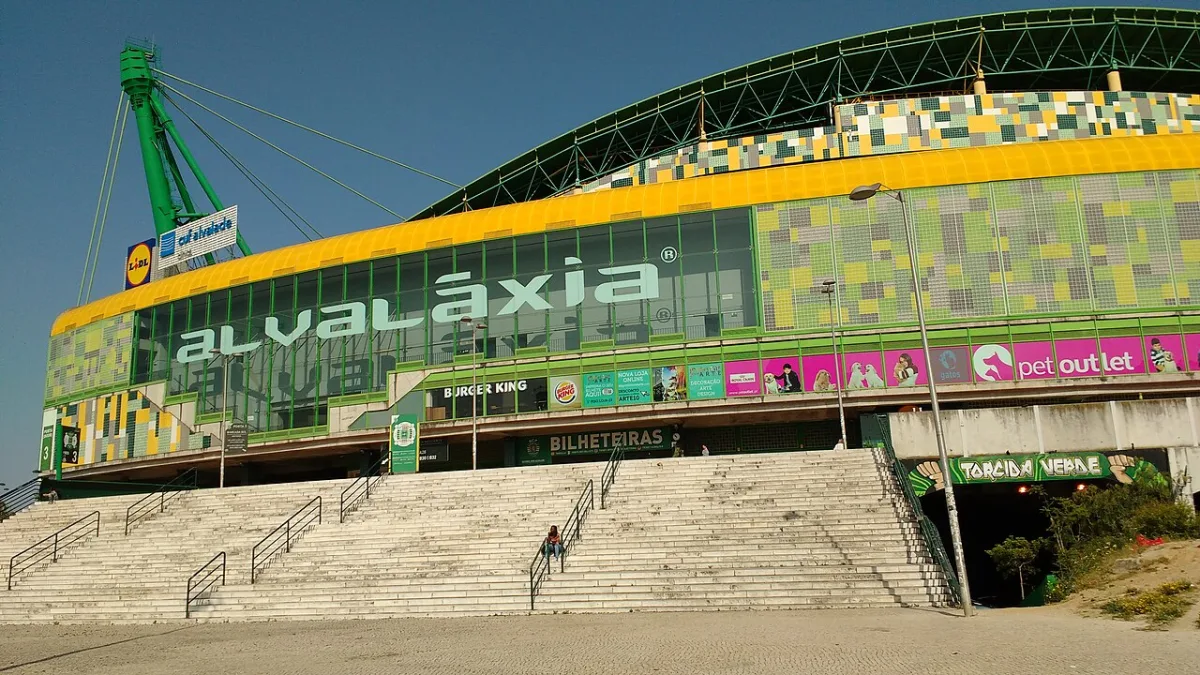
About Estádio José Alvalade
Few stadiums announce themselves as loudly as this one. The Estádio José Alvalade, Sporting CP’s home in northern Lisbon, wears a facade of bright, clashing colored panels, the work of an architect who never met a bold idea he did not like. Behind that skin is a bowl that opened in 2003 and now holds 52,095 after a 2025 expansion, named for the man who founded the club, and built to put Lisbon on the map for Euro 2004.
The ground replaced an older Alvalade that had stood on the site since the 1950s, and it sits at the heart of the Alvalade XXI complex, a cluster of retail, restaurants, and the Sporting museum in the Lumiar district of northern Lisbon, near the university and barely four kilometres from the airport. The pitch is natural grass, 105 metres by 68, under a roof that covers the stands but leaves the turf open and lets daylight flood in. Sporting own and run the whole thing.
Its opening night is the stuff of legend for reasons that had nothing to do with Sporting: they beat Manchester United 3-1 in the friendly after which United signed a teenage Cristiano Ronaldo, a homegrown Sporting talent who would leave Lisbon within days. Since then the ground has hosted a European Championship semifinal and a UEFA Cup final, and on a Lisbon derby night, green and white from top to bottom, it is one of the most vivid stadiums in the country.
Getting to Estádio José Alvalade
Getting here is refreshingly simple: the metro stops almost at the door. Here is how to reach Alvalade however you are traveling.
Public Transit
The metro is the obvious choice, and a good one. Campo Grande station, an interchange on both the Green and Yellow lines, is only about 280 metres from the gates, one of the shortest walks from train to turnstile anywhere in European football. From Baixa in the center the Green Line runs straight there; from Marquês de Pombal the Yellow Line does the same, each around ten to fifteen minutes. Campo Grande is also a big bus hub, so routes like the 736 are a useful backup.
Driving + Parking
By car the ground is easy to reach, ringed by the Segunda Circular, the Eixo Norte-Sul, and the CRIL, with the Campo Grande and Telheiras exits feeding right to it. Parking is the tighter part. The Alvalade XXI mall next door has an underground garage of around 1,315 spaces, but it fills quickly on match days and the surrounding streets clog. As with most Lisbon grounds, the metro will save you the hassle of getting out afterward.
Rideshare
Uber and Bolt both operate normally across Lisbon, around the clock and including the airport, with Bolt usually the slightly cheaper of the two. Drivers drop off around the Alvalade XXI complex beside the stadium. Fares are reasonable by Western European standards, though the usual surge applies on match nights and the crawl out of the area after a big game is real.
From the Airport
Alvalade may be the easiest major stadium in Europe to reach from its airport. Lisbon’s Humberto Delgado sits barely four kilometres away on the same northern side of the city. A taxi or Bolt gets you there in under ten minutes for around eight to ten euros. By metro, take the Red Line from the airport to Alameda, change to the Green Line, and ride to Campo Grande, roughly twenty to twenty-five minutes on a single ticket.
Construction & Design
Sporting handed the commission to Tomás Taveira, a Portuguese architect known for buildings that shout rather than whisper, and he obliged. His Alvalade is wrapped in a mosaic of vivid, mismatched panels, a facade that looks less like a stadium than a work of pop art, paired with a translucent roof designed to pour natural light onto the stands. Ground was broken on 15 January 2001, and the finished ground opened in August 2003, purpose-built as a Lisbon host venue for Euro 2004 and a replacement for the tired 1950s original next door.
It was not cheap. The project came in around 184 million euros, roughly 80 million over its original budget, of which the Portuguese state contributed a precise 17,907,915 euros. That figure covered more than the bowl: the Alvalade XXI complex added shops, restaurants, and a 1,000-square-metre Sporting museum that opened in 2004, turning a stadium into a small district. The idea, common enough now but bold then, was that the ground should earn its keep on the 350-odd days a year without a match, drawing shoppers and museum visitors to a corner of Lisbon that had little reason to gather before.
Taveira’s riot of color has softened over the years. The club gradually swapped the original multicolored seats for a uniform green, a job finally finished in 2022, and painted the roof towers and stairwells in Sporting’s shade. The bones and the bold facade remain, but the inside now reads as one clean sweep of green rather than the architect’s original confetti. It is a rare example of a stadium being quietly toned down rather than dressed up, the club trading its designer’s chaos for the plain identity of its own colors.
History of Estádio José Alvalade
The first night set an unlikely tone. On 6 August 2003 Sporting opened the ground by beating Manchester United 3-1, and the visiting manager left so impressed by a teenage winger on the other side that he signed him within weeks. Cristiano Ronaldo’s Old Trafford career, and the long road to five Ballons d’Or, effectively began on this pitch, in front of the club that raised him.
Euro 2004 arrived within a year. Alvalade hosted five matches, from group games including Portugal’s 1-0 win over Spain up through the semifinal on 30 June 2004, where the host nation beat the Netherlands 2-1, Cristiano Ronaldo and Maniche scoring, to reach the final on home soil. It was a fitting stage for the tournament that the ground had been built to serve, and it earned UEFA five-star status in 2005, the top rating of its day.
Not every big night went Sporting’s way. On 18 May 2005 the stadium staged the UEFA Cup final, and Sporting had the cruel luck of losing it 3-1 to CSKA Moscow on their own pitch, as the Russian side became the first from their country to win a major European trophy. Few clubs have had to watch a European final handed out in their own home to someone else, and the wound is still remembered in Lisbon.
In the years since, Alvalade has kept its place among Europe’s important grounds, hosting Champions League nights, Portugal internationals, and, in 2025, the Women’s Champions League final. Happier nights came later: Sporting’s long-awaited league titles in 2021, ending a 19-year wait, and again in 2024 were roared home at Alvalade, finally giving the bold ground the domestic glory its architect’s ambition always implied. An expansion for the 2025-26 season lifted the capacity from its original 50,095 to 52,095, a modest but telling addition for a club whose crowds had outgrown the ground. For a stadium built on a deadline for one tournament, it has aged into a fixture of the European game.
Sources & Further Reading
- Sporting CP official site: sporting.pt. The club’s own pages on the stadium, capacity, and directions.
- Wikipedia entry on Estádio José Alvalade: en.wikipedia.org/wiki/Estádio_José_Alvalade. Construction, capacity, and the full events record with sourcing.
- ESPN match report: espn.co.uk. The Euro 2004 semifinal, Portugal 2-1 Netherlands, at Alvalade.
- Football Ground Guide: footballgroundguide.com. Capacity, address, and visitor detail.
Quick Facts
Everything you need at a glance.
Stadium specs
- Capacity
- 52,095
- Opened
- 2003
- Cost
- €184 million
- Roof
- Roof over stands (open pitch)
- Surface
- Natural grass
- Tenants
- Sporting CP (Primeira Liga)
Construction & location
- Groundbreaking
- 2001
- Architects
- Tomás Taveira
- Engineering
- Not separately recorded
- General contractor
- Not separately recorded
- Address
- Rua Professor Fernando da Fonseca, 1501-806 Lisboa, Portugal
- GPS
- 38.7611°N, 9.1608°W
Photo Gallery
Fun Facts
The stadium opened on 6 August 2003 with Sporting beating Manchester United 3-1, the friendly after which United famously signed a teenage Cristiano Ronaldo.
Architect Tomás Taveira originally scattered the seats in a random mosaic of mixed colors; the club later replaced them all with green, a change finally completed in 2022.
It hosted a Euro 2004 semifinal, where Portugal beat the Netherlands 2-1, and less happily the 2005 UEFA Cup final, where Sporting lost 3-1 to CSKA Moscow on their own pitch.
Stadium Location
Frequently Asked Questions
- What is the capacity of Estádio José Alvalade?
- The stadium now holds 52,095, following an expansion completed for the 2025-26 season. It opened in 2003 with a capacity of 50,095, so both figures still circulate depending on how recent the source is.
- Who plays at Estádio José Alvalade?
- It is the home of Sporting CP, who own and operate the stadium and have played there since 2003. The Portugal national team also hosts selected matches here.
- Why is it called Estádio José Alvalade?
- It is named after José Alvalade, the founder and first member of Sporting Clube de Portugal in 1906. The ground carries no corporate sponsor name.
- When did Estádio José Alvalade open?
- It opened on 6 August 2003 with a friendly against Manchester United, replacing the original 1950s Alvalade in time for Portugal to co-host Euro 2004.
- What role did the stadium play at Euro 2004?
- It hosted five matches, including the semifinal on 30 June 2004 where Portugal beat the Netherlands 2-1 to reach the final. It earned UEFA five-star status in 2005.
- How do I get to Estádio José Alvalade by metro?
- Take the Green or Yellow line to Campo Grande, about a 280-metre walk from the ground. From central Lisbon the ride is roughly 10 to 15 minutes.
- How close is Estádio José Alvalade to the airport?
- Very close. Lisbon Airport is only about 4 kilometres away on the same side of the city, a taxi ride of under 10 minutes.
- Is the pitch covered by a roof?
- The roof shelters the stands but leaves the pitch open to the sky, and it was designed to let plenty of natural light through. The surface is natural grass.
Last updated: 2026-07-13