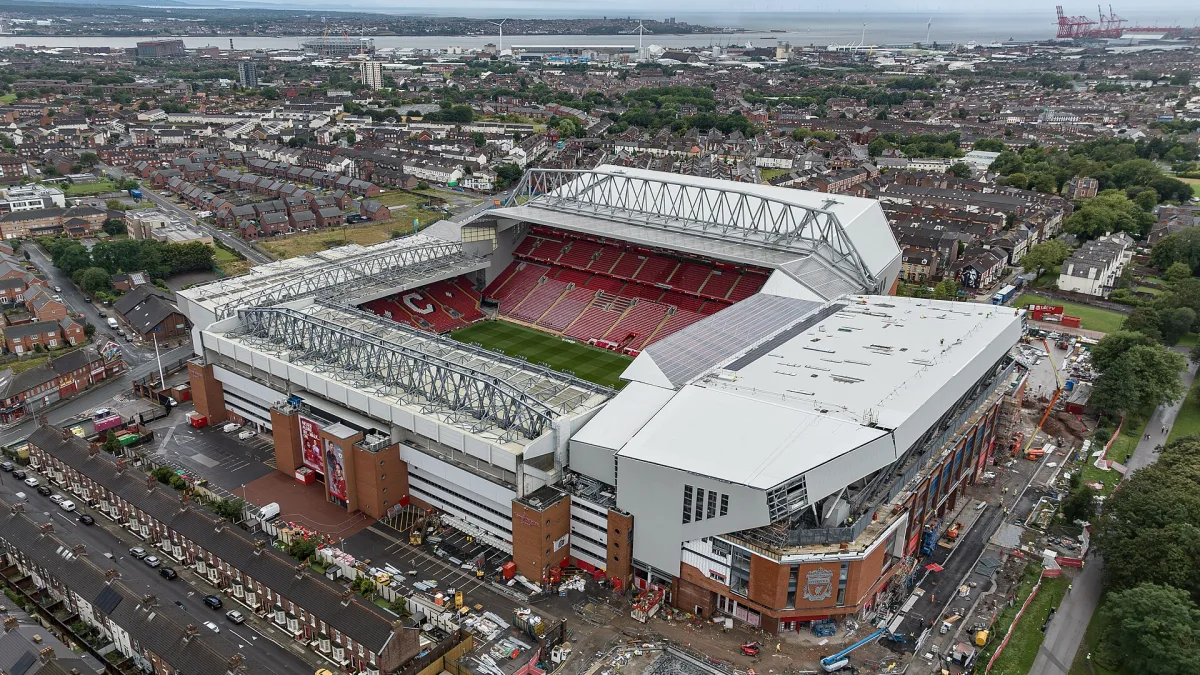
About Anfield
Stand on the Kop in the minute before kick-off and the noise arrives before the song does: scarves up, sixty thousand people, and a single tier of more than 12,000 seats behind the goal doing most of the work. That end made the ground’s name. The rest of Anfield brings the total to 61,276, the figure Liverpool confirmed in August 2024 and the one the Premier League prints for 2026-27, third in this season’s top flight behind Old Trafford and the Tottenham Hotspur Stadium. The club has played here since 1 September 1892, when no more than 200 people watched its first match, a 7-1 friendly win over Rotherham Town. Everton got here first. They played at Anfield from 1884 until a row over rent with their landlord John Houlding sent them across Stanley Park in 1892, and Houlding, left with an empty ground, founded Liverpool to play in it.
Four stands, four histories. The Kop, named in 1906 by a Liverpool Echo sports editor after a Boer War hill where a local regiment had lost more than 300 men, many of them from Liverpool, was a terrace of somewhere between 27,000 and 30,000 standing until the Taylor Report turned it into seats in 1994. The Main Stand, whose lower tier went back to Archibald Leitch’s 1906 ground, was rebuilt around itself in 2014-16 under a 650-tonne roof truss and now holds about 20,500 on three tiers. The Sir Kenny Dalglish Stand opposite (Kemlyn Road until 1992, the Centenary Stand until 2017) has two. The Anfield Road End got a new upper tier in 2024 after its contractor collapsed halfway through the job. That is how a ground on a residential street ended up above 61,000 without moving an inch.
It nearly did move. Liverpool spent 2002 to 2010 planning a 60,000-seat replacement 300 yards (270 metres) away in Stanley Park, won planning permission, hired an architect, and then ran out of money when the 2008 crash caught owners who had bought the club with borrowed cash. Fenway Sports Group arrived in October 2010, John W. Henry sat through a few games, called the Kop unrivaled, and chose to expand instead. The pitch is a hybrid carpet of grass and synthetic fibre, 101 by 68 metres (110 by 74 yards), four metres too short for UEFA’s tournament rules, and that is why Euro 2028 goes to Everton’s new stadium on the docks rather than here.
The guest list is long regardless. England’s first visit in 1889, a world featherweight title fight in 1934, Billy Graham preaching to 30,000 a night in 1984, Euro 96 with three group games and a quarter-final, the 2016 Rugby League Four Nations final, Taylor Swift for three nights in June 2024. And a record of 61,905 from an FA Cup tie against Wolves in 1952 that no football crowd here has touched since.
Getting to Anfield
Public Transit
There is no station at the ground. The nearest, Kirkdale on Merseyrail’s Northern Line, is about a mile (1.6 kilometres) away; Lime Street, where the trains from London Euston arrive, is two miles (3 kilometres). The club’s answer is a bus.
→ Soccerbus from Sandhills: Take the Northern Line to Sandhills and board the Soccerbus shuttle. It runs for two hours before kick-off, with the last bus about 15 minutes before the whistle, and for 90 minutes afterward; the last one leaves Walton Lane roughly 75 minutes after full time.
→ 917 express from the city center: Leaves Commutation Row and reaches the ground in about 15 minutes. Adult single £2.30, return or day ticket £4.60; children £1.20 and £2.30.
→ Other buses: The 26 from Liverpool ONE bus station and the 17 from Queen Square run direct.
→ Back to Lime Street afterward: Peoplesbus 501 leaves Walton Lane for Lime Street (Skelhorne Street) for up to two hours after the final whistle, £2.50 for adults and £1.50 for children.
→ On foot: Lime Street is a signposted two-mile walk of 30 to 40 minutes. Sandhills and Kirkdale are each about half an hour on foot, and the approach from the County Road side, past Goodison, climbs steeply at the end.
Take the bus in. Walk out. The roads around the ground stay closed for an hour after the final whistle, so the crowd thins on foot before anything with wheels moves.
Driving + Parking
Do not. The club says it plainly: there is no public matchday parking at Anfield, every surrounding street runs a residents’ permit scheme, and cars parked illegally are fined. The stadium address is Anfield Road, Liverpool L4 0TH, about two miles north of the city center, ten minutes by car on a quiet day.
→ Roadworks until March 2027: Walton Breck Road, the street along the Kop, is down to a single lane between Oakfield Road and Sleepers Hill while the pavements are widened and the road resurfaced, and traffic runs one way only, from Oakfield Road toward the city.
→ Matchday closures: The roads around the ground shut 90 minutes before kick-off and reopen an hour after the final whistle. Supporters in the Sir Kenny Dalglish Stand can only leave by turning left onto Anfield Road.
→ If you must drive: Use the club’s express matchday buses from the city center and Bootle as a park-and-ride. Registered disabled supporters can enter a ballot for accessible bays at the top of the Stanley Park car park, less than five minutes from the turnstiles, with drop-off points on Gilman Street and Oakfield Road.
Cyclists do better: the Cycle Hub in the Stanley Park car park is free.
Rideshare
Black cabs and Uber both work in Liverpool, and the club keeps taxi ranks around the ground; the one beside the Paisley Gates has moved to Venmore Street for the duration of the Walton Breck Road works. Taxi One runs a shared taxibus from Commutation Row direct to Anfield from £3 a head. Getting away is the hard part: with the roads shut for an hour after the whistle, the choice is the 501 bus, a pint on Oakfield Road, or a walk toward Walton Lane before you order a car.
From the Airport
→ Liverpool John Lennon (LPL): About 10 miles (16 kilometres) south of the ground, 25 to 35 minutes by taxi depending on traffic. By public transport, take the 80A or 86A bus from the terminal to Liverpool South Parkway station (about 15 minutes), a Northern Line train toward Ormskirk to Sandhills, and the Soccerbus from there, or head into the city center and pick up the 917 from Commutation Row.
Watching a Match at Anfield
Start with the argument, because the people who sit here have it every week. In December 2023, after a goalless draw with Manchester United, Jürgen Klopp said he had not been happy with the atmosphere behind him, wondered what the crowd wanted, and told anyone not in the right shape to give their ticket to someone else. Four months later a Liverpool supporter in the lower Main Stand posted on r/LiverpoolFC that Atalanta’s away end had outsung the home crowd from an hour before kick-off to the final whistle, and the replies blamed a season-ticket waiting list so long that nobody ever gives one up, plus touts selling Kop seats to visitors on the condition they did not sing. An away supporter who had done every Premier League ground by May 2025 put it more kindly: a bit of a tourist trap, the atmosphere has gone down recently, and when it gets going there are few better places in England. The club’s response has come through the ticket office. Local tickets are frozen at £9, Kop prices have not risen in more than 15 years, and from 2026-27 the young adult discount runs to age 24 instead of 21.
Then a European night arrives and the argument goes quiet. You’ll Never Walk Alone is sung before kick-off with the scarves held up, and the Kop leans forward. Sit there if you can. It is a single tier with rail seating through most of the blocks, and since August 2023 the club has held a safe-standing license from the Sports Grounds Safety Authority covering about 13,300 places in the Kop and the lower Anfield Road, so supporters there may stay on their feet from kick-off to the final whistle. Everywhere else, sit: stewards in the rebuilt upper Anfield Road handed out persistent-standing notices in its first weeks in December 2023, and the fans who got them were furious. The Main Stand is the television view and the best all-round sightline, three tiers of it, with the £9 local tickets up in the top tier. The Anfield Road End is where regulars say the atmosphere beats the Main Stand’s, and its new upper tier is high and steep. Away fans get about 3,000 places in the lower Anfield Road, on the Main Stand side.
Eat before you go in, or eat local. Inside, the item is the scouse pie from the Paddock Bar, the city’s lamb-and-potato stew in pastry, and the club cooks for itself: close to 200 chefs work a matchday, and a pint cost £4.80 at the start of 2026-27, 17th of the 20 Premier League grounds against a £5.50 average. Outside is where the ritual is. Homebaked, at 199 Oakfield Road opposite the Kop, opened on 5 October 2013 in what had been Mitchell’s bakery for nearly a century, run as a community land trust by the residents who saved it; the Shankly family let it name the steak and mushroom pie after Bill, and it sells out on matchdays. Down the same road, The Sandon at 166-182 Oakfield Road is the pub John Houlding owned, where Everton once changed and where Liverpool FC was founded in 1892. The Arkles, on the corner of Anfield Road and Arkles Road behind the away end, is the away pub.
Arrive an hour early and walk the ground. Bill Shankly’s bronze, unveiled on 4 December 1997, stands outside the Kop over eight feet (2.4 metres) tall with a fan’s scarf round his neck and the words He Made The People Happy at his feet. The Paisley Gateway next to it, put up in 1999, carries the three European Cups Bob Paisley won; Paisley himself, in bronze since 30 January 2020, stands in Paisley Square outside the Main Stand carrying an injured Emlyn Hughes off the pitch, an image from April 1968. The Hillsborough memorial, with its eternal flame and the names of the 97, sits on 97 Avenue in front of the Main Stand, and there are always flowers. The Shankly Gates at the Anfield Road end carry You’ll Never Walk Alone in wrought iron; Nessie Shankly unlocked them on 26 August 1982. Flagpole Corner, by the Kop, is where people arrange to meet. Fan zones with big screens and stalls run on Anfield Road and in Paisley Square, and the club store and ticket office are at the Kop end on Walton Breck Road.
Getting in is the hard part. Buy a membership, then aim at the fixtures nobody fights over: general admission for non-season-ticket holders goes on sale in waves with priority by past attendance, and the derbies and title games go to ballots. Adult general admission prices rose three percent for 2026-27, with junior tickets frozen at £9 for an eleventh season. Hospitality guarantees a seat and costs several hundred pounds; the fans who have done it say the Anfield Road packages give a better atmosphere and the Main Stand a better view. Bring layers. The ground is cold and windy.
Construction & Design
The ground exists because of noise. Everton had been playing on a field off Priory Road until the crowds upset the neighbors, so in 1884 the club’s president John Houlding arranged a pitch on Anfield Road owned by his friend John Orrell, for a small rent, and bought the land himself the next year. Everton put up stands for the 8,000 or more who came regularly, and the ground could hold around 20,000. The rent argument of 1892 emptied it, and Houlding started a club of his own to play there. A 3,000-seat stand went up in 1895 on the site of the present Main Stand and a timber and corrugated-iron stand at the Anfield Road end in 1903. In 1906, after Liverpool’s second league title, Archibald Leitch, the Glasgow engineer behind Ibrox, Goodison and Old Trafford, laid out a new Anfield: a Main Stand whose lower tier lasted until 2016, and behind the Walton Breck Road goal an open bank of 100 concrete steps that Ernest Edwards of the Liverpool Echo christened the Spion Kop. Its 1928 rebuild added a roof and took the terrace to a capacity of 27,000 by some accounts and 30,000 by others, more than some entire grounds held.
The rest of the century was piecemeal. Floodlights for £12,000 in 1957. A cantilevered Kemlyn Road stand for £350,000 in 1963, with 6,700 seats. A new Main Stand in 1973, extended backward from the old one under a new roof. Seats on the Anfield Road terrace in 1982. Then the Kemlyn Road stand got its second tier in 1992, 11,000 seats and a row of executive boxes, after the club spent two decades buying the houses behind it and waited until 1990 for two sisters, Joan and Nora Mason, to agree to sell theirs; renamed the Centenary Stand, it opened on 1 September 1992, a hundred years to the day after the first Liverpool match. Hillsborough changed the last terrace. The Kop stood for the final time in May 1994 and came back as a single tier of around 12,400 seats, still without an executive box in it. The Anfield Road End got its second tier in 1998 and, within a year, a row of support poles under it after the top tier moved during Ronnie Moran’s testimonial against Celtic.
The twenty-first century began with a plan to leave. From 2002 Liverpool designed a 60,000-seat stadium in Stanley Park, won permission in 2004 and a 999-year lease in 2006, and under Tom Hicks and George Gillett had HKS draw a version due to open in August 2011. It needed about £500 million the owners did not have once the 2008 crash arrived. Fenway Sports Group bought the club in October 2010 and in April 2014 signed up with the city council and a housing association to redevelop the streets around the ground instead, a package put at about £260 million, with KSS as architects.
The Main Stand came first, and it was built on top of the one still in use. KSS started design work in October 2013, planning consent came in September 2014, and Carillion began on site on 8 December 2014 with Jacobs as engineer, a £75 million contract inside a project the club put at around £110 million. The whole of Lothair Road was demolished for it. The new structure rose behind and over the old stand so that every home game of 2015-16 could go ahead at full capacity, with a nine-metre gap behind the old stand kept clear as an escape route for 24 hours before domestic games and 48 before European ones. The roof needed a single truss 140 metres (459 feet) long, 20 metres (66 feet) high and 650 tonnes in weight, lifted by two 77-metre cranes onto towers at either end and left hanging for two hours while the cranes were ballasted before it could be set down. Around 4,800 tonnes of steel and 1.8 million bricks and blocks went into a stand more than 40 metres (131 feet) high, nearly twice the old one. Crews started pulling the old stand down two days after the last home game of May 2016 and had it gone in around five weeks; the new one opened on 9 September 2016, 22 months after work began: three tiers, about 20,500 places, 8,500 more than before, and a capacity of 54,074. Leicester City, the champions, lost 4-1 in it the next day before 53,075.
The Anfield Road Stand was harder. Permission for a 4,825-seat version was allowed to lapse in 2019 for something bigger, the pandemic delayed the application by a year, and the council approved a 7,000-seat upper tier in June 2021 at an expected £60 million, again by KSS, again built over a lower tier that stayed open. Buckingham Group started on 30 September 2021 with Klopp turning the first sod. On 17 August 2023, two days before the first home game of the season, Buckingham filed to appoint administrators, and the upper tier missed the start of 2023-24. Liverpool took control of the site, appointed Rayner Rowen Construction on 7 September, and opened half the new tier for Manchester United on 17 December before around 57,000. The full stand opened for Burnley on 10 February 2024 before 59,896, a fourth interim safety certificate lifted the ground to 60,725, and on 9 August 2024 the club confirmed 61,276. The final bill came to around £80 million. The old Family Park moved under cover into the new stand as a fan zone, and the away section stayed downstairs.
What did not change is the size of the pitch. It measures 101 by 68 metres (110 by 74 yards). A GrassMaster surface stitched with 20 million polypropylene fibres was laid in 2017, sixteen years after the first one, and in July 2022 the club swapped it for a hybrid carpet, 95 percent grass and five percent synthetic fibre, grown at a turf nursery and laid in three days over the 2017 drainage. The stands are too close to stretch it to UEFA’s 105 metres, and nobody has been willing to rebuild the lower tiers to do it. The stadium has 64 suites, 80 turnstiles that have read RFID cards instead of taking tickets since 2005, and three letters picked out in white seats across the red of the Kop: L.F.C.
History of Anfield
The first goals here were Everton’s. On 28 September 1884 they beat Earlestown 5-0 in the ground’s opening match, played Anfield’s first Football League game against Accrington on 8 September 1888, and won the league from here in 1890-91. Within a year they were gone, and a club that did not yet exist had the keys.
- The split (1892): Rent that had risen from £100 a year in 1884 to £250 by 1892, and John Houlding’s plan to have Everton buy his land, ended in a members’ vote on 15 March 1892 to leave for Goodison. Houlding founded Liverpool FC at his Sandon Hotel; the Football Association refused the name Everton Athletic.
- First matches (1892-93): Liverpool 7-1 Rotherham Town in a friendly on 1 September 1892 before a crowd of no more than 200; the first league game, 4-0 against Lincoln City on 9 September 1893, drew 5,000. The lowest crowd on record, 1,000, watched Loughborough on 7 December 1895.
- The Kop (1906) and its roof (1928): Built to mark a second title, named by the Echo’s Ernest Edwards, roofed in 1928 when it held 27,000 to 30,000 standing, depending on the count, and had become the largest Kop in the country.
- Dick, Kerr Ladies (14 February 1921): The comedian Harry Weldon brought the famous women’s team to Anfield to play a Rest of Britain side for the unemployed ex-servicemen’s fund; 25,000 watched them win 9-1, one visiting player having traveled from Unst in Shetland.
- A world title fight (20 September 1934): Nel Tarleton, a Liverpool boxer, challenged the American champion Freddie Miller for the world featherweight title here and lost on points over 15 rounds, in a decade when boxing, a city marathon that finished with a lap of the pitch, and exhibition tennis on boards all used the ground.
- Record attendance (2 February 1952): 61,905 for an FA Cup tie against Wolverhampton Wanderers, Liverpool winning 2-1. Never beaten by a football crowd.
- Hillsborough (15 April 1989): Ninety-seven Liverpool supporters died at an FA Cup semi-final in Sheffield. The Taylor Report that followed ended standing at top-flight grounds, and the Kop’s last match as a terrace was a 1-0 defeat to Norwich in May 1994, Jeremy Goss scoring.
- Euro 96: Italy 2-1 Russia on 11 June (35,120), the Czech Republic 2-1 Italy on 14 June (37,320), Russia 3-3 the Czech Republic on 19 June (21,128), and a goalless quarter-final on 22 June that France won 5-4 on penalties against the Netherlands before 37,465.
- England’s last visit (1 March 2006): A 2-1 win over Uruguay. The short pitch has kept internationals, European finals and Euro 2028 away since.
- Concerts (2008 onward): 36,000 for the Zutons, Kaiser Chiefs and Paul McCartney on 1 June 2008, in Liverpool’s year as European Capital of Culture; Take That, Bon Jovi and Pink in 2019, Elton John, the Rolling Stones and the Eagles in 2022. Taylor Swift’s three June 2024 nights, the first of them the hundredth show of the Eras Tour, were claimed as an all-time record above 62,000 and disputed locally as soon as the claim was made.
- Rugby league: The 1991 World Club Challenge, Wigan against Penrith, drew 20,152; the 2016 Four Nations final 40,042; Super League’s Magic Weekend came here in 2019 after test matches in 2016 and 2018.
- Women’s records: 27,574 watched the Merseyside derby on 25 September 2022, a record for a Liverpool Women’s game, and the women’s team won at Anfield for the first time on 14 March 2025, 3-1 against Manchester United.
- Record league crowd (27 December 2025): 60,466 against Wolverhampton Wanderers, the same opponents as in 1952.
The records Liverpool care about are the streaks. Eighty-five games without defeat here between January 1978 and January 1981, scoring 212 and conceding 35. Sixty-eight unbeaten home league games from April 2017 to January 2021, and 24 straight home league wins across 2018-19 and 2019-20, the longest run in the history of the English top flight. Everton put up the flagpole on the Kop corner in 1891 and left it behind a year later. Shankly got the gates.
Sources & Further Reading
- Wikipedia entry on Anfield: en.wikipedia.org/wiki/Anfield. History, every stand, the redevelopment, records, other uses and transport.
- Liverpool FC official site: liverpoolfc.com. The club’s August 2024 confirmation of the 61,276 capacity, plus its own travel, roadworks and ticket-pricing statements.
- Premier League Handbook 2026/27: premierleague.com. The league’s club directory, including each ground’s capacity at the start of the season and pitch dimensions.
- Construction News, Anfield expansion project report: constructionnews.co.uk. The Main Stand’s £75 million contract, the 650-tonne truss and the 12-week close-season join.
- KSS, Anfield Road Stand expansion: kssgroup.com. The architects’ project page for the 2021-24 stand and the covered concourse.
- Fan accounts: reddit.com/r/LiverpoolFC. An away night when the Kop was outsung, and the supporters’ own arguments about atmosphere.
Sources are cross-referenced where they disagree; contested figures are noted in the text with the competing values.
Quick Facts
Everything you need at a glance.
Stadium specs
- Capacity
- 61,276
- Opened
- 1884
- Cost
- £110 million (Main Stand, 2014-16); £80 million (Anfield Road Stand, 2021-24)
- Roof
- Covered (all four stands)
- Surface
- Hybrid grass (laid 2022)
- Tenants
- Liverpool FC (Premier League)
Construction & location
- Groundbreaking
- 1884 (first match 28 September 1884); Main Stand expansion 8 December 2014; Anfield Road Stand 30 September 2021
- Architects
- Archibald Leitch (1906 ground: Main Stand and the Kop terrace), KSS Design Group (Main Stand 2014-16; Anfield Road Stand 2021-24)
- Engineering
- Jacobs (Main Stand redevelopment, 2014-16); the 1884 and 1906 grounds' engineers are not separately recorded
- General contractor
- Carillion (Main Stand, 2014-16); Buckingham Group, replaced by Rayner Rowen Construction in September 2023 (Anfield Road Stand, 2021-24)
- Address
- Anfield Road, Anfield, Liverpool L4 0TH, England, UK
- GPS
- 53.4308°N, 2.9608°W
Photo Gallery
Fun Facts
The white flagpole on the corner of the Kop is the topmast of Brunel's SS Great Eastern, the largest ship in the world when it was launched in 1858. Everton bought it from a breaker's yard on the Wirral in 1891, floated it across the Mersey and hauled it up to Anfield behind a team of horses. It has outlasted Everton's stay here by more than 130 years.
The Main Stand roof hangs from one truss 140 metres (459 feet) long, about two jumbo jets nose to tail, and weighing 650 tonnes. In 2015 two of the largest cranes in Britain lifted it over the old stand, still in use underneath, and held it in the air for two hours while ballast was added so it could be set down.
Anfield's first league champions were Everton, in 1890-91. The club had played here since 1884, and when a row over rent with landlord John Houlding sent them across Stanley Park to Goodison in 1892, Houlding founded Liverpool FC to fill his empty ground. The first Liverpool match here drew no more than 200 people.
Stadium Location
Frequently Asked Questions
- Where are the best seats at Anfield, and where do away fans sit?
- For noise, the Kop: a single tier behind the goal with rail seating through most of it, where the club's safe-standing license lets supporters stand for the whole match, and where Liverpool traditionally attack in the second half. For the view, the Main Stand: three tiers along the touchline, the television angle, and the players' tunnel under the This Is Anfield sign. Regulars will tell you the Anfield Road End is livelier than the Main Stand, and its rebuilt upper tier is high and steep. Away supporters get about 3,000 places in the lower tier of the Anfield Road Stand, on the Main Stand side of the ground.
- Is Anfield as loud as people say?
- On the big nights, yes; on an ordinary Saturday, not always. Jürgen Klopp said it himself in December 2023: he was not happy with the atmosphere behind him, and anyone not in the right shape should give their ticket to someone else. Liverpool fans on r/LiverpoolFC complained of being outsung by Atalanta for the whole of a European tie in April 2024, and an away supporter who had visited every Premier League ground in 2025 called it a bit of a tourist trap, then added that when it gets going there are few better places in England. Both things are true.
- How do I get Liverpool tickets as a visitor?
- Join as an official member and aim for the less glamorous fixtures. General admission seats for non-season-ticket holders are sold in waves through the club's ticket site with priority by previous attendance, and the big games go in ballots. Adult general admission prices rose three percent for 2026-27; local and junior tickets stay at £9, Kop prices have not risen in more than 15 years, and the young adult discount now runs to age 24. Hospitality is the only route that guarantees a seat, and it costs several hundred pounds.
- How do I get to Anfield by public transport?
- There is no station at the ground. The club's workaround is the Soccerbus: Merseyrail Northern Line to Sandhills, then a shuttle that runs for two hours before kick-off and 90 minutes after it. From the city center the 917 express bus leaves Commutation Row and takes about 15 minutes (£2.30 single, £4.60 return), the 26 runs from Liverpool ONE and the 17 from Queen Square. After the game the 501 goes from Walton Lane to Lime Street for two hours. Lime Street itself is a two-mile signposted walk of 30 to 40 minutes.
- Is there parking at Anfield?
- No. The club offers no public matchday parking, every surrounding street is under a residents' permit scheme, and illegally parked cars are fined. Only registered disabled supporters can enter a ballot for bays in the Stanley Park car park. Until March 2027 Walton Breck Road is down to one lane for roadworks and runs one way, toward the city, and on matchdays the roads around the ground close 90 minutes before kick-off and for an hour after the final whistle. The club's advice is the express matchday buses from the city center and Bootle, and a free Cycle Hub sits in the Stanley Park car park.
- What should I eat and drink at Anfield?
- The scouse pie from the Paddock Bar on the concourse, a pastry version of the city's lamb-and-potato stew, is the item to order inside. A pint at Anfield cost £4.80 at the start of 2026-27, 17th of the 20 Premier League grounds and well under the £5.50 average. Outside is better. Homebaked, the community bakery at 199 Oakfield Road opposite the Kop, sells a steak and mushroom pie called The Shankly with the family's permission and sells out on matchdays. The Sandon, further down Oakfield Road, is the pub where Liverpool FC was founded in 1892; The Arkles, on the corner of Anfield Road and Arkles Road, is the away pub.
- Can I tour Anfield when there is no match?
- Yes, seven days a week between 10am and 3pm, with the LFC Museum in the Kop open from 9am to 5pm. The stadium tour and museum ticket is £24 for adults, £14 for children and £72 for a family of four; museum-only is £12.50. The tour takes in the press room, the home dressing room, the tunnel and the This Is Anfield sign, and the dugout. A matchday version costs £28 and the Anfield Abseil, off the Main Stand roof, £46. Tours get pulled around home fixtures, so book once the fixture list settles.
- Why is the stand called the Kop?
- After a hill. In 1906 Liverpool built a huge open terrace on Walton Breck Road to celebrate a second league title, and Ernest Edwards, sports editor of the Liverpool Echo, named it after Spion Kop, the South African hilltop where a local regiment had lost more than 300 men, many of them from Liverpool, in the Boer War six years earlier. A roof went on in 1928, when the terrace held somewhere between 27,000 and 30,000 standing, and many English grounds copied the name. It became all-seated in 1994.
- Why is Anfield not hosting Euro 2028?
- The pitch is too small. Anfield's playing surface measures 101 by 68 metres, and UEFA requires 105 by 68 for its tournaments, so the ground was never eligible and was left off the UK and Ireland shortlist from the start. The stands sit so close to the pitch that lengthening it would have meant rebuilding the lower tiers and their exits. The same rule has kept Champions League finals and England internationals away since 2006. Liverpool's Euro 2028 matches will be played at Everton's Hill Dickinson Stadium on the docks instead.
- What is the This Is Anfield sign?
- A red plaque above the steps from the tunnel to the pitch, put up by Bill Shankly in 1972 to remind his own players who they were playing for and the opposition who they were playing against. Liverpool players touch it on the way out. Jürgen Klopp banned his squad from touching it in 2016 until they had won something, and lifted the ban after the 2019 Champions League final. The original hangs at the new tunnel; the stadium tour lets you stand under it.
- Is Anfield the biggest stadium in the Premier League?
- Third for 2026-27. The Premier League's handbook lists Anfield at 61,276, behind Old Trafford (74,158) and the Tottenham Hotspur Stadium (62,850) and a few hundred seats ahead of Manchester City's ground. The 2016 Main Stand added about 8,500 seats and the 2024 Anfield Road Stand another 7,000; before them the ground held around 45,000. The all-time record is 61,905, for an FA Cup tie against Wolves on 2 February 1952, when most of the crowd stood.
- What is worth seeing outside the ground before kick-off?
- Walk the whole way round; it takes half an hour. Bill Shankly's bronze stands outside the Kop with a scarf round his neck, the Paisley Gateway beside it carries the three European Cups Bob Paisley won, and Paisley himself stands in Paisley Square outside the Main Stand, carrying an injured Emlyn Hughes off the pitch. The Hillsborough memorial with its eternal flame is on 97 Avenue in front of the Main Stand, the Shankly Gates with You'll Never Walk Alone across them are at the Anfield Road end, and the flagpole on the Kop corner is a Victorian ship's mast. Fan zones with big screens and food run on Anfield Road and in Paisley Square.
- Does anyone other than Liverpool play at Anfield?
- Rugby league has used it for the 1991 World Club Challenge, the 2016 Four Nations final before 40,042 and the 2019 Magic Weekend. Liverpool Women set a record for one of their games here with 27,574 at the Merseyside derby in September 2022. England played here as far back as 1889 and as recently as 2006, and Euro 96 brought three group games involving Italy, Russia and the Czech Republic, and a quarter-final. Concerts came back in 2019, and Taylor Swift played three nights in June 2024.
- What went wrong with the Anfield Road Stand?
- The builder went bust. Buckingham Group started the new upper tier on 30 September 2021 with Jürgen Klopp turning the first sod, but on 17 August 2023, two days before the first home game of the season, it filed to appoint administrators. Liverpool took control of the site and appointed Rayner Rowen Construction on 7 September 2023 to finish the job with as many of the original subcontractors as it could keep. Half the upper tier opened for Manchester United on 17 December 2023, the whole stand for Burnley on 10 February 2024 before 59,896, and the capacity was confirmed at 61,276 that August. The bill had grown from an expected £60 million to around £80 million.
Last updated: 2026-08-28