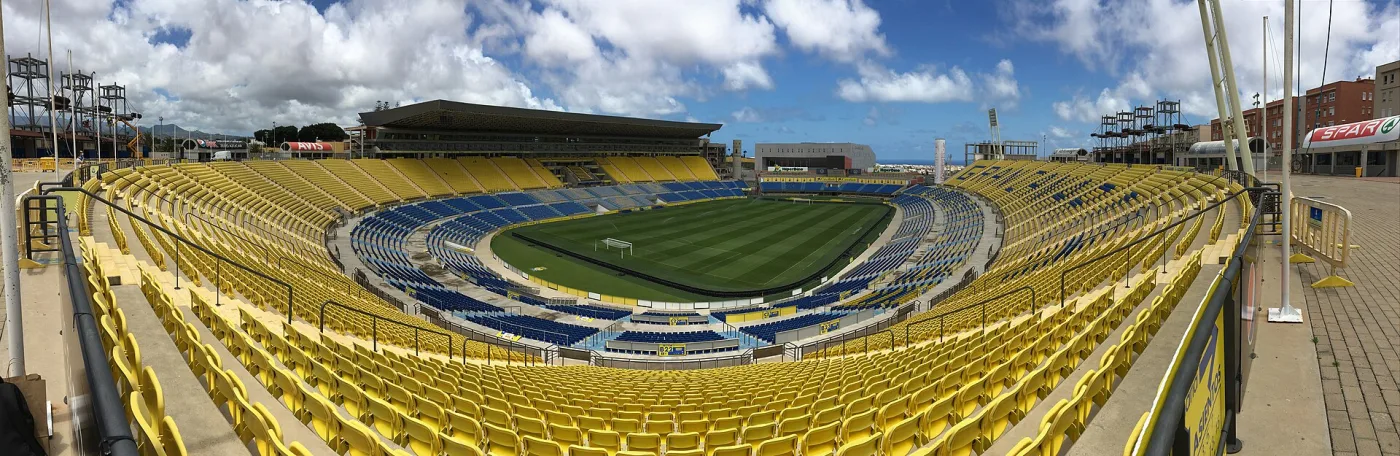
About Estadio de Gran Canaria
Look at the Estadio de Gran Canaria on a map and you will see it sitting in a hollow. That was deliberate. The architect Pedro Medina dropped the bowl into a ravine in the Siete Palmas district, like a Greek theater, so the land itself would solve his drainage and his sightlines. The result is a 32,392-seat ground that looks smaller from the road than it is, home to UD Las Palmas and owned not by the club but by the Cabildo, the island council.
It is a stadium still shedding an old identity. It opened in 2003 as a multi-purpose venue with a 400-metre running track ringing the pitch, and only between 2014 and 2016 was that track finally torn out and the lower bowl dragged some 20 metres closer to the grass. Even now the stands sit further back than at a purpose-built football ground, a permanent souvenir of the track’s footprint. The pitch is natural grass, 105 metres by 68, and there is no complete roof over the seats.
The club that plays here is currently in the Segunda División, and the ground has a habit of drawing crowds that outstrip the level of the football. Its biggest ever attendance came in the third tier. Its future, meanwhile, hangs on a World Cup: Gran Canaria is a confirmed Spanish venue for 2030, with an ambitious roofed redesign already chosen, and, as of this summer, nobody willing to build it.
Getting to Estadio de Gran Canaria
There is no metro or tram on the island, so this is a bus city. Here is how to reach the ground however you are traveling.
Public Transit
The local buses are called guaguas, and four municipal lines will get you there: 26, 44, 45 and 91. Line 91 is the pick, stopping at the Siete Palmas shopping center barely 100 metres from the corner of the Curva and Sur stands, while line 44 runs right up to the ground itself. From the Santa Catalina hub near the port it is roughly 20 to 25 minutes, and a single fare is about a euro forty. On match days the operator adds a dedicated Fútbol line from the port and the Teatro terminal, starting almost two hours before kickoff, with around twenty extra buses waiting when the whistle goes.
Driving + Parking
You can drive, and the bus operator would rather you did not. Coming up from the south you leave the GC-1 for the GC-3 ring road and take exit 7B, which lands you on the roundabout at the stadium. There is an annex car park at the ground and, more usefully, the big Siete Palmas shopping-center garage immediately next door, plus free street parking across the surrounding grid. But on a full house the municipal transport company warns bluntly that private cars can cause a traffic collapse in Siete Palmas, and it gives buses priority through the crush. Take the hint.
Rideshare
There is none. Do not stand outside the stadium opening an app, because Uber, Cabify and Bolt simply do not operate in Gran Canaria. The island council refused thousands of private-hire license applications, arguing the request dwarfed the roughly 2,650 taxi licenses already on the island, and the dispute is still grinding through the courts. What you use instead is a licensed taxi, hailed at a rank or ordered by phone. Reckon on somewhere around twenty to twenty-five euros from the city center.
From the Airport
Gran Canaria Airport sits about 23 kilometres down the coast to the south, and there is no direct bus to the stadium. A taxi is the simple answer, twenty to twenty-five minutes up the GC-1 and GC-3 for somewhere in the region of thirty to forty euros. By bus it is two legs: Global line 60 runs from the airport into the city, dropping at San Telmo or Santa Catalina, and from there you pick up a municipal guagua for Siete Palmas. Budget the better part of an hour. Watch the numbering, incidentally: there is a Global line 91 and a municipal line 91, and they are not the same bus.
Construction & Design
The old Estadio Insular, hemmed in by the city since 1944, was falling apart, so in early 1998 the island council put a replacement out to tender: an Olympic-standard bowl for around 35,000 people, out in the Siete Palmas ravine, budgeted at just under three billion pesetas, roughly 18 million euros, on a twenty-month build.
It did not go to plan. Pedro Medina, who had toured European grounds and admired Eindhoven’s, sank the stadium into the ravine and spent two years on the design before resigning mid-project. Guillermo Ortego inherited an advanced building site and rewrote the parking, the roof structure, the changing rooms and the access systems as the concrete went up, running a site office of ten and, at the peak, some 800 workers. The scale of it: 96,000 cubic metres of concrete, a million and a half cubic metres of earth shifted, 42 press cabins, 714 VIP seats.
Then the awkward part. The stadium opened in 2003 unfinished, and was completed in pieces over the following decade. By 2011 the running total had passed 90 million euros, five times the tender price. The last major piece of the puzzle came in 2014, when the athletics track was finally pulled out and the lower stands pushed 20 metres in, arriving at today’s 32,392 seats. Even so, the crowd still sits about 40 metres from the pitch, the track’s ghost.
History of Estadio de Gran Canaria
May 8, 2003: the stadium opened with a friendly against Anderlecht, Las Palmas winning 2-1, Rubén Castro scoring the first goal it ever saw. Kickoff was delayed because the traffic into Siete Palmas seized up, a warning nobody heeded.
The big nights came quickly and from odd directions. In August 2004 Spain beat Venezuela 3-2 here in Luis Aragonés’s first match as national coach, and Spain came back in 2007 and 2018. Shakira played to more than 30,000 in 2006, and Bruce Springsteen in 2012. But the ground’s fullest ever night belongs to the third division: on 21 May 2006, with the club stuck in Segunda B, the gates were thrown open for a promotion push against Rayo Vallecano and roughly 35,000 crammed in, more than would ever see a league match here.
The official record, set with everybody properly ticketed, is 32,037, for the visit of Real Madrid on 27 January 2024. That same season the club averaged 25,041 through the gates, its best ever, and in recent years the ground has doubled as a festival site, hosting the Granca Live Fest across several days each summer.
Now the stadium is caught between two futures. Gran Canaria was ratified as a 2030 World Cup venue in December 2024, and a striking roofed redesign nicknamed La Nube, the Cloud, would cover 90 percent of the seats, pull the stands in from 40 metres to about 10, and lift capacity toward 44,000. But when the 174.7 million euro construction contract went out to tender in the summer of 2026, not a single builder bid for it. The design exists. The stadium, for now, does not.
Sources & Further Reading
- UD Las Palmas official site: udlaspalmas.es. The club’s own pages on the stadium, its opening, and the 2014-16 works.
- LaLiga: laliga.com. The league’s history of the ground, with capacity and attendance figures.
- Wikipedia entry on Gran Canaria Stadium: en.wikipedia.org/wiki/Gran_Canaria_Stadium. Construction, capacity, and events with sourcing.
- Guaguas Municipales: guaguas.com. Bus lines serving the stadium and the special match-day Fútbol service.
- Metalocus on La Nube: metalocus.es. The chosen 2030 World Cup redesign by L35 Arquitectos.
Quick Facts
Everything you need at a glance.
Stadium specs
- Capacity
- 32,392
- Opened
- 2003
- Cost
- €18 million tender, over €90 million final
- Roof
- Partial roof (no full cover)
- Surface
- Natural grass
- Tenants
- UD Las Palmas (Segunda División)
Construction & location
- Groundbreaking
- 1998
- Architects
- Pedro Medina, Guillermo Ortego
- Engineering
- Not separately recorded
- General contractor
- Not separately recorded
- Address
- Calle Fondos del Segura s/n, 35019 Las Palmas de Gran Canaria, Canary Islands, Spain
- GPS
- 28.1002°N, 15.4567°W
Photo Gallery
Fun Facts
The biggest crowd the ground has ever held came while the club was in the third division: about 35,000 packed in against Rayo Vallecano in May 2006, more than the 32,037 who saw Real Madrid visit in 2024.
It opened as an athletics stadium with a running track around the pitch, and had to be partly un-built: works from 2014 to 2016 ripped the track out and dragged the lower stands some 20 metres closer to the grass.
The architect Pedro Medina sank the bowl into the Siete Palmas ravine on purpose, like a Greek theater, so the slope would handle drainage and sightlines for him.
Stadium Location
Frequently Asked Questions
- What is the capacity of Estadio de Gran Canaria?
- The stadium holds 32,392. Larger figures of 44,000 or 45,000 that circulate online refer to a proposed 2030 World Cup expansion that has not been built, so they are not the current capacity.
- Who plays at Estadio de Gran Canaria?
- It is the home of UD Las Palmas, who currently play in the Segunda División. The stadium is owned and run not by the club but by the Cabildo de Gran Canaria, the island council.
- When did Estadio de Gran Canaria open?
- It opened on 8 May 2003 with a friendly against Anderlecht of Belgium, which Las Palmas won 2-1. It replaced the old Estadio Insular, the club's cramped home since 1949.
- Does Estadio de Gran Canaria still have a running track?
- No. It was built as a multi-purpose venue with a 400-metre track, but works between 2014 and 2016 removed it and moved the lower bowl about 20 metres closer to the pitch.
- How do I get to Estadio de Gran Canaria?
- Take a guagua. Municipal bus lines 26, 44, 45 and 91 all serve the stadium, with line 91 stopping about 100 metres away at the Siete Palmas shopping center. A dedicated Fútbol line runs on match days.
- Can I use Uber in Gran Canaria?
- No. Uber, Cabify and Bolt do not operate on the island at all, after the Cabildo rejected thousands of private-hire license applications. Use a licensed taxi or the bus.
- What is the record attendance at Estadio de Gran Canaria?
- The official record is 32,037, set against Real Madrid on 27 January 2024. A larger unofficial crowd of about 35,000 crammed in for a third-division promotion match against Rayo Vallecano in May 2006.
- Will Estadio de Gran Canaria host 2030 World Cup matches?
- It is a confirmed Spanish venue for 2030 and a roofed redesign called La Nube has been chosen, but the construction tender drew no bidders in July 2026. The rebuild is agreed on paper and unbuilt in practice.
Last updated: 2026-07-13