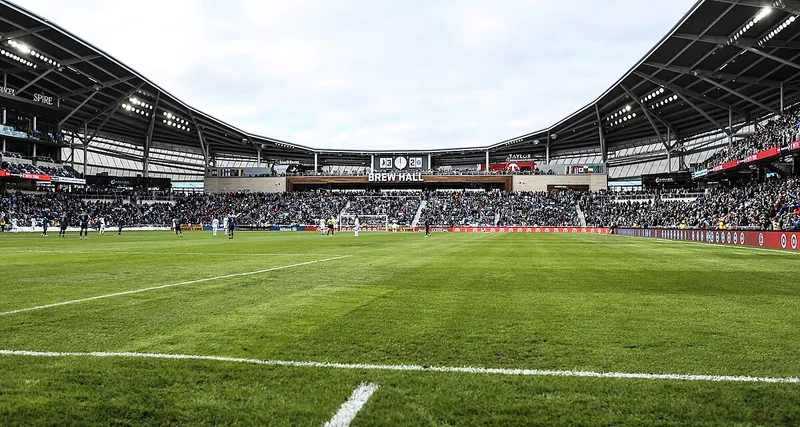
About Allianz Field
For three seasons, Minnesota United borrowed a college football field. TCF Bank Stadium on the University of Minnesota campus got the club through its first MLS years, but it was never really home. Allianz Field fixed that in April 2019, when the Loons finally moved into a 19,400-seat, soccer-specific ground of their own in the Midway neighborhood of Saint Paul.
The site tells you how far the project came. It had been a Metro Transit bus barn at the corner of Snelling Avenue and University Avenue, an unglamorous slab of asphalt at the geographic center of the Twin Cities. Populous designed the replacement, Mortenson Construction built it, and the privately financed job first estimated at $200 million ended up closer to $250 million. Not cheap for 19,400 seats. But the money shows.
The exterior is the calling card. Roughly 8,200 square meters (88,000 square feet) of translucent PTFE mesh wrap the steel structure, lit from within by 1,700 color-changing LED fixtures that shift through the night in a nod to Minnesota’s Northern Lights. On match evenings the whole building glows above the neighborhood, a lantern you can spot from the freeway.
Then there is the Wonderwall. The south-end supporter terrace holds 2,920 fans on a steep 34.9% incline, standing the entire match, with rail seats that fold up for international games to satisfy FIFA. No seats to sink into. Named after the Oasis song the supporters have belted out after wins since 2012, that end sets the tone for one of the loudest atmospheres in American soccer, and the noise carries clean across the pitch.
The stadium has become a regular US national team venue too, most infamously on February 2, 2022. The USA hosted Honduras in a World Cup qualifier with a kickoff temperature around 5°F and a wind chill near -17°F, the coldest match in USMNT history. Two Honduras players were pulled at halftime with hypothermia. The USA won 3-0, and Minnesota’s home-field advantage stretched, for one night, all the way to the weather.
Getting to Allianz Field
Public Transit
Transit is the reason this site was chosen. The light rail drops you one block from the gate.
→ Via Metro Green Line: Snelling Avenue station is one block from the stadium. Service runs every 10-15 minutes, and the line connects downtown Saint Paul to downtown Minneapolis. Fare is $2 (off-peak) or $2.50 (peak) via the Metro Transit app.
→ Via METRO A Line BRT: Stops at Snelling & University, connecting Rosedale Transit Center to 46th Street station in Minneapolis. Runs every 10-15 minutes.
Metro Transit adds extra service after matches. From downtown Minneapolis, the Green Line ride takes about 25 minutes. From MSP Airport, take the Blue Line to Downtown East and transfer to the Green Line.
Driving + Parking
The stadium address is 400 Snelling Avenue North, Saint Paul, MN 55104. I-94 is the primary approach.
→ From Downtown Minneapolis (~12 mi): I-94 East to the Snelling Avenue exit. About 20 minutes.
→ From Rochester (~85 mi): US-52 North to I-94 West. About 1 hour 20 minutes.
→ From St. Cloud (~75 mi): I-94 East to the Snelling Avenue exit. About 1 hour 15 minutes.
Here is the catch: the whole site has fewer than 1,000 on-site parking spaces, which is deliberate, because the planners wanted people on the train. Stadium-adjacent lots (A, B, C) run $20-$50, often reserved for season ticket members. Best Value lots farther away start around $10. The smart move is to park at a downtown Saint Paul ramp (Smith, 7A, Lowertown, or Block 19) for a flat $5 and ride the Green Line two stops. All lots are cashless and open 2.5 hours before kickoff.
Rideshare
Uber and Lyft drop off curbside on approach. Post-match pickup is at a designated zone on St. Anthony Avenue near the southeast entry. From downtown Minneapolis, expect $15-$25. From MSP Airport, $20-$30. Walk a block from the stadium after the match to beat the surge.
From the Airport
→ Minneapolis-Saint Paul International (MSP): About 12 miles south, 15-20 minutes by car. By transit, take the Blue Line to Downtown East and transfer to the Green Line (about 45-50 minutes total, ~$2.50). Rideshare runs $20-$30.
Construction & Design
Ground broke on December 12, 2016, and the finished stadium opened on April 13, 2019, roughly 20 months of work on a former bus garage. Populous, the Kansas City firm behind a long list of ballparks and soccer grounds, took the lead on design, with Walter P Moore engineering the structure and Mortenson Construction, a Golden Valley company, running the build. Minnesota United owns and operates the place outright. That ownership matters: unlike most American sports venues of its era, Allianz Field went up on private money, first pegged at $200 million and settling near $250 million by opening day.
The translucent skin is where the budget went. About 8,200 square meters (88,000 square feet) of PTFE mesh, both transparent and laminated panels, sheathe the exterior steel, and 1,700 LED fixtures backlight the whole envelope so it can wash the building in any color. Populous designed it to read as a single glowing volume rather than a stack of concourses. The comparison people reach for is the aurora, and on a clear night above the freeway it earns it.
Inside, the bowl is tuned for closeness and noise. The pitch was raised about 46 centimeters (18 inches) and the seating pulled tight, so the nearest seat sits just 5.2 meters (17 feet) from the touchline and every seat lands within about 38 meters (125 feet) of the field. Under the grass runs a heating system, roughly 44 kilometers (27.5 miles) of piping that holds the surface near 55°F so Kentucky bluegrass survives a Minnesota March. The Wonderwall anchors the south end, a rail-standing terrace for 2,920 raked at a 34.9% grade, its safe-standing seats folding up whenever FIFA rules demand fixed seating.
Sustainability got baked in rather than bolted on. The site captures and reuses stormwater, with the club projecting around 2 million gallons of rainwater recycled each year, and the transit-first approach, fewer than 1,000 parking spaces plus racks for 400 bikes, was itself an environmental choice. The bowl is designed to expand: fill the four open corners and capacity climbs from 19,400 to roughly 24,474 without moving the roofline. That phase remains on paper for now, which tells you the current size still fits the crowd.
History of Allianz Field
Allianz Field exists because Minnesota United needed a permanent home. After joining MLS, the club spent 2017 and 2018 renting TCF Bank Stadium across the river, a fine college venue and a poor fit for pro soccer. The answer rose on 34 acres of former bus-barn land in the Midway, chosen for its dead-center location and its light rail stop. The bet was that a purpose-built, transit-fed ground would do for the Twin Cities what similar stadiums had done in Portland and Kansas City.
April 13, 2019, the debut. Minnesota United and New York City FC drew 3-3 in front of a sellout 19,796, with Osvaldo Alonso striking the stadium’s first goal in the 13th minute. The PTFE skin glowed at dusk, the Wonderwall roared, and MLS suddenly had a new destination venue in the upper Midwest.
February 2, 2022, the freeze. The US men hosted Honduras in a World Cup qualifier at a kickoff temperature around 5°F, wind chill close to -17°F. Two Honduras players came off at halftime with hypothermia. The USA won 3-0 in what remains the coldest match in the program’s history, a scheduling choice US Soccer more or less admitted was strategic.
August 10, 2022, the showcase. The MLS All-Stars beat the Liga MX All-Stars 2-1 before a sellout 19,797, with Carlos Vela and Raúl Ruidíaz scoring. Minnesota United goalkeeper Dayne St. Clair made four saves and took MVP, a home-stadium honor that put a bow on the club’s arrival.
The stadium has since become a fixture for the US women’s national team as well, drawing near-capacity crowds against Portugal, South Korea, and China. From a Northern Lights facade to a standing terrace to a sub-zero qualifier, Allianz Field turned a bus barn into one of the finest soccer-specific grounds in North America. Not bad for a site that used to store buses.
Sources & Further Reading
- Minnesota United FC official stadium page: mnufc.com. Club overview of Allianz Field, the Wonderwall, and event hosting.
- Wikipedia entry on Allianz Field: en.wikipedia.org. Capacity, construction dates, ownership, and event history with citations.
- Soccer Stadium Digest venue profile: soccerstadiumdigest.com. Design and construction detail on the PTFE facade, LED lighting, and pitch systems.
- Metro Transit Green Line service: metrotransit.org. Schedules and fares for the light rail stop one block from the stadium.
Quick Facts
Everything you need at a glance.
Stadium specs
- Capacity
- 19,400
- Opened
- 2019
- Cost
- ~$250 million (initial estimate $200 million) (~$310 million (2026 dollars) today)
- Roof
- Open
- Surface
- Natural Grass (Kentucky Bluegrass)
- Tenants
- Minnesota United FC (MLS)
Construction & location
- Groundbreaking
- December 12, 2016
- Architects
- Populous
- Engineering
- Walter P Moore
- General contractor
- Mortenson Construction
- Address
- 400 Snelling Avenue North, Saint Paul, MN 55104, USA
- GPS
- 44.9528°N, 93.1651°W
Photo Gallery
Fun Facts
Allianz Field's exterior is wrapped in roughly 8,200 square meters (88,000 square feet) of translucent PTFE mesh lit by 1,700 LED fixtures that change color nightly, a nod to Minnesota's Northern Lights that turns the stadium into a glowing landmark visible across the Midway neighborhood.
The Wonderwall, the south-end supporter terrace, holds 2,920 fans standing on a steep 34.9% incline with rail seats that fold up for international matches to meet FIFA seating rules, named after the Oasis song Minnesota United supporters have sung after victories since 2012.
On February 2, 2022, the USA hosted Honduras in a World Cup qualifier at Allianz Field with a kickoff temperature around 5°F and a wind chill near -17°F, the coldest match in USMNT history, and two Honduras players were substituted at halftime with hypothermia as the USA won 3-0.
Stadium Location
Frequently Asked Questions
- What is the seating capacity of Allianz Field?
- Allianz Field seats about 19,400 fans, including 2,920 safe-standing spots in the Wonderwall section. Populous designed the bowl so it can grow to roughly 24,474 by filling in the four open corners, a phase the club has not yet built.
- Where is Allianz Field located?
- Allianz Field is at 400 Snelling Avenue North in Saint Paul, Minnesota 55104. It occupies the Midway neighborhood at the corner of Snelling Avenue and University Avenue, about 6 miles east of downtown Minneapolis and 3 miles west of downtown Saint Paul.
- Can you take the light rail to Allianz Field?
- Yes. The Metro Green Line stops at Snelling Avenue station, one block from the stadium. Trains run every 10-15 minutes and connect downtown Saint Paul to downtown Minneapolis. Metro Transit adds extra service after matches.
- What is the Wonderwall at Allianz Field?
- The Wonderwall is a 2,920-capacity safe-standing supporter section behind the south goal. Fans stand on terraced rails at a steep 34.9% incline, with rail seats that fold up for FIFA international matches. It is named after the Oasis song Minnesota United supporters have sung after victories since 2012.
- Is there parking at Allianz Field?
- The stadium has fewer than 1,000 on-site spaces. Stadium-adjacent lots run $20-$50, often reserved for season ticket members, and Best Value lots farther out start around $10. The smart move is a downtown Saint Paul ramp (Smith, 7A, Lowertown, or Block 19) at a flat $5 park-and-ride rate, then two Green Line stops to the gate. All lots are cashless and open 2.5 hours before kickoff.
- Is Allianz Field an indoor or outdoor stadium?
- It is open-air. A 360-degree canopy overhangs the seating bowl but leaves the natural grass pitch exposed to the sky. The translucent PTFE roof shields most fans from rain and snow while keeping an outdoor feel.
- How far is the airport from Allianz Field?
- Minneapolis-Saint Paul International Airport (MSP) is about 12 miles south, roughly 15-20 minutes by car. By transit, take the Blue Line to Downtown East station and transfer to the Green Line, about 45-50 minutes total. Rideshare runs $20-$30.
- Who designed and built Allianz Field, and what did it cost?
- Populous designed the stadium, Walter P Moore engineered the structure, and Golden Valley-based Mortenson Construction built it. The privately financed project was first estimated at $200 million and ended up costing roughly $250 million, funded by the club with no public construction bonds.
- Why is it called Allianz Field?
- The naming rights belong to Allianz Life, the Golden Valley, Minnesota-based US subsidiary of German insurer Allianz. The deal runs through the end of 2028. The financial terms were never publicly disclosed.
- When did Allianz Field open?
- The stadium opened on April 13, 2019, when Minnesota United drew New York City FC 3-3 before a sellout of 19,796. Construction had broken ground on December 12, 2016 and wrapped in February 2019, roughly 20 months of work.
- What was the coldest match played at Allianz Field?
- The USA versus Honduras World Cup qualifier on February 2, 2022. Kickoff temperature sat around 5°F with a wind chill near -17°F, the coldest match in US men's national team history. Two Honduras players left at halftime with hypothermia, and the USA won 3-0.
Last updated: 2026-07-10