About Hill Dickinson Stadium
Filling a dock with sand is a strange way to start a football ground. Everton did it anyway. Bramley-Moore Dock had been a working coal berth on the north Liverpool waterfront, walled in granite and watched over by a Grade II listed hydraulic engine house from 1883, and the only way to build on it was to put 450,000 cubic metres of dredged Liverpool Bay sand where the water used to be. Four years later there is a stadium on top of it, licensed for 52,769 and open since 2025.
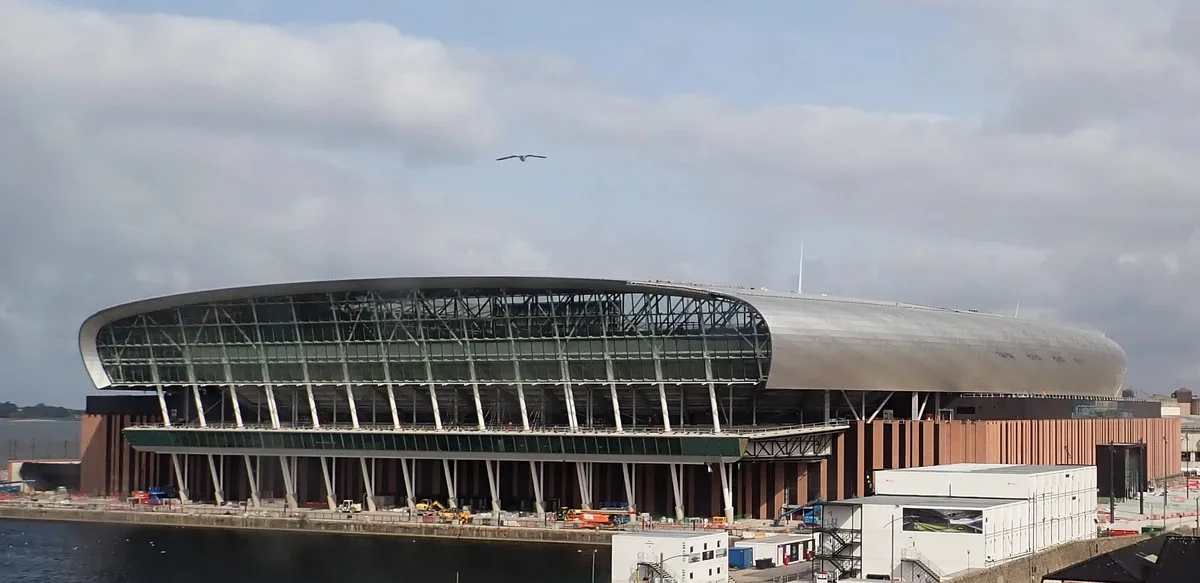
The design splits cleanly in two, and the split is the whole point. A red brick base, ribbed with vertical fins, sits under a curved skin of perforated silver metal and glass. The brick answers the Victorian warehouses along this stretch of dock road, the Stanley Dock tobacco warehouse most of all, and it nods to the latticework Archibald Leitch built into Goodison Park a century earlier. The metal above it does not pretend to be old at all. Designer Dan Meis described his original sketch as a brick base with a metal roof washing over it like a wave, and the finished thing is recognizably that sketch.
Inside, the bowl is squared off rather than elliptical, with stands that stay defined as stands. The South Stand is the home end, a large steep bank the club has openly compared to Borussia Dortmund’s Yellow Wall. Everton wanted noise more than they wanted seats, which is why the capacity landed near 53,000 and not the 70,000 some supporters were pushing for.
Everton were founded in 1878 and spent 133 years at Goodison Park before this. The move covered barely 3 kilometres (2 miles). It changed almost everything else. The pitch runs to the standard 105 by 68 metres (115 by 74 yards) on a SISGrass hybrid surface, the stands are roofed and the pitch is not, and the River Mersey is close enough that wind engineering became one of the defining problems of the build.
Getting to Hill Dickinson Stadium
Public Transit
Sandhills, on Merseyrail’s Northern line, is the station that matters. It sits about a mile from the turnstiles, roughly 15 minutes on foot, and it carries most of a 53,000 crowd on its own.
→ From Liverpool city center: Liverpool Central to Sandhills is a short hop underground, then walk. Merseyrail runs a 15-minute timetable on the Southport, Ormskirk, Hunts Cross and Headbolt Lane lines either side of kick-off.
→ From Lime Street: Intercity trains land at Lime Street, which is not close. Cross to Liverpool Central for the Northern line, or walk the whole way in about 30 minutes.
→ From Bootle: Bootle New Strand to Sandhills takes six minutes, and Bootle Strand’s car park is one of the recommended park and ride sites.
→ By bus: X2, 20, 53, 67, 310 and 345 leave Queen Square, beside Liverpool Central, and run near the ground.
A fan management zone operates on the Sandhills platforms, and a new footbridge was added after the first season made the case for it. Accessible supporters have a free shuttle between Sandhills Lane and Boundary Street, about 175 metres from the stadium.
Driving + Parking
There is no general parking at the stadium. None. The satnav address is Regent Road, Liverpool L3 0BW, but pointing a car at it on a matchday is a mistake most visiting clubs warn against in writing.
→ Park and ride: Bootle Strand and the city center are the two sites clubs and councils point supporters toward, both with a shuttle or a train at the far end.
→ Shuttle buses: Services run before and after matches from Liverpool city center, Bootle and Kirkby bus stations. The Bootle Strand shuttle goes from Stand 4 and costs £2 each way to the Derby Road drop-off.
→ Residential streets: Parking in them earns a penalty notice, not a shortcut.
Cycling is the underrated option here. A segregated lane runs along Regent Road to Bankfield Street, and 152 cycle stands line the dock wall, left at your own risk.
Rideshare
Uber and local private hire both work in Liverpool, and a ride in from the city center is short. Getting out is the problem, because the roads around the docks congest badly at full time and every driver on the app is trying to reach the same handful of streets.
Pro tip: walk ten minutes toward town before opening the app. The fare drops and the wait collapses.
From the Airport
→ Liverpool John Lennon (LPL): About 14 kilometres (9 miles) south of the ground, half an hour by car. The airport bus runs into the city center, where you pick up the Northern line.
→ Manchester (MAN): About 55 kilometres (35 miles) east by road. Direct trains run to Liverpool Lime Street in about an hour and a half, then it is Central to Sandhills.
Watching a Match at Hill Dickinson Stadium
The walk in tells you where you are. From Sandhills it is a mile past shipping firms, trucking yards, steel and timber merchants and a United Utilities water treatment plant that is all pipe and no windows, and then the granite dock wall appears on your right with its turreted gatehouses, tall enough to hide the stadium completely until you pass through one of the gates punched into it. Architecture critic Jason Sayer called it a historic membrane.
Inside the wall, the Grade II listed hydraulic engine house from 1883 stands alone on the original cobbles among preserved railway lines and mooring posts, with no confirmed use yet. The plaza around it is paved in granite engraved with Everton dates and trophies. The western terrace steps down toward the Mersey and is the pre-match spot: a pint, Wallasey across the water, the Three Graces off to the south, and container cranes to the north.
The concourses are the first surprise. They are wide, and you can see the pitch from them the moment you walk in, which is rare. On the south side the glazing angles out over Nelson Dock and gives you a view back toward the city that few concourses in the country can match. Catering is run by Aramark through a mix of kiosks, self-service EBars and Through Pass points that let you take food and walk out without queueing at a till. The ground is entirely cashless. A pint sits around £6.50 to £7.50. English law keeps it on the concourse rather than in your seat.
Then the bowl. Every stand climbs at 35 degrees, the steepest UK guidance permits, and the top rows are around 35 metres above the grass. It feels vertical and it feels close, which is the trade the architects made deliberately: proximity over volume, 53,000 seats rather than 70,000. Away fans get the north-east corner. The South Stand, the steep home end behind the goal, is where the noise starts.
Not everyone is sold. The first season produced a run of complaints that Evertonians made loudly and in public: queues at Sandhills afterward, congestion on the roads, queues for toilets, a Carabao Cup night against Mansfield where thousands were still outside at kick-off. Deeper than the logistics is a loss of the thing Goodison had, where the ground sat inside terraced streets and the same faces filled the same pubs. One supporter wrote that the sense of community will be difficult to rebuild. Another described watching his 78-year-old father give up a season ticket held for nearly 60 years because the walk had become too much. Set against that, fans traveling in from further afield rate the move highly: 30 minutes from city-center hotels and bars, and a noise inside that one called very impressive when the team are at it.
Euro 2028 at Hill Dickinson Stadium
Five matches, and none of them will be advertised under this name. UEFA strips commercial titles for its tournaments, so for a month in 2028 the place reverts to Everton Stadium.
Group stage: Four games, on 11, 14, 17 and 20 June 2028, drawn from Groups D, A, E and C in that order.
Knockout: A round of 16 tie on 24 June, between the runners-up of Groups A and B. Eight of the nine host grounds stage a round of 16 match. Wembley, holding the final, is the exception.
Context: The tournament spreads 51 fixtures across nine venues in four host nations. Teams and kick-off times follow the draw in late 2027.
Construction & Design
The first engineering decision was the one nobody sees. Buro Happold looked at the soft silt sitting at the bottom of Bramley-Moore Dock and asked whether it had to come out at all, then concluded it did not: leave it, and infill on top. That single call avoided dredging and disposing of 75,000 cubic metres of silt, enough to fill 30 Olympic swimming pools, and took months off the program. On top went 450,000 cubic metres of sand from Liverpool Bay, roughly 40 kilometres (25 miles) north. Ground-probing radar mapped the hidden geometry of the Grade II listed dock walls so that foundation piles could be threaded past them without contact. The orientation of the entire stadium was set by that constraint.
Laing O’Rourke signed the main contract in April 2021, started enabling works in July and broke ground on 10 August 2021, with a contract value of about £555 million. The wider project has been reported at closer to £750 million and, in at least one account, £800 million, the gap being land, infrastructure, financing and everything else a construction contract does not cover. More than 6,000 components were manufactured off site through the contractor’s own Explore Manufacturing operation, including the precast composite red brick facade panels, with mechanical and electrical modules built by Crown House Technologies. BDP Pattern put the share of off-site construction at 70 percent. Over 550 people worked the site at peak. Twelve unexploded Second World War munitions came out of the ground first.
Dan Meis was appointed design architect in 2016 and carried the concept through Stage 3; BDP Pattern took it from there as delivery architect while Meis stayed on as the club’s design guardian. The sightline work is where the care shows. BDP wrote a bespoke parametric script defining the roof, the steelwork and the bowl together, then tested every seat by drawing lines to all four corners of the pitch. They also modeled how people actually sit, on the argument that a spectator shifts naturally in a seat and a rule assuming rigid forward-facing posture flags perfectly good seats as defective. Reinforced glass balustrades replaced the usual concrete ones to keep the lines clean. Goodison Park had columns blocking roughly half its seats. Here the restricted ones are a handful beside the press desk, sold as such. The bowl was drawn for 52,888 seats; the figure the ground is actually licensed for is 52,769, after 119 came out to satisfy segregation and media requirements.
The waterfront fought back in one respect. Wind off the Mersey was severe enough that Buro Happold ran both physical models and digital simulation, and the answer arrived as perforated steel baffles set into the landscape to break and disperse the gusts, plus gates that can be closed when conditions turn dangerous. Elsewhere the heritage was kept rather than cleared: the listed dock wall repaired and stabilized, the 1883 hydraulic engine house stabilized, and more than 30,000 square metres of paving laid in reclaimed granite setts. The stadium was structurally complete in February 2024 when the last precast terracing panel dropped in, and Laing O’Rourke handed it over on 19 December 2024, 178 weeks after arriving on site.
History of Hill Dickinson Stadium
Everton spent nearly 30 years trying to leave Goodison Park before they managed it. Peter Johnson floated a 60,000-seat ground in 1996. King’s Dock, a 55,000-seat plan aimed at 2005, collapsed over funding. A 2006 scheme at Kirkby with Tesco and Knowsley Council won a supporter ballot 59 to 41 and was then refused by central government. Walton Hall Park was scrapped by May 2016. Bramley-Moore Dock was named the preferred site in January 2017, a deal with Liverpool City Council and Peel Holdings followed that March, and the funding model kept moving even after the diggers arrived. The £280 million council loan arrangement put to the city in January 2018 was gone by March 2022, when Everton announced they would take no council loan at all and had found the money elsewhere, seven months into construction.
The reasons for going were never in doubt. The Taylor Report cut Goodison from over 78,000 to under 40,000, the ground was boxed in by terraced housing on three sides, and by 2007 the club was spending around £500,000 a year on repairs to keep it structurally sound while Liverpool’s expanded Anfield pulled clear at over 61,000.
Milestones:
- July 2021, world heritage lost: UNESCO stripped Liverpool of its world heritage status, citing this stadium and the wider Liverpool Waters scheme. Architecture Today’s verdict four years on was that the damage is hard to see, and that the waterfront is better for the building.
- August 2023, the site death: Michael Jones, a lifelong Evertonian from Kirkby, died of head injuries after an accident on site. Work stopped. A memorial to him was unveiled in August 2024.
- 17 February 2025, first event: Everton’s under-18s lost 2-1 to Wigan in front of 10,000. Ray Robert scored the club’s first goal at the ground, an 88th-minute penalty.
- 16 May 2025, the name: Hill Dickinson, a Liverpool-rooted commercial law firm, took the naming rights in a deal reported at around £10 million a year, which the club called one of the largest stadium sponsorships in Europe.
- 18 May 2025, the goodbye: Everton beat Southampton 2-0 in the last men’s game at Goodison Park, Iliman Ndiaye scoring both. The women’s team moved in the following season.
- 24 August 2025, the real opening: Everton 2, Brighton 0, in front of 51,759. Ndiaye again, on 23 minutes, from a Jack Grealish assist. Jordan Pickford saved a Danny Welbeck penalty on 77.
Other sports moved in fast. Australia beat England 14-4 in the second Ashes rugby league test on 1 November 2025 before 52,106. Magic Weekend arrived in July 2026 and drew 82,925 across two days, a record for the event, with 42,903 on the Sunday alone; it returns in 2027. England’s rugby union side beat Fiji 73-8 here on 11 July 2026 in front of 50,209. The football attendance record stands at 52,590, set against Sunderland on 17 May 2026.
One season in, Everton run two grounds rather than one. The women’s team, based at Goodison since 2025, played their first Women’s Super League game at the new stadium on 12 October 2025 and lost 1-4 to Manchester United.
Sources & Further Reading
- Hill Dickinson Stadium official site: hilldickinsonstadium.com. Matchday guidance, travel pages, food and drink, and the event calendar.
- Architecture Today review: architecturetoday.co.uk. Jason Sayer’s site visit, with Dan Meis and BDP Pattern on capacity, sightlines and the brick concept.
- Laing O’Rourke project page: laingorourke.com. The contractor’s own figures for contract value, dock infill, off-site manufacture and heritage works.
- Buro Happold project page: burohappold.com. Engineering account of the silt strategy, piling around the listed dock walls and waterfront wind mitigation.
- Wikipedia entry on Hill Dickinson Stadium: en.wikipedia.org/wiki/Hill_Dickinson_Stadium. Timeline, attendances and the full event record.
Quick Facts
Everything you need at a glance.
Stadium specs
- Capacity
- 52,769
- Opened
- 2025
- Cost
- Around £555 million contract; project reported near £750 million
- Roof
- Roof over stands (open pitch)
- Surface
- Hybrid grass (SISGrass)
- Tenants
- Everton (Premier League)
Construction & location
- Groundbreaking
- August 10, 2021
- Architects
- Meis Architects (Dan Meis, design architect and client design guardian), BDP Pattern (delivery architect)
- Engineering
- Buro Happold
- General contractor
- Laing O'Rourke
- Address
- Regent Road, Liverpool L3 0BW, England
- GPS
- 53.4251°N, 3.0028°W
Photo Gallery
Fun Facts
Bramley-Moore Dock was filled with 450,000 cubic metres of sand dredged from Liverpool Bay, about 40 kilometres (25 miles) north. Engineers left the soft silt in place at the bottom and built on top of it, which avoided digging out and disposing of 75,000 cubic metres of the stuff, enough to fill 30 Olympic swimming pools.
The stands are raked at 35 degrees, the steepest UK guidance permits, and the highest rows sit around 35 metres (115 feet) above the pitch. The building tops out just under 45 metres, deliberately: 45 metres would have tripped a different planning classification.
Twelve unexploded Second World War munitions were found and safely disposed of during site preparation, before a single foundation pile went in.
Stadium Location
Frequently Asked Questions
- Which station do I use for Hill Dickinson Stadium, and how long is the walk?
- Sandhills, on Merseyrail's Northern line, is the one everybody uses. It is about a mile from the turnstiles and roughly 15 minutes on foot down Regent Road. Coming in on an intercity train, you arrive at Lime Street rather than anywhere useful, so walk or ride through to Liverpool Central and take one stop north. Moorfields is the other option, around 25 minutes on foot from its Old Hall Street exit. Merseyrail runs a 15-minute timetable on the main lines around kick-off and staffs a fan management zone at Sandhills, which exists because the first season needed it.
- Can you park at Hill Dickinson Stadium?
- No. There is no general admission parking on the site, and parking in the residential streets around the docks will get you a fine rather than a space. Visiting clubs tell their supporters to leave the car in the city center or at Bootle Strand and use the park and ride from there. Cyclists do better: a segregated lane runs along Regent Road as far as Bankfield Street, and there are 152 cycle stands against the dock wall, used at your own risk.
- Where do away fans sit at Hill Dickinson Stadium?
- In the north-east corner, lower tier, straddling the North and East stands. Away turnstiles are at block 24 on the North Stand, and visiting supporters are directed in through Gate E, the gate closest to the coaches. The coaches themselves park on Regent Road north of Boundary Street, about a ten-minute walk from those turnstiles. The away ticket office sits beside turnstile 24 and opens three hours before kick-off. The section has its own concourse and its own kiosks, alcohol included.
- What is the food and drink like inside Hill Dickinson Stadium?
- Broad, and quick, which is not the usual football combination. Aramark runs the catering across a mix of traditional kiosks, self-service EBars where you pour and pay by contactless in seconds, and Through Pass points that let you pick something up and walk out without queueing at a till. The whole ground is cashless, so leave the notes at home. A pint runs about £6.50 to £7.50, with Budweiser, San Miguel, Stella, Kopparberg, Guinness and Camden's pale ale and stout on the taps. One thing to know: English law bars drinking in view of the pitch at a regulated match, so the pint stays on the concourse.
- Where are the best seats at Hill Dickinson Stadium?
- The South Stand is the home end and the noisy one, built steep behind the goal on purpose, with Borussia Dortmund's Yellow Wall as the stated model. Everywhere else, the thing to understand is the rake. Every stand climbs at 35 degrees, the maximum UK guidance allows, so the upper tiers feel close and on top of the play rather than remote, and the front rows sit tight to the touchline. The trade-off is that the top sections are steep enough underfoot to notice. BDP Pattern ran a parametric script that drew sightlines from every seat to all four corners of the pitch, and used glass balustrades instead of concrete ones to keep views clear. At Goodison Park roughly half the seats had a column in the way. Here it is a handful next to the press desk.
- Which pubs near Hill Dickinson Stadium are worth it?
- The Bramley Moore at 32 Regent Road is the obvious one, directly opposite the ground, thick with Everton memorabilia and packed by two hours before kick-off, so go early or do not bother. The Terrace faces the stadium too. Walking in from town, Ten Streets Social does pie-and-a-pint deals and has the room to absorb a crowd, and Murphy's on Regent Road distills its own gin and vodka on site and has a covered courtyard. Stanley's Bar and Grill at the Titanic Hotel is the civilized option, looking out over Stanley Dock.
- How bad is getting away after the final whistle?
- It was the biggest complaint of the first season, and it has improved rather than vanished. Sandhills backs up after a full house, the roads around the docks clog, and the second test event in March 2025 drew descriptions from supporters ranging from awful to dangerous. A new footbridge at Sandhills and reworked crowd management have taken the edge off. The practical answer is the same as at every ground with one railhead: do not sprint for the station. Stay in your seat a while, or walk twenty minutes toward town and pick up a train, a bus or a pub instead.
- Is it cold and windy on the waterfront?
- It is a stadium on the open Mersey, so yes, and the design takes it seriously. Buro Happold modeled the wind physically and digitally and the site carries perforated steel baffles to break it up, with gates that can be shut off when conditions get dangerous. Inside, the enclosed bowl and steep tiers keep most of it off you. Outside, the western terrace steps down toward the river and is a fine place for a pre-match pint on a calm day, and a bracing one otherwise.
- What is the bag policy at Hill Dickinson Stadium?
- Anything bigger than A4 will not get in, and bags that are allowed are searched at the gate. Sniffer dogs work the entrances. Anyone under 14 has to be with an adult over 18. Everything about the entry process rewards arriving early, particularly with digital ticketing: a Carabao Cup tie against Mansfield left thousands of fans outside at kick-off while the new system chewed through the queue.
- What will Hill Dickinson Stadium host at Euro 2028?
- Five matches, under the UEFA name Everton Stadium, since tournament rules strip commercial names. Four group games, on 11, 14, 17 and 20 June 2028, and a round of 16 tie on 24 June between the runners-up of Groups A and B. The tournament runs across nine venues in four host nations, and every ground except Wembley stages a round of 16 match.
- Why did Everton leave Goodison Park?
- Because the ground had run out of room and money. Goodison was hemmed in on three sides by terraced streets, the Taylor Report's all-seater rules had cut it from over 78,000 to under 40,000, and by 2007 the club was spending around £500,000 a year simply keeping the structure sound. Everton had been hunting a replacement since the mid-1990s: King's Dock, Kirkby, Walton Hall Park, each one collapsing in turn. Bramley-Moore Dock was picked in January 2017 and it took another eight years from there.
- What happened to Goodison Park?
- It is still standing and still hosting football. Everton's men played their last game there on 18 May 2025, beating Southampton 2-0 with two goals from Iliman Ndiaye, and the women's team moved in as permanent tenants from the following season. For a club that spent three decades trying to leave, keeping the old ground in use rather than flattening it is a better ending than most.
Last updated: 2026-09-04