About BMO Stadium
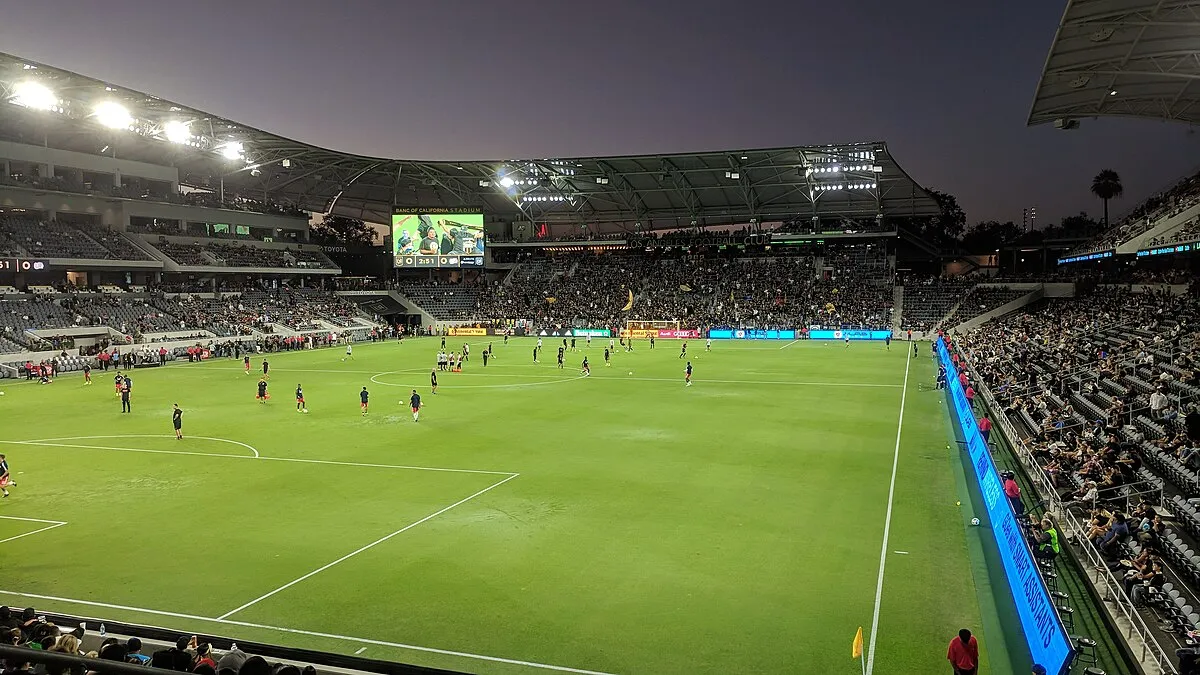
In the Exposition Park neighborhood of Los Angeles, next to the Memorial Coliseum and the USC campus, BMO Stadium packs 22,000 fans into one of the loudest soccer-specific grounds in MLS, a design that traps crowd noise under a cable-supported ETFE canopy.
Home to Los Angeles FC since 2018 and Angel City FC of the NWSL since 2022, BMO Stadium was purpose-built for soccer in a city that had waited decades for a venue that matched the sport’s ambitions. Decades, and then this. The playing field was sunk well below street level, creating an intimate bowl where the closest seats sit just 12 feet from the pitch and the steepest section rises at a 34-degree angle. Small numbers, deliberately.
Gensler designed the $350 million stadium on the former site of the LA Memorial Sports Arena, which was demolished in 2016. Construction took less than two years. The venue earned LEED Gold certification and became the first open-air stadium built in Los Angeles since Dodger Stadium opened in 1962. The north end’s 3,252-capacity safe-standing section, home to LAFC’s supporters’ group, The 3252, features angled handrails modeled after roller coasters.
Beyond MLS and NWSL matches, BMO Stadium has hosted CONCACAF Gold Cup matches, international friendlies, blink-182’s reunion concerts, and Korn’s 30th anniversary show. In 2023 the venue sold over 1.3 million tickets across all of it, and finished fifth on Pollstar’s year-end Top 100 Stadiums chart on $109.13 million of concert grosses, which is a remarkable placing for a 22,000-seat ground on a list dominated by venues three and four times its size. In 2028 it hosts flag football, which has never been at a Games before, and lacrosse, which has not been a medal sport since 1908 and returns in the six-a-side format. Every site for those Games is mapped in our Los Angeles 2028 Olympics guide.
Getting to BMO Stadium
Public Transit
The Metro E Line (Expo Line) is the best way to reach BMO Stadium. The Expo Park/USC station sits about a half-mile north, an easy 8-minute walk down Expo Park Blvd and Figueroa Street.
→ From Downtown LA: Board the E Line at 7th Street/Metro Center heading west. The ride to Expo Park/USC takes about 10 minutes. Trains run every 8-12 minutes on match days.
→ From Santa Monica: Take the E Line eastbound from Downtown Santa Monica station. The ride is about 45 minutes to Expo Park/USC.
Fare is $1.75 each way with a TAP card. Buy your round-trip fare before the match to skip the lines afterward. Bus routes 40, 81, and DASH also serve the area.
Driving + Parking
BMO Stadium sits near the convergence of the I-110 and I-10 freeways, just one block from the 110. GPS users should enter “3939 S Figueroa Street, Los Angeles, CA 90037.”
→ From Downtown LA (~4 mi): Take I-110 South to Exit 20A (Martin Luther King Jr. Blvd). Turn left and continue to the stadium entrance.
→ From Santa Monica (~13 mi): Take I-10 East toward downtown, exit onto Figueroa Street, and head south. The stadium is on your right.
→ From Pasadena (~14 mi): Take I-110 South through downtown LA, continuing south. Exit at Exposition Blvd or MLK Jr. Blvd, then proceed to Figueroa Street.
Expo Park offers several lots: the Blue Structure, Yellow Lot, Pink Lot, and the premium Gold Lot. General parking runs $25-40. Pre-purchase through the LAFC app or Ticketmaster, lots are limited and passes sell out quickly. Third-party options on SpotHero and ParkWhiz start around $15. Over 100 bike racks are available around the stadium.
Rideshare
Uber and Lyft have a designated pickup and drop-off zone at the corner of Figueroa Street and MLK Jr. Boulevard. On match days, an enhanced rideshare zone operates in the Green Lot near the Southeast Entrance for easier access.
Pro tip: BMO Stadium is fully cashless, so make sure your rideshare app payment is set up before you arrive. Walk a block or two from the immediate stadium area after the match for faster pickups and lower surge pricing.
From the Airport
→ Los Angeles International (LAX): 9 miles southwest, 20-30 minutes by car. By transit, take the LAX FlyAway bus to Union Station, then Metro to Expo Park/USC, about 60 minutes total.
→ Hollywood Burbank Airport (BUR): 13 miles north, 25-35 minutes by car. No direct transit, rideshare or car rental is your best bet.
Watching a Match at BMO Stadium
Start with the north end, because it is the part of this stadium that was designed rather than just built. Behind that goal is the 3252, named for the number of safe-standing places in it, and it comes with a physical detail most grounds cannot offer: the handrails are raked like roller-coaster restraints, angled so supporters can lean into them rather than stand square for the whole match. LAFC season-ticket holders on r/LAFC describe taking friends new to the sport into that end specifically, on the theory that it converts them.
Everywhere else, the geometry does the work. The bowl is pitched at about 34 degrees, among the steepest in Major League Soccer, and the nearest seats are 12 feet from the touchline. Both numbers matter more than they sound. A steep rake means the row in front drops away from you rather than sitting in your eyeline, so a cheap seat high in the stand still looks down cleanly at the whole pitch. It also means the climb up to a 200-level row is a real climb, which is worth knowing if stairs are a problem. The ETFE canopy does cover a good deal of the seating, but it is not a roof and it is not uniform: how much shade you actually sit in depends on which side you are on and what time kickoff is.
The food is the one part regulars are not romantic about. On paper it should be a strength: the club runs a chef-led program under Hugo Miranda, the menu reaches for tteokbokki, Peruvian chicken, conchas and tortas, and there is a satellite of the Mercado González market selling chicharrón, duros de harina and aguas frescas. In practice the r/LAFC threads on the subject are a running complaint, and they have been for a few seasons. Season-ticket holders from the opening year describe a first couple of seasons stocked with local restaurants and a steady narrowing since, with the Korean fried chicken and the rotisserie chicken both gone and more of the concourse turned over to pizza, fries and tenders. The item that survives every one of those threads is the torta. If you want the neighborhood’s actual food, the advice fans give is to eat before you go in, with the honest caveat that Figueroa traffic can turn that into missing the first twenty minutes.
One deliberate gap in that ring is worth finding. The northeast corner was left open so the downtown skyline and the San Gabriel Mountains sit in the frame from inside the bowl, which is the single best photograph in the building and the reason to arrive before kickoff rather than at it. Arrive early anyway: the stadium shares Exposition Park with the Coliseum, three museums and the USC campus, so a match day here is a neighborhood rather than a car park. The Metro E Line drops you eight minutes’ walk away, and given what parking costs and how the Figueroa exit behaves afterward, the train is the correct answer more often than not.
Construction & Design
BMO Stadium was the first open-air stadium built in Los Angeles since Dodger Stadium in 1962, and LAFC paid for all of it. Gensler designed it, Thornton Tomasetti engineered the structure, and PCL Construction built it after an August 2016 groundbreaking, for roughly $350 million financed entirely by the club’s ownership rather than the public. It opened on April 18, 2018, on the Exposition Park footprint of the demolished Los Angeles Memorial Sports Arena.
The design is all about pressure. Not scale, pressure. The seating bowl is raked at about 34 degrees, among the steepest in Major League Soccer, so 22,000 fans end up stacked almost vertically over the pitch rather than spread away from it. A translucent ETFE canopy of roughly 190,000 square feet rings the roof, self-cleaning in rainfall and flexible enough to warp during a seismic event, keeping the venue open to the California sky while trapping the noise underneath it. That last part was the brief. Behind the north goal, the safe-standing supporters’ section known as The 3252 turns that acoustic design into a wall of sound.
The venue opened as Banc of California Stadium and took its current name at the start of 2023, when the Bank of Montreal stepped in as naming-rights partner. The bones, the steep bowl and the canopy, have not changed. What LAFC really built for its $350 million was less a stadium than an instrument: a compact, reliably sold-out, deafening box that turned the club into one of the toughest road trips in Major League Soccer from the day it opened. It earned LEED Gold along the way, and its handrails in the standing section are angled like roller-coaster restraints so fans can lean into them for ninety minutes without tiring, a small detail that captures how deliberately the whole place was tuned for noise.
History of BMO Stadium
The club came before the ground, and only just. LAFC was awarded an MLS expansion franchise in 2014, with an ownership group that includes Magic Johnson, Will Ferrell and Mia Hamm, and the brief was a soccer-specific stadium that could match the intensity of the world’s best. They chose Exposition Park. It cost the Los Angeles Memorial Sports Arena, demolished in August 2016 to make room, which is a striking trade even by the standards of Los Angeles. Gensler designed a 22,000-seat bowl set below street level, with a translucent ETFE canopy to trap crowd noise while keeping the venue open-air.
- Ground was broken on August 23, 2016, on a $350 million project with no public money in it.
- The stadium met the public first, on April 18, 2018, at an open practice and dedication. The football waited another eleven days.
- First Match (April 29, 2018): LAFC beat Seattle Sounders 1-0 on a Laurent Ciman goal in stoppage time, in front of a sold-out house.
- Carlos Vela’s Record Season (2019): Vela scored 34 goals across the regular season, home and away, setting the MLS single-season record and taking league MVP honors.
- MLS Cup 2022 (November 5, 2022): LAFC defeated Philadelphia Union 3-3 (3-0 on penalties) in one of the most dramatic finals in MLS history. Gareth Bale’s 128th-minute equalizer forced the shootout, and John McCarthy saved two penalties to seal the title.
- BMO Naming Rights (January 19, 2023): The Bank of Montreal replaced Banc of California and the venue was renamed BMO Stadium. The 2016 deal it superseded had run 15 years and $100 million, and Banc of California had paid $20.1 million in 2020 to get out of it early. Neither LAFC nor BMO disclosed the new terms; reporting at the time put the deal at roughly $100 million over 10 years, which would make it one of the largest in MLS.
- 2023 was the year the building stopped being only a soccer ground: 45 matches, 24 concert nights and more than 150 other events, over 1.3 million tickets sold, and fifth place on Pollstar’s year-end Top 100 Stadiums chart on $109.13 million of concert grosses.
- Angel City FC Expansion (2022-present): The NWSL’s Angel City FC made BMO Stadium their home venue, adding a second professional tenant and growing the venue’s year-round calendar.
- 2028 Olympics (upcoming): BMO Stadium joins the Games as part of the Downtown Sports Park cluster, hosting flag football and lacrosse. Flag football has never appeared at an Olympics. Lacrosse has, twice, as a medal sport in 1904 and 1908 and as a demonstration event three times after that, so 2028 ends a 120-year wait for a medal, played in the six-a-side format.
Sources & Further Reading
- Wikipedia entry on BMO Stadium: en.wikipedia.org/wiki/BMO_Stadium. Construction, the design, financing, and the name change.
- Gensler, BMO Stadium project page: gensler.com. The architect’s account of the steep-bowl design and ETFE canopy.
- PCL Construction, “Drawing up a game plan”: pcl.com. The general contractor’s piece on building for MLS, which references the stadium in passing.
- LAFC, LEED Gold certification announcement: lafc.com. The club’s own record of the certification level and the construction-waste and energy figures behind it.
- Thornton Tomasetti, BMO Stadium project page: thorntontomasetti.com. The structural engineer on the 34-degree seating rake and the 190,000 square feet of ETFE.
- BMO Stadium official site: bmostadium.com. Events, tickets, and visitor information.
Quick Facts
Everything you need at a glance.
Stadium specs
- Capacity
- 22,000
- Opened
- 2018
- Cost
- Around $350 million (2018, privately financed)
- Roof
- Open
- Surface
- Natural Grass
- Tenants
- Los Angeles FC (MLS), Angel City FC (NWSL)
Construction & location
- Groundbreaking
- August 23, 2016
- Architects
- Gensler
- Engineering
- Thornton Tomasetti
- General contractor
- PCL Construction
- Address
- BMO Stadium, 3939 South Figueroa Street, Los Angeles, CA 90037
- GPS
- 34.0128°N, 118.2845°W
Photo Gallery
Fun Facts
The 3252, LAFC's north end supporters' section, holds exactly 3,252 safe-standing spots built at a 34-degree incline, among the steepest in MLS.
BMO Stadium was the first open-air stadium built in Los Angeles since Dodger Stadium in 1962, a gap of 56 years.
BMO Stadium sold over 1.3 million tickets in 2023 across soccer, concerts and festivals, and finished No. 5 on Pollstar's year-end Top 100 Stadiums chart with $109.13 million in concert grosses.
Stadium Location
Frequently Asked Questions
- What is the seating capacity of BMO Stadium?
- BMO Stadium seats 22,000 for soccer matches, and more for concerts once the floor is in use. It is one of the smaller purpose-built grounds in MLS, and by reputation one of the loudest, which is largely down to how steeply the seating is stacked around the pitch.
- Where is BMO Stadium located?
- BMO Stadium is at 3939 S Figueroa Street in the Exposition Park neighborhood of Los Angeles, adjacent to the LA Memorial Coliseum and USC campus. It sits one block from the I-110 freeway.
- How do I get to BMO Stadium by public transit?
- Take the Metro E Line (Expo Line) to Expo Park/USC station. From there, it's an 8-minute walk south along Expo Park Blvd and Figueroa Street to the stadium entrance. Fare is $1.75 each way with a TAP card.
- Is there parking at BMO Stadium?
- Yes. Expo Park offers several lots including the Blue Structure, Yellow Lot, Pink Lot, and Gold Lot. General parking runs $25-40 depending on the event. Pre-purchase through the LAFC app or Ticketmaster, passes sell out quickly. Third-party options on SpotHero start around $15.
- Is BMO Stadium the same as Banc of California Stadium?
- Yes. The venue opened as Banc of California Stadium in 2018, under a 15-year, $100 million naming deal LAFC signed in 2016. The bank paid $20.1 million to exit that agreement early in 2020, and the Bank of Montreal took over as naming rights partner on January 19, 2023. LAFC and BMO never disclosed the terms, though several outlets reported the deal at around $100 million over 10 years.
- When was BMO Stadium built?
- BMO Stadium broke ground on August 23, 2016, on the former site of the Los Angeles Memorial Sports Arena. It opened on April 18, 2018. The stadium was designed by Gensler and cost approximately $350 million, entirely privately funded.
- Is BMO Stadium cashless?
- Yes. BMO Stadium is fully cashless. It accepts debit cards, credit cards, Apple Pay, and Google Pay only. There are no ATMs on the property.
- Can I bring a bag to BMO Stadium?
- BMO Stadium enforces a clear bag policy. Bags must be clear plastic and no larger than 12" x 6" x 12", or a one-gallon clear Ziploc-style bag. Non-clear bags of any size are not allowed.
- Where should I sit at BMO Stadium?
- Depends what you came for. The north end is the 3252, the safe-standing supporters' section, and it is where the noise comes from: expect to be on your feet and singing for ninety minutes, and expect the handrails to be angled to let you lean. If you want to watch rather than participate, the sidelines give you the benefit of the 34-degree rake, which is steep enough that the row in front drops out of your eyeline instead of blocking it. There is no bad angle in a bowl this small, but there is a big difference in what kind of afternoon you get.
- Is the food any good at BMO Stadium?
- It is the most common complaint from regulars, which is awkward for a stadium in one of the great food cities. The club runs a chef-led program and the menu reaches for tteokbokki, Peruvian chicken, conchas and tortas, with a Mercado Gonzalez outpost selling chicharron and aguas frescas. But long-time season-ticket holders describe the range narrowing since the opening seasons, when local restaurants ran more of the stands. The torta is the item that survives the complaint threads. Many regulars simply eat in the neighborhood beforehand.
- Is there shade at BMO Stadium?
- Some, and it depends where you sit. The ETFE canopy covers a good deal of the seating but it is not a full roof and it is not even across the bowl, so how much sun you get comes down to which side you are on and what time the match kicks off. For an early-afternoon kickoff in summer, assume you will be in it.
- What will BMO Stadium host at the 2028 Olympics?
- Flag football and lacrosse, as part of the Downtown Sports Park cluster alongside the Coliseum and Crypto.com Arena. Flag football has never been played at an Olympics. Lacrosse has, as a medal sport in 1904 and 1908 and as a demonstration event three times after that, so 2028 ends a 120-year wait, in the six-a-side format.
Last updated: 2026-08-16