About Tropicana Field
Nobody built Tropicana Field for a baseball team that existed. When the tilted white dome opened in March 1990 as the Florida Suncoast Dome, St. Petersburg had no franchise and no promise of one. The city spent $138 million on a gamble that an empty stadium would eventually pull a Major League club across the bay. The bet took eight years to pay off, and the building sat mostly idle in the meantime, hosting arena football, hockey, and a Final Four before baseball ever showed up.
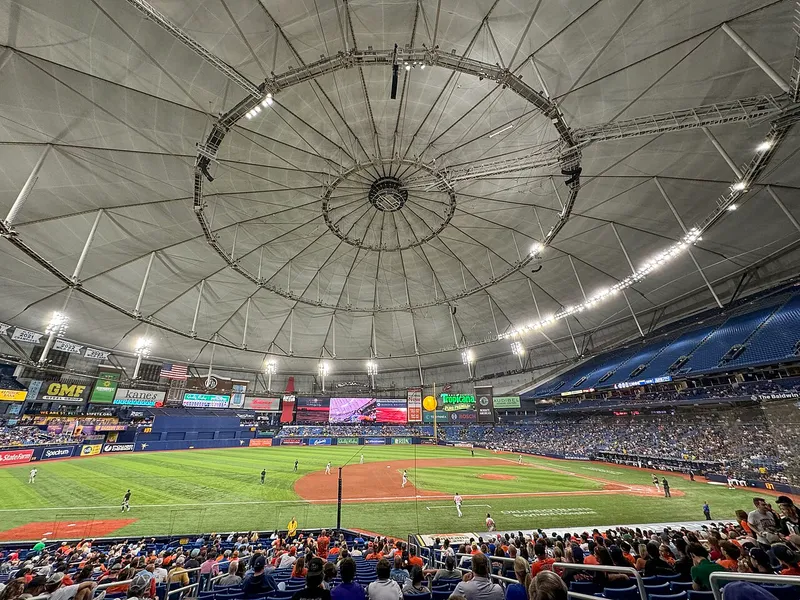
That origin story explains the place. Tropicana Field is the smallest ballpark in Major League Baseball, seating 25,025, and the last one played entirely beneath a fixed, non-retractable roof. It is also, depending on who you ask, either the sport’s strangest venue or its most maligned. The catwalks are why. Four steel rings hang from the slanted ceiling, and the ground rules attached to them exist nowhere else in the game: a ball that strikes the C or D ring in fair territory is a home run, the A ring stays in play, and the B ring is partly in play. Pop flies have turned into accidental homers. Routine fly balls have vanished into the girders. The Rays have always known the quirks better than the visitors, which is about the only home-field edge a dome this quiet can offer.
The roof itself is an engineering oddity worth pausing on. It tilts, dropping from about 225 feet (69 m) above second base to 85 feet (26 m) over the center-field wall, a slant designed to shrink the interior volume, cut cooling costs, and give the structure a lower profile against hurricanes. That last detail turned bitterly ironic in 2024. The dome is cable-supported, hung from masts and cables rather than interior columns, which is how a stadium this age still offers clean sightlines from nearly every seat.
Then there is the Touch Tank. Beyond the right-center-field wall sits a 10,000-gallon tank of cownose rays that fans can reach in and pet during games, stocked and maintained by the nearby Florida Aquarium and a fixture here since 2006. No other Major League ballpark lets you touch a live marine animal between innings. It is exactly the kind of gimmick a dome with a reputation problem leans into, and it works.
The building’s most violent chapter came on October 9, 2024. Hurricane Milton, a Category 3 storm at landfall, tore the Teflon-coated fiberglass panels off the roof and left the interior open to the sky, all while the stadium served as a staging base for emergency crews. The damage displaced the team for a full year (the Rays spent 2025 playing outdoors across the bay in Tampa). By the time repairs finished in the spring of 2026, the sealed interior was back to holding steady at roughly 72°F (22°C) year round, which matters in a city where summer afternoons routinely climb into the low 90s with brutal humidity.
Getting to Tropicana Field
Public Transit
St. Petersburg’s bus network and the newer SunRunner BRT are the main transit options. There is no rail service to the stadium.
→ From downtown St. Petersburg: PSTA local bus routes, including the 7, 9, and 18, serve stops within a few blocks of the stadium. The SunRunner bus rapid transit line runs along 1st Avenue S with a stop near the dome.
→ From Tampa: There is no direct transit link across the bay, so most fans coming from Tampa drive or use rideshare. Allow 45 to 60 minutes depending on traffic on the Howard Frankland Bridge.
The Looper, downtown St. Pete’s free trolley, circulates through the waterfront district and reaches within walking distance of the stadium on game days. It is the easiest way to pair a game with dinner along Central Avenue.
Driving + Parking
GPS address: 1 Tropicana Drive, St. Petersburg, FL 33705.
→ From Tampa (34 km): I-275 South across the Howard Frankland Bridge, exit at 22 (I-175) or 23A (5th Avenue S). About 30 minutes.
→ From Orlando (170 km): I-4 West to I-275 South. About 1 hour 50 minutes.
→ From Sarasota (93 km): I-275 North across the Sunshine Skyway Bridge. About 1 hour.
Seven numbered lots surround the stadium, with prepaid and game-day options. General parking typically runs about $25 to $35 depending on proximity, and the lots closest to the gates fill first. Additional private lots and metered street parking are available along 1st Avenue S and in the EDGE District.
Rideshare
Uber and Lyft drop off and pick up at the 1st Avenue S entrance, near Lot 1. From downtown St. Pete, expect $8 to $12; from Tampa about $25 to $40; from Tampa International Airport about $30 to $45. After games, walk a block south for faster pickups with less congestion.
From the Airport
→ Tampa International Airport (TPA): 30 km northeast, about 25 to 35 minutes by car across the Howard Frankland Bridge. Uber/Lyft $30 to $45.
→ St. Pete-Clearwater International Airport (PIE): 20 km north, about 20 to 25 minutes. A smaller airport with budget carrier service. Uber/Lyft $20 to $30.
Construction & Design
Ground broke on November 22, 1986, and the project was a civic dare from the start. St. Petersburg had watched Tampa and the rest of the state chase Major League Baseball for years, and its leaders decided the surest way to win a team was to build the ballpark first and argue about tenants later. HOK Sport, the Kansas City firm that would go on to design half the ballparks in America, led the architecture alongside two local practices, Lescher & Mahoney Sports of Tampa and Criswell, Blizzard & Blouin of St. Petersburg. Huber, Hunt & Nichols handled construction. Geiger Engineers designed the cable roof.
The slanted dome was the whole point and the whole problem. Rather than a level ceiling, the engineers pitched the roof at an angle, high over the infield and low over the outfield, to reduce the volume of air that needed cooling and to present less surface to a storm. It is a clever piece of engineering that also produced the catwalk mess, because those support rings had to live somewhere, and where they lived was directly in the flight path of fly balls.
Cost is the part the records never quite agree on. The most widely cited figure is $138 million, roughly $340 million in today’s money, though some accounts put the original build closer to $130 million before the mid-1990s baseball retrofit. The City of St. Petersburg owned the building then and still does; the Rays operate it under a lease. When the Devil Rays were awarded an expansion franchise in 1995, the dome went through an extensive renovation of roughly $70 million to turn it from a multipurpose barn into a real ballpark, and the seating bowl has been trimmed again and again since, from more than 43,000 at the 1998 debut down to the current 25,025 as upper sections were tarped or pulled out.
The playing surface has never been grass. Tropicana Field has run through a series of artificial turfs, from the original AstroTurf to the Shaw Sports Turf installed in 2017, one of the last synthetic infields in the majors. It is a dome, so weather was never the excuse. Cost and multipurpose flexibility were.
Then came Milton. The October 2024 storm shredded the fabric roof, and the repair bill ran to roughly $60 million, funded by the city. Crews began the fix in mid-2025 and finished in the spring of 2026. Whether that money was well spent is an open question, because the Rays’ long-term future in the building is anything but settled.
History of Tropicana Field
The stadium’s history is mostly a story of waiting, and then of leaving. For eight years after it opened in 1990, the Florida Suncoast Dome was a stadium in search of a sport. It courted the Chicago White Sox, the Seattle Mariners, and the San Francisco Giants, each of which flirted with a move and then stayed put. In the meantime it took whatever it could get: arena football’s Tampa Bay Storm, the NHL’s Tampa Bay Lightning (who played here from 1993 to 1996 and gave the building its second name, the ThunderDome), and the 1999 NCAA Final Four. The dome was renamed Tropicana Field in 1996 after the St. Petersburg orange-juice company bought the naming rights, and the change took effect that October.
Then the wait ended. Major League Baseball awarded Tampa Bay an expansion franchise in 1995, and the Devil Rays played their first game on March 31, 1998, before a sellout of 45,369. They lost it 11-6 to the Detroit Tigers, which turned out to be a fitting start. The team lost 99 games that first year and would not post a winning season until 2008, when it dropped “Devil” from the name, reached the World Series behind one of the youngest rosters in baseball, and fell to the Philadelphia Phillies in five games. The Trop had its best week ever and its heartbreak in the same October.
Key moments in the stadium’s history:
- March 31, 1998: The Devil Rays lose their franchise opener 11-6 to the Detroit Tigers before a sold-out 45,369. Wade Boggs hits the first Rays home run in the building later that night.
- June 25, 2010: Edwin Jackson no-hits the Rays here while pitching for the visiting Arizona Diamondbacks, a month before Tampa Bay answers with one of its own.
- July 26, 2010: Matt Garza throws the first no-hitter in Rays history, a 5-0 win over the Tigers.
- October 19, 2008: The Rays win Game 7 of the ALCS over the Boston Red Sox to reach their first World Series.
- October 9, 2024: Hurricane Milton tears open the roof while the stadium shelters first responders, displacing the team to Tampa for the entire 2025 season.
- April 6, 2026: The Rays return, beating the Chicago Cubs 6-4 in their first game back under the repaired dome.
The Rays’ run in St. Petersburg is now clearly winding down, though the exit keeps getting delayed. In 2023 the team and the city announced a roughly $1.3 billion ballpark to anchor a redevelopment of the surrounding Gas Plant District, the project that was supposed to close out the Trop era cleanly. Hurricane Milton blew that plan apart along with the roof. The Rays pulled out of the stadium deal in March 2025, and months later owner Stuart Sternberg agreed to sell the franchise for $1.7 billion to a group led by developer Patrick Zalupski, a sale approved by Major League Baseball and completed in October 2025. The new owners have been open about wanting a new ballpark, most likely somewhere in the Tampa Bay area, but as of 2026 no site, design, or opening date is settled. For now the Rays are back under the tilted roof they spent a year away from, in a building nobody is quite sure how to say goodbye to. Love it or hate it, there has never been another ballpark like it.
Sources & Further Reading
- Wikipedia entry on Tropicana Field: en.wikipedia.org. Comprehensive reference for construction, naming history, capacity, tenants, and the Hurricane Milton timeline.
- Baseball Almanac stadium record: baseball-almanac.com. Confirms the $138 million cost, the HOK Sport design team, and the cable-supported roof heights.
- MLB official ballpark guide: mlb.com. Team-published details on capacity, seating, parking, and the cownose rays Touch Tank.
- ESPN report on the Rays sale: espn.com. Covers Stuart Sternberg’s $1.7 billion agreement to sell the franchise to Patrick Zalupski’s group.
Quick Facts
Everything you need at a glance.
Stadium specs
- Capacity
- 25,025
- Opened
- 1990
- Cost
- $138 million (~$340 million (2025) today)
- Roof
- Fixed Dome
- Surface
- Artificial Turf
- Tenants
- Tampa Bay Rays (MLB)
Construction & location
- Groundbreaking
- November 22, 1986
- Architects
- HOK Sport, Lescher & Mahoney Sports, Criswell, Blizzard & Blouin Architects
- Engineering
- Geiger Engineers (roof); Martin/Martin Consulting Engineers (bowl)
- General contractor
- Huber, Hunt & Nichols
- Address
- 1 Tropicana Drive, St. Petersburg, FL 33705, USA
- GPS
- 27.7682°N, 82.6534°W
Photo Gallery
Fun Facts
Four steel catwalk rings hang from Tropicana Field's slanted roof, creating ground rules found nowhere else in baseball: a ball that strikes the C or D ring in fair territory is a home run, while the A ring stays in play, producing some of the sport's strangest bounces.
The Rays Touch Tank behind the right-center-field wall holds 10,000 gallons of water and houses cownose rays that fans can pet during games. Stocked and maintained by the nearby Florida Aquarium since 2006, it makes Tropicana Field the only MLB stadium where you can touch a live marine animal between innings.
Hurricane Milton tore open the Teflon-coated fiberglass roof on October 9, 2024, while the stadium was serving as a staging base for first responders. The roughly $60 million repair was finished in the spring of 2026, and the Rays returned that April after a full season away.
Stadium Location
Frequently Asked Questions
- What is the capacity of Tropicana Field?
- 25,025 seats for baseball, the smallest capacity in Major League Baseball. The stadium seated more than 43,000 for baseball when the Rays debuted in 1998, and the bowl has been trimmed repeatedly since, reaching the current figure in 2019.
- When did Tropicana Field open?
- The building opened on March 3, 1990, as the Florida Suncoast Dome, eight years before it had a baseball tenant. The first Major League game was played on March 31, 1998.
- Does Tropicana Field have a roof?
- Yes. It has a fixed, non-retractable dome of Teflon-coated fiberglass, tilted so it sits about 225 feet above second base and 85 feet over the center-field wall. Hurricane Milton tore it open in October 2024, and it was repaired by the spring of 2026.
- What are the Tropicana Field catwalk rules?
- Four rings (A, B, C, and D) hang from the dome. A ball that hits the C or D ring in fair territory is ruled a home run. The A ring stays in play, and the B ring is partly in play, which has produced some of baseball's oddest plays.
- Why is it called Tropicana Field?
- The dome opened as the Florida Suncoast Dome in 1990, became the ThunderDome in 1993 while the NHL's Tampa Bay Lightning played there, and was renamed Tropicana Field in 1996 after the St. Petersburg orange-juice company bought the naming rights.
- How do I get to Tropicana Field by public transit?
- The SunRunner bus rapid transit line connects St. Pete Beach and downtown St. Petersburg with a stop within walking distance of the stadium. PSTA local bus routes, including the 7, 9, and 18, also serve the area.
- Is there parking at Tropicana Field?
- Yes. Seven numbered lots surround the stadium, with prepaid and game-day options. General parking typically runs about $25 to $35 depending on proximity, and the closest lots fill first. Additional private lots and metered street parking are available along 1st Avenue S and in the EDGE District.
- Where did the Rays play in 2025?
- After Hurricane Milton damaged the roof, the Rays played their entire 2025 home season outdoors at George M. Steinbrenner Field in Tampa, the New York Yankees' spring-training ballpark, before returning to a repaired Tropicana Field for 2026.
- Are the Rays leaving Tropicana Field?
- Eventually, yes. A planned $1.3 billion ballpark in St. Petersburg's Gas Plant District collapsed in 2025, and owner Stuart Sternberg agreed to sell the franchise for $1.7 billion to a group led by developer Patrick Zalupski, a sale completed in October 2025. The new owners want a new ballpark in the Tampa Bay area, but as of 2026 no site or opening date is set.
- What happened to Tropicana Field during Hurricane Milton?
- Hurricane Milton struck on October 9, 2024, tearing open a large section of the Teflon-coated fiberglass roof while the stadium was set up as a first-responder staging base. The roughly $60 million repair, funded by the city, was completed in the spring of 2026.
Last updated: 2026-07-10