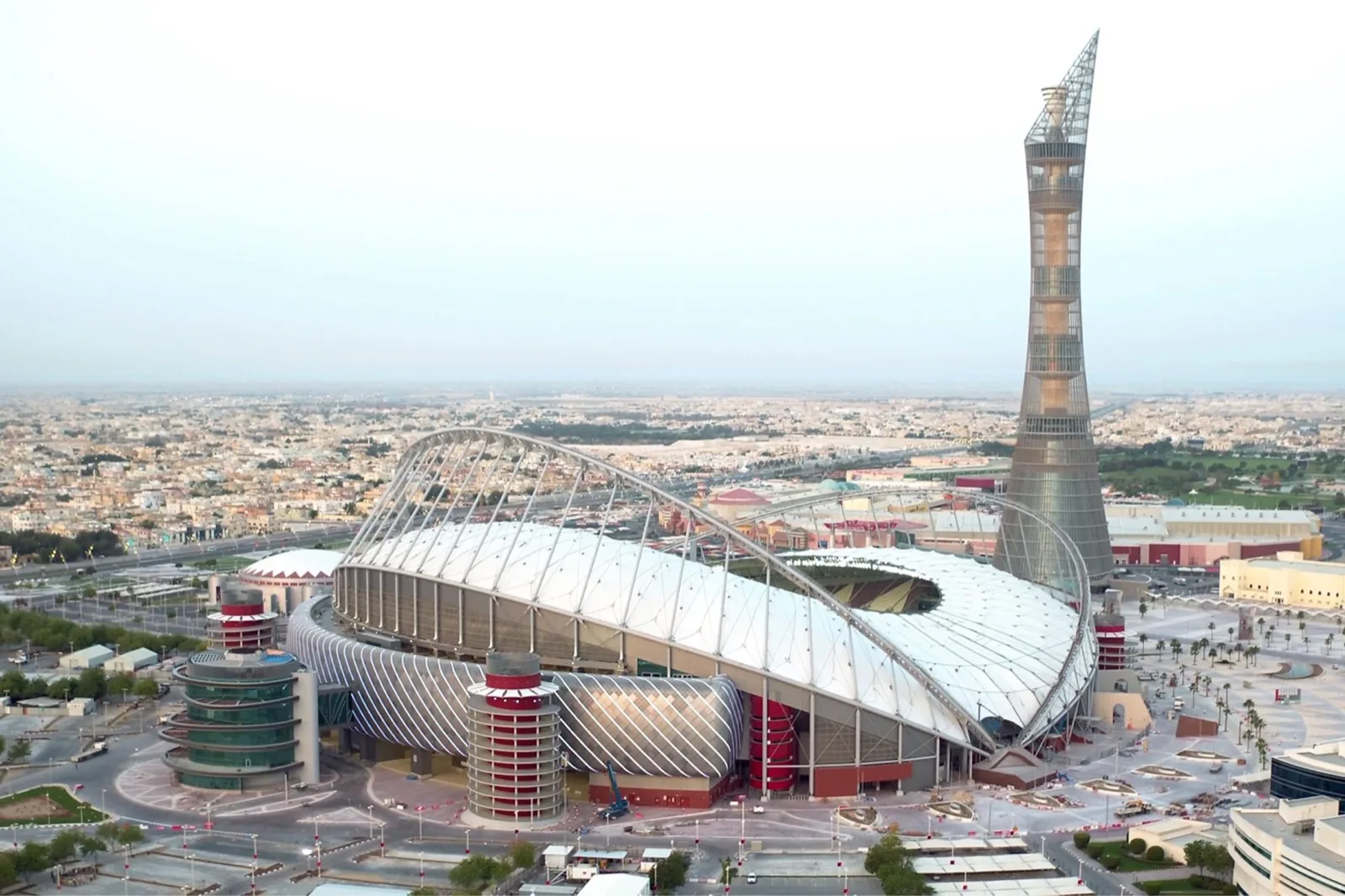
About Khalifa International Stadium
Long before Qatar won the right to host a World Cup, there was Khalifa. The stadium opened in 1976, when Doha was a fraction of the city it is now, and for decades it was the country’s national ground, the place where Qatar played its biggest matches. Every other 2022 venue was built for the tournament. Khalifa was already there, and it earned its place by being rebuilt rather than replaced.
The stadium sits in Aspire Zone, Qatar’s purpose-built sports district in Al Rayyan, about 9 kilometres (6 miles) west of central Doha. It is the anchor of a complex that also holds the 300-metre Torch Doha tower, the sprawling Aspire Park, the Villaggio Mall, and a sports academy. Two great arches, each over 120 metres (394 feet) high, frame the bowl and give the stadium its silhouette, recognizable across the city skyline.
Between 2014 and 2017 the venue was completely redeveloped for the World Cup by Dar Al-Handasah, who kept the arches and slung a wide new canopy between them to shade roughly 70 percent of the seats. An advanced outdoor cooling system was added, designed to keep players and fans comfortable while using far less energy than you might expect. The work made Khalifa the first of Qatar’s eight tournament venues to be ready, reopening in May 2017.
What sets Khalifa apart from its newer neighbors is what it kept. It still has a full athletics track, still hosts the Doha Diamond League and world-class track meets, and it did not shrink after the World Cup. Where the other venues shed their upper tiers, the grand old stadium simply carried on, doing the job it has done since 1976.
Getting to Khalifa International Stadium
Public Transit
The Gold Line drops you right inside the sports complex, which makes this an easy one.
→ From central Doha: Take the Gold Line to Sport City station, about 20 minutes. The station sits inside Aspire Zone, a short signposted walk from the stadium past Aspire Park and the Torch Doha tower.
→ Make an afternoon of it: With Villaggio Mall and Aspire Park next door, plenty of fans arrive early, eat or wander the park, then stroll to the gates.
Because the stadium shares its district with the mall and park, the post-match exit spreads out across the zone rather than funneling everyone onto a single platform.
Driving + Parking
Aspire Zone is reached from Doha along the Al Waab Street and the G Ring Road, with well-marked entrances to the complex.
→ From central Doha (~9 km): Head west on Al Waab Street, about 15-20 minutes outside peak traffic.
→ From West Bay (~12 km): A straightforward drive southwest toward Aspire Zone, roughly 20 minutes.
The zone and the adjacent Villaggio Mall have substantial parking, so driving to a regular national team match or an athletics meet is easy. For a sold-out international, the metro spares you the exit traffic.
Rideshare
Uber, Careem, and the metered Karwa taxis all serve Aspire Zone, and the mall next door gives drivers clear pickup points. After a big event, expect surge pricing and a queue as the crowd disperses across the complex.
Pro tip: Set your pickup at Villaggio Mall rather than the stadium gate. The mall’s drop-off lanes are built for volume, and you can wait indoors in the cool.
From the Airport
→ Hamad International Airport (DOH): About 22 km (14 mi) east, roughly 20 minutes by car. A taxi or rideshare is simplest, or take the metro and change in central Doha for the Gold Line to Sport City.
→ From the city center: Aspire Zone is a quick, well-signed drive west from downtown Doha and West Bay.
The 2022 World Cup at Khalifa International Stadium
Khalifa hosted eight matches, including the third-place play-off, and as the oldest and most experienced venue it handled the big occasions with ease.
England’s statement: On the opening Monday, England beat Iran 6-2 here, the stadium’s record crowd of 45,344 watching a six-goal haul that announced England as contenders. It was one of the highest-scoring matches of the group stage.
Japan stun Germany: Two days later, Japan came from behind to beat Germany 2-1, one of the great upsets of the tournament and the start of a chaotic group that Japan would go on to win. Trailing at half-time, Japan scored twice in the last 15 minutes, the kind of comeback that makes a neutral venue feel like a fortress for whoever needs it most.
The third-place match: On December 17, Croatia beat Morocco 2-1 in the play-off for third, ending Morocco’s remarkable run. Khalifa, which had hosted finals and ceremonies for decades, was a natural home for the tournament’s penultimate match.
Construction & Design
Khalifa’s story is one of reinvention rather than construction. The original stadium dates to 1976, and it has been reshaped repeatedly: expanded for the 2006 Asian Games, then completely redeveloped between 2014 and 2017 for the World Cup. The challenge was not to build something new, but to take a much-loved old ground and bring it up to the standard of a global tournament without losing what made it Khalifa.
The two arches were the answer. They were already the stadium’s signature, rising over 120 metres above the bowl, and the redevelopment by Dar Al-Handasah kept them and made them work harder. A wide cantilevered canopy was slung beneath the arches to shade roughly 70 percent of the seats, with a membrane roof supplied by Birdair. The result frames the pitch dramatically while solving the practical problem of keeping a crowd out of the sun.
The other major addition was cooling. Khalifa received an advanced outdoor cooling system, engineered to hold the pitch and stands at a comfortable temperature while using around 40 percent less energy than conventional approaches. That, combined with the decision to renovate rather than rebuild, helped Khalifa become the first stadium to earn a FIFA-endorsed four-star rating under the region’s Global Sustainability Assessment System.
The redevelopment was delivered by a joint venture of Midmac and Six Construct, part of Belgium’s BESIX, at a cost of around €307 million. Crucially, the stadium kept its athletics track throughout, preserving the dual football-and-track role that has defined it for half a century. When it reopened in May 2017, Khalifa became the first of Qatar’s World Cup venues ready for action.
History of Khalifa International Stadium
No other Qatar 2022 venue comes close to Khalifa for history. While the rest were drawings or building sites, this stadium had already hosted nearly half a century of Qatari sport.
- Opened (1976): The stadium opened as Qatar’s national ground and hosted the Arabian Gulf Cup that year.
- 2006 Asian Games: Khalifa staged the opening and closing ceremonies and the athletics of the Doha Asian Games, the catalyst for building the wider Aspire Zone around it.
- 2011 AFC Asian Cup: The stadium hosted matches, including the final, as Qatar staged the continental championship.
- Redevelopment and reopening (2014-2017): A full rebuild added the canopy, cooling, and modern facilities, and Khalifa reopened in May 2017 as the first completed World Cup venue.
- 2019 events: Khalifa hosted the World Athletics Championships and matches at the FIFA Club World Cup, underlining its rare dual role across football and track.
- World Cup (2022): Khalifa hosted eight matches, including England’s 6-2 win over Iran and the third-place play-off.
- 2025 finals: The stadium staged the final of the FIFA U-17 World Cup and matches at the FIFA Arab Cup, proof that its event life continued well past 2022.
Since the tournament, Khalifa has carried on much as before, hosting the Qatar national team, the Doha Diamond League, and major finals, the grand old stadium still at the center of the country’s sporting life. It is also lined up for athletics at the 2030 Asian Games, which means the venue that opened in 1976 will be working into its sixth decade. Few stadiums anywhere can say that.
Sources & Further Reading
- Wikipedia entry on Khalifa International Stadium: en.wikipedia.org/wiki/Khalifa_International_Stadium. History from 1976, the redevelopment, capacity, and the matches.
- Aspire Zone Foundation: aspirezone.qa. The operator’s information on the stadium and the wider sports complex.
- Visit Qatar stadium guide: visitqatar.com. Visitor information, the arches, and Aspire Zone attractions.
- Doha Metro (Qatar Rail): qr.com.qa. Gold Line service to Sport City station inside Aspire Zone.
Quick Facts
Everything you need at a glance.
Stadium specs
- Capacity
- 45,857
- Opened
- 1976
- Cost
- redevelopment around €307 million
- Roof
- Partial (cantilevered canopy)
- Surface
- Natural Grass (with athletics track)
- Tenants
- Qatar National Team, Aspire Zone (athletics & events)
Construction & location
- Groundbreaking
- 1976 (original); redeveloped 2014-2017
- Architects
- Dar Al-Handasah (2014-2017 redevelopment)
- Engineering
- Dar Al-Handasah; Birdair (roof membrane)
- General contractor
- Midmac / Six Construct (BESIX) joint venture
- Address
- Khalifa International Stadium, Aspire Zone, Al Rayyan, Qatar
- GPS
- 25.2636°N, 51.4481°E
Photo Gallery
Fun Facts
Khalifa is Qatar's oldest major stadium, opened in 1976, and it was the first of the country's eight World Cup venues to be completed, reopening in 2017 after a full redevelopment.
The stadium is framed by two sweeping arches over 120 metres (394 feet) high, with a wide canopy added for 2022 that shades roughly 70 percent of the seats.
It keeps a full athletics track and has hosted the 2019 World Athletics Championships and the Doha Diamond League, one of the few World Cup venues that doubles as a top track-and-field arena.
Stadium Location
Frequently Asked Questions
- What is the seating capacity of Khalifa International Stadium?
- Khalifa held 45,857 for the 2022 World Cup, following its 2014-2017 redevelopment. Unlike the purpose-built venues, it kept its full capacity after the tournament rather than shrinking, and remains the home of the Qatar national team.
- Where is Khalifa International Stadium located?
- It is in Aspire Zone, Qatar's main sports complex in Al Rayyan, about 9 km (6 mi) west of central Doha. The Gold Line metro stops at Sport City station inside the zone, beside Aspire Park and Villaggio Mall.
- How old is Khalifa International Stadium?
- It originally opened in 1976, making it Qatar's oldest major stadium by far. It has been expanded and renovated several times, most recently between 2014 and 2017 for the World Cup, but its roots go back nearly five decades.
- Was Khalifa the first Qatar 2022 stadium completed?
- Yes. Khalifa reopened in May 2017 after its redevelopment, the first of the eight World Cup venues ready. Al Janoub was the first purpose-built new stadium completed, in 2019, but Khalifa came first overall as a renovation.
- What 2022 World Cup matches did Khalifa International Stadium host?
- It hosted eight matches: six group games, a Round of 16, and the third-place play-off. England beat Iran 6-2 here in the opening round, and Croatia beat Morocco 2-1 in the third-place match on the tournament's final weekend.
- Did Khalifa host the World Cup third-place play-off?
- Yes. On December 17, 2022, Croatia beat Morocco 2-1 at Khalifa in the third-place play-off, ending Morocco's historic run. It was a fitting stage for it, given the stadium's long history of hosting major finals and ceremonies.
- What are the two arches at Khalifa International Stadium?
- Two sweeping arches over 120 metres high frame the stadium on its east and west sides. They are its signature feature and were retained and highlighted in the redevelopment, which added a wide canopy slung between them to shade most of the seats.
- How do I get to Khalifa International Stadium by metro?
- Take the Gold Line to Sport City station, which sits inside Aspire Zone right by the stadium. From there it is a short, signposted walk to the gates, past Aspire Park and the Torch Doha tower.
- Does Khalifa International Stadium have a cooling system?
- Yes. The redevelopment added an advanced outdoor cooling system that keeps the pitch and stands comfortable, reportedly using around 40 percent less energy than conventional cooling. The wide canopy added for 2022 shades roughly 70 percent of the seats.
- What other major events has Khalifa International Stadium hosted?
- Khalifa has a deep event history: the 2006 Asian Games opening and closing ceremonies, the 2011 AFC Asian Cup, the 2019 World Athletics Championships, the Doha Diamond League, and the 2019 FIFA Club World Cup. It also staged the 2025 FIFA U-17 World Cup final.
- How far is Khalifa International Stadium from the airport?
- Hamad International Airport (DOH) is about 22 km (14 mi) east, roughly 20 minutes by car. The Gold Line metro connects the airport area to Aspire Zone with a change in central Doha, though many visitors simply take a taxi.
- Does Khalifa International Stadium have an athletics track?
- Yes. Unlike the other Qatar 2022 venues, Khalifa keeps a full athletics track around the pitch, reflecting its dual role. It hosted the 2019 World Athletics Championships and regularly stages the Doha Diamond League.
- What is next to Khalifa International Stadium?
- The stadium sits in Aspire Zone alongside the 300-metre Torch Doha tower, the 3-2-1 Qatar Olympic and Sports Museum, which wraps around the stadium, Aspire Park, and Villaggio Mall, making it the center of Qatar's sporting district.
- How sustainable is Khalifa International Stadium?
- It was the first stadium to earn a FIFA-endorsed four-star rating under the Global Sustainability Assessment System in the region. The redevelopment reused the existing structure rather than building new, and its cooling system was designed to cut energy use sharply.
Last updated: 2026-07-10