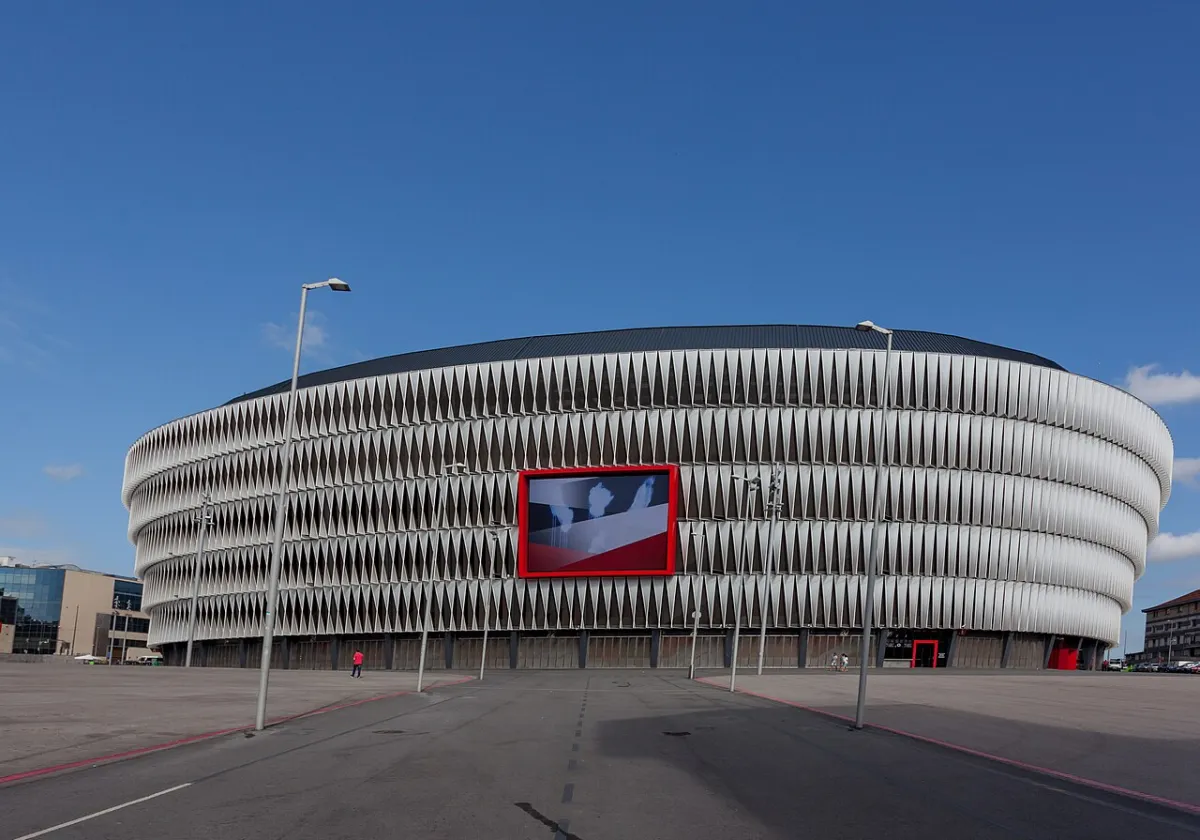
About San Mamés
Wrapped in a skin of twisted, glowing panels on a bank above the Nervión river, San Mamés is Bilbao’s cathedral rebuilt for the modern game. The stadium stands in the Basurto district, at Rafael Moreno Pitxitxi Kalea, only a couple of kilometres west of the city center and a short walk from the Guggenheim. It opened on 16 September 2013, and holds 53,289, which makes it the largest stadium in the Basque Country and the eighth-largest in Spain. It is the home of Athletic Club, one of only three sides never relegated from Spain’s top division.
The name carries a story that runs through the whole club. San Mamés honors Saint Mammes, a 3rd-century martyr venerated at a chapel that sat on this hillside from the 15th century, and the saint’s legend of taming lions is where Athletic’s nickname, Los Leones, the Lions, comes from. The old ground here, which stood from 1913, was known across the country as La Catedral, The Cathedral of Spanish football. When the new stadium rose on the adjacent lot, it inherited both the name and the title.
Athletic have never had another home, and they run the club on a principle almost no one else in elite football shares: only players born or developed in the Basque Country pull on the shirt. That identity is stitched into the building. The bowl is steep and four-sided, pulled tight around the pitch to trap noise and keep every seat close, and the surface is a hybrid grass laid over a ground built to UEFA’s elite category. On a European night the place is loud in a way modern stadiums rarely are.
The most striking feature is the outside. More than 2,700 curved ETFE panels form a textile-like envelope that reads as translucent by day and turns into a programmable light show at night, shifting colors and animations across the whole facade. It won the 2015 World Architecture Festival’s top prize, World Building of the Year, a rarity for a stadium. Bilbao spent a generation reinventing itself around the Guggenheim, and San Mamés is the sporting half of that same story.
Getting to San Mamés
Public Transit
The Metro is the easy way in. San Mamés station is served by both Line 1 and Line 2, and its exit opens right at the stadium.
→ From central Bilbao: Lines 1 and 2 share the same tunnel through the center, so from Abando or Casco Viejo it is a direct ride of a few stops on either line, no transfer needed. A few minutes, door to door.
→ By tram: The Euskotren tram runs from the old town and past the Guggenheim along the river to a stop beside the ground, with extra service starting about 90 minutes before kickoff.
City and regional buses (Bilbobus and Bizkaibus) also stop at the adjoining Bilbao Intermodal terminal, which shares the San Mamés interchange. On a match day the Metro is faster and simpler than anything on the road.
Driving + Parking
The stadium sits on a high bank over the Nervión in the Basurto district, close to the city center. GPS address: Rafael Moreno Pitxitxi Kalea, 48013 Bilbao.
→ From the center: A short hop west, though the surrounding Indautxu and Basurto streets clog badly around kickoff.
Parking is tight on match days. There are paid car parks and regulated on-street (OTA) spaces nearby, but capacity is limited and the club advises against driving. Given how central and well-connected the ground is, the Metro or tram is the sensible choice.
Rideshare
Uber, Cabify and the taxi app FreeNow all operate in Bilbao, though availability thins out late at night, when a metered street taxi is often the better bet. Traditional taxis, white with a red stripe, are easy to find at the stations and main squares. From the city center it is only about 2 km to the stadium, so the fare is small.
From the Airport
→ Bilbao Airport (BIO): About 12 km north of the city. The Bizkaibus A3247 bus runs to the center and terminates at the Bilbao Intermodal (San Mamés) interchange right by the stadium, roughly 20 minutes for around 3 euros. A taxi runs about 25 to 30 euros and takes 20 to 25 minutes.
Bilbao is the only major airport for the city, so there is no second-airport decision. The airport bus dropping you at the stadium interchange makes San Mamés one of the easier grounds in Spain to reach straight off a flight.
The New Cathedral
Replacing a stadium as loved as the old San Mamés was a delicate job, and Athletic solved it with a trick of geography. Rather than knock down La Catedral and play elsewhere for years, the club built the new ground on the plot next door, kept playing at home through construction, and only demolished the old stadium at the end, finishing the last stand on its footprint in 2014. Fans barely missed a home game.
The result keeps the soul and upgrades everything else. The bowl is deliberately steep and continuous, with the stands pulled close to the touchline so the noise has nowhere to escape, and Athletic’s European nights under the lights have made it one of the more intimidating trips in Spanish football. The single arch that crowned the old main stand was saved during demolition and moved to the club’s Lezama training ground, a piece of La Catedral kept alive.
What the new San Mamés added is spectacle. The ETFE facade turns the exterior into a canvas, lit red and white for Athletic, or any color a big night calls for, and it made the building a landmark on the Bilbao skyline rather than just a place to watch football. The city that rebuilt its reputation around the Guggenheim now has a stadium in the same conversation, an architecture-award winner that happens to hold 53,000 people. For a club defined by its refusal to change who it signs, it is a striking piece of change everywhere else.
Construction & Design
Bilbao did not have to look far for an architect. IDOM, the city’s own engineering house, took the job under its ACXT architecture brand, with César Azcárate leading the design and IDOM’s in-house team carrying the structure. Construction ran from 2010 to the 2013 opening, phased around the old stadium so the club never had to leave, and the total project cost about 211 million euros, financed mostly by Basque public institutions alongside Athletic Club and the savings bank BBK.
The signature is that outer skin. More than 2,700 double-curved ETFE panels, each roughly 5.4 by 1.2 metres, wrap the concrete bowl in a textile-like envelope. By day the panels read as a soft translucent lattice; by night an LED system behind them lights the whole facade in programmable colors and patterns, using up to around half the energy of a conventional lighting rig. The roof is a full cantilevered canopy covering all four stands while leaving the pitch open to the Basque sky, carried on composite frames with a 50-metre span, and it was extended in 2016 for about 12.6 million euros to keep more of the crowd dry.
The engineering underneath is as considered as the surface. The four-sided bowl was raked steeply and drawn tight to the pitch to maximise both capacity and atmosphere on a compact, hemmed-in urban site of roughly 114,500 square metres of built area. The whole thing was assembled to UEFA’s elite standard, which is why it keeps drawing European finals. The design collected a shelf of honors, headlined by the 2015 World Architecture Festival naming it World Building of the Year in the sport category, the profession’s rare acknowledgement that a stadium can be great architecture and not just a big shed for a crowd.
History of San Mamés
The story starts in 1913, when the original San Mamés opened on this hillside and quickly became La Catedral, the oldest and most revered football ground in Spain. It was renovated in 1952 and almost entirely rebuilt in 1982 to host matches at that year’s World Cup, and for a century it staged the whole sweep of Athletic Club’s history. The last league match there, a 1-0 loss to Levante on 26 May 2013, closed a hundred years on the site.
By the 2000s the old ground could no longer meet modern demands, and the club approved a replacement in 2006. Building it on the adjacent plot, rather than relocating, kept Athletic at home throughout, and the new stadium opened in September 2013 and was completed in 2014. The name, the nickname and the atmosphere all crossed over intact.
Notable events:
- Inauguration (16 September 2013): Athletic Club beat Celta Vigo 3-2 in the first match at the new ground, then still partly under construction.
- European Rugby Champions Cup finals (2018 and 2026): San Mamés hosted rugby’s biggest club final twice, with Leinster winning in 2018 and Bordeaux Bègles taking the 2026 edition.
- Euro 2020, and its loss: Bilbao was chosen in 2014 as a host city for Euro 2020, but UEFA removed it in April 2021 when the city could not guarantee spectators during the pandemic, and its four matches were reassigned to Seville.
- 2024 Women’s Champions League final and 2025 Europa League final: The ground hosted the women’s European final in 2024, then the 2025 Europa League final, where Tottenham beat Manchester United 1-0 for their first trophy in decades.
- Concerts: Guns N’ Roses (2017), Fito y Fitipaldis (2022) and Metallica (2022) have all played the stadium.
The old San Mamés drew far larger crowds in its standing-terrace years, but the new ground has set its own marks, with a football attendance record of 52,114 against Rangers in April 2025 and an overall record of 52,327 at the 2026 rugby final. What has not changed across the century, from one stadium to the next on the same patch of Bilbao, is the club, the name, and the noise.
Sources & Further Reading
- Athletic Club official San Mamés site: sanmames.athletic-club.eus. Club history, the naming story, visitor and matchday information.
- Wikipedia entry on San Mamés (2013): en.wikipedia.org/wiki/San_Mamés_Stadium_(2013). Capacity, construction, events and records.
- IDOM project page: idom.com. The architecture and engineering from the firm that designed it.
- ArchDaily on San Mamés: archdaily.com. The design team, the ETFE facade and the project scope.
- Metro Bilbao: metrobilbao.eus. Line 1 and Line 2 service to San Mamés station.
Quick Facts
Everything you need at a glance.
Stadium specs
- Capacity
- 53,289
- Opened
- 2013
- Cost
- €211 million
- Roof
- Roof over stands (open pitch)
- Surface
- Hybrid grass
- Tenants
- Athletic Club (La Liga)
Construction & location
- Groundbreaking
- 2010
- Architects
- IDOM / ACXT (lead architect César Azcárate)
- Engineering
- IDOM (in-house)
- Address
- Rafael Moreno Pitxitxi Kalea, s/n, 48013 Bilbao, Basque Country, Spain
- GPS
- 43.2643°N, 2.9504°W
Photo Gallery
Fun Facts
San Mamés is named after Saint Mammes, a 3rd-century martyr said to have tamed lions, which is why Athletic Club are nicknamed Los Leones, the Lions.
The stadium's facade is wrapped in more than 2,700 twisted ETFE panels that light up in programmable colors at night, and the design won World Building of the Year at the 2015 World Architecture Festival.
The whole ground was built on a site next to the old stadium so Athletic could keep playing at home throughout the 2010 to 2013 construction, then the last stand was finished on the old stadium's footprint after it was demolished.
Stadium Location
Frequently Asked Questions
- What is the capacity of San Mamés?
- San Mamés holds 53,289, though official sources list the figure slightly differently (53,289, 53,331 or 53,332) after minor seat reconciliations. It is the eighth-largest stadium in Spain and the largest in the Basque Country. The football attendance record for the current ground is 52,114, set against Rangers in April 2025.
- Where is San Mamés located?
- San Mamés sits at Rafael Moreno Pitxitxi Kalea in the Basurto district of Bilbao, on a high bank overlooking the Nervión estuary. It is central, immediately west of the Indautxu and Abando core, so most trips from the city center are only a few minutes.
- When was San Mamés built?
- The current San Mamés was inaugurated on 16 September 2013, with Athletic Club beating Celta Vigo 3-2. It was fully completed in 2014 once the old stadium was demolished and the final stand built on its footprint. It replaced the original San Mamés, which had stood since 1913.
- Who plays at San Mamés?
- San Mamés is the home of Athletic Club, also known as Athletic Bilbao. The club has played at San Mamés continuously since 1913, first at the old ground and then at the new one from 2013. Athletic is one of only three clubs never relegated from Spain's top flight, alongside Real Madrid and Barcelona.
- Why is it called San Mamés and The Cathedral?
- The stadium is named after Saint Mammes, a 3rd-century Christian martyr venerated at a chapel that stood on the site from the 15th century. The saint's legend of taming lions gave Athletic their nickname, Los Leones. The ground earned the nickname La Catedral, The Cathedral, as the spiritual home of Spanish football, a title carried over from the historic old stadium.
- How do I get to San Mamés by metro?
- Take the Bilbao Metro to San Mamés station, served by both Line 1 and Line 2, whose exit opens right at the stadium. The two lines share the same tunnel through central Bilbao, so from Abando or Casco Viejo it is a short, direct ride with no transfer. The tram also has a stop beside the ground.
- How much did the new San Mamés cost?
- The total project cost about 211 million euros, financed largely by Basque public institutions (the Basque Government, the Bizkaia provincial council and Bilbao city council) alongside Athletic Club and the savings bank BBK. A separate construction-only figure of around 186.5 million euros is sometimes cited. A roof extension added about 12.6 million euros in 2016 to 2017.
- Who designed San Mamés?
- San Mamés was designed by the firm IDOM, under its ACXT architecture brand, with César Azcárate as lead architect. IDOM handled both the architecture and the engineering in house. The design won the 2015 World Architecture Festival's World Building of the Year in the sport category, a rare top prize for a stadium.
- What events has San Mamés hosted?
- San Mamés hosted the 2025 UEFA Europa League final, where Tottenham beat Manchester United 1-0, plus the 2024 Women's Champions League final and two European Rugby Champions Cup finals (2018 and 2026). Bilbao was chosen as a Euro 2020 host city but was removed in 2021 when it could not guarantee crowds during the pandemic, and its matches went to Seville.
Last updated: 2026-07-12