About Prince Moulay Abdellah
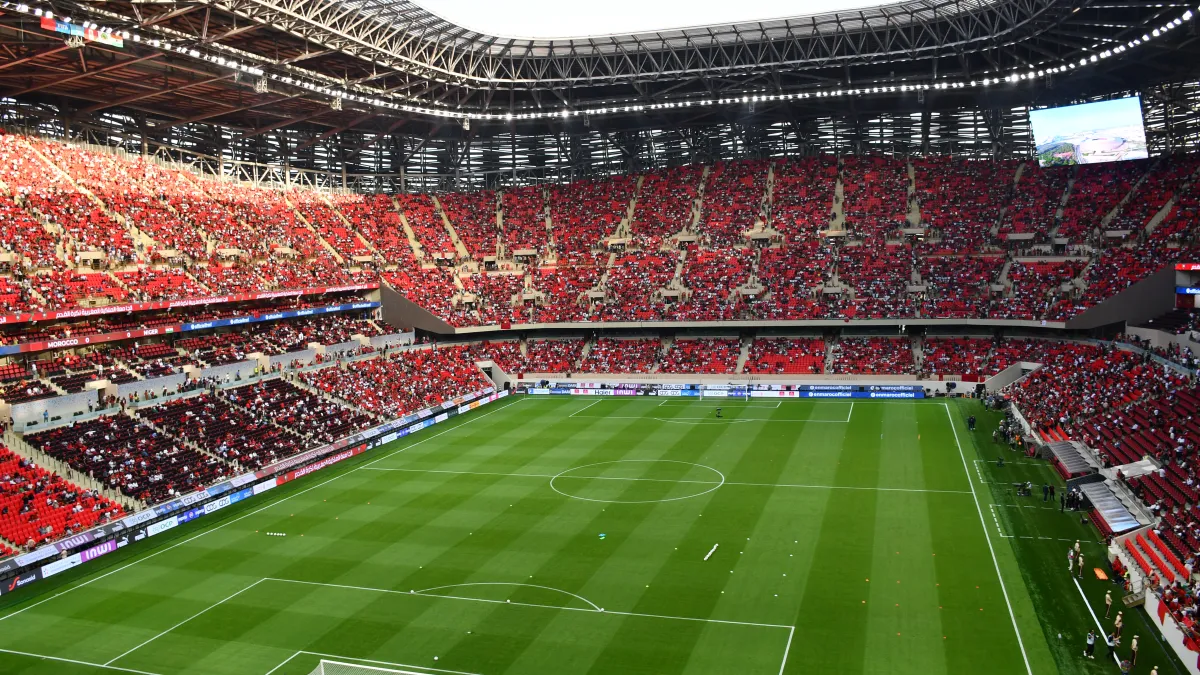
Prince Moulay Abdellah Stadium is Morocco’s grand new national ground, and it is grand in the most literal sense. It sits about 7 kilometres southwest of central Rabat, the country’s capital, and it is the main home of the Morocco national team as well as the army club AS FAR. What stands there today opened only in September 2025, a complete rebuild of the 1983 stadium that once occupied the site, and it was built for one purpose above all: to help Morocco co-host the 2030 World Cup.
It holds about 69,000, a figure that shifts a little between sources, from roughly 68,000 up to 69,500 depending on the configuration, with the World Cup setup put at around 68,700. Either way it is one of the largest stadiums in Africa, on a hybrid natural-and-synthetic pitch, with a sweeping roof that covers the stands and shields them from the wind while leaving the field open to the Rabat sky.
The design is the headline. Wrapped in a parametric façade of nearly 20,000 champagne-colored aluminum triangles that light up at night, and anchored by a 23,000-seat southern stand, it is a statement building, meant to announce Morocco’s arrival as a host of the world’s biggest tournament. It has already had its trial by fire, hosting the Africa Cup of Nations final within months of opening, a night Morocco won on home soil.
For 2030 it has a defined role: a semifinal. The final itself is reserved for the even bigger Grand Stade Hassan II rising in Casablanca. But a World Cup semifinal in a brand-new 69,000-seat arena is a marquee night by any measure, and Rabat’s stadium was built to hold exactly that.
Getting to Prince Moulay Abdellah
The stadium sits out in the Al Irfane district southwest of the city, and the tramway makes it an easy trip from central Rabat.
Public Transit
The Rabat-Salé tramway is the recommended way to the ground, cheap and frequent, and it drops you a short walk away.
→ Via tram: Take the Rabat-Salé tramway to Madinat Al Irfane station, then walk a few hundred metres to the stadium. The ride from central Rabat takes only 10 to 15 minutes.
→ Special event service: For big matches, Rabat has run extra tram and bus service and event passes, worth checking before a World Cup or a Morocco international.
Driving + Parking
The complex was rebuilt with parking on a scale to match its size.
→ Parking: There is extensive underground parking on site, cited in the thousands of spaces, though it fills for big matches, so arriving a couple of hours early is wise.
→ From the center: A short drive southwest from central Rabat, quick outside match traffic but slow around kickoff.
Rideshare
Taxis are the everyday way to move around Rabat, and a ride to the stadium runs about 15 minutes from the center. App-based rideshare coverage in Morocco is patchier than the local petit and grand taxis, so a metered or agreed-fare taxi is often the surer bet, particularly in the crush after a big game.
From the Airport
→ Rabat-Salé (RBA): The city’s own airport is about 18 kilometres away, roughly 20 to 30 minutes by taxi.
→ Casablanca Mohammed V (CMN): The country’s main international gateway is about 110 kilometres south. The simplest route is the direct train to Rabat, a little over an hour, then the tram or a taxi to the ground.
Matchday at Prince Moulay Abdellah
A Morocco night at Prince Moulay Abdellah is one of the loudest occasions in African football, and the stadium is built to bottle that noise. The roof over the stands is designed with a windbreak system that doubles as an acoustic lid, keeping the sound in, and when the ground sells out for the national team the effect is overwhelming. The chant you will hear over and over is “Dima Maghrib,” always Morocco.
The atmosphere lives in the ends. The vast South Kop, the roughly 23,000-seat southern stand, is the heart of it, and the ultras gather in the north and south with drums, giant flags and choreographed tifos. If you want to be inside the wall of sound, that is where to aim. For a calmer, panoramic view, the long west stand runs the full length of the pitch, and the corner categories and skyboxes sit higher and more comfortable, if less feverish.
The practical side is straightforward, with one local piece of advice worth knowing. Your ticket names the gate you should enter by, and the exterior perimeter is large, so getting to the right side early saves a long walk around. Inside, more than 40 concession stands serve Moroccan and international food, and, as at Moroccan grounds generally, no alcohol is sold. There is no signature stadium dish to seek out yet, since the place only reopened in 2025, so the real eating is done beforehand in central Rabat, in the medina and the cafés of the city.
The one tip regulars pass on is about the exit. The tram back into town is quick but gets swamped the moment a big match ends. Wait 15 to 20 minutes after the final whistle, let the first wave clear, and the ride home is far more pleasant. It is a small thing, but it is the difference between soaking up the afterglow and standing in a crush.
Construction & Design
The stadium that stands today was built at remarkable speed. The original 1983 ground, itself put up by a Chinese company over three years, was demolished in August 2023, and the replacement rose in roughly two years, reopening on September 5, 2025, when Crown Prince Moulay El Hassan inaugurated it. The pace was so fast it has been discussed as a possible world record for stadium construction, delivered through a mass mobilization of Moroccan firms, with SGTM leading the build.
The design was drawn by the global sports-architecture firm Populous, best known for grounds like Tottenham Hotspur Stadium, working with the Moroccan practice Orange Atelier. Its signature is the parametric façade: a skin of nearly 20,000 champagne-colored aluminum triangles arranged in a pattern that nods to Moroccan ornamentation, covering around 100,000 square metres and threaded with some 70 kilometres of LED strips that turn the whole building into a light show after dark.
Inside, the scale is deliberate. The two-tier South Kop holds about 23,000 on its own, its upper deck cantilevered roughly 8 metres over the lower to press the crowd toward the pitch. The roof wraps the stands with a windbreak system that also sharpens the acoustics, and the playing surface is a hybrid of natural grass reinforced with synthetic fibers, billed as a first of its kind on the continent. It is a stadium designed less as a quiet renovation than as a showpiece, a physical argument for Morocco’s place on the world stage.
History of Prince Moulay Abdellah
There has been a Prince Moulay Abdellah Stadium in Rabat since 1983, and for four decades the original was Morocco’s main national ground. It hosted the 1988 Africa Cup of Nations, editions of the FIFA Club World Cup in 2014 and 2022, the 2019 African Games and a string of continental finals, serving as the home of both the national team and AS FAR through it all.
That first stadium reached the end of its life as Morocco’s ambitions grew. With the country bidding to co-host the 2030 World Cup alongside Spain and Portugal, the old bowl was demolished in 2023 and rebuilt from nothing, a decision to replace rather than patch that produced the arena standing today.
The new stadium announced itself almost immediately. Within months of its September 2025 reopening it was thrown into the 2025 Africa Cup of Nations, which Morocco hosted, and it carried the tournament all the way to the final. On January 18, 2026, Morocco beat Senegal 3-0 there in front of a record crowd of 66,525 to win the continental title on home soil, a night that gave the new ground its first great memory.
Now the bigger stage waits. As a confirmed venue for the 2030 World Cup, Prince Moulay Abdellah is set to host a semifinal, one of the last matches before a final that will be played in Casablanca. A stadium built in two years for a tournament six years away has already proved it can hold the biggest nights, and its greatest one is still to come.
Sources & Further Reading
- Wikipedia entry on Prince Moulay Abdellah Stadium: en.wikipedia.org/wiki/Prince_Moulay_Abdellah_Stadium. Capacity, architects, the rebuild, and the AFCON 2025 final.
- North Africa Post on the rebuild: northafricapost.com. The construction story, firms and the hybrid pitch.
- Parametric Architecture on the design: parametric-architecture.com. The façade, the roof and the South Kop.
- CAF on the AFCON 2025 venue: cafonline.com. Capacity configuration and the tournament role.
- Morocco Stadium Guide, visitor information: moroccostadiumguide.com. Seating categories, atmosphere and transit tips.
Quick Facts
Everything you need at a glance.
Stadium specs
- Capacity
- 69,000
- Opened
- 2025
- Cost
- Not separately recorded
- Roof
- Open
- Surface
- Hybrid Grass
- Tenants
- AS FAR, Morocco national team
Construction & location
- Groundbreaking
- 2023
- Architects
- Populous, Orange Atelier
- Engineering
- Not separately recorded
- General contractor
- SGTM
- Address
- Avenue Hassan II, Rabat, Morocco
- GPS
- 33.9594°N, 6.8886°W
Photo Gallery
Fun Facts
The new stadium was rebuilt in roughly two years, a pace so fast it has been talked about as a possible Guinness World Record for stadium construction.
Its parametric façade is clad in around 19,200 champagne-colored aluminum triangles across about 100,000 square metres, wrapped in some 70 kilometres of LED strips for a nightfall light show.
The southern stand, the South Kop, seats around 23,000 in a two-tier wall whose upper deck cantilevers roughly 8 metres out over the lower, one of the biggest single fan sections in African football.
Stadium Location
Frequently Asked Questions
- Is Prince Moulay Abdellah Stadium new?
- The current stadium is brand new. The original 1983 ground on the site was demolished in 2023 and completely rebuilt, reopening on September 5, 2025. It is a fresh structure designed by Populous with the Moroccan firm Orange Atelier, not a renovation of the old bowl.
- What is the capacity of Prince Moulay Abdellah Stadium?
- About 69,000. Official figures vary slightly by source, from around 68,095 seats up to 69,500, with roughly 68,700 cited as the configuration for the 2030 World Cup. Unlike some Moroccan grounds, there is no large further expansion planned, so what you see now is close to its World Cup size.
- What is Prince Moulay Abdellah Stadium's role in the 2030 World Cup?
- It is set to host a semifinal of the 2030 World Cup, which Morocco co-hosts with Spain and Portugal. The final itself is planned for the even larger Grand Stade Hassan II being built in Casablanca. Rabat's ground will be one of the tournament's marquee venues below that.
- Where are the best and loudest seats at Prince Moulay Abdellah?
- The heart of the atmosphere is the South Kop, the roughly 23,000-seat southern stand, and the ultras sections in the north and south ends, all drums, flags and choreography on Morocco nights. For a calmer view, the west stand runs the full length of the pitch, while the corner categories and skyboxes sit higher and more comfortable.
- What food is there at Prince Moulay Abdellah Stadium?
- The stadium has more than 40 concession stands serving Moroccan and international fare, and, as at Moroccan grounds generally, no alcohol is sold inside. There is no single documented signature dish for the venue yet, as it only reopened in 2025, so the street food of central Rabat and the medina is the better pre-match option.
- How do you get to Prince Moulay Abdellah Stadium?
- The simplest route is the Rabat-Salé tramway to Madinat Al Irfane station, a short walk from the ground. Taxis and rideshare take about 15 minutes from central Rabat, and there is large underground parking on site. A local tip: wait 15 to 20 minutes after the final whistle before heading to the tram to avoid the worst of the crush.
- Who plays at Prince Moulay Abdellah Stadium?
- It is the home of AS FAR, the army club of the Botola Pro, and the main home of the Morocco national team. It has long been Morocco's principal national stadium, a role the new building continues on a much grander scale.
- Did Prince Moulay Abdellah Stadium host the Africa Cup of Nations?
- Yes. Soon after reopening it hosted matches at the 2025 Africa Cup of Nations, which Morocco staged and won, including the final on January 18, 2026, when Morocco beat Senegal 3-0 in front of a record crowd of 66,525. The original stadium had also hosted the 1988 Africa Cup of Nations decades earlier.
Last updated: 2026-07-18